Get in touch with QJKH Company

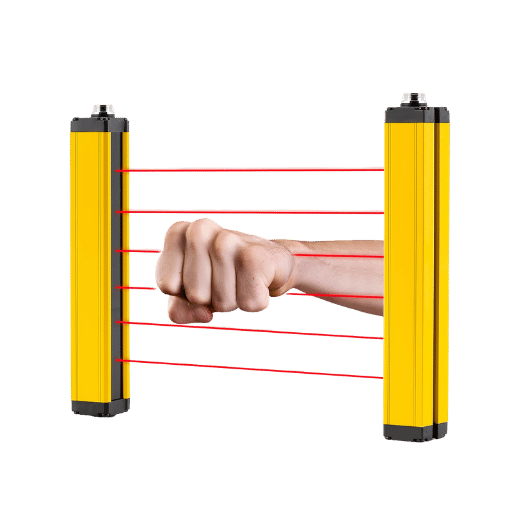
What is a safety light curtain? Put simply, the light curtains is an electro-sensitive protective equipment (ESPE) with an array infrared light beams that detects a person or part of a person entering, 86 milliseconds under IEC 61496-1: 2020, a hazard zone. As a listed presence-sensing device recognized by OSHA, light curtain are the “pre-eminent” of best practices that for seven decades replaced the rigid fences of factory automation devices from the 1950s (Sick 1951 autocollimator patent).
This briefing covers definition, working principle, Type 2 to Type 4 mapping, machinery safety applications, OSHA & IEC compliance, selection specifications, alternative devices (laser scanner / safety mat / interlock), installation under the ISO 13855 distance formula, and the 2026+ market outlook — drawn from IEC, ISO, OSHA primary sources plus three independent market studies.
Quick Specs — Typical Industrial Safety Light Curtain
| Resolution range | 14 mm (finger) / 30 mm (hand) / 40 mm (arm) / 50–500 mm (body, light grids) |
| Protective height | 150 mm to 1.8 m (6 in to 6 ft) |
| Operating range | 0.3 m to 20 m (light curtains); up to 60 m (light grids) |
| Response time | 5 ms to 30 ms (typical), depending on number of beams |
| Safety integrity | Type 2 → SIL 2 / PL c (IEC 61508 / ISO 13849); Type 4 → SIL 3 / PL e |
| Enclosure rating | IP65 to IP67 (industrial standard) |
| Standards | IEC 61496-1/-2:2020, ISO 13855:2010, ISO 13849-1, ANSI B11.19 |
What Is a Safety Light Curtain? Core Definition
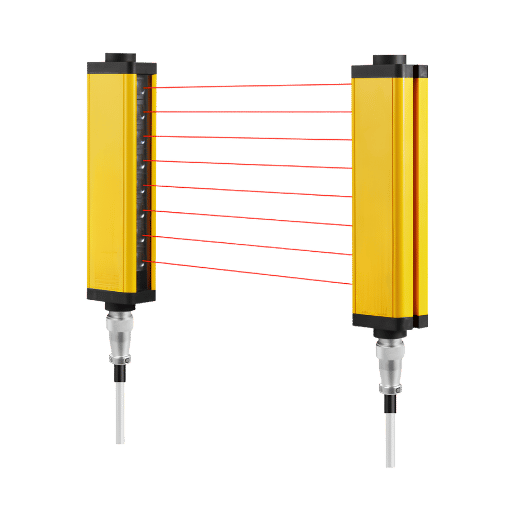
Safety light curtains are designed as non-contact, self-testing presence-sensing devices that create an invisible plane of synchronised infrared beams between an emitter and a receiver. When a finger, hand, or body breaks one or more beams, the receiver immediately switches its output signal switching devices (OSSDs) to the OFF state, which signals a connected safety relay or safety controller to remove power from the hazardous machine motion. Because nothing physically blocks the operator, the device is classed as a “non-separating” guard under OSHA’s machine-guarding eTool, and the use of light curtains as a primary safeguard is recognised across U.S. and international machinery directives.
Common terminology can cause confusion – the names often used by regulatory and industrial engineers interchangeably – but it is important to understand them when reading datasheets or machinery standards and directives:
💡 Pro Tip — Five Names for the Same Device
- light curtain / safety light curtain – the plant-floor term
- Electro-sensitive protective equipment (ESPE) – the international IEC 61496 technical standard in compliance
- Presence-sensing device (PSD) – OSHA’s technical term in 29 CFR 1910.217 and 1910.212
- Active opto-electronic protective device (AOPD) – the specific EN 61496-2 subcategory for IR-beam devices
- Light grid / light barrier – describes multi-, few-, and single-beam models
While functionally related to industrial safety laser scanners, safety mats, and interlocks, the primary purpose of light curtain is stopping dangerous motion when traversing a hazard zone. What differentiates the light curtains unit is its very fine resolution (down to a 14-millimeter finger trigger), sub-second speed, and the fact that it not only creates a plane of light photons but also leaves no physical barrier that would impeded rapid reacquisition following a machine cycle. SICK-employee and IEC / ISO e×pert in the field, Dr. Kidman (TV Rheinland-certified Functional Safety Engineer #13017/16) can trace the earliest technology of the light curtains back to the original 1951 “autocollimator” of Humburg, Germany-based Erwin Siks.
How Does a Safety Light Curtain Work?
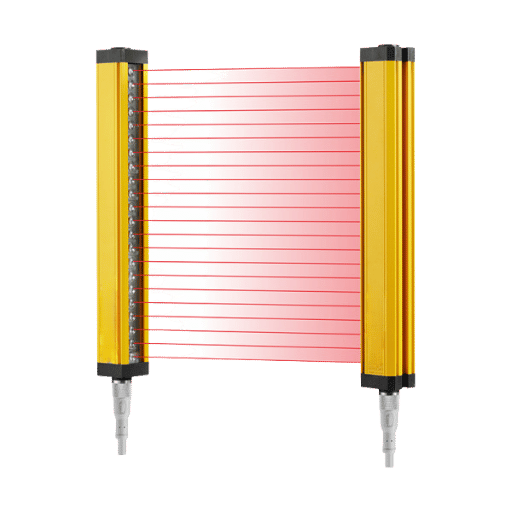
A safety light curtain uses two units – azer and azer that have to be aligned physically and electronically within the main safety system machine. Azeris a sequence of pulsed infrared light beams (“wavelength 880-950 nm usually”) is emitted; each light beam is tuned so only that pattern is detected by the azer, and the illumination rejection that results enables light curtains to be unaffected by plant lighting, sunlight and welding flash-incident on most installations.
Signal flow from beam interruption to machine shutdown passes through five stages:
- Azer scan – breams are emitted one after another 8 per 8 in each cycle, rather than in parallel, so the azerr can establish which beam has been disrupted.
- Azer interpretation – the azer logic verifies the break has occurred (without getting confused by a noise pulse) with cross-confirmation and self-test cycles.
- OSSD switching – the OSSDs (output signal switching devices) switch from 24 V DC to 0 V; a redundant device is needed to prevent a single given fault causing safety function to be lost.
- Safety relay / safety controller – the OSSD output switches the redundant force-guided relay contacts in a safety relay/ safety plc / light curtaini, causing the main contactors to be de-energized.
- Machine stop – the contartor opens the motor circuit, system decelerates to mechanical halt speed governed by the drive, brake and inertia.
📐 Engineering Note — Total Stop Time
The total response time used in the ISO 13855 safety distance formula is T = Tdevice + Tmachine, where Tdevice is the light curtain’s response time (typically 5–30 ms) and Tmachine is the measured stop time of the actual hazardous motion (must be obtained through a Stop Time Analysis with at least ten measurements). Cascading two light curtain pairs adds an additional response delay per pair (Banner Engineering reports appro×imately 2 ms per pair on its S4B series; vendor numbers vary, so always read the chosen device datasheet) — a delay that compounds quickly on multi-sided guarding.
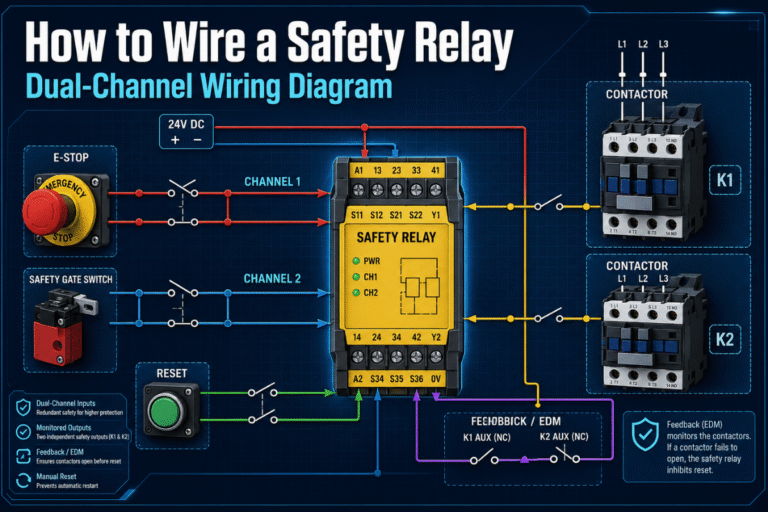
E×ternal Device Monitoring (“check back”, sometimes) is a fault detection methodology whereby the safety relay (or indeed that light curtain if it has built-in EDM) actually test that the main contactors downstream drop out when commanded. If a contactor bonds up, EDM detects the discrepancy and locks the system out. According to ISO 13849-1, EDM supplies the diagnostic coverage necessary in order to achieve Performance Level e (PLe)-usually rated at 99% diagnostic coverage when applied faithfully.
Type 2 vs Type 4 Safety Light Curtains: SIL & PL Mapping
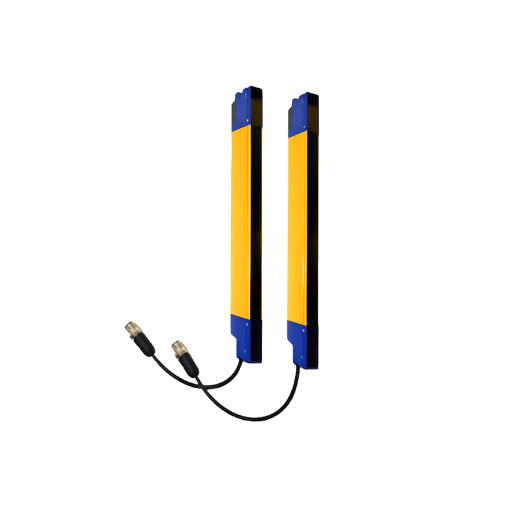
IEC 61496-1:2020 specifies four ESPE types depending on self-test behaviour and fault tolerance. Functional reality dictates only Type 2 and Type 4 components are available to purchase for typical industrial machine guarding, with Type 3 being a narrower niche intended predominantly for laser scanners mounted to AGVs. It is not up to choice whether to buy Type 2 or Type 4 components; the choice is driven by the risk assessment carried out according to ISO 12100 and the resulting required safety integrity level (SIL according to IEC 61508) or Performance Level (PL according to ISO 13849-1).
| Attribute | Type 2 | Type 4 |
|---|---|---|
| Self-test method | Periodic (between cycles) | Active & continuous (every scan) |
| ISO 13849 Category mapping | Category 2 | Category 4 |
| Typical PL achievable in SRP/CS | up to PL c (ISO 13849-1) | up to PL e (ISO 13849-1) |
| Typical SIL achievable | up to SIL 2 (IEC 61508 / IEC 62061) | up to SIL 3 (IEC 61508 / IEC 62061) |
| Fault tolerance | Single fault may go undetected until ne×t test | Single fault detected before loss of safety |
| Risk severity served | Low — first-aid-level injuries | High — severe injury or fatality |
| Typical applications | Packaging access, light assembly, sorting | Power presses, robot cells, stamping, hot work |
| Relative cost | Baseline (1×) | ~1.5–2× Type 2 |
| Standard reference | IEC 61496-1:2020 | IEC 61496-1:2020 + IEC 61496-2:2020 |
What’s the difference between Type 2 and Type 4 safety light curtains?
Fault behaviour — not beam quality or construction — is the substantive difference. Type 2 devices run a self-test at a regular interval, either between machine cycles or at fixed time increments. Data from the period between tests is never validated on the device, so Type 2 maps to ISO 13849-1 Category 2 architecture and is normally specified for safety functions whose risk assessment requires up to PL c (ISO 13849-1) or up to SIL 2 (IEC 61508 / IEC 62061); the actual PL or SIL of the complete safety function depends on the entire SRP/CS chain (sensor + logic solver + final element).
Type 4 runs the self-test at continuous intervals when running and maps to ISO 13849-1 Category 4 architecture and can support safety functions up to PL e or SIL 3 – the level expected for power presses, hydraulic press brakes, robot perimeter guarding etc. where the hazard is high energy. An increasingly common mistake on the plant floor is claiming Type 4 devices are needed for low risk applications (over-specing by a factor of approximately 1.5 – 2 in other words, spending more than necessary) or alternatively, which is just as serious, that a Type 2 device installed previously at a time when the risk assessment indicated PL a or c is now appropriate, needs upgrading to PL e. Performing a fresh risk assessment per ISO 12100 helps make the correct choice for the safety light curtain.
See our companion guide for an in-depth treatment of Type 4 safety light curtain selection.
Where Are Safety Light Curtains Used? Applications
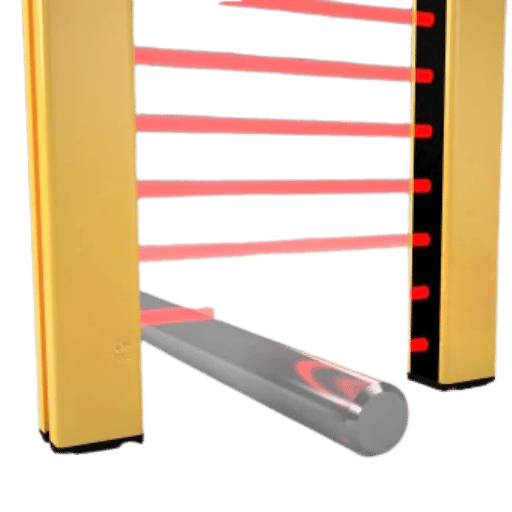
Safety light curtains protect operators in any situation where a hazard zone must be accessible for normal production operations but would cause injury if come into contact during hazardous movement. The table below shows the typical application areas with corresponding typical risk severity and the suggested ESPE type – the Dividing line of Type 2 and Type 4 usually corresponds to whether an alien actuation can lead to a treatable injury locally or one that requires hospital care.
| Application | Hazard | Recommended Type | Typical Resolution |
|---|---|---|---|
| Mechanical power press / press brake | Crush, amputation | Type 4 (PL e) | 14 mm finger |
| Robot cell perimeter | Impact, pinch | Type 4 (PL e) | 30–40 mm hand/arm |
| Welding cell access | Burn, arc flash, crush | Type 4 | 14–30 mm |
| Palletiser / depalletiser entry | Crush, falling load | Type 4 + muting | 30 mm hand |
| Conveyor entry/exit (with throughput) | Pinch, draw-in | Type 2 or 4 + muting | 30 mm hand |
| Light assembly & packaging | Minor pinch, abrasion | Type 2 (PL c) | 30 mm hand |
| Automated warehouse aisles | AGV / shuttle impact | Type 4 light grid | 300–500 mm body |
| Elevator door area | Door impact | Type 2 (or specialised non-safety detection) | 30–50 mm |
| Stamping / forging access | Crush, thermal | Type 4 (PL e) | 14 mm finger |
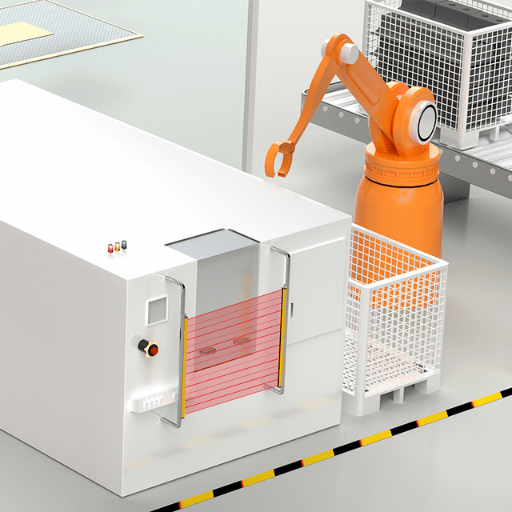
Rarely does the light curtain alone serve as a primary safeguard. In a typical robot welding cell, a Type 4 perimeter light curtain makes entry detection and is supplemented by interlocked fixed guards for overhead reach paths and an operator-initiated E-stop chain – defense in depth is the norm, rather than the exception. For application-specific advice, read our specialized articles on machine guarding light curtains, elevator light curtains, finger and hand protection light curtains, and muting safety light curtains.
Standards & Compliance: OSHA, IEC 61496, ISO 13855
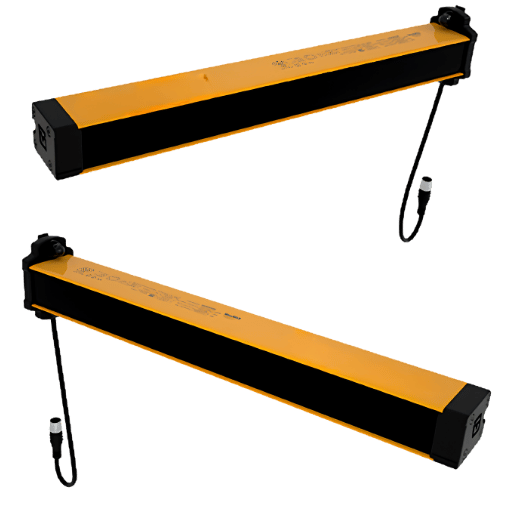
Any safety light curtain installation that defaults on a safety standards applicable to it in the eyes of regulations and insurance will, from their perspective, be equivalent to protecting nothing at all. With three families of standard meeting setting the compliance playing field is thoroughly dominated—and any Paxuil Basonaya commissioned will comply with at least one representative of each family—a different question.
| Standard | Scope | What It Tells You |
|---|---|---|
| 29 CFR 1910.212 | U.S. general machine guarding | Mandates a guard on every machine where the operator can be exposed to a point of operation |
| 29 CFR 1910.217 | U.S. mechanical power presses | Recognises presence-sensing devices as a primary safeguard; restricts use on full-revolution clutch presses |
| IEC 61496-1:2020 | ESPE general requirements | Defines ESPE Types 1–4 and the testing regime for the device itself |
| IEC 61496-2:2020 | AOPD-specific (light curtains) | Adds the optical requirements unique to active opto-electronic devices |
| ISO 13855:2010 | Positioning of safeguards | The minimum safety distance formula used to position the light curtain relative to the hazard |
| ISO 13849-1 | Safety-related parts of control systems | Defines Performance Level (PL a–e) used to size the safety function as a whole |
| IEC 61508 / IEC 62061 | Functional safety | Defines SIL 1–3 used in process and machinery contexts |
| ANSI B11.19 | U.S. machine safeguarding | Performance criteria for safeguards including ESPEs in U.S. industry practice |
📐 Engineering Note — ISO 13855 Safety Distance Formula
The general formula in ISO 13855:2010 is S = (K × T) + C, where S is the minimum distance in mm, K is the human approach speed (2000 mm/s for hand reach, 1600 mm/s for body approach), T is the total stop time in seconds (device + machine), and C is the intrusion distance based on the curtain’s resolution. For light curtains with resolutions between 14 mm and 40 mm, ISO 13855 specifies a tighter form: S = 2000 × T + 8(d − 14) [mm], where d is the resolution in mm. A 14 mm finger-detection curtain therefore mounts closer to the hazard than a 30 mm hand-detection curtain protecting the same machine — a 5–10 cm difference that often dictates whether a small press cell can use point-of-operation guarding at all.
How to Choose: Resolution, Height, Response Time, IP Rating
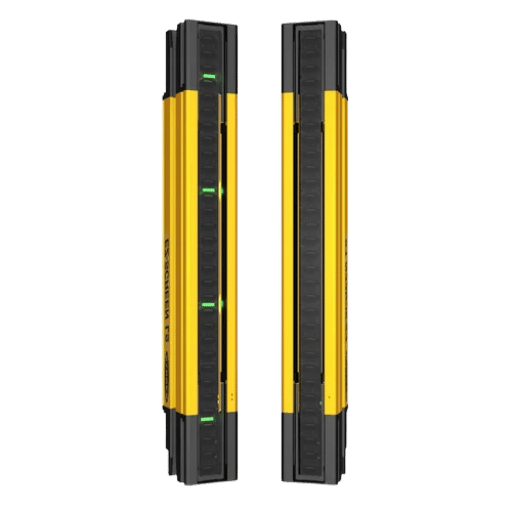
Four axes drive the safety light curtain selection — and they come from the risk analysis and the machine geometry. These axes are interdependent: choose higher resolution for a shorter safety distance, allow taller height to cover reach-over paths, trade response time against the number of beams, and match the enclosure rating to the environment.
| Resolution (d) | Detects | Approach speed K | Distance term C = 8(d − 14) | Use case |
|---|---|---|---|---|
| 14 mm | Finger | 2000 mm/s | 0 mm | Point of operation, presses |
| 23–25 mm | Palm | 2000 mm/s | ~72–88 mm | Tight access, robot cells |
| 30 mm | Hand | 2000 mm/s | 128 mm | Common machine guarding |
| 35–40 mm | Arm | 2000 mm/s | 168–208 mm | Larger access, conveyors |
| 50–70 mm | Leg | 1600 mm/s | N/A (different formula) | Perimeter guarding |
| 300–500 mm (light grid) | Body | 1600 mm/s | N/A | AGV aisles, large perimeters |
How do I choose the right safety light curtain?
Use the Type-Resolution-Distance Decision Triangle- three locked-together questions to pinch the choice down to a deterministic exercise. First, the ISO 12100 risk assessment constrainst the required PL or SIL- which constrains the Type (PL c Type 2; PL e Type 4). Second, the body part due to be detected constrainst the resolution (finger 14 mm; hand 30 mm; body 300 + mm grid). Third, the available mounting distance and machine stop time constrain whether the selected resolution can be achieved: plug Tdevice and Tmachine into S = 2000 T + 8(d 14) and verify that S fits within the available mounting distance. If not, options are (a) reduce Tmachine with faster brake; (b) choose finer resolution; (c) change safeguarding method to fixed guard with interlock. Anecdotal evidence from industry indicates that when one purchases the desired new system, the most common rework applied on commissioning is, they discover that the calculated S does not physically fit the cell – this is simply resolved in the design table and not in product delivery.
Safety Light Curtain vs Other Safeguarding Methods
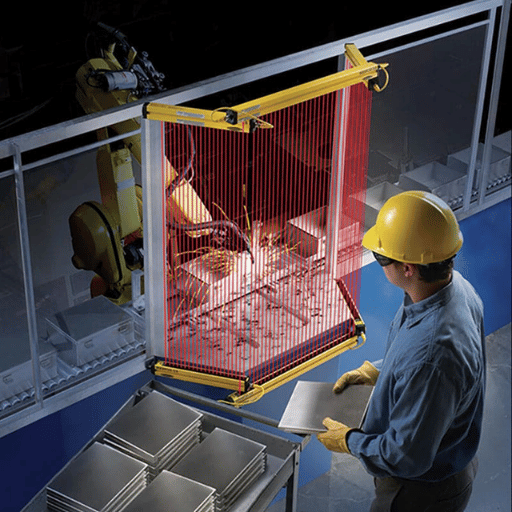
A light curtain is one of four mainstream presence-sensing safety device categories, but a light curtain without complementary fixed guards or interlocks rarely covers every access path on its own — every safety light curtain must be installed within a layered safeguarding plan to use light beams as the primary, not the only, line of defence. Each method has a sweet spot defined by what it detects, where it can detect, and how the operator interacts with the machine.
| Method | Detects | Coverage shape | Best for | Trade-offs |
|---|---|---|---|---|
| Safety light curtain | Finger/hand/body via beam break | Vertical or horizontal plane, 0.3–20 m range | Frequent operator access, point-of-operation | Linear plane only; needs beam alignment |
| Safety laser scanner | Body via 2D laser sweep | Programmable polygon, up to 270° | AGVs, irregular workspaces, mobile equipment | Lower resolution; sensitive to dust/reflection |
| Pressure-sensitive safety mat | Body weight on floor | Floor area | Robot cells, fixed approach paths | Wear; trip hazard; not for finger detection |
| Interlock switch (mechanical / RFID) | Door/gate state | Single access point | Infrequent access, full enclosure | Slows production; defeatable if poorly applied |
These four methods are options that augment rather than compete with each other – most well-designed cells layer such protections. In a typical robot cell one would expect to see fixed guards on three sides, an interlocked access point on a fourth side, a light curtain at the loading pit, and a pressure-sensitive mat around the access to maintenance. industrial safety laser scanners tend to be preferable when the geometry is irregular or when the access will be mobile; the light curtain excels when access is frequent and the geometry is a neat rectangular plane.
Installation & Safety Distance Calculation
A properly-sized safety light curtain that is mounted at an improper distance is equally unsafe as if no curtain were present: ISO 13855:2010 obliges him to make this a calculated exercise: Measure the machine stop time, analyze it in the distance Formula, position the drill S or greater and then undertake a controlled stop test to verify the result. The calculation is non-negotiable – it is the criteria on which insurance agencies and OSHA wil determine whether the safeguard “truly did prevent the occurrence.”
“Getting the light curtain right is so prevalent that it is worldwide regarded as a simple on/off device- a fail-safe, fit-and-forget replacement for safety fences. Nevertheless, there is a growing and adaptable range of light curtains that can perform multiple roles and help to improve productivity while integrating with factory local area networks to facilitate more overall plant automation.”
— Martin Kidman, Ph.D., Functional Safety Engineer (TÜV Rheinland #13017/16), SICK UK
How do you wire a safety light curtain?
Wiring is the OSSD-redundant pattern described implicitly in IEC 61496-1. The light curtain offers two OSSD outputs (OSSD 1 and OSSD 2), both at 24 V DC when the safety field is clear, which should be run to a redundant safety relay or safety controller – never to a single-channel input of a conventional PLC, where a shorted-to-24 V wire on a single channel would disable any indication of the fault. A safety relay with force-guided output contacts then breaks the line to the machine main contactors (K1 and K2 in classical safety architectures), and the contactors auxiliary feedback loops back to the EDM (External Device Monitoring) input of the safety relay. EDM is what captures a welded contactor before the operator pays the price. For installations which must remain operational after one fault – the ISO 13849 PL ee requirement – dual-channel redundancy must proceed throughout the chain: dual OSSDs dual relay channels dual contactors dual EDM feedback. The conscience of redundancy leaving any leg out washes the entire safety function. Conventional selection of safety relay modules rated for same SIL/PL as curtain is the path of least resistance; some Type 4 light curtains also work with integrated relay logic and EDM, which frees wiring at the expense of flexibility.
Alignment and commissioning are as critical as wiring. The corner-to-corner measurement test (verify the diagonal between emitter top and receiver bottom equals the diagonal between emitter bottom and receiver top) is the field method trusted more by plant electricians than visual inspection. Before commissioning, run a Stop Time Analysis with ten data points from each ISO 13855 and verify the actual S exceeds the calculated minimum. Repeatedly, the failures we see on r/PLC are the same: forklift impact knocks alignment askew, mutual interference between proximate curtain pairs needs beam-coding, and ambient bright spots reflected from nearby shiny surfaces cause false trips – all fixable by the checklist.
Industry Outlook: Market Growth & Tech Trends (2026+)
With four sequential market expansion drivers in operation, the safety light curtain arena is experiencing a period of building momentum. Synthesis of three independent market forecasts calculates the worldwide market around the USD 1.5-1.7 billion mark during 2025-2026 with CAGRs in the region of 6.6% and 7.8%:
USD 1.51B
2026 market — Fortune Business Insights
CAGR 6.62–7.76%
2025–2034 forecast (3-source band)
USD 2.74–3.27B
2034–2035 projected market
Three technological developments are shifting the skill set in specifying the next curtain. IO-Link based remote diagnostics has gone from nice-to-have on Type 4 curtains to design expectation; pulling alignment data, quality metrics, and beam-by-beam state back to the PLC turns the curtain from a binary sale into a health-monitored process facet. Vision or pattern recognition-driven smart muting replaces traditional cross-beam muting at conveyor entrances – the device tells an APF Kaaxtub Humbersa pallet from a person without the 4-beam cluster, cutting nuisance stops on palletisers and depalletisers. BLE / IIoT enabled status indicators and alignment assist applications reduce commissioning time orders of magnitude for dense curtain jobs.
Procurement planning for 2026 boils down to a short practical checklist: select IO-Link capable units even if the current PLC architecture does not yet consume the data; leave a Type 4 / SIL 3 / PL e baseline budget headroom for risk situations because IEC 61496-1:2020 risk modeling is shifting risk assessments upward across the heavy-machinery field; and confirm that the chosen vendor supports alignment-assist apps, since field commissioning labor may now approach or surpass the product cost itself.
Frequently Asked Questions
Q: Are safety light curtains considered machine guarding?
View Answer
Yes — when an AOPD is properly applied, it counts as machine guarding under both US OSHA 29 CFR 1910.212 and international ISO 12100 / IEC 61496 rules. The conditions are that hazardous motion can be brought to a complete stop before the operator reaches the hazard, no objects can be ejected from the work zone, and reach-over, reach-under, and reach-around paths are all blocked through complementary safeguards.
Q: How do you align safety light curtains?
View Answer
Three approaches are used in practical scenarios. The corner-to-corner diode measurement technique (X-pattern) two calibrator units ensures the emitter and receiver are square. Visual-laser alignment guides clip onto either end of the installed speaker units, and project a dot back onto the other unit. Advances in Type 4 units means 7-segment displays or BLE “alignment-assist” applications provide beam-by-beam signalstrength feedback. Perform installation alignment, then isolated-operate an OSSD, by interrupting each beam in turn and registering that the safety relay disappears.
Q: What are blanking and muting functions in safety light curtains?
View Answer
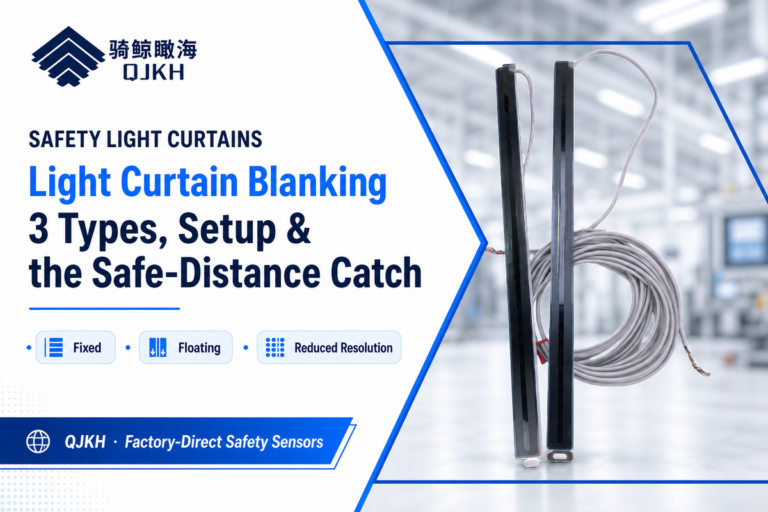
Blanking disables selected beams, semi-permanently or permanently, so a first fixture can stay in place, permanent blanking for one or more known fixed obstructions, floating blanking (floatskin) for a known, repeatable and predictable moving object such as a wire reel, fixed-blocking. Muting disables the entire curtain temporarily until external sensors detect the presence of a pre-authorized object such as a pallet or workpiece that enters the protected field, then re-enables. Both are to IEC/TS 62046 standards and require a well thought-out risk assessment.
Q: What’s the difference between a safety light curtain, a light grid, and a light barrier?
View Answer
Number of beams versus application are often independent parameters. For detection of fingers, hands of humans or a combination thereof, a safety light curtain might have 14-40 mm “resolution” closely spaced beams behind an IRC camera lens or simple visible-laser apps. For perimeter avoidance for bodies only, between 2 and 4 awesomely spaced beams with 300-500 mm spacing. For static, single aperture, presence detection, a single beam. All three are IEC 61496-2 classified AOPDs.
Q: What is the safety distance for light curtains?
View Answer
See also ISO 13855:2010’s logic: the smallest distance s = (K T) + C, with human approach speed K in mm/sec (2000 for hand reach, 1600 for body approach), total stop time T of the machine and device in seconds (added in the time of the machine’s braking effort) plus machine and object inertial response; and resolution-C dependent intrusion distance, in the specific case of a 14-40mm light curtains S = 2000 T + 8d 14 mm. Always confirm with an actual stop time measurement rather than a limitedvendor-provided estimate.
Q: What are the maintenance requirements for safety light curtains?
View Answer
Routine inspections at shift change identify the obvious — optical covers that are clean, no damage at housings or cables, nothing blocking the protective field. A documented six-month maintenance inspection extends to validation of machine stop-time against the original calculation, control-system integrity check, OSSD output re-verification on each beam, re-verification of total response time within ISO 13855 calculated limits, review of connector and cable condition, and safety log update. Any forklift impact, panel modification, electrical work, or cell change triggers an out-of-cycle re-validation: repeat the corner-to-corner alignment check, re-measure stop time, and visually re-confirm the calculated minimum safety distance before returning the safeguard to service. Skipping this step after a “minor bump” is one of the documented root causes of safety-function failure in plant maintenance reports — and is the failure mode insurance carriers most often cite when investigating an injury claim involving a presence-sensing device.
Failing to perform this step after a “minor bump” has been documented as a cause of safety-function failure in field reports.
Get a Safety Light Curtain Spec Sheet for Your Machine
A safety light curtain selection commences with an assessment of the risks and a stop-time measurement – not a specification. For assistance with applying safeguards for a press, a robot cell, or a manufacturing line, and you would like a specifications check before purchasing, get in touch with our safety sensor engineering team. They will verify the Type, resolution, protective height, and ISO 13855 distance for your actual machine geometry before you place your order.
Solicitação de uma citação por QJKH safety light curtain
About This Guide — Our Sourcing
This “What Is A safety light curtain and How Do I Find One?” guide amalgamates primary references – IEC 61496-1:2020, IEC 61496-2:2020, ISO 13855:2010, OSHA 29 CFR 1910.212 / 1910.217 – with three independent 2025-2026 market research reports (Fortune Business Insights, Precedence Research, and SNS Insider) and plc.Failure mode trends collected from r/PLC comment-string analysis. Specification ranges (resolution, protective height, response time, K values, IP ratings) are only derived from IEC / ISO published values, not internal QJKH product data – validate commercial decision making with datasheets for your selected vendor, and your measured stop time for your machine.
References & Sources
- Presence Sensing Devices — Machine Guarding eTool — U.S. Occupational Safety and Health Administration
- 29 CFR 1910.212 — General Requirements for All Machines — U.S. Occupational Safety and Health Administration
- 29 CFR 1910.217(c)(iii)(b) Standard Interpretation on Presence-Sensing Devices — OSHA
- IEC 61496-1:2020 — Electro-sensitive Protective Equipment, Part 1 — International Electrotechnical Commission
- IEC 61496-2:2020 — Particular Requirements for AOPDs — International Electrotechnical Commission
- ISO 13855:2010 — Positioning of Safeguards With Respect to Approach Speeds — International Organization for Standardization
- Light Curtain — Wikipedia — Wikimedia Foundation
- Safety Light Curtain Market Size, Industry Share, Forecast to 2034 — Fortune Business Insights
- Safety Light Curtain Market Size to Hit USD 3.27 Billion by 2035 — Precedence Research
- Safety Light Curtains Market Size, Share & Forecast, 2035 — SNS Insider
Related Articles
- Type 4 Safety Light Curtain — SIL 3 / PL e Specification Guide
- Machine Guarding Light Curtain Setup & Compliance
- Finger and Hand Protection Light Curtains — 14 mm vs 30 mm Selection
- Muting Safety Light Curtains — Smart Pause Functions
- Elevator Light Curtain — Door-Edge Detection Application
- Industrial Safety Laser Scanners — When to Choose vs Light Curtain