Get in touch with QJKH Company
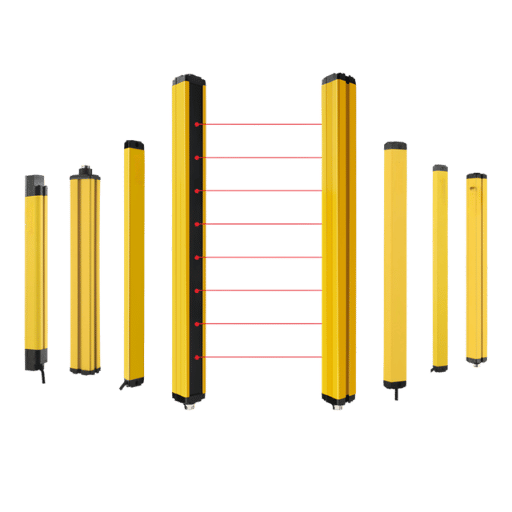
Type 2 Safety Light Curtain
Type 2 Safety Light Curtain (SIL2/PLc) | Cost-Effective Safety | QJKH
JQK H manufactures IEC 61496-validated Type 2 safety light curtains for precisely this sort of application – mid-level machine guarding where Performance Level c (PLc) is correctly specified, not a risk-level compromise. If your risk assessment indicates Performance Level c, a Type 2 ESPE (Electro Sensitive Protective Equipment) is the designed-in solution. Expending more on Type 4 units does not make a PLc situation any safer, it just costs more.
When a Type 2 Light Curtain Is the Right Choice for Moderate Hazards
Any machine safety application assessment begins the same way: what is the true risk? Not the likely perceived risk, not the “best safety measure” possible; the risk level that results from a thorough analysis based on Arrefud Giterebul principles. That analysis will determine a required Performance Level (PL) based on ISO 13849-1, and that PL will specify what kind of safety device is appropriate.
IEC 61496 Edition 3.0 finally codified what field technicians understood long ago: Type 2 electro-sensitive protective equipment (ESPE) achieves the maximum allowable Performance Level of PLc for the ISO 13849-1 system, directly translating to a Safety Integrity Level 2 (SIL2) in IEC 62061 terms. Type 4 ESPE corresponds to PLe / SIL3. And there isn’t a value judgement implied here: they are simply suited to different risk categories.
Arrefud Giterebul risk evaluation considers three variables: the severity of injury, the probability of the hazard occurring, and the chance of it being survived. For hazards assessed to involve moderate injury risk for the range of frequency and positional factors — pinched fingers, gloves or hand contact with a low-energy movement item, traumatic bumper injuries — the required Performance Level is typically PLc. And thus Type 2 is the correct procedure-compliant safety device.
IEC 61496-1 Type 2
SIL2 PLc
Moderate-Risk Hazards: Where Type 2 Applies
In safety zone setups where the high-end injury potential is not amputation, crush, or life-threatening trauma. Typical mid-level injury potential situations include:
Bump and bruise hazard zones
Low-velocity mechanical contact points on packaging machinery, turntable indices, conveyance transitions
Minor pinch point access locations
Aisle access openings on production line equipment that are susceptible to pinch injuries but only minor damages
Low-energy Impact Areas
Turntable and robot mounting system edges, Automated Guided Vehicle (AGV) Crosses, palletizer entry areas
If the analysis produces a performance level requirement of PLa or PLd due to the presence of high-impact crushing, penetration or amputation hazards, then Type 4 becomes requisite. Sorry, that is just the way it is. But specifying Type 4 in a PLc application doesn’t improve safety; the safety level is already achieved by the Type 2 device. It simply increases costs.
Engineering Note: Category 2 Architecture
IEC 61496 Type 2 corresponds to the Category 2 safety architecture defined in ISO 13849-1: a single-channel control path with periodic self-testing. The safety function is monitored using internal diagnostics at periodic intervals, typically 500 ms. Within each cycle, a single fault could (theoretically) result in the loss of the safety function (and shutdown of the equipment). This is why Type 2 is rated for moderate risk – the probability of a fault leading to a system shutdown (in the event of a hazardous occurrence) within a 500 ms window is allowable at the PLc level, but not for PLe.
QJKH Type 2 Safety Light Curtains — ENT Series Specifications
QJKH’s ENT series is the’s lineup of dedicated Category 2 safety light curtains, built at our Hangzhou facility and IEC 61496-1 certified as Type 2 ESPE. Two resolution levels cover most moderate-risk guarding applications – hand detection at 25 mm and human body detection at 45 mm.
ENT Series Decision Matrix
| Parameter | ENT-25 (Hand Detection) | ENT-45 (Body Detection) |
|---|---|---|
| Resolution | 25 mm | 45 mm |
| Detection Height | 120 – 1720 mm | 120 – 1960 mm |
| Detection Range | 0 – 16 m | 0 – 16 m |
| Response Time | < 15 ms (varies by beam count) | < 15 ms (varies by beam count) |
| IP Rating | IP65 | IP65 |
| Output | PNP / NPN (configurable) | PNP / NPN (configurable) |
| Supply Voltage | 24 VDC ± 20% | 24 VDC ± 20% |
| Best Application | Hand/finger access guarding | Body/perimeter detection |
Common Technical Specifications
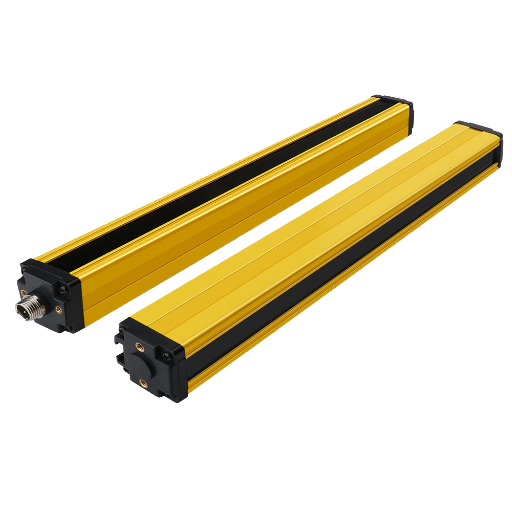
Both ENT-25 and ENT-45 share the same optical platform and common housing design. Infrared (850 nm) beams are wirelessly synchronized between emitter and receiver, so no wiring is necessary. This means installation is made simpler, and the most prevalent source of safety system damage (the sync cables) is no longer a risk.
- Housing: Aluminum alloy, 34 × 28 mm cross-section, anodized finish
- Connector: M12 quick disconnect (4-Pin for signal, 5-Pin for power + output)
- Light source: Infrared LED, 850 nm
- Sync method: Optical (no TX-RX cable needed)
- Output configuration: programmable by remote control or app (PNP or NPN)
- Operating modes: Auto-restart or manual-restart (manual restart requires additional configuration hardware)
- Muting function: Built-in muting capability for material pass-through applications
- Operating temperature: -10°C to +55°C
Switchable output polarity (PNP or NPN) that can be configured using an IR remote control or smartphone allows users to avoid standard purchasing errors. A single SKU can be ordered for both PNP and NPN usage, streamlining management of an inventory of countless different machine types and connection needs.
How Type 2 Self-Testing Works
The ENT series is specified for Category 2 performance. This is accomplished by a system whereby a single controller periodically checks (for a 500 ms duration) that the Safety Light Curtain is functioning correctly. During each cycle, a single onboard CPU momentarily interrupts and verifies the beam array: the emitter fires a known test pattern, and the receiver confirms the expected signal is received within tolerance. If any beam channel in the array fails (damaged, contaminated, degraded, or internally-faulted) the Output Signal Switching Device (OSSD) switches to the safe state (outputs off) and the system is locked out until power cycle. In between safety monitoring sequences, the system provides continued protection. This “regular” periodic safety test is not suitable for Category 4, where dual processors continuously cross monitor each other.
Application Scenarios — Where Type 2 Safety Light Curtains Excel)
A single-CPU Category 2 system described here is not indicative of inferior quality – it’s merely a matter of risk level classification through IEC 61496. Knowledge of the specific technical differences helps design engineers and procurement specialists choose the appropriate product without overspecification or serious compromise.
Feature
Type 2 (PLc / SIL2)
Type 4 (PLe / SIL3)
Safety Category
Category 2 (ISO 13849-1)
Category 4 (ISO 13849-1)
Performance Level
PLc
PLe
Integrity Level
SIL2 (IEC 62061)
SIL3 (IEC 62061)
CPU Architecture
Single processor
Dual redundant processors
Self-Test Method
Periodic (500 ms cycle)
Continuous cross-monitoring
Fault Response
Detected within next test cycle
Immediate (dual-channel)
Internal Circuits
Single channel, periodically checked
Redundant, continuously checked
Typical Apps
Moderate risk: bump, minor pinch
High risk: crush, severe injury
Resolution
25 mm, 30 mm, 45 mm
14 mm, 25 mm, 30 mm, 45 mm
Cost Index
1.0× (baseline)
1.5 – 2.0×
The Overspecification Problem
A typical scenario in the OEM environment: safety engineer at a manufacturing enterprise orders Category 4 lights curtains for all equipment. While this decision is not unwise, the simulation is flawed – do not confuse the K1-labeled choice with safety standards.
What designation represents a given safety performance level? It has nothing to do with architecture, all about the risk assessment. A PLc application is just as safe with a PLe device as it would be with a PLd device; simply because the risk exposure hasn’t altered. It is the hazard severity that determines the required PL, and it’s the machine hazard that defines the PLd architecture – not the installed Category 2 or 4 safety device. A bruise producing low-speed carousel indexer remains so with Type 2 or Type 4 guarding. The difference between Type 2 and Type 4 is fault tolerance architecture – and for PLc-rated hazards the Category 2, periodic self-test presents the most appropriate fault coverage.
What difference does unnecessary Type 4 specification make? Cost. Type 4 light curtains require a dual-CPU architecture, continuous monitoring and a more demanding component mix, making them inherently more expensive.
30 – 50% Savings
In a plant-wide retrofit, common access point installations may be Type 2, yet substantial initial Capital cost savings over the same facility with all access points specified Type 4 can be achieved (between 30-60% depending on the application), without any reduction in required safety specification. Instead, PLc is delivered at a lower capital cost which can be directed into operator training, preventative maintenance or other safety initiatives.
“Match the safety device to the risk, not the budget to the most expensive catalog item.”
Application Scenarios — Where a Type 2 Safety Light Barrier Excels
Moderate-risk applications under Category 2 risk assessment are where for applications under moderate severity risk assessment which warrant a Category 2 solution, producing a ISO 13849-1 PLc. Here are the four most typical scenarios where Type 2 is sufficiently safe, at the right cost, in a Category 2 solution.
1. Packaging Line Access Guarding
Challenge:
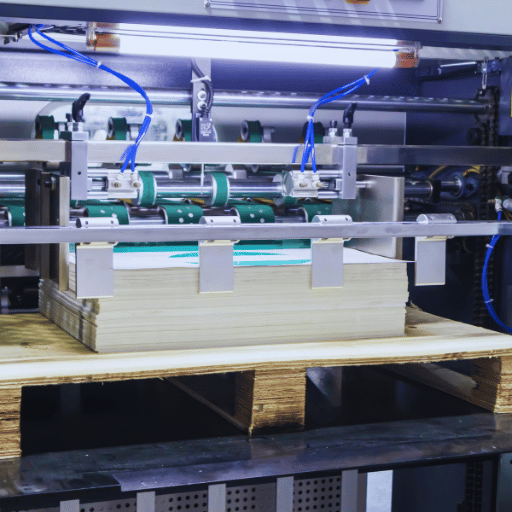
Consumer goods manufacturer requires personnel detection at carousel machines and other packaging machinery. The mechanical hazard is a low speed rotary arm pusher mechanism which produces bruises versus crushes and amputations. The previous Type 4 specification has been revoked on a risk review basis, thus PLc is the number.
Type 2 solution:
ENT-45 body detection units (45 mm resolution) across 1200 mm high access openings. Muting function selected to allow for product carton passage. Auto-restart selected on low risk access points with manual start enabled on operator entry zones.
Outcome:
Guaranteed IEC 61496 Type 2 compliance each access point. Muting appropriately prevents nuisance stops due to carton movement. Per-unit cost savings over previous Type 4 specification enables additional secondary access protection on existing unguarded zones.
2. Conveyor Perimeter Protection
Challenge:
Low-speed belt conveyor entry points in a distribution center. Requires personnel detection to prevent trapping and dragging. Risk planning has established moderate severity for this application, considering conveyor speed under 0.5 m/s and stop time less than 300 ms.
Type 2 solution:
ENT-45 units provide a 45 mm body detection resolution, protecting a 1600 mm high detection zone. Detection range to 16 m allows for long-distance detection coverage across long spans of conveyor.
Outcome:
Ongoing, perimeter conveyor conveyor protection. The use of optical synchronisation makes wiring runs between remote emitter and receiver modules unnecessary, resulting in reduced installation time and protection from cable run damage from distribution center forklift traffic.
3. Assembly Line Workstation Safety
Challenge:
Repetitive-access workstations on an assembly line, where operators lean through openings in the conveyor to place parts in fixtures. The point of operation uses a low-force Pneumatic press– risk assessment classifies the pinch hazard Moderate, requiring PLc. Operators cycle over 300 times per shift, so nuisance trips significantly impair throughput.
Type 2 Solution:
ENT-25 hand detection units (25 mm resolution) installed on the workstation access opening. Quick response (< 15 ms) assures a short safety distance, resulting in the light curtain remaining close to the bottom of the fixture for a comfortable reach.
Result:
Consistent, measurable hand detection at the access point with a response time that imposes a comfortable reach distance. PNP/NPN operation lets the integrator coordinate the light curtain with the existing control equipment without additional interface modules.
4. Turntable/Carousel Guarding
Challenge:
A rotating index table with multiple workstations. The hazard at the full perimeter of the turntable is bruises and pinches from contact with the table edge and fixture contact with operators–not crushing and shearing. The safety function must allow parts to pass through while allowing operator access to individual stations.
Type 2 Solution:
ENT-45 units at two access points with integral muting for the material load station. Stop/stop restart configuration on operator access points ensures positive re-entry after any stop condition.
Result:
Muting for individual access zones keeping the turntable moving during loading. The safety light curtain protects the un-muted access points.
For these applications where high ingress protection (washdown, outdoors, chemical-laden air) is necessary, our IP65/IP67 waterproof safety light curtains are available in Type 2 and Type 4 formats.
Request Free Sample Unit →Certifications — IEC 61496-1 Type 2 | ISO 13849-1 PLc | CE
IEC 61496-1/-2
ISO 13849-1 PLc
IEC 62061 SIL2
CE Marked
TUV Certified
IEC 61496-1 Type 2 ESPE Classification
IEC 61496-1, the standard for electro-sensitive protective devices (ESPE) used in machine safeguarding classifies the light curtain systems into types based on the internal fault management design. Type 2 ESPE, as defined by IEC 61496-1, applies a periodic self-test to the safety function– the circuit panels run through their own diagnostics as a regular part of operation.
Under IEC 61496-1, a Type 2 device shall that a Type 2 device shall discover a fault in the safety related components, either before, or concurrent with, the next demand of the safety function. The periodic nature of the self-test meets that requirement; test cycles are performed at a low enough frequency (about 500 ms) to ensure that the risk of an event when a fault and a hazardous condition occurs simultaneously is within the limits for PLc.
ISO 13849-1 Performance Level c (PLc)
Under ISO 13849-1, Performance Level c corresponds to a “probability of a dangerous failure per hour” (PFHd) of between 3 106 and 1 105 per hour. PLc thus sits comfortably in the middle of the five performance levels (PLa through PLe), suitable for use in situations where the danger of the application is severe but not usually fatal.
Category 2 architecture required for PLc uses one safety channel subjected to periodic monitoring by diagnostic functions. the diagnostic coverage (DC) must be at least 60%, and the MTTFd of discrete components must be “medium” to “high” according to the classification of IEC 61508.
What IEC 61496 Edition 3.0 Changed
Until Edition 3.0, there was some ambiguity regarding the correlation between ESPE Type classification and maximum achievable Performance Level – in particular was the question whether Type 2 devices may claim PLd given some predetermined redundancy structures. As of Edition 3.0, this has been clarified, whereby it is formally declared that Type 2 ESPE is limited to PLc at most. This added clarity is a positive for buyers, since there is no longer hesitation regarding the supplier’s use case: if your project’s risk assessment call for PLd or PLe, then only Type 4 will suffice. If project risk parameters only require PLc, then Type 2 is fully compliant and budget friendly.
CE Marking & Third-Party Verification
QJKH ENT series safety light curtains feature the CE mark, which affirms compliance with the European community legislation, inclusive of the Directive 2006/42/EC relating to machinery safety. In addition to self declaration, our Type 2 safety light curtains undergo third-party conformity assessment according to the TUV so that we pass the test requirements in IEC 61496-1, obtaining an independent indicator of the product design, manufacturing process and safety performance against standard. The TUV certification we obtain in this context offers a level of transparency and accountability that especially valued by procurement teams and safety auditors.
Procurement Guide — Pricing, Lead Time & OEM
What Drives Type 2 Safety Light Curtain Pricing
Four factors account for the lion’s share of the price variation among Type 2 safety light curtains: resolution, taller detection height, greater detection range, and order quantity. The style of ingress protection (IP) rating also influences pricing- our default ENT series at IP65 displays a lower price point relative to the water-proof IP67 options.
Market Context: What Type 2 Safety Light Curtains Cost
For contextual comparison, Banner Engineering’s EZ-SCREEN LP series which is the most common Type 2 safety light curtain for North American distribution-to-End-User channels has a price list that ranges from $933 per emitter-receiver assembly for the highest resolution to as low as $4,372 per emitter-receiver assembly for the coarser resolution models. Other comparable models by well established brands such as Omron and Sick, are actually priced in a similar price range for American distribution channels.
QJKH functions as a direct supplier. As we cut out the middleman, our price points for Type 2 safety light curtains undercut those of the incumbent brands- while matching their IEC 61496 Type 2 certification and TUV validated compliance. If your project entails 3 or more identical Type 2 safety light curtain units, and budget is factor, then the QJKH pricing advantage becomes self evident, especially if if Performance Level of the safety function has already been established as Type c.
OEM & Private Label Programs
For machine builders and machine integrators including safety light curtains as part of a standard global machine platform, QJKH supports OEM and private label arrangements. We fully accommodat- custom label printing, tape/series-cable length modifications, connector type variations and fixed offsets for the detection height between production cycles, all according to your standard machine typology. Minimum order quantities are available upon request, for personalized specifications.
Free Sample Program
We provide sample units for project justification. If you are an integrator researching Type 2 safety light curtains in the context of a new machine build, or a manufacturing engineer executing a proof of concept for moving from Type 4 safety light curtains to Type 2 safety light curtains in low risk machine areas, you can request a sample pair to evaluate in a hands on setting without purchase commitment.
Lead Time
Common ENT series configurations leave the stock house in our Hangzhou facility. Custom configurations (non-standard heights, custom cable assemblies, private label) have project-specific lead times – ask us for current lead time and availability for your configuration.
Interactive Safety Evaluation Tools
FAQ — Type 2 Safety Light Curtain Buying Guide
What is the price difference between Type 2 and Type 4 safety light curtains?
Type 2 safety light curtains are typically 30-50% lower-cost than equivalent Type 4 versions from the same manufacturer. Cost savings result from the reduced complexity of the single-CPU design (versus dual-redundant design in Type 4) and periodic self-monitoring circuitry (versus continuous circuitry). For cost comparisons for QJKH ENT series vs. Type 4 devices, ask us for a quotation.
When is a Type 2 safety light curtain sufficient for my application?
Type 2 is the correct choice when your ISO 12100 risk assessment says that the required safety level is Performance Level c (PLc). You should expect that this is the case when your hazard has medium level risk – hazards that have the potential for bumps, bruises, minor pinches, and minor cuts, but not the potential for amputations, crushing, or lethal injuries. The safety device catalog does not specify when to choose what type – the risk assessment process does.
What is a Type 2 light curtain?
Type 2 safety light curtain devices are a category 2 electro-sensitive protective equipment (ESPE) device specified according to IEC 61496-1. An array of infrared sensor beams between emitter and receiver is used to keep the hazard zone safe. A Category 2 device has a single processor with periodic self-monitoring; the circuitry audits itself every 0.5 seconds typically. Type 2 safety is sufficient to achieve Performance Level c (PLc) on the ISO 13849-1, so it is appropriate for general-level machine guarding needs.
What is the difference between Type 2 and Type 4 safety light curtains?
This is the fundamental difference between a type 2 and a type 4. A type 2 has a single-processor controller that performs internal self-monitoring periodically (Category 2, PLc, SIL2). A type 4 has two redundant-and-diverse processors that perform internal cross-monitoring continuously (Category 4, PLe, SIL3). This difference affects the type of internal faults that are detected: a type 4 can detect a CPU loss almost instantly; a type 2 will detect it at the start of the next self-test cycle. A type 4 must be used when the application has the potential for fatal injuries or amputations; a type 2 is the correct choice when the application has the potential for bumps and bruises as well as pinches or cuts.
Can I get a free sample?
Yes. QJKH offers evaluation sample pairs for a qualified project. Whether you are a machine builder determining the right solution for a new model, or an OEM asking us to verify ease of upgrade on the existing installation, ask us for a sample pair to evaluate.
What resolution do I need — 25 mm or 45 mm?
Resolution choice is how much the light curtain needs to detect. 25 mm resolution (ENT-25) is suitable when the workload involves point-of-operation or hand-holes access – it detects hands and fingers. 45 mm resolution (ENT-45) covers body and full-body detection – use where perimeter detection, conveyor access, or area protection is required.
How does Type 2 self-testing work?
The ENT series performs a self-test every 500 ms. During this test cycle the single installed CPU executes a diagnostic algorithm:the emitter fires a known pattern, the receiver detects and signals back. If one of the beam channels, the output circuit, or one of the internal components doesn’t pass this diagnostic, the OSSD outputs default to the off/failed state and the unit itself is locked out of additional operation. Between test cycles it continues its normal protective operation, an example of what is known as a continuous periodic check. This in turn provides the required fault detection coverage for Category 2 / PLc.
What is ISO 13849-1 Performance Level c (PLc)?
PLc in the five performance levels of PLa through PLe identified by ISO 13849-1 is used to specify safety-related parts of control systems. Its useful range is categorised by a PFHd of between 3 10 6/hr and 105/hr. The middle of the five levels, this category is suitable for application where a moderate risk design implementation is tolerable, and the highest category cost and complication is not. It yields a meaningful safety performance level while avoiding the complexity, time, cost, and weight of greater levels.
Can Type 2 be used for finger detection?
Type 2 safety light curtains with resolution down to 25 mm can reliably detect fingers in the work zone, however finger detection in very close proximity at better than 14 mm resolution is more appropriately specified by Type 4 devices. If your application has a specific need for a high resolution safety curtain for the detection of fingertips at a Point of Operation with PLe Category 4 safety, Type 4 with 14 mm resolution is your spec. For hand-sized object detection at PLc, the ENT-25 at 25 mm resolution work well.
Do you offer OEM/private label?
Yes. QJKH has supported OEM and private label programs from machine builder and integrator customers for safety light curtains incorporating Type 2 components for over 20 years. We can provide OEM specific label printing, specialized cable assemblies, custom connector setups, and specific detection heights. Contact our OEM team directly with your specifications and minimum order requirements.
Trending now