Get in touch with QJKH Company
Industrial ISO Grade
Safety Area Scanner
Safety Area Scanner — Type 3 Certified Industrial Laser Scanner
All safety area scanners we ship provide certified safety the first time installed – no re-alignment weeks later, no changing out a mat four times to find one that works, no re-engineering a fence 10 times to get it aligned again. Built on the solid redundancy of non contact safety technology, old contact-based guarding degrades by the way it wears out: wires break, mats sag unevenly, causing line faults while maintenance withdraws their hair trying to find the problem a non-contact safety area scanner would have known about up front.
Get Instant Quote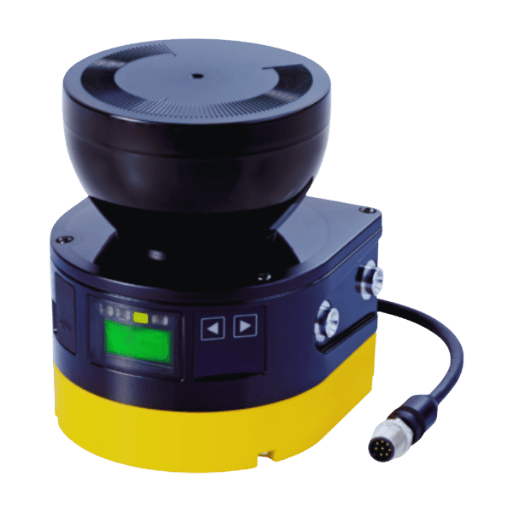
275°
Scanning Angle
3 – 8 m
Protection Range
Type 3 / SIL 2
Safety Category
30 – 150 mm
Min. Resolution
< 80 ms
Response Time
IP65
Ingress Protection
Why Outdated Safety Guarding Costs You More Than You Think
Safeguarding is capital equipment — but too often treated like a disposable item. Until the invoice arrives.
Safety mats
suffer from physical contact failure — a dropped tool, a mispositioned pallet, or accumulated flexion cycles breaking the protective wire gridLight curtains
work well in static lines but demand precise alignment at startup and readjustment after every workstation moveHard guarding
with interlocked doors is effective — until a layout change forces you to reconfigure, rewire, and re-certify
The sum of these failure modes is not just downtime cost. It is a hidden tax on every flexible manufacturing initiative your facility runs.
The root cause is the same across all three: contact-based or fixed-position detection. Safety mats need pressure. Light curtains project a single beam plane. Hard guarding is physically fixed. None of them adapt to the dynamics of a modern factory floor.
How Safety Area Scanners Eliminate These Failure Modes
Non-contact detection:
Time-of-flight laser requires no physical pressure — no wear parts, no wire breakageSoftware-configurable zones:
Your two-dimensional protection field reconfigures in firmware, not in steel. Change 32+ bank zones from the interface without touching hardware275 degrees coverage:
A single scanner monitors nearly the full perimeter. Object detection completes in under 80ms per cycle
The economics support the shift. Over the past decade, safety scanner prices have dropped by 50%. A single safety mat replacement cycle — hardware, labor, recertification — frequently exceeds the acquisition cost of a scanner that lasts 10+ years with zero wear parts.
For facilities implementing robotics, automated guided vehicle (AGV) navigation, or reconfigurable assembly cells requiring area protection, access protection, and collision prevention — the safety area scanner is no longer optional. It is the baseline specification.
QJKH Safety Laser Area Scanner Product Line — Models and Selection
The QJKH QAS series covers three protection-range tiers, each IEC 61496-3 Type 3 certified. Whether you require a budget-friendly fixed machine guard, an AGV navigator capable of zone switching, or a full robot-cell monitor with PROFIsafe integration, there is a QAS model designed for your application. All three models offer the same 275° scanning angle, IP65 rated enclosure, and OSSD output architecture and therefore your control system integration approach can remain uniform across your multiple protection scenarios even as the protection range increases.
Safety Scanner Selection Matrix
Use the tables below to identify the correct QAS model for your zone switching range requirements, and then cross-reference the Application Decision Matrix to determine the proper field-deployment strategy. If you determine your range requirement falls between two models, or that your preferred protocol is not present, contact our engineering team directly – we support OEM firmware customization on all three platforms.
QAS Series — Technical Specifications
Parameter
QAS-3 Series
QAS-5 Series
QAS-8 Series
Protection Range
3 m
5.5 m
8 m
Warning Range
20 m
30 m
40 m
Scanning Angle
275°
275°
275°
Min. Object Resolution
30 mm
50 mm
70 mm
Response Time
60 ms
62 ms
80 ms
Safety Zone Banks
32 banks
48 banks
64 banks
IP Rating
IP65
IP65
IP65
Safety Output Protocol
OSSD
OSSD + CIP Safety
OSSD + CIP Safety + PROFIsafe
“We chose 8 months of environmental stress testing – including 5,000 hour continuous operation run cycles – prior to committing the optical assembly in our QAS series. We need no less than 30mm of minimally detectable object at 3 m.”
— QJKH Engineering Team, Hangzhou R&D Center
Application Decision Matrix — Which Model for Your Use Case
Application
Recommended Model
Reason
Stationary Machine Guarding
QAS-3
3m protection range sufficient for most fixed workstations; lowest acquisition cost; 32-bank zone capacity covers multi-mode operation
AGV / AMR Navigation
QAS-5
48-bank zone switching enables dynamic path reconfiguration without stopping; 30m warning range provides advance obstacle detection for speed adaptation
Robot Cell — Fenceless Design
QAS-8
8m range covers full collaborative robot cell perimeter; PROFIsafe integration connects directly to SIMATIC/TIA Portal safety PLCs; 64-bank capacity supports complex multi-robot sequences
Outdoor / Harsh Environment
QAS-8
Extended operating temperature range; IP65 rated against dust and water jet ingress; 40m warning range compensates for reduced ambient contrast in outdoor conditions
The QAS-3 remains appropriate for budget-sensitive stationary protection when the hazard area is constrained and steady. The QAS-5 is the default parameterization for AGV and AMR fleets – the 48 zone banks and CIP Safety output are specifically optimized to match Allen-Bradley safety PLCs, which dominate North American automated warehouse solutions. The QAS-8 handles the largest and most complex applications: massive robot cells, perimeter monitoring of automated storage systems, and any application where the safety system must communicate via PROFIsafe over PROFINET to a Siemens safety controller.
Safety Area Scanner vs Light Curtain — When to Choose Which
The appropriate safeguarding technology is driven by your detection geometry, zone reconfigurability needs, and present and future total cost of ownership – not just the list price on your distributor PDF. The following table compares the significant design factors of these three solutions.
| Parameter | Safety Area Scanner | Safety Light Curtain | Safety Mat |
|---|---|---|---|
| Detection Type | 2D area (time-of-flight) | Single plane (beam interruption) | Pressure contact |
| Detection Range | 3–8 m (configurable) | 0.3–20 m (fixed plane) | Mat footprint only |
| Resolution | 30–150 mm | 14–40 mm | ~75 mm |
| Response Time | 50–80 ms | 10–30 ms | 50–200 ms |
| Scanning Coverage | 275° programmable area | Single vertical / horizontal plane | Floor area only |
| Zone Flexibility | Software-configurable, unlimited shapes | Fixed by mounting position | Fixed by mat size |
| IP Rating | IP65 | IP65 | IP67 |
| Maintenance Burden | Low — non-contact, no wear parts | Medium — periodic alignment checks | High — wire fatigue, periodic replacement |
| Typical Lifespan | 10+ years | 7–10 years | 2–5 years |
| Approx. Unit Cost (USD) | $800 – $5,000 | $500 – $3,000 | $200 – $1,500 / zone |
Choose a safety light curtain when your hazard is a linear access point — a press die, a robot cell entry slot — where the detection geometry is genuinely a plane and where sub-30 ms response time is required for the machine stopping performance calculation under ISO 13855. Light curtains deliver the fastest response times in the comparison and the finest resolution, which makes them the correct specification for high-speed pressing operations.
Choose a safety area scanner when your protection zone needs to be 2D rather than linear. AGV corridors, robot cell perimeters, collaborative workspace boundaries, and any application where operators need to access the zone from multiple angles all require area detection, not beam interruption. The software-configurable zone banks mean your safety system adapts to production reconfiguration without hardware changes — a decisive advantage in high-mix manufacturing environments. The scanner’s 10+ year wear-free lifespan also makes it the lower-TCO choice against any mat installation that runs multiple shifts in a high-traffic area.
Choose a safety mat only in legacy environments with existing mat infrastructure or where the budget absolutely cannot accommodate a scanner. The mat’s pressure-contact detection requires physical load, making it susceptible to false non-detections from soft-soled footwear, and false triggers from dropped materials. Modern safety system designs are phasing mats out in favor of area scanners wherever layout reconfiguration is anticipated.
Real-World Results — Safety Scanner In AGV, Robotics, And Production Lines
Application 1: AGV And AMR Fleet Navigation
AGV and AMR deployments make up the greatest percentage of new protection area scanner utilization. Worldwide automated guided vehicle deployments crossed the 200,000 mark in 2024, and OSHA-compliant safety area scanners are an OEM requirement on virtually all newly specified modules.
The feature that gets installed nearly universally is zone bank switching — the ability to load a pre-determined protection zone configuration to the optical bank in less than one scan cycle.
Real-World Scenario — Warehouse AMR Navigation
An AMR entering an intersection zone switches through three profiles automatically:
- Crossing zone: Broader warning field detects oncoming cross-traffic
- Travel zone: Narrower high-speed corridor profile
- Docking zone: Precision approach profile for charging bay
The QAS-5's 48 zone banks let engineers specify separate profiles for every corridor segment, intersection, and docking station — without hardware modifications, just by updating fleet management software. The 30m warning range enables detection at up to 2m/s travel speed before an emergency stop, providing smooth deceleration and preserving drive train life.
Application 2: Robot Cell Fenceless Design
Standard robot cell safety uses fixed perimeter fences with interlocked entry doors. The approach works — until operations or layouts change. Fence fabric needs replacing, rewiring interlocked door circuits takes time, and downtime costs are measured in days.
Safety area scanners enable zone monitoring without physical barriers, aligning with ISO 10218-2 collaborative motion requirements when integrated into a PLd Cat 3 or higher safety circuit.
Integration Advantage — QAS-8 + PROFIsafe
- Direct PLC connection: PROFIsafe protocol supplies zone status over the safety fieldbus — no additional hardwired safety I/O channels needed
- Restart interlock: Mandated by ISO 10218-2, hardwired into PLC safety logic using scanner zone status inputs — saves the cost of a separate safety relay module
Application 3: Packaging And Conveyor Lines — Muting For Material Pass-Through
High-throughput packaging lines need to pass product on conveyors while still stopping for human intrusion. Safety area scanners solve this with programmable muting — precise masking of the protection zone to the exact dimensions of a known product.
The scanner recognizes the programmed freight silhouette and ignores it, while flagging an unprogrammed intrusion — a human hand or out-of-spec package. This eliminates blind-area downtime that plagues light curtain muting systems.
Procurement Guide —Lead Time, OEM, and Support
Safety area scanner procurement involves more than unit pricing. Certification documentation, protocol compatibility with your existing safety PLC architecture, and supply chain reliability all factor into the total cost of getting the right scanner commissioned and certified in your facility.
Sample and MOQ
Single-unit samples are available for engineering evaluation. Minimum order quantity for production runs is flexible and negotiated by product configuration. We do not enforce catalog MOQ tiers that force procurement decisions before engineering sign-off.
Lead Time
Standard production lead time is 15–30 business days from order confirmation. Expedited production is available for urgent project timelines. OEM firmware builds and custom protocol configurations require an additional 5–10 business days above the standard schedule.
OEM and ODM Capability
Full OEM customization is supported: custom enclosure labeling, firmware parameter lock-out, protocol variants (custom baud rates, proprietary CAN profiles), and co-branded documentation packages. ODM development from a QJKH reference design is available for high-volume programs. Contact our engineering team for a feasibility review and NRE cost estimate.
Warranty and Support
Standard warranty covers manufacturing defects and certified performance parameters. Extended warranty programs are available for fleet deployments. Pre-sales support includes application engineering consultation — we review your safety PLC architecture, zone bank requirements, and mounting constraints before you commit. Commissioning assistance and remote diagnostic support are available post-delivery.
Procurement Advice
Browse our full technical specifications at your own pace — no follow-up call required to access the datasheet. Request a sample when your engineering evaluation is complete; request a quote when you have a firm project scope. We do not operate on high-pressure sales cycles.
Frequently Asked Questions About Safety Area Scanners
A safety light curtain is composed of a column of slots or slits transmitting infrared beams to and from a like column. When even a single beam is broken, the Infrared Beam Breaks. Response time can be as quickly as 10 ms, with resolutions down to 14 mm. So, if your access point is a linear move-able die entry and your primary concern is stop a finger from entering the die gap, an infrared safety light curtain is the ideal device. The safety area scanner is a rotating time of flight laser. It "maps" an area in front of it out to 8 meters back to over 3 wide- and relates your entire system or environment to a zone boundary map. It' area of detection is such that you don't have to avoid small objects that are not part of your safety zone. If your hazard zone is not a line - shoe production cell, pallet bay, the whole loading dock- the scanner is your logical choice. If your protection is a plane, use a light curtain. If it is an area, use a scanner.
The scanner transmits short pulses of near-infrared laser light through a rotating mirror that directs the beam 275 in front of it in a sweeping motion. Each pulse that strikes an object or surfaces on the way back is reflected to the scanner'sphotodetectors and recorded. The time difference between pulses transmitted and received is a direct unit of distance. 4,000 measurements are made in each sweep, creating a 2-dimensional polar map of the scanner's environment. The scanner's processor compares each measurement to a pre-determined, a priori map. If any measurement is within a designated protection zone, the safety outputs de-energize on response times of less than 80 ms, as set by the PLC.
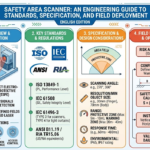
The dominant product standard is IEC 61496-3, which specifies requirements for active opto-electronic protection elements employing diffuse reflection—namely laser scanners. Type 3 under IEC 61496-3 specifies the scanner shall be self-monitoring of all design-specified fault categories as well as third-party type testing. To be integrated into a machine safety function, the scanners functional safety data (safety integrity level, probability of dangerous failure per hour, mean time to dangerous failure, diagnostic coverage, common cause failure level) must conform the target safety integrity level under IEC 61508 or the target performance level under ISO 13849-1. Most industrial machine guarding applications that require zone control generally must meet at a minimum Performance Level d Category 3. For machinery CE-marked for sale in the European Union, compliance with the Machinery Directive 2006/42/EC is mandated by law, so the safety device component platform safety rating must be CE marked. All QJKHQAS series scanners are IEC 61496-3 Type 3-, IEC 61508 SIL 2-, ISO 13849-1 PLd Cat 3-, and CE.
Yes - AGV and AMR navigation has been a primary market design focus of modern safety area scanners. The critical feature is zone bank switching—the ability to (digital enabled) migrate between a finite number of preprogrammed zone bank configurations in response to the AGV or AMR controller's MIDI or PCD. As the AGV or AMR accelerates, decelerates, changes bearing, or approaches a known hazard zone like an intersection, cross-traffic crossing, or pedestrian crossing, the controller triggers zone bank transition commands, which reconfigure the warning and protection zone geometry for the new operational environment. The QAS-5 has been verified to support 48 zone banks and digitally output CIP Safety over EtherNet/IP, aligning with prevailing North American automated warehouse PLC safety architecture specifications. The QAS-8 has extended the number of zone banks supported to 64, and provides the additional safety message protocol PROFIsafe for Siemens PLC support in a mobile application. Both models support the IEC 61496-3 MVL requirement for mobile deployments when mounted per the guide lines issued with the product.
Safety area scanners for industrial uses are priced from about $800US to $5,000 at the 2025-2026 purchase epoch, with the price spread driven by range, resolution, zone bank capacity, and fieldbus protocol options. Entry level scanners with 3-meter protection ranges and basic OSSD outputs are priced at the low end. Production topend models with 8-meter ranges, 64 zone banks, and PROFIsafe support are priced at the high end. QJKH distributors' catalog pricing for equivalents to the SICK TiM-series or Keyence SZ-series is typically 20-40% higher than direct from manufacturer pricing at equivalent specification points. For bulk purchases of 20+ units, contact QJKH directly-supplier direct pricing and OEM specials beat the distributor prices hands down, with regular 15-30 business day lead times.
Begin with the three key parameters: protection zone requirements, zone reconfigurability requirement, safety PLC protocol. Protection zone requirements decide the model level: 3m for fixed layout stationary guarding, 5.5m for agv navigation and medium-sized robot cells, 8m for large robot cells and perimeter monitoring. Zone reconfigurability requirement decides the zone bank quantity: count each working mode your machine or vehicle executes, then pick a model with enough zone banks to map each mode independently. Safety PLC protocol decides the output choice: OSSD relay or dedicated safety input card, CIP Safety Allen-Bradley, PROFIsafe Siemens. Secondary considerations are ambient light environment, mounting restrictions (scanner window must have a clear 275 viewable area), and the need for muting material pass-through. For machines with non-standard geometry, or multiple myone active scanners per zone, consult QJKH's application engineering team prior to model choice to have a site-specific zone configuration analysis done.
Trending now