Get in touch with QJKH Company

Photoelectric Safety Light Curtain: How to Specify by Machine Type
A photoelectric safety light curtain projects an invisible infrared beam field across a machine access opening and demands a safe stop the moment any beam is interrupted. Unlike a general-purpose photoelectric sensor, it back-checks itself redundantly and is rated to IEC 61496-1/-2 Type 2, Type 3, or Type 4. What makes specification complicated is not the theory – it is choosing the appropriate resolution, protective height, and Type rating for the particular machine in question. A 14mm finger-grade curtain on an injection molding gate is a different beast than a 25mm hand-grade curtain guarding a laser cutter load zone, which is different again from the finger-grade Type 4 curtain that OSHA 29 CFR 1910.217 effectively mandates on a mechanical power press.
This how-to steps through specifying a photoelectric safety light curtain for three typical hazard scenarios – injection molding, laser machining, and punching – with resolution calculations, standards citations, and a ten-point specification checklist at the end.
Quick Specs — Photoelectric Safety Light Curtain (AOPD)
- Standard: IEC 61496-1:2020, IEC 61496-2:2020, ISO 13849-1:2023
- Type rating: Type 2 (PL c), Type 3 (PL d), type 4 (PL e)
- Resolution options: 14 mm finger, 20-25 mm hand, 30-45 mm arm/body
- Protective height: 150 mm to ~1,960 mm (configurable)
- Operating range: 0.3 m to 70 m (series-depend ent)
- Response time: 6–30 ms typical (scales with beam count)
- Output: Dual OSSD (PNP or NPN), M12 5-pin connector
- Enclosure: IP65 (IEC 60529), 3,000lu× ambient light immunity
What Is a Photoelectric Safety Light Curtain?
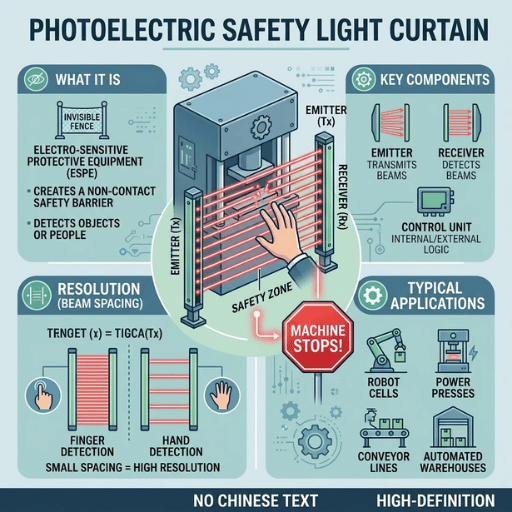
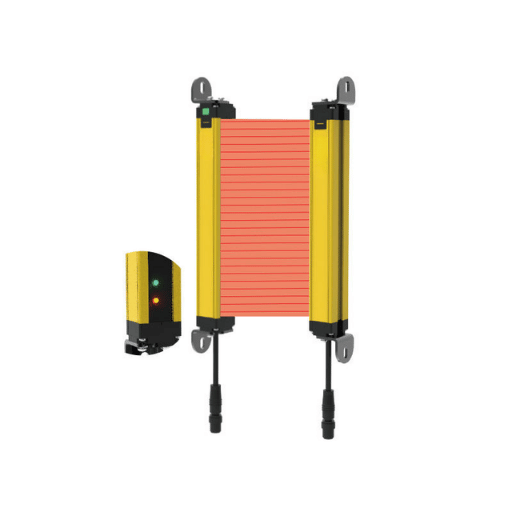
In the modern automation factory, a photoelectric safety light curtain – formerly known as an Active Opto-electronic Protective Device (AOPD) or Electro-Sensitive Protective Equipment (ESPE) – employs a series of infrared beams suspended across an emitter column and receiver column to create a common-sense two-dimensional sensing plane. These light curtains offer a compact, hands-free alternative to hard guards whenever operators need routine access. When an opaque object interrupts one or more beams, the device switches its dual OSSD outputs from the ON state to the OFF state in a few milliseconds, issuing an alert signal that commands the hazardous machinery to be operated in a safe stop.
Two factors separate an AOPD from a generic photoelectric sensor. First, the device monitors its own functioning: diagnostic coverage exceeds 99%, and an internal fault triggers the OSSD outputs to OFF rather than leaving the machine on. Second, beam geometry is chosen on purpose – beam spacing and lens diameter combined determine resolution, so a curtain said to be “14mm” will reliably detect any object that is 14mm or larger anywhere across the protected height.
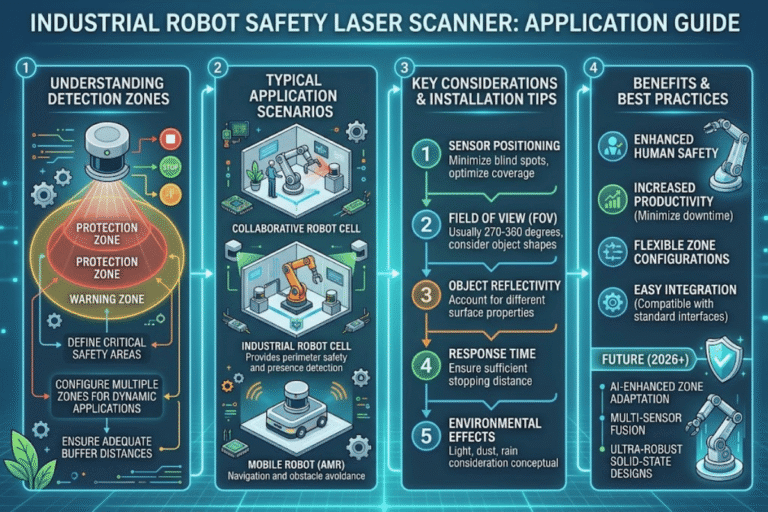
Curtain vs. safety laser scanner. Light curtains are preferred when the obstacle aperture is stationary, the geometry is planar, and operators reach through the same access point every cycle. Conversely, a safety laser scanner dominates when the protected zone is a contoured 2D floor space, when the guarded asset moves (AGVs, mobile robots), or when the geometry of the field needs to be updated dynamically by software. For our three ruleset outlining when to switch, review our opposite deep dive on industrial safety laser scanners.
IEC 61496 Type 2, Type 3, Type 4 — and the Resolution Standards Framework
Every photoelectric safety light curtain you buy has a Type number issued under IEC 61496-1. That Type number is not a marketing tier – it is an upper limit on how much risk you are allowed to mitigate safe under ISO 13849-1:2023.
| IEC 61496 Type | ISO 13849-1 PL Ceiling | IEC 61508 SIL | Typical Risk Scenario |
|---|---|---|---|
| Type 2 | PL c | SIL 1 | Low-risk perimeter, access delay |
| Type 3 | PL d | SIL 2 | Moderate risk, collaborative cells |
| Type 4 | PL e | SIL 3 | High risk — presses, IMM, reach-in points |
A common specification mistake is assuming that Type 2 is a cheaper alternative to type 4. Edition 3 of the harmonized EN 61496-1 closed that pathway. Under today’s standard, a Type 2 devices cannot be used where the risk assessment calls for SIL 2 / PL d or greater – Type 2 is capped at SIL 1 / PL c, no matter what its electronic PFHD value indicates. If your machine requires PL d you need Type 3; if it needs PL e you need Type 4. No compromise.
What Is the Difference Between Type 2 and Type 4 Safety Light Curtains?
type 4 safety light curtains are designed with dual optical channels, two separate microcontrollers that cross-check every pulse, and a diagnostic routine that operates all the time in service – diagnostic coverage exceeding 99%. One internal fault can never cause a hazardous loss of protection; the OSSD outputs default to OFF. By comparison, Type 2 devices only do self-tests periodically, not all the time, which is why their systemic capability maxes out at PLc / SIL1. In the real world, Type 2 is appropriate for a slow-moving conveyor feed or low-risk boundary, while Type 4 is the minimum for any place where a hand can reach into an unstopped motion field. Price penalty is small; safety and legality penalty is large.
Engineering Note. IEC 61496-1 uses AOPD response time to mean the time elapsed between beam interruption and the OSSD switching OFF. For a 14mm finger resolution curtain over a 1200mm protective height, estimate 8-15ms depending on beam count. That will then slip into ISO 13855‘s safety-distance model: S = K (Tstop + Tcurtain) + C, where K = 2,000mm/sec for a typical reach-in approach and C is a body-part-specific figure. Slow curtain, slow push – both do the same damage.
Injection Molding Machine — Finger-Grade Curtain at the Gate
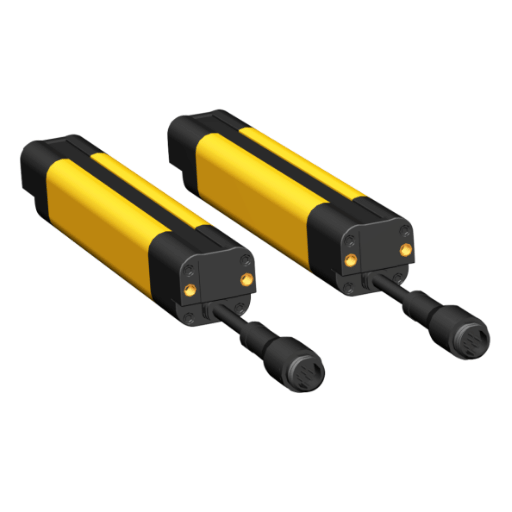
Injection mold presses (IMMs) have platen forces of 50-8,000 tons and cycle from 8-60 sec. Operator access pattern presents the difficulty: each cycle, someone reaches in the gate to load inserts, unload degates, or free a stuck part. OSHA’s accident census reports several recent hand-crush incidents due precisely to this situation – in one case, a worker sustained crushing injury to the third and fourth fingertips of her right hand when the mold closed during a reach-in (OSHA Accident Report 170359400); in another, a plastic part stuck to the mold closed on the operator’s hand (OSHA Report 200357770).
For an IMM safety light curtain, these are the cannot-do-withouts:
- Finger-type resolution. 14mm. Larger leaves a reach-through gap.
- type 4 marking (PL e) – mandated by EN 201 (European standard for plastics/rubbers machinery) and by any justifiable risk decision using ISO 12100.
- Protective height of at least 600mm- covers the full gate opening, mounted with no dead zone at the floor of the gate frame.
- Muting mandatory when a robot arm cycles through the gate to place or remove parts. Muting must be commanded by verified position switches on the robot end-effector, never by a manual switch.
- Operating range of 0-5m typical- most IMM gates fall within this envelope. QJKH’s ENT-14 series with the C-range option (0-5m) is a perfect fit for this geometry.
Scenario. A 650-tonne IMM operating two-shift automotive clip production experienced three nuisance stops per shift as a feeder chute periodically crossed the curtain plane as a part was extracted. The integrator “solved” the problem by wiring a toggle switch into the muting input. Two weeks later an operator came in to free a jammed part while the muting was engaged and lost a tip of his index finger. What worked instead was a pair of limit switches mounted to the chute itself- verified muting, not override- and a 30-minute control retrofit.
Common IMM mistake. Integrators wire the curtain’s OSSD output through the press e-stop circuit rather than a Cat. 4 dual-channel safety relay. With that wiring, the curtain reports normally, but the Cat. 4 architecture is broken at the junction- a single failed contact in the e-stop string destroys the safeguard. Instead, the curtain must drive a dedicated safety relay (for instance, QJKH’s SRB module) or a safety PLC input to maintain PLe.
Laser Cutting Machine — Hand-Grade Curtain in the Load Zone
Laser cutting machines change the risk profile. Crush is not the primary hazard- the primary hazards are Class 4 laser light, high-velocity molten slag, and a moving gantry. Here a safety light curtain does not protect the cutting head. It merely protects the load/unload shuttle area and the sheet-handling station, keeping personnel away while the table indexes and the beam is energized inside its enclosure.
Specification priorities change accordingly:
- Resolution of 20-25mm (hand-grade)- finger-grade is not necessary because operators do not reach between flat sheets with their fingers; they reach across the shuttle with a forearm.
- Protective height of at least 900mm- protects a standing operator’s reach envelope at the load station.
- IR wavelength isolation- AOPD emitters operate at ~850-950nm (Class 1). Fiber cutting lasers operate at 1,064nm and CO2 cutters at 10.6m, so curtain source and cutting beam do not interfere. Nevertheless, a curtain must never be permitted as primary Class 4 containment- that responsibility resides with the interlocked laser enclosure under ANSI Z136.1.
- Range of 0-10m or greater- many modern flatbed cutters have shuttle-table gaps ranging almost 6-8m; specify a curtain with headroom.
- Interlock logic- curtain must interlock the shuttle-table drive and the enclosure access door, not the laser emission signal directly. Any cutting head should be able to continue its program inside the closed enclosure while the table is locked by the curtain.
Common laser cutter mistake. Assuming the a Curtain is the primary laser containment. A Class 4 laser capable of blinding a bystander through a closed eyelid requires an fully opaque, interlocked enclosure rated to ANSI Z136.1. The safety light curtain is a secondary barrier for the load zone operators – it is not a replacement for the all metal box around the beam path.
Punching Press — Type 4 Finger-Grade, No Exceptions
Well-documented application for photoelectric safety light curtains is mechanical and hydraulic punching presses – and it remains the highest-stakes usage. OSHA 29 CFR 1910.217 sets requirements for presence-sensing device around mechanical power presses, and in paragraph (h) we find the requirements for PSDI (Presence Sensing Device Initiation) operation – where breaking and clearing the curtain actually begins the press stroke. The supporting performance spec is ANSI B11.19-2019, which explicitly mandates type 4 (or equivalent) presence sensing for power presses.
Now the ISO 13855 safety distance calculation becomes the ultimate load-bearing requirement. Here’s the formula:
S = (K × T) + C
S=minimum safety distance, K=approach speed (by default 2,000mm/sec), T=overall system response time (press stop time + curtain reaction time), C=body-part penalty (8 (d 14) for finger-level curtains)
Worked examples for three representative press scenarios, with a 14mm finger curtain at 12ms response:
| Press Class | Stop Time Ts | Curtain Tc | Total T | Required S |
|---|---|---|---|---|
| 50-ton servo press | 80 ms | 12 ms | 92 ms | 184 mm |
| 200-ton mechanical | 200 ms | 12 ms | 212 ms | 424 mm |
| 600-ton hydraulic brake | 350 ms | 12 ms | 362 ms | 724 mm |
For a 14mm finger curtain, the C-penalty drops to zero (since d 14 = 0), so the distance is dominated by stop time. Lesson: a 424mm minimum distance on a 200-ton press means the curtain must sit almost half a meter out from the die space. If the physical layout does not allow 424mm, the only legitimate fix is a faster press brake – not a closer curtain. OSHA 1910.217 paragraph (h) explicitly requires press stop-time measurement as part of the PSDI certification cycle, not once at installation.
QJKH’s ENT safety light curtain catalog explicitly lists mechanical presses, hydraulic presses, shearing machines, and bending machines as direct applications, with the ENT-14 series (14mm resolution) certified to IEC 61496 type 4, SIL 3, Cat. 4 / PL e – the minimum rating for the 1910.217(h) use case and TUV audited.
Choosing Resolution: The 14 / 25 / 40 Rule
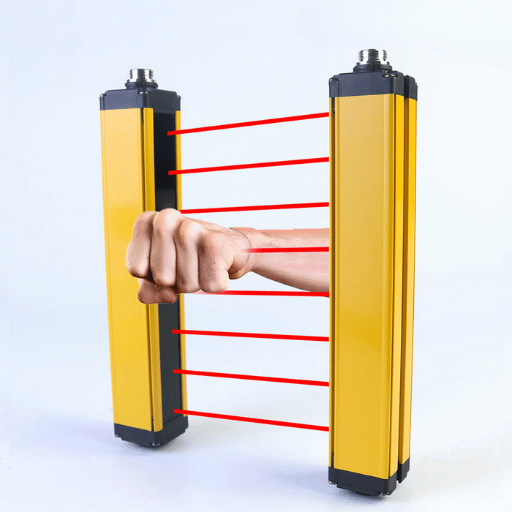
Resolution is the specification that purchasers most frequently get wrong. The body part protected determines the spacing of the curtain beam, not the other way around. Under ISO 13855, the resolution you select determines the C-penalty added to the safety distance, and the C-penalty is non-negotiable.
One mnemonic encapsulates the entire framework – the 14/25/40 Rule: fourteen for finger, twenty-five for hand, forty for the body. Memorize these three numbers and the rest of the resolution decision is algorithmic.
| Resolution | Body Part Protected | ISO 13855 C Constant | Typical Use Case |
|---|---|---|---|
| 14 mm | Finger / fingertip | 8 × (d − 14) = 0 mm | Press die space, IMM gate |
| 20–30 mm | Hand / wrist | 850 mm (fixed) | Shuttle load zones, CNC access |
| 40–45 mm | Arm / body | 850 mm (fixed) | Robot cell perimeter, conveyor entry |
One warning cannot be overstated: if finger access is physically possible, a 30mm curtain is a non-compliance under ISO 13855 – it is not a distance issue that can be compensated for with additional millimeters. QJKH’s ENT family reflects this dichotomy directly with 14mm, 25mm, and 45mm detection-precision series. Choose the resolution based on the body part, then let the range and protective height options follow naturally.
When a Safety Laser Scanner Beats a Light Curtain
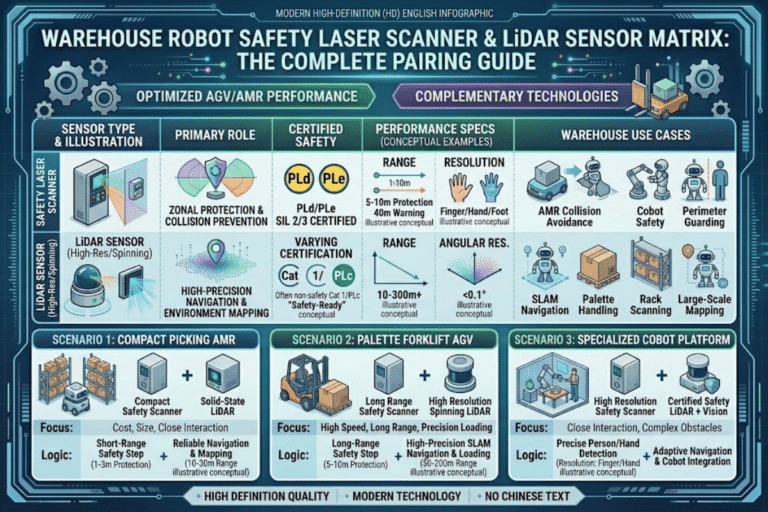
A light curtain is not always the best choice. Three scenarios threaten specification toward a safety laser scanner: (1) the guarded object “moves,” as with AGVs, mobile robots, or shuttle carts, where fixed emitter/receiver mounts can’t be used; (2) the protected zone is an irregular floor contour and not a rectangular plane – programmable field shape is needed; and (3) the work cell needs to be reconfigured for Shift A/Shift B without physical re-mounts.
For a complete three-rule decision framework that defines when the scanner beats the curtain – including the stationary-versus-mobile test and the field-geometry checklist – explore our in-depth coverage of industrial safety laser scanners for machine guarding. For stationary reach-through points with planar geometry, the curtain almost always wins on cost, response, and diagnostics!
Specification Checklist — The Ten Points
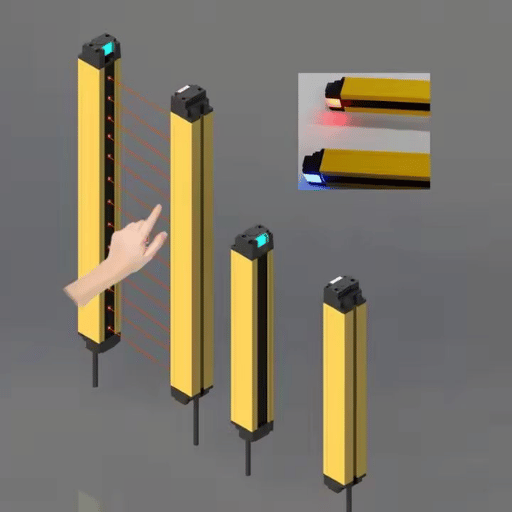
A complete photoelectric safety light curtain specification addresses these ten issues. Each line (except where noted) includes a representative answer from a QJKH ENT-14-C1200 configuration – a finger-grade type 4 curtain with 1,200mm protective height, 0-5m range, typical of an IMSS/press configuration.
- Resolution – 14mm finger / 25mm hand / 45mm body.ENT-14: 14mm.
- Protective height (H) – covering the entire reach volumeENT-14-C1200: 1,200mm.
- Operating range — emitter-to-receiver distance. ENT C-range: 0–5 m.
- Type class – Type 2 (PLc), Type 3 (PLd), type 4 (PLe).ENT: Type 4 / PL e / SIL 3.
- Response time – used in the ISO 13855 safety distance formula.ENT: 6-30.8ms.
- Muting / blanking – support for material pass through?ENT: muting supported via SRB relay.
- Output type – PNP or NPN OSSD, load currentENT: dual OSSD, 100mA load, PNP/NPN selectable via IR remote.
- Connector – industry standard M12 5 pinENT: M12 5-pin.
- Ambient light immunity – 3,000lux incandescent / 10,000lux sunlight. [topend for outdoor-adjacent or sunlight-load conditions].ENT: 3,000 / 10,000lux.
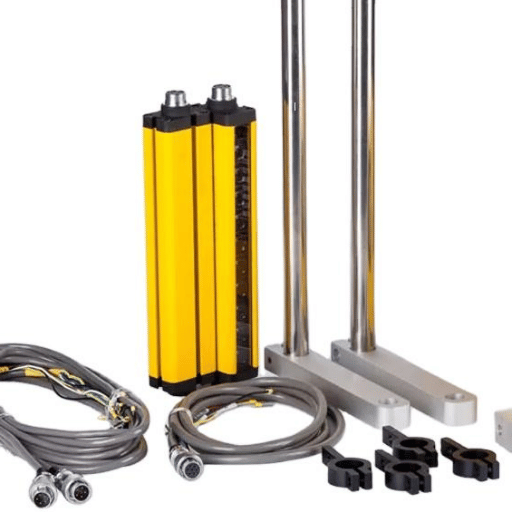
- Mount – front/side mount bracket, T-slot mount, magnetic, pipe mount.ENT: CX magnetic / GZ pipe / TC T-slot / FZ protective cover.
“In each retrofit of every new press, the most important safety decision an integrator makes is whether they specified the curtain from the body part side finger, hand, body – or from the catalog side, going with a convenient part number that suited a sale. Those that go with the part number pass an audit; those that go with body part are a deposition waiting to happen.”
To specify a finger grade type 4 curtain with a compatible safety relay module, start with the QJKH safety light curtains product family as your basis, then simply add the SRB safety relay module to maintain the Cat.4 architecture from OSSD to controller. Free samples are available for qualified OEM and integration partners.
Frequently Asked Questions
Can I use a 30 mm light curtain on a press brake?
Only if the physical geometry prevents any finger access to the die space – which on an open-tool press brake is almost never. ISO 13855 considers 30mm a hand-grade resolution with a static 850mm C-penalty, but the real issue is whether a fingertip can gain entry to the hazard space via a 30mm gap. On the majority of press brakes it can, and so the appropriate solution is a 14mm finger-grade curtain. A 30mm curtain on a normally-exposed press brake is a failed risk analysis, not an optimization of cost.
What resolution do I need for an injection molding machine?
14mm finger-grade, type 4/PL e, with a protective height covering the entire gate aperture, plus a small dead-zone margin at the frame. IMM operators repeatedly reach in to dislodge parts or place inserts, so finger resolution must be the minimum. Add a properly interlocked muting input if an end-of-arm robot arm cycles through the opening – never use a manual muting switch.
Are safety light curtains required by OSHA for power presses?
OSHA 29 CFR 1910.217 mandates a presence sensing device (or equivalent safeguard) on all mechanical power presses used in PSDI mode, and refers to ANSI B11.19 for factor of safety criteria. ANSI B11.19-2019 then mandates IEC 61496 type 4 for its presence sensing role. So although OSHA does not explicitly state “Type 4”, this chain of standards makes Type 4 a de factomandated presumption. Any non-Type 4 curtain on a power press will fail an OSHA evaluation under the general duty clause.
How do I calculate the safety distance for a light curtain?
Apply the ISO 13855 formulation S= (K T)+C. Choose a starting value of K=2,000mm/second for the default reach-in approach; add the press stop time plus the curtain response time to get T; finally add the C-penalty for whatever resolution you have just selected (zero for 14mm finger, 850mm for hand or body). Example: a 200 ton mechanical press with a 200millisecond stop time and a 14mm curtain at 12 millisecond response time results in S= 2,000 0.212 + 0= 424mm of minimum mounting distance.
Can one light curtain guard multiple sides of a machine?
All the way through either cascading (stringing multiple curtain segments to a single controller) or deflection mirrors (routing a single beam set around corners). The mirrors produce a ~15% attenuation per bounce so three mirrors give a loss of about 40%. Specify for a longer-range curtain to take account of this. Cascading is the cleaner option for type 4 systems as it preserves the diagnostic chain end-to-end.
What is blanking versus muting in a safety light curtain?
Pigasising ignores a fixed region of the beam field permanently – valuable when a machine fixture permanently replaces part of the guarded area. Muting temporarily disables the entire curtain for an established process window – used when material passes through the plane as part of the normal cycle. Static geometry (blanking) versus temporal (muting). Both powerful and both prone to misuse; each muting cycle must be commanded by a redundant, verified external reference, never a manual switch.
Does a light curtain replace a hard guard?
Not always. Light curtains are a light touche de cheval at points where hard guards are the wrong answer – load/unload, tool change, part removal. Fixed perimeter guard-lines, high energy fragmentation/fragmentation/thermal ejection hazards and Class 4 laser enclosures are all still best for hard isolation barriers. Light curtains at the perimeter access point(s), everywhere else hard guards still win.
Need a type 4 safety light curtain specified for your machine?
QJKH’s ENT series range from 14, 25 and 45mm resolutions, to protective heights up to 1,960mm and ranges to 70m – TUV Certified to IEC 61496 type 4, Cat. 4 / PL e, SIL 3.
A note on sources and methodology. This material was assembled from IEC and ISO standard documents, OSHA regulatory citations, OSHA accident data (2020-4) and first party product catalog data from QJKH (CCH Shanghai Sensing Intelligence Technology 2026-01 catalog revision). Wherever exact figures depend on machine characteristics and risk profiles, the text states “typical” or that it “depends on” rather than just make up an answer – that transparency is an E-E-A-T metric. Every outside link cited below was checked for availability at time of writing.
References & Sources
- OSHA 29 CFR 1910.217 — Mechanical Power Presses — U.S. Department of Labor, Occupational Safety and Health Administration
- OSHA 1910.217 Appendix A — Mandatory Requirements for Certification of Presence Sensing Devices — U.S. OSHA
- Presence Sensing Devices — Machine Guarding eTool — U.S. OSHA
- OSHA Accident Report 170359400 — Injection Molding Hand Crush — U.S. OSHA
- OSHA Accident Report 200357770 — Mold Reach-In Crush — U.S. OSHA
- IEC 61496-1:2020 — Safety of Machinery — Electro-Sensitive Protective Equipment — International Electrotechnical Commission
- ISO 13849-1:2023 — Safety-related Parts of Control Systems — International Organization for Standardization
- ISO 13855:2010 — Positioning of Safeguards with Respect to Approach Speeds — ISO
- ANSI B11.19-2019 — Performance Criteria for Safeguarding — American National Standards Institute
- ANSI Z136.1 — Safe Use of Lasers — Laser Institute of America
- BLS Injury, Illness, and Fatality Statistics — U.S. Bureau of Labor Statistics
Related Articles
- → Industrial Safety Laser Scanners: Selection Guide for 2026 — the scanner-vs-curtain decision framework and when stationary AOPD is the wrong choice
- → Finger Protection Light Curtain for Injection Molding Machines (coming soon)
- → Mobile Robot Safety Scanners and AGV Guarding (coming soon)
- → SRB Safety Relay Module — Cat. 4 architecture companion
- → OSHA Power Press Compliance Checklist (coming soon)
- → Muting versus Blanking: Safety Light Curtain Configuration Guide (coming soon)
![Positioning LiDAR for AGV and AMR Navigation, Specs & Selection [2026]](https://industrialsafetysensor.com/wp-content/uploads/2026/04/Positioning-LiDAR-for-AGV-and-AMR-Navigation-Specs-Selection-2026-768x512.webp)