Get in touch with QJKH Company

Overhead crane safety sits at the line where a steel mill’s productivity ends up in a coroner’s report. From 2011 to 2017, the U.S. Bureau of Labor Statistics tracked 297 work-related fatalities involving cranes. That works out to an average of 42 crane-related deaths each year. Cranes aren’t becoming more lethal; the penalty for overlooking how they fail is climbing.
This handbook breaks down what OSHA 1910.179 actually says, names the three hazard categories that drive most injuries, walks through a pre-use inspection that would survive an audit, explains what the industry “3-3-3 rule” really means (and where it bends the truth), and details which engineering controls for accident prevention — laser scanners, safety relays and LiDAR zone detection — belong on a modern overhead crane in 2026.
Quick Specs: Overhead Crane Safety at a Glance
- Primary regulation: OSHA 29 CFR 1910.179 (general industry) plus the 1926.1400 series (construction)
- Consensus standard: ASME B30.2 — Overhead and Gantry Cranes (Top Running Bridge, Single or Multiple Girder, Top Running Trolley Hoist)
- Fatalities 2011–2017: 297 workers (average 42/year) — down from 78/year during 1992–2010
- Inspection cadence: Pre-use (daily) + Frequent (daily-to-monthly) + Periodic (1–12 month intervals)
- Three dominant hazard groups: electrical contact, overload and structural failure, and falling or swinging loads
- Minimum clearance per 1910.179(b)(6): 3 in overhead and 2 in laterally between the crane and any obstruction
Why Overhead Crane Safety Still Kills Workers in 2026

Headline figure from the Bureau of Labor Statistics: crane fatalities have roughly halved over a single generation. From 1992 through 2010, crane-related work deaths averaged 78 a year. For 2011 through 2017, the yearly average dropped to 42. That is an attributable win driven by better guarding, mandatory operator certification, and smarter engineering controls — but “better” is not “solved.”
Read the BLS factsheet more closely and it becomes clear where the remaining danger sits. Roughly 53% of fatal crane injuries show up as “struck-by” events — a load, a hook, a boom or the crane itself making contact with a worker. Around 14% are falls. Another 13% are transportation incidents. Those are not abstract classifications. Every one of them is why a 10-ton ingot is allowed to travel through a bay at only a walking pace and only when the floor below is clear.
Two population groups stand out in the data. Crane operators themselves are responsible for about 22% of fatal crane injuries, and workers performing assembly, disassembly or rigging around the crane are responsible for a further 23%. That near-symmetry should shape training budgets. Operator certification on its own does not keep floor personnel safe.
💡 Engineering Note — The “70% preventable” figure you see everywhere
A widely cited 10-year OSHA analysis concluded in 2007 reviewed roughly 250 reported crane incidents and 270 casualties, with average economic losses near $2 million per incident. About 70% of those events would likely have been avoided if proper operator training had taken place, the analysis concluded. Aging as the figure is, it is still echoed in every OSHA region’s Local Emphasis Program directive because the failure modes it describes — poor communication, unfamiliarity with load charts, and operating outside the manufacturer’s envelope — have not changed.
Industry context explains the disproportionate attention overhead crane safety deserves: 43% of fatal crane injuries during 2011–2017 occurred in the private construction sector and 24% in manufacturing. If you run a steel fabrication shop, a stamping plant, a die-casting foundry or a port terminal, you sit directly on that risk curve.
OSHA 1910.179 in Plain English: The Requirements That Actually Matter
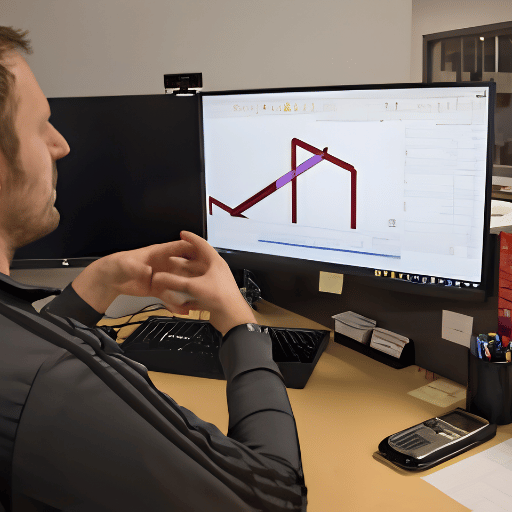
OSHA 29 CFR 1910.179 — Overhead and Gantry Cranes is the bedrock rule for general industry overhead and gantry cranes. It is long, written in 1960s prose, and references the American National Standard Safety Code for Overhead and Gantry Cranes. Most employers only need to operationalize a handful of subparts. Here is what actually matters on the shop floor day to day.
What OSHA standard covers overhead top-running cranes?
For general industry applications, the governing rule is 29 CFR 1910.179, which applies to overhead and gantry cranes including top-running bridge, cantilever gantry, semi-gantry and wall cranes with powered or manual trolleys and hoists. For construction work, 29 CFR 1926.1400 series takes over, with 1926.1427 requiring operator certification. An overhead crane installed in a manufacturing plant falls under 1910.179 even while the plant is being built, because the crane is a permanent fixture of the general-industry workplace.
The subparts that drive day-to-day operation:
- 1910.179(b)(2) — New cranes have to meet the design specifications of ANSI B30.2. Second-hand or altered cranes must be tested before first use under (k)(2).
- 1910.179(b)(5) — Rated load must be plainly marked on each side of the crane, and each hoist on a multi-hoist crane must show its individual capacity legibly from the floor.
- 1910.179(b)(6) — A minimum clearance of 3 inches overhead and 2 inches laterally must be maintained between the crane and any obstruction. OSHA inspectors measure this with a tape during walk-downs.
- 1910.179(g) — Electrical equipment has to follow specific guarding and grounding rules. Controllers must be spring-return or deadman-style so that releasing the control returns the crane to a neutral state.
- 1910.179(j) — The inspection regime: a two-tier schedule of “frequent” (daily to monthly) and “periodic” (1 to 12 month intervals) inspections with written records required for the periodic tier.
- 1910.179(n)(3) — Load handling: no load over people, no riding the hook, tag line required whenever load swing presents a hazard, and no leaving a suspended load unattended.
While 1910.179 does not prescribe a training curriculum, OSHA’s General Duty Clause together with the companion sling standard 29 CFR 1910.184 effectively forces one. Construction projects add the explicit operator certification requirement of 1926.1427(a).
The Three Big Overhead Crane Hazards — and How They Actually Happen

Nearly every fatal overhead crane accident traces back to one of three hazard families: electrical contact, structural overload, and falling or swinging loads. Those categories are familiar enough. Root causes of how they actually occur are less so.
What are the hazards of overhead cranes?
Overhead crane hazards cluster into three dominant families: (1) electrical contact — the hoist line, boom or load striking an energized conductor; (2) overload and structural failure — lifting beyond rated capacity, side-loading, or operating with degraded wire rope or slings; and (3) falling or dropped loads — releases caused by rigging failure, two-blocking, or loads that were never centered over their pick point. A fourth, mechanical, category — brake failure, controller faults, runway derailment — is usually a consequence of skipped inspection rather than a distinct hazard.
Hazard 1: Electrical Contact
Powerline contact is the single leading cause of crane fatality events, accounting for close to half of all crane deaths across industries. Inside the plant, the equivalent hazard is the exposed busway or shore-power conductor running above the runway. Fatality pathways include the operator being electrocuted through the hoist pendant, a ground worker touching the load or tag line while the crane is energized, and step-potential at the crane supports.
What works: equip and enclose all crane electrical components in NEMA-rated housings; use non-conductive tag lines made from manila or synthetic rope (never wire rope) for load stabilization; physically guard bus bars with insulated covers; and test ground continuity before each shift. For outdoor or yard-mounted overhead structures, respect the clearance envelopes in the OSHA 1926.1408 table — typically a 20 ft minimum from any line up to 350 kV.
Hazard 2: Overload and Two-Blocking
Overload is rarely a single catastrophic pick that nobody authorized. More often it is a slow drift: a bridge crane rated at 10 tons that has been used for 12 years on 9-ton picks suddenly meets a 10.5-ton pour of scrap, in wet conditions, on aged wire rope. Static rating held; dynamic rating did not.
One commonly overlooked variation is two-blocking: the hook block or overhaul ball being hoisted all the way up until it contacts the upper sheave or boom tip. When that happens, cable tension can spike past the rope’s breaking strength within a fraction of a second. As a senior rigging engineer on industry forums put it: “Two-blocking often occurs when the operator keeps hoisting up while extending the boom — the rope runs out of reeving length and the cable snaps.” Modern overhead cranes mitigate this with anti-two-block (ATB) limit switches and upper-block paddle actuators, both required under ASME B30.2 for new equipment. Older fleets often lack them and need a retrofit.
⚠️ Common Misconception
Two-blocking is often described as a “mobile crane problem.” It is not. Any overhead hoist without a properly set upper-limit switch can two-block during routine inching operations, particularly during maintenance lifts performed by technicians who are not the primary operator. Verify upper-limit actuation during every frequent inspection.
Hazard 3: Falling and Swinging Loads
A falling load is the final link of a rigging-failure chain that almost always started earlier: a worn sling that should have been red-tagged, a hook latch that was bent and still in service, a load that was never centered on the pick point before hoisting began. BLS data sorts these by fatal event type — 53% struck-by — but the individual failure modes read like a rigging textbook. Improperly secured slings, load drift during travel from side-loading, and dropped loads from uncontrolled rope backlash during emergency stops are the recurring threads.
Controls that work: a verified load-moment indicator on cranes over 5 tons; tag lines and designated floor spotters; “no walk-under” barriers marked on the floor; and hard exclusion zones enforced by physical barriers, not signage alone.
Pre-Use Inspection: Daily, Frequent and Periodic Checklists
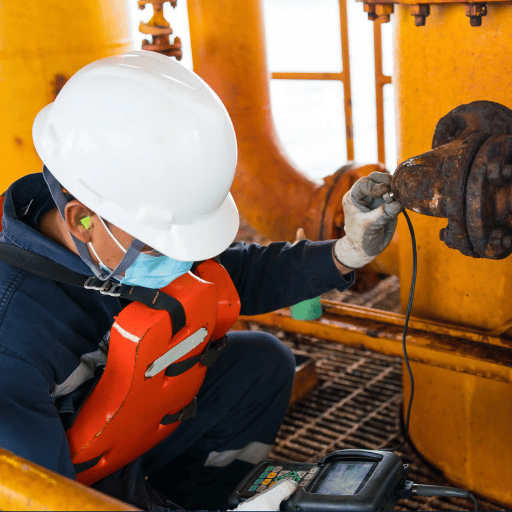
OSHA 1910.179(j) defines two inspection tiers — “frequent” and “periodic” — but a properly run shop actually runs three, by adding a pre-shift walk-around that the operator performs every single time the crane is energized. Conflating the tiers is the single most common citation in overhead crane safety inspection audits.
| Tier | Interval (1910.179(j)) | What to check | Records required |
|---|---|---|---|
| Pre-shift walk-around | Every shift / every operator change | Control function test (all motions), emergency stop, limit switches, hook latch, wire rope visible length, audible warning, brake response | Operator log (not required by OSHA but best practice) |
| Frequent | Daily to monthly (based on duty cycle) | All operating mechanisms, air/hydraulic lines, hooks for deformation, wire rope for broken wires, chain wear stretch, hoist-brake drift | Written record not required, but critical items (hooks, rope) should be logged |
| Periodic | 1 to 12 months (severity-based) | Structural members, bolts and rivets, pins and bearings, sheaves, load-indicating equipment, electrical components, power plant | Dated, signed report required (1910.179(j)(3)) |
“The difference between a frequent inspection and a periodic inspection is not the checklist — it is who is qualified to sign the bottom of the page. Periodic inspections have to be performed by a qualified person and the record has to survive an OSHA subpoena two years later.”
Wire rope red-tag criteria (drawn from 1910.179 and ASME B30.2): discard if there are 12 or more randomly distributed broken wires in one rope lay, or 4 broken wires in a single strand; if there is evidence of heat damage; if the outer wires are worn to less than 65% of original diameter; or if the rope has been kinked, birdcaged or has a protruding core.
Safe Operating Procedures and the “3-3-3 Rule” Decoded
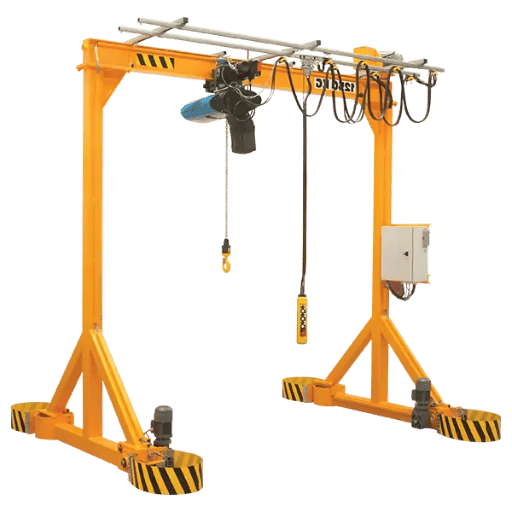
Operating a crane safely is a habit set, not a document. Those habits break down into four stages: pre-lift verification, hoist and travel, load placement, and shutdown. OSHA 1910.179(n) mandates the floor-level behaviors; the sequence below is how plant-floor trainers actually teach them.
What is the 3-3-3 rule for cranes?
The “3-3-3 rule” is an industry mnemonic for safe lifting operations — it is not codified in OSHA 1910.179 or ASME B30.2, and different regions teach it with slightly different values. The most common version taught on rigging courses reads as: (1) 3 seconds — pause for three seconds after taking the slack out of the sling so the rigger can visually verify balance, hook engagement and sling seating before the lift begins; (2) 3 meters — keep all personnel at least three meters (roughly ten feet) from the suspended load throughout travel; and (3) a 3-point check — confirm three independent signals before energizing the hoist: tag line in hand, spotter acknowledging, and path clear. Its strength is that the whole check takes about eight seconds to execute and catches most of the lift-initiation failures that show up in incident reports.
Core operating procedures drawn from 1910.179(n):
- Confirm the rated load capacity of the crane and of every component in the rigging chain — never rely on the hook tag alone. Inspect slings and hardware per 1910.184.
- Center the hoist directly over the load before hoisting to prevent side-pull. Side-loading introduces lateral bending moments the crane’s girder was never rated for.
- Sound the audible warning before travel and at every direction change. Use standardized ASME B30.2 hand signals or radio; one designated signaler, not the whole crew.
- Travel with the load only as high as necessary to clear obstacles. Moving a load close to the floor is a forbidden practice in most plants because the crane movement outruns operator situational awareness at full speed.
- Never lift, travel or position a load over personnel. Enforce exclusion zones with physical barriers or laser scanner zones when barriers are impractical.
- Set loads on blocking, never directly on slings. Remove slings only after the load is fully stable.
- Do not leave a suspended load unattended (1910.179(n)(3)(vi)). Even for a ninety-second break, lower the load first.
Engineering Controls: Anti-Collision Systems, LiDAR Zones and Safety Interlocks
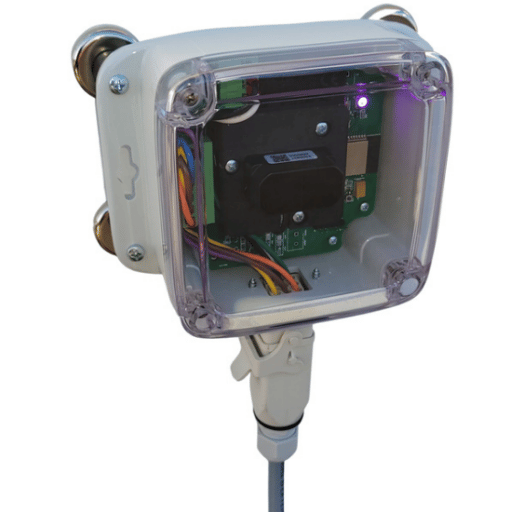
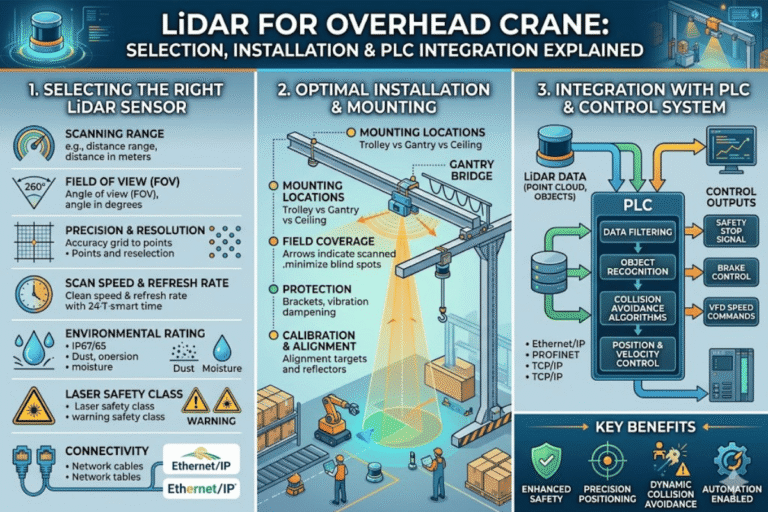
OSHA 1910.179 was written when the most advanced preventive crane safety device was a mechanical upper-limit switch controlled from a remote pendant. Modern overhead crane installations have moved well past that. In 2026 the engineering-control stack layers passive protection (bumpers, end-stops, mechanical limits) on top of active protection (electrical interlocks, overload relays) designed to minimize incident risk on top of engineered protection (LiDAR zone monitoring, laser scanner exclusion fields, safety light curtains). Each layer costs money but each layer catches a different failure mode.
CCH Shanghai Sensing Intelligence’s engineering group has deployed crane safety sensors for twenty years across steel mills, port terminals and automotive stamping plants. Across those installations, the pattern that repeats is simple: sites that upgrade from passive-only protection to active plus engineered controls reduce reportable near-misses by a margin large enough to pay back the hardware within the first fiscal year. That is not a marketing claim — it is what operations managers report when they cancel their next insurance rate hike.
The hazard-to-control mapping below is the decision matrix we hand to new customers when they ask which sensor they actually need. It is organized by root-cause hazard, not by product line.
| Hazard root cause | Recommended engineering control | Typical specification |
|---|---|---|
| Bridge-to-bridge collision on shared runway | 2D safety laser scanner zone protection with dual-zone slowdown + stop | Range 3–40 m, angle 190–270°, response ≤80 ms, IP65 |
| Load falling into personnel zone | 3D LiDAR volumetric exclusion with overhead crane LiDAR anti-collision sensors | 10–100 m detection, 10–20 Hz scan rate, ISO 13849 PLd compliant |
| Maintenance worker accessing crane aisle | Type 4 safety light curtain gate interlock | Resolution 14–40 mm, response 8–20 ms, Category 4 per EN ISO 13849-1 |
| Hoist upper-limit failure / two-blocking | Redundant ATB limit switch wired through a safety relay module (dual-channel) | Cat 4 / PLe, forced-guided contacts, manual reset |
| Uncontrolled bridge travel on power loss | Fail-safe spring-applied brake + travel-limit end-stops | Brake torque ≥150% rated, end-stop absorption per ASME B30.2-3.3.6 |
💡 Engineering Note — Why LiDAR is taking over
A 2D laser scanner protects a plane. A 3D LiDAR protects a volume. On a bay with multiple bridges working at different elevations, a planar device throws a false-positive every time an upper bridge crosses the scan line, forcing operators to disable zones. 3D LiDAR with point-cloud filtering (used in systems such as FME’s NOCOL with Ouster sensors) distinguishes an overhead bridge from a ground worker by z-coordinate, so protection stays active all day. IP67, 10–20 Hz refresh, and 100 m detection at 10% reflectivity is the current 2026 baseline for industrial deployments.
For a plant building a new crane or retrofitting an aging fleet, the sensor stack is best specified early — ideally at PLC architecture definition — because adding Category 4 PLd-rated devices after commissioning typically costs 2–3 times the original integration budget. CCH Shanghai’s engineering team provides free sample sensors to OEMs and integrators for design-phase evaluation; the details are covered under our OEM safety sensor customization program.
Operator Training, Qualification and Standard Hand Signals
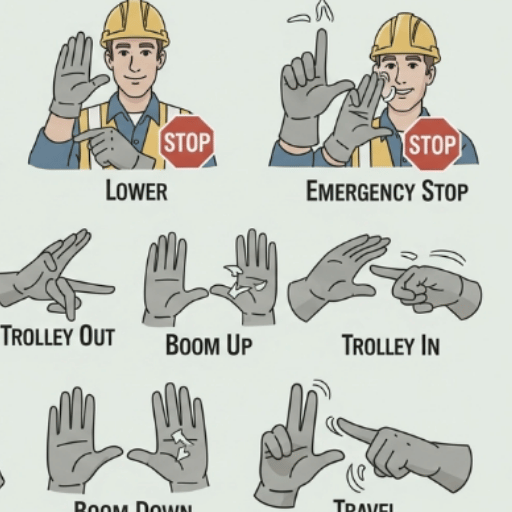
A certified operator is the last line of defense when every other control fails. ASME B30.2 treats operator qualification as a three-legged stool: written examination, practical demonstration, and physical qualification (vision, hearing, depth perception, reaction time). For construction work, 29 CFR 1926.1427(a) makes certification explicit and legally binding; for general industry, the General Duty Clause together with the crane’s specific manufacturer documentation carries the same force during a citation.
A defensible overhead crane safety training curriculum covers:
- OSHA 1910.179 and ASME B30.2 regulatory framework
- Crane-specific operating manual, load chart and control familiarization
- Pre-use inspection procedure with go / no-go criteria
- Rigging principles: sling selection per ASME B30.9, hook inspection, load balance
- Standard hand signals: stop, emergency stop, hoist, lower, bridge travel, trolley travel, main hoist use, dog everything
- Communication protocols — single designated signaler, radio channel discipline, stop-signal override
- Emergency response: power loss, runway obstruction, near-miss reporting
Refresher training is the component most often skipped. ASME B30.2 calls for re-qualification at least every three years, or whenever an operator transfers between crane types. Many insurers now require documented refresher training every 12 months as a condition of liability coverage.
Frequently Asked Questions
What are the safety guidelines for overhead cranes?
View answer
The core safety guidelines for overhead cranes come from OSHA 1910.179 and ASME B30.2. Only certified operators should run the crane. Inspect brakes, limit switches and wire rope before every shift. Never exceed the rated load marked on each side of the crane. Keep the 3-inch overhead and 2-inch lateral clearance envelope clear. Use a designated signaler on every lift. Never carry a load over personnel. Schedule documented periodic inspections by a qualified person at intervals between 1 and 12 months based on duty cycle.
Is operator certification legally required by OSHA for overhead cranes?
View answer
For construction work, yes — 29 CFR 1926.1427(a) explicitly requires operator certification or licensing before running a covered crane. For general industry work under 1910.179, OSHA does not name a specific certification body, but employers have to demonstrate that operators are “qualified,” which in practice means documented training, a practical test, and familiarity with the specific crane’s manual. Failing to demonstrate qualification during an OSHA walk-through will generate a General Duty Clause citation.
How often must an overhead crane be inspected?
View answer
OSHA 1910.179(j) defines two tiers. Frequent inspections run at daily to monthly intervals and cover operating mechanisms, air and hydraulic systems, hooks, and wire rope. Periodic inspections run at 1 to 12 month intervals depending on crane activity, environment, and severity of service, and must cover structural members, bolts, bearings, sheaves and load-indicating equipment. Periodic inspections require a dated, signed written report. Most plants add an operator-led pre-shift walk-around as a third tier.
What PPE is required when operating or working near an overhead crane?
View answer
Standard PPE for crane operations includes a hard hat meeting ANSI Z89.1, ANSI Z87-rated safety glasses, ASTM F2413-rated safety footwear with toe protection, work gloves suitable for rigging (cut-resistant or leather), and high-visibility apparel meeting ANSI/ISEA 107 Class 2 or higher for ground personnel in active crane zones. Hearing protection is required where sound levels exceed 85 dBA. Fall protection meeting ANSI Z359 is required whenever maintenance work occurs on elevated crane platforms without guardrails.
Can one worker operate an overhead crane alone?
View answer
Technically yes, for simple lifts where the operator has full visual coverage of the load and the travel path from the pendant or cab. In practice, any lift with blind spots, multiple direction changes, or personnel in adjacent bays should involve a designated signaler. OSHA 1910.179(n)(3) requires that the operator have a clear view of the load path — if the view is obstructed, a signaler becomes mandatory for compliance.
Are overhead cranes actually dangerous, statistically?
View answer
Cranes are responsible for about 42 fatal occupational injuries per year in the United States, based on BLS data for 2011–2017 — roughly 4% of all equipment-related workplace fatalities. The rate has been falling for three decades thanks to mandatory operator certification, better engineering controls, and improved rigging standards. Cranes are dangerous the way a steel press is dangerous: absolutely lethal if procedures are ignored, and remarkably safe when 1910.179 is followed and the engineering controls listed in ASME B30.2 are installed and maintained.
Key Takeaways and Next Steps
Overhead crane safety is a compliance problem and a design problem at the same time. Compliance side is 1910.179 plus ASME B30.2 plus documented training. Design side is the engineering control stack — passive stops, active interlocks, and engineered LiDAR or laser scanner protection — that catches the residual risk regulations alone cannot eliminate. Both layers have to be funded, and neither can substitute for the other.
If you are specifying a new crane or retrofitting an aging bay, the fastest payback comes from installing a hazard-matched sensor stack at PLC architecture time, not after an incident. CCH Shanghai Sensing Intelligence’s engineering team provides free sample sensors, OEM customization and pre-deployment consultation for integrators building Category 4 / PLd-rated overhead crane safety systems — contact us to scope a build or request sample units.
Transparency note: this guide references OSHA regulations, BLS fatality statistics and ASME consensus standards. Product specifications mentioned are typical industry baselines for 2026; exact certified values vary by manufacturer and installation. Readers responsible for regulatory compliance should consult the current published text of 29 CFR 1910.179 and ASME B30.2 and engage a qualified safety engineer for site-specific risk assessment.
References & Sources
- 29 CFR 1910.179 — Overhead and Gantry Cranes — U.S. Occupational Safety and Health Administration
- 29 CFR 1926.1427 — Operator Qualification and Certification — U.S. Occupational Safety and Health Administration
- Fatal Occupational Injuries Involving Cranes, 2011–2017 — U.S. Bureau of Labor Statistics
- Crane-related Work Deaths Trended Down from 1992 to 2017 — BLS Economics Daily
- Regional Local Emphasis Program for Cranes — OSHA Boston Regional Office
- ASME B30.2 — Overhead and Gantry Cranes — American Society of Mechanical Engineers