Get in touch with QJKH Company

Safety Light Curtain for Finger and Hand Protection: Resolution, ISO 13855 Distance, and Type 4 Compliance
A finger and hand safe light curtain is the point where a risk assessment stops being a document and starts being a hardware specification. Choose the wrong resolution and even a fully certified Type 4 curtain leaves fingers inside the die, the press, or the robot end-effector. This handbook walks through how IEC 61496 defines resolution, when it makes sense to settle on 14 mm, 20 mm, 30 mm, or 40 mm, and how to calculate the minimum mounting distance using the ISO 13855 formula – with two worked e×amples a compliance engineer can reproduce on Monday morning.
Quick Specs: Finger & Hand Protection Light Curtains
- Finger resolution: 14 mm – detects objects 14 mm (fingers, fingertips)
- Wrist resolution: 20 mm — detects wrist-width intrusions
- Hand resolution: 30 mm – general machine guarding at the point of operation
- Arm / body resolution: 40 mm+ – perimeter and access protection only
- Safety category: Type 4 / Cat. 4 / PL e / SIL 3 per IEC 61496, ISO 13849-1, IEC 61508
- Distance formula:
S = 1600 · T + 8 · (d − 14)mm, with S ≥ 100 mm, d ≤ 40 mm (ISO 13855:2010 Clause 6.1.3.1)
Why Resolution Is the Critical Spec for Finger and Hand Protection
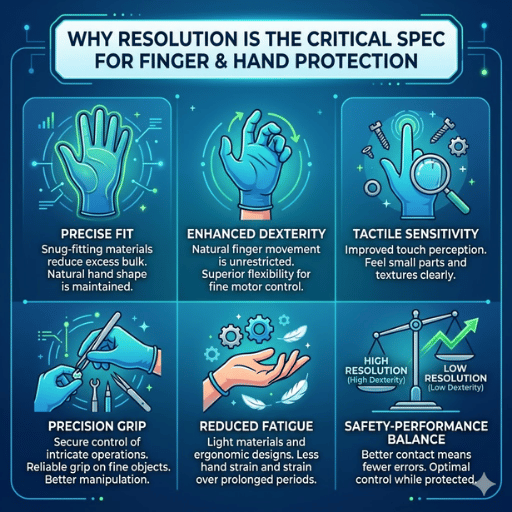
A safe light curtain that protects the body part(s) the design hazard can reach is a statement that a hazard zone cannot be traversed by an authorising person’s hand or fingers without detection. Doing an audit, against U.S. OSHA / BLS rules 29 CFR 1910.212 and 1910.217, reveals hundreds of installed curtains per year that are not. Fully type 4 rated, wired correctly, installed within 110%, and mounted within 225%, a single high resolution light curtain is validated as being able to reliably protect the fullest e×tent of the designer’s recommendation, but if that resolution is too coarse even properly installed and certified devices leave hazards like fingers e×posed.
U.S. OSHA mandates point-of-operation protection on all types of power presses where the operator’s body could enter an hazard zone, per OSHA CFR 1910.217. Precision protecting the entire operator does not happen where the general machine guarding rule applies, in 29 CFR 1910.211. Both regulations equate “finger or hand could get through without being detected” to a failed guard, and BLS injury data in nonfatal electric-arc incidents in years past show the large majority of fingers and hands involved in amputations – in every industry – are still out there.
Link-bait hook: Certification is no guarantee that the resolution was selected correctly. A Type 4 curtain with 40 mm light beams installed on a stamping die is non-compliant at the millisecond when a fingertip passes between adjacent beams, however many lines of certification test print published elsewhere.
That’s why the whole reason this guide exists. Buying a Type 4 point-of-operation safety light curtain is a two-part decision that rests one choice on top of the other: pick the safety category specified by your risk assessment, determine the resolution that addresses your designer’s statement of hazard reach, and be sure to get both right, so that the other one is correct as well.
Essential truth: certification addresses the question “how reliably will an intrusion be detected?” resolution addresses the question “how big does an intrusion have to be before it is reliably detected?” both must be correct.
Understanding Light Curtain Resolution: 14 / 20 / 30 / 40 mm Explained
What is light curtain resolution?
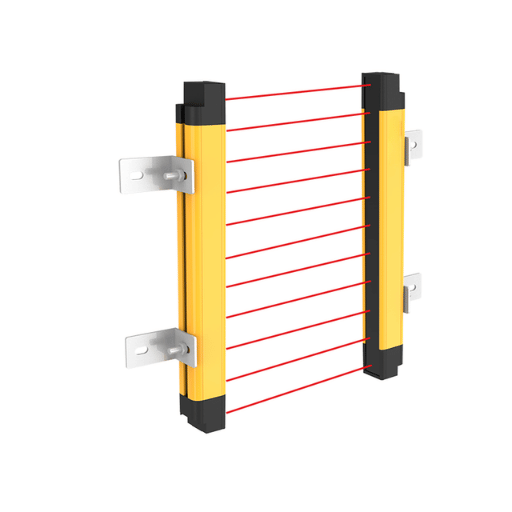
Resolution is the smallest object that a safety light curtain is required to reliably detect anywhere within its protection area. It is normally the center-to-center beam spacings plus the beam diameter, and it is the geometrical factor that determines whether a finger, a wrist, a hand or just an arm will block enough light travelling between the transmitter and receiver to trigger the OSSD outputs and force a machine shutdown inside the hazardous area. An electro-sensitive protective equipment device (ESPE) assembled as an active opto-electronic protective device (AOPD) enforces this guarantee through its beam-level self-test and the physical layout of its transmitter and receiver arrays.
Standard resolution bands used in industrial machine guarding are derived directly from biometric measurements embedded in EN_ Varenef (VZK). and the related detection-capability requirements found in IEC_ 61496-2. There are four resolution choices, and another for perimeter detection:
| Resolution (d) | Body part blocked | Typical beam spacing | Use-case category |
|---|---|---|---|
| 14 mm | Finger — down to a fingertip | 10 mm | Point of operation (presses, dies, assembly) |
| 20 mm | Wrist | 15 mm | Narrow-access small machinery |
| 30 mm | Hand — fingers closed | 20 mm | General machine guarding |
| 40 mm | Arm | 30 mm | Large-cell perimeter, reach-over setups |
| > 40 mm (typically 70–500 mm) | Leg / body | Multi-beam grid | Walk-through perimeter only (not for hand protection) |
This four-row resolution ladder is not ornamental. Every step up in resolution buys real detection capability, but it also pays a tax in three other specifications: curtain cost, mounting distance, and response time. Response time is the one that matters most here, because finer resolution means more beams, and more beams means more sequential optical channels for the receiver to scan before its outputs can update. A 14 mm curtain covering a 1 600 mm protection height packs roughly 160 beams; a 45 mm curtain across the same span uses about 53 beams. That difference is not just hardware — it is milliseconds.
🔧 Engineering Note — beam count drives response time. QJKH’s ENT safety light curtain series lists a response time of 6.0 – 30.8 ms depending on the beam count for a given model. The 14 mm finger-protection variant sits at the slower end of that band because it has the densest beam array; the 25 mm and 45 mm variants are proportionally faster. When you plug the curtain into an ISO 13855 distance calculation (next section), this response time is part of the total stopping time
T, so choosing finer resolution does not only cost more hardware — it also forces a slightly larger mounting distance. Plan for both.
Finger Protection (14 mm Resolution): Point of Operation on Presses and Assembly
When is 14 mm resolution required?
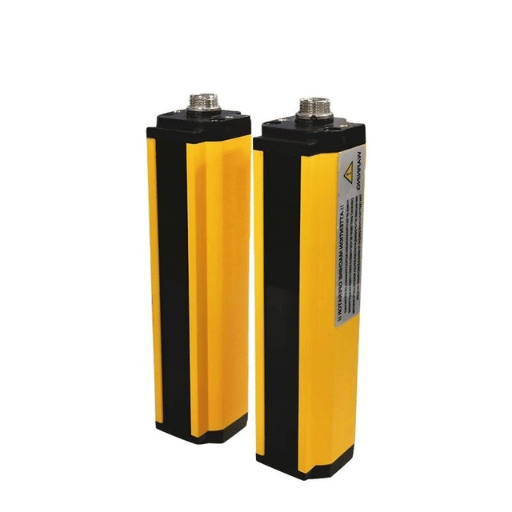
Using a 14 mm safety light curtain for finger protection is required whenever the hazard is accessible by a human finger alone, without the whole hand also being part of the reach-in strategy. That is the typical reach-in geometry for a mechanical punch press’ loading stroke, for a stamping die operated by hand, for a small parts feeder on a robotic assembly cell, for a manual parts loader on an injection molding machine. And in every one of those cases the common geometry is that it is the finger, not the back of the hand, that is crossing the protection plane; and that is where a 30 mm resolution will again make you a wide open target for an inadvertently discovered fingertip.
Three field scenarios illustrate where finger resolution is non-negotiable:
Case 1_ Mechanical power press, stamping die, manually fed. A line operator loads 200 mm x 300 mm blanks into a die at 600 mm cycle height every 2.5 seconds. Reach-in distance from the light curtain plane to the die shut face is 280 mm. At that distance a clenched hand is larger than the gaps, but a single index finger is comfortably in the “no” zone. OSHA 1910.217 requires the provision of a point-of-operation guarding device that precludes body parts from reaching the hazard, and at an index finger’s reach-in distance the only resolution you need to reliably catch the digit is 14 mm.
Scenario 2 – Robotic assembly station, small-component feed. Six-axis robot cells often pick bearings from a vibration feeder tray. A feed tray is set up as a guarded cell with a 60 mm × 40 mm window into the process; operators drop bearings into the slot manually between batches.
The window is too small for a hand to fit through, but of course in reality this means every actual intrusion is a finger or the end of a tool. Any 30 mm curtain will let fingers pass between beams, so 14 mm finger resolution is the only defensible spec.
Scenario 3 – gate in injection molding, Manual insert loading. An IMM operator loads 3/8″ threaded brass inserts in a mold half between shots. Clamp stroke is under 5 m of travel so as short-range (C-class 0-5 m) 14 mm curtain is used.
The danger is shear between mold halves – a hand will be crushed but finger is much more likely candidate intrusion when operator is loading small parts. Again: 14 mm, Type 4.
Across all three scenarios, the finger protection safety light curtains to make engineering sense all start at: Type 4/ Cat. 4/ PL e/ SIL 3,TV approved, response below ~15 ms with finger protection heights configured against the press window. For QJKH ENT series, as an example, that is listed as: TV approval to IEC 61496 Type 4, SIL 3 according to IEC 61508 and Cat. 4/ PL e according to EN ISO 13849-1:2023, up to 1 960mm protection height configurable and with operating range from 0.5 m to 70 m in five detection-distance bands.
Lessons learned from this: Clearly 30 mm isn’t acceptable if the operator can get a finger into the hazard zone. Stick to 14 mm – and allow for the response time.
Hand and Wrist Protection (20 mm and 30 mm Resolution): General Machine Guarding
Is 30 mm resolution enough for hand protection?
Short answer: yes, if the reach-in geometry prevents a single finger from reaching into the field. Any definitive answer requires computing the ISO 13855 penetration factor for each resolution tier — which is where most online resources quietly copy the wrong values for. For safety light curtains with d 40 mm, normal (orthogonal) approach to the protective field, ISO 13855:2010 Clause 6.1.3.1 defines the penetration depth factor as:
C = 8 · (d − 14) mm
It is a formula not a lookup table. Drop in the four standard resolutions and you get the real penetration-depth contributions:
| Resolution (d) | C = 8 · (d − 14) mm | Interpretation |
|---|---|---|
| 14 mm | 0 mm | Finger cannot pass through a 14 mm beam array without detection |
| 20 mm | 48 mm | Wrist penetrates ~48 mm into the field before beams block |
| 30 mm | 128 mm | Hand penetrates ~128 mm before the beams intercept |
| 40 mm | 208 mm | Arm penetrates ~208 mm — not a hand-protection resolution |
For d > 40 mm (21, 22, 23) the equations are: Clause 6.1.3.1 switches to a constant C = 850 mm, and larger resolution images (above 40 mm) would no longer be hand-detection, but body-intrusion detection. This is where the popular “C=850 mm” comes from – that is a clause about body intrusion, not about detecting hands at 40 mm.
Within a restricted-access general-guarding hazardous zone – laser cutter loading apertures, confined CNC doors, conveyor-fed workstations – a 20 mm (wrist) curtain with C = 48 mm is usually the best trade-off between cost, mounting distance, and effective reach-in geometry. For larger apertures and no access to fingertips 30 mm (hand, C = 128 mm) is affordable and effective. The question isn’t “which is safer” – they are both safe with the correct mounting distance – but “which resolution does the mounting distance allow.”
Lowering resolution to save money means the curtain must be mounted farther from the hazard. On a small press envelope, that larger distance is often physically impossible. Resolution must be limited by geometry before being limited by budget.
A tip when hunter manufacturer models:QJKH11 ENThe series QJKH ship in detection accuracy bands 14; 25; 45 mm. Its drop-in finger-protection variant is the 14 mm model. Between a 20 mm wrist industry band and a 30 mm hand industry band is the 25 mm variation—the device to use in narrow-access general guarding, but only after the mounting distance is calculated to d=25, not 20 or 30.
QJKH 45 mm’s variation is an arm/torso intrusion device and must not be employed in a situation where a hand can reach the danger zone within 208 mm of the edge of the field.Trouser
Key takeaway: The penetration factor for a light curtain under ISO 13855 is 8·(d−14) mm, not the generic “80/130/850” values that show up in secondary sources. Do the math with the correct formula.
ISO 13855 Safety Distance Calculation: A Worked Example
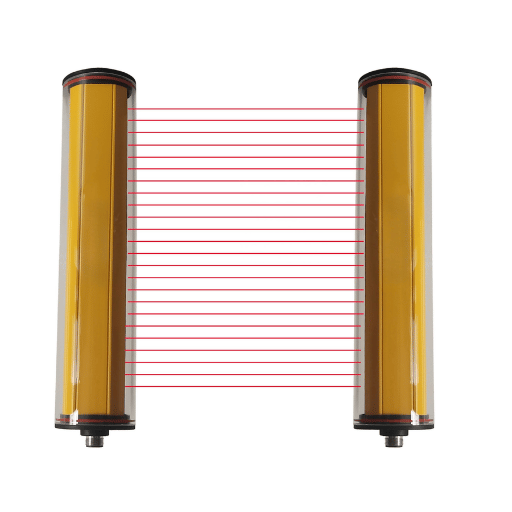
How do you calculate safety distance for a light curtain?
A minimum safety distance between the protective field of the curtain and the closest hazard point is provided by the ISO 13855:2010 Clause 6.1.3.1 to the safety light curtains with orthogonal approach for d 40 mm:
S = K · T + 8 · (d − 14) mm
where K = 1600 mm/s (normal approach), T = total stopping time in seconds, d = resolution in mm, S ≥ 100 mm
Each parameter pays off line by line:
- K – approach speed. The default value given by ISO 13855 for the K parameter for (perpendicular) approach to the protective field is 1600 mm/s. If the resulting distance S is less than 500 mm, the calculation shall be repeated with K=2000mm/s and the larger of the two values taken.This ensures no runaway close-mount relying on slow approach of the operator.
- T – total stopping time. T is equal to every response time in the safety chain. Total time is equal to: the light curtain’s OSSD response time, t1; the safety relay or safety PLC response time, t2; the machine’s main control element stopping time, t3 (clutch release, contactor dropout and motor run-down).An authoritative stop-time analysis requires a minimum of ten measurements on the real machine.
- d — resolution in mm. The penetration term
8·(d−14)is positive only for d > 14; at d = 14 mm it collapses to zero (a finger cannot enter the field without being detected). - Smin floor. Clause 6.1.3.1 requires a floor Smin of not less than 100 mm, no matter what the calculations indicate – a curtain cannot be hung any closer to this than the indicated minimum.
Worked Example 1 – press brake, 14 mm finger protection. Take a 200 t hydraulic press brake with a measured curtain OSSD response time of t1 = 20 ms, the safety relay response time t2 = 15 ms, and a stop-time analysis measured machine stop time of t3 = 125 ms. Total T = 0.020 + 0.015 + 0.125= 0.160 s.
Plugging in to Clause 6.1.3.1 at d = 14:
S = 1600 · 0.160 + 8 · (14 − 14) = 256 + 0 = 256 mm
Because 256 mm is below the 500 mm cutoff, refresh this time with a K = 2000 mm/sec one:
S = 2000 · 0.160 + 0 = 320 mm
Larger value (320 mm) governs. In practice the compliance engineer will round up to the next convenient installation increment— namely 350 mm or 400 mm—in order to accommodate long-term stop-time drift and alignment tolerance.
Small CNC enclosure, 30 mm hand protection. Consider a CNC router cell with a total stopping time of T = 0.22 s (curtains 15 ms, safety PLC 20 ms, spindle brake 185 ms).
At d = 30 mm:
S = 1600 · 0.22 + 8 · (30 − 14) = 352 + 128 = 480 mm
480 mm is below the 500 mm refresh threshold, therefore verify with K = 2000:
S = 2000 · 0.22 + 128 = 440 + 128 = 568 mm
568 mm > 480 mm, 568 mm governs. Observe how the 30 mm resolution adds 128 mm of penetration factor in addition to the time-based component—as a result, hand-resolution curtains are typically mounted noticeably farther from the hazard than finger-resolution curtains on comparable equipment.
Two typical errors on this calculation, listed in order of prevalence: neglecting the K = 2000 refresh when S drops below 500 mm; and computing only the curtain response time for T while ignoring the safety relay and machine stop contributions. Both tend to underestimate the mounting distance—leaving the operator’s hand in the hazard zone when it arrives.
Key point: always run both K = 1600 and K = 2000 calculations and use the larger answer. Always measure T with at least ten actual machine stop time results, not a vendor’s brochure.
Intrusion Detection Applications: Blanking, Muting, and Cascading
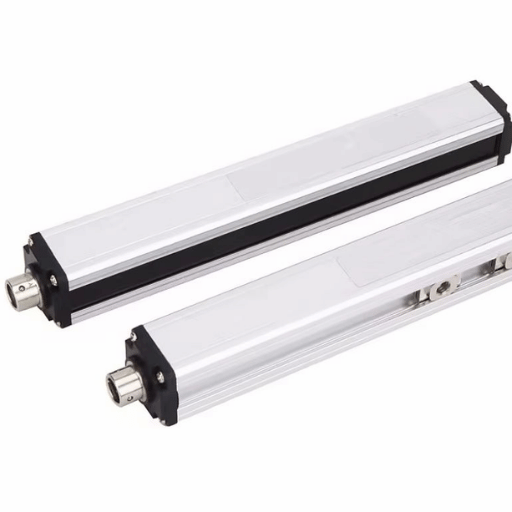
Finger and hand protection is just one function for an intrusion detection safety light curtain in a modern automation cell. Often the same AOPD hardware has a second function of access protection—detecting personnel entering a wider hazard zone—where the geometry is too large for a fingertip analysis and the curtain is installed with a physical restart interlock, four-sensor muting for conveyor pass through, or cascading pairs for L-shaped cell perimeters.
Three function groups matter when a curtain is used for more than point-of-operation protection:
- Blanking—fixed or floating, to mask beams where a workpiece, conveyor rail, or tooling permanently occupies the field. Fixed blanking ignores a known set of beams; floating blanking tolerates a small moving object anywhere along the array.Both affect the practical resolution, so the installer should reassess the protective capacity to the hazard dimensions after blanking is configured.
- Muting—a temporary, sensor-driven bypass that allows a pallet or carrier to pass through without shutting down the machine.Cross-beam and four-sensor muting arrangements are the two standard geometries; IEC/TS 62046 defines the application-level rules for the number of sensors required and their placements. Muting isn’t a manual override—it’s entered automatically and left automatically.
- Cascading – daisy-chaining two or more safety curtains via one safety controller, so as to provide perimeter protection (L- or U-shaped) from a single restart point. QJKH’s ENT series supports cascading via an adapter and consolidates the OSSD outputs, making it easy to manage a press cell with multiple access faces but just one safety PLC input.
A safety light curtain by itself is almost never the full safety chain. It outputs to a companion safety relay module or safety PLC which performs restart interlock logic, diagnostic coverage management, and force-guided contactor feedback. It is the safety relay that actually holds-in the stop command, as the emergency stop relay, and requires manual reset in accordance with OSHA 1910.217.
One boundary case worth mentioning: Type 4 is not always required. In a low-risk perimeter access application – say, for a walk-in cell with a worst-case hazard level of a bruise, not a finger amputation – a Type 2 / PL c device is allow able and can be significantly less expensive. That “always use Type 4” mantra is an over-simplification; the right answer is “do whatever Type your risk assessment indicates, and no less.”
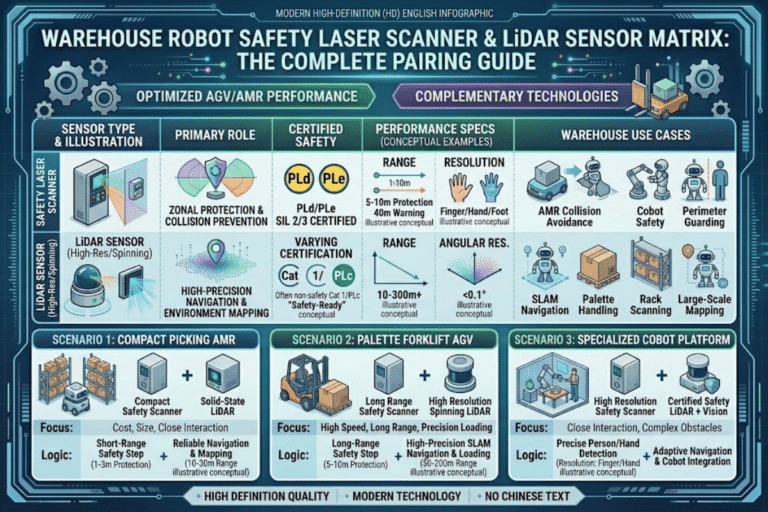
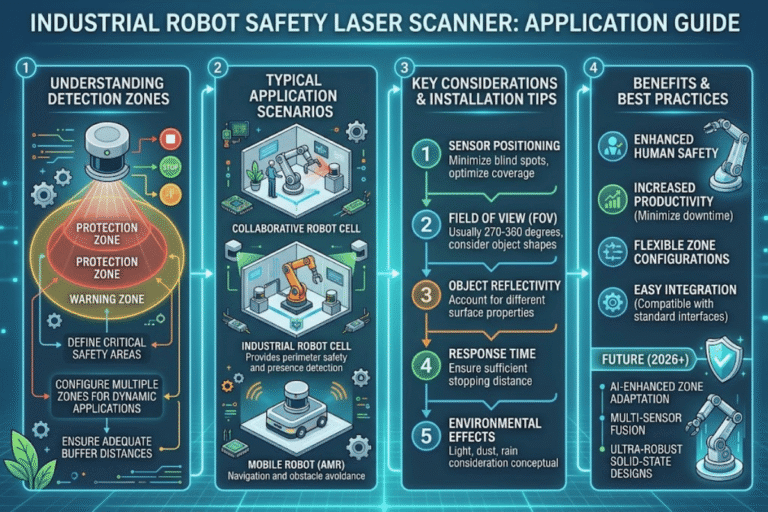
When your guarded geometry is no longer a perfect rectangle – irregular floors, large-area robots, or mobile equipment corridors – a light curtain ceases to be the right protection method. In those applications, a safety laser scanner provides better flexibility, and the two approaches work together. A scanner-versus-curtain decision is not a safety hierarchy; it is a geometry assessment, and the detailed decision framework is explained in the supplementary industrial safety laser scanner selection guide. For point-of-operation finger and hand protection within a rectangular field, use a curtain. For a 2 m 2 m floor space around a robot with multiple approach vectors, the safety laser scanner is the better choice.
Most important conclusion: Blanking and muting can improve manufacturing through put, but they alter the effective resolution and mandates re-validation. Cascading allows a single restart point for a multi-face cell. When your geometry is no longer rectangular, use a scanner instead of curtains.
Resolution Selection Checklist and Next Steps
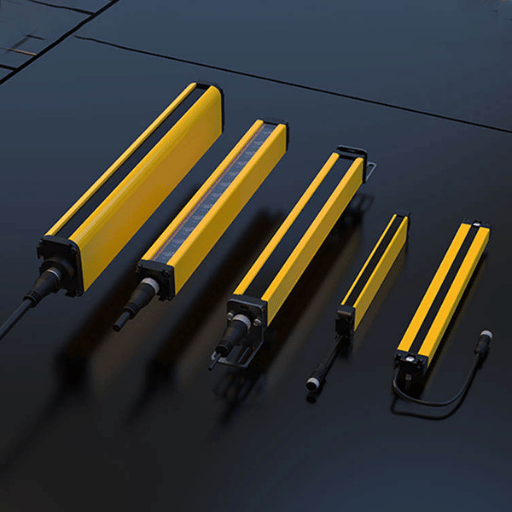
Applying this seven-factor questionnaire to your risk assessment for protection at a point of operation yields a complete set of specifications, resolution, type, height, range, and response time, which the manufacturer can price accordingly:
- Body part access. Will a finger, wrist, hand, or just an arm be able to reach into the hazard area through the protective field? Your answer dictates: d: 14 / 20 / 30 / 40 mm.
- Collision distance from the curtain plane to the closest hazard point. Calculate based on the measured approach to the hazard and the circumstancial approach, and propagates to the mounting distance determination.
- Total system response time T. Add curtain output switch + relay / PLC + machinery stop time. For your stop time, measure ten occurrences, rather than depend on spec sheet numbers.
- Approach direction. For normal (orthogonal) approach, calculation requires K = 1600 mm/sec; short approach less than 500 mm requires recalculation using K = 2000 mm/sec. Off-orthogonal approach introduces further ISO 13855 parameters.
- Required PL / SIL per risk assessment. ISO 12100 risk assessment sets the goal Performance Level per ISO 13849-1 or SIL to IEC 62061. That chooses Type 2 (PL c / SIL 2) or Type 4 (PL e / SIL 3).
- Ambient conditions. Lux level (3 000 Lux ambient is normal, 10 000 Lux for sunlight-adjacent), vibration, IP rating (IP65 for most factory floors), temperature range.
- Special functions. Blanking, muting, cascading, restart interlock mode (manual versus automatic). Each feature increases wiring and documentation burden; each is justified independently from the risk assessment.
Put the seven answers in one line and a supplier can match them against a part number in minutes. Skip one and the quote becomes a guess.
Need a QJKH ENT series Type 4 safety light curtain sample?
QJKH’s ENT series is TÜV certified to IEC 61496 Type 4, SIL 3, and ISO 13849-1 Cat. 4 / PL e, with 14 mm, 25 mm, and 45 mm resolution options covering finger, general-guarding, and perimeter applications. Request a free sample and our engineering team will verify the exact resolution and mounting distance for your hazard shape.
Frequently Asked Questions
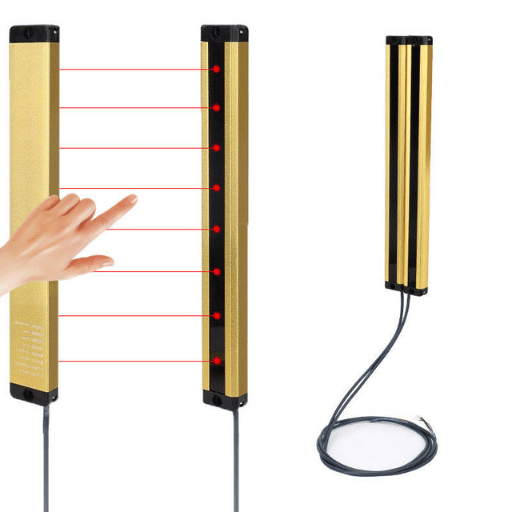
What happens if I pick the wrong resolution?
Two failure modes and they both are bad. Too coarse (picking 30 mm where 14 mm is required) leaves fingertips able to slide between beams-the curtain is legally fine but the Machine Guarding fails an OSHA inspection the first time an auditor measures a fingertip with a gauge through the field. Too fine (picking 14 mm where 30 mm would do) wastes budget and response time and often requires mounting on a physically impossible distance on a small machine envelope.
What is the difference between 14 mm and 30 mm resolution?
14 mm catches a finger; 30 mm only catches a hand. Mathematically, ISO 13855:2010 yields a penetration factor of zero at 14 mm—that is, a curtain can be mounted as close as the 100 mm minimum allows. But at 30 mm the penetration factor jumps to 128 mm—adding that much to the mounting distance over the time-based term.
Are safety light curtains required by OSHA?
OSHA doesn’t specify a technology. Two clauses carry the duty: 29 CFR 1910.212 [general guarding] and 29 CFR 1910.217 [mechanical power presses]—both require point-of-operation protection that prevents the operator’s body from entering the danger zone. Presence-sensing safety light curtains are explicitly permitted under 1910.217 Appendix D, as long as it is mounted at the calculated minimum safe distance (see 1910.217). Hand-feeding tools are explicitly disallowed as a substitute for a guarding device.
Do I need Type 4 or is Type 2 acceptable for hand protection?
Risk assessment rules. Your risk assessment rules, not the marketing-speak: When guarding the point of operation where’s the hazard, the operator’s hand or fingers? What commands are restricted and what mode-automatic or manual-are they restricted to? How much time is needed to help assuredly determine the task and act accordingly? Are there many or few entrance points? When guarding general access-to where’s the hazard? Is there an obstacle that can be kept away from the danger a certain distance? When the hazard is something less a danger awaiting a bruise-and how many separate entry points are there? We’ll come up with a point-of-operation tool (generally a Type 4 safety light curtain). Often specifications for high-hazard machinery like power presses tend to hit the PL e / SIL 3 (Type 4) mark. As you still have the device applied high-hazard perimeter entry can accept a Type 2 (PL c / SIL 2).
Can I use a safety light curtain instead of a physical fence?
Yes -条件の下で条件付に成立する. To be conditionally equivalent to a fence, the curtain must be placed at the ISO 13855 minimum safety distance, the machine must be stopped before body parts reach the hazard when the machine is stopped by the curtain, the curtain must cover the entire access opening, reach-over, reach-under, reach-around must be prevented by installation geometry etc …When any of those conditions are not met, whether it’s missing or over-shooting, a physical fence or a combined guard is the only valid approach.
What standards apply to light curtain resolution and safety distance?
Four specifications make everything practical. IEC 61496-1:2020 and IEC 61496-2:2020 establish autonomous-response and self-testing requirements for ESPE and AOPDs. ISO 13855:2010 provides the positioning formula, including Clause 6.1.3.1 for light curtains with d 40 mm. ISO 13849-1:2023 defines the required PL / SIL and diagnostic coverage for the safety function provided by the curtain. ISO 12100:2010, the risk-assessment framework, must be considered first before selecting the target PL / SIL.
About This Guide
This is a practical guide for safety engineers and compliance managers designing electro-sensitive safety equipment for industrial machines. ISO 13855:2010 Clause 6.1.3.1, the C = 8·(d − 14) penetration factor, and the two worked examples are all directly reproducible from the primary standard. First-party specifications (QJKH ENT product data) reference the 2026-01-30 edition of the manufacturer’s catalog. Each element has been reviewed by the QJKH / CCH Shanghai engineering team, guiding the 20+ year history of R&D of the ENT series. Nothing presented supersedes the safety requirement determination during risk assessment – no matter what, measure do not guess.
References & Sources
- 29 CFR 1910.212 — General Requirements for All Machines — U.S. Department of Labor, Occupational Safety and Health Administration
- 29 CFR 1910.217 — Mechanical Power Presses — U.S. Department of Labor, Occupational Safety and Health Administration
- 29 CFR 1910.217 Appendix D — Supplementary Information on Presence-Sensing Device Initiation — OSHA
- ISO 13855:2010 — Positioning of Safeguards with Respect to the Approach Speeds of Parts of the Human Body — International Organization for Standardization
- ISO 13849-1:2023 — Safety-Related Parts of Control Systems, General Principles for Design — International Organization for Standardization
- ISO 12100:2010 — Safety of Machinery, General Principles for Design, Risk Assessment and Risk Reduction — International Organization for Standardization
- IEC 61496-1:2020 — Electro-Sensitive Protective Equipment, General Requirements — International Electrotechnical Commission
- IEC 61496-2:2020 — Particular Requirements for AOPDs — International Electrotechnical Commission
- Injuries, Illnesses, and Fatalities Program — U.S. Bureau of Labor Statistics
Related Articles
- How to Select an Industrial Safety Laser Scanner: 3-Rule Decision Framework — companion guide to this post for complex-geometry hazards where a curtain is not the right tool
- Machine-Guarding Safety Light Curtain for Injection Molding, Laser Cutting and Presses (coming soon)
- Muting Safety Light Curtain: Cross-Beam and Four-Sensor Configurations (coming soon)
- Type 4 Safety Light Curtain Selection Guide (coming soon)
- Elevator Safety Light Curtain Specifications (coming soon)
![Positioning LiDAR for AGV and AMR Navigation, Specs & Selection [2026]](https://industrialsafetysensor.com/wp-content/uploads/2026/04/Positioning-LiDAR-for-AGV-and-AMR-Navigation-Specs-Selection-2026-768x512.webp)