Get in touch with QJKH Company

The DP full form in electrical work is Double Pole, a switch, breaker, isolator, or relay that opens or close two conductors together through two mechanically linked contacts. You’ll see “DP” stamped on MCBs, isolators, and wiring diagrams, but the same two letters also stand for Distribution Panel in building services, and for DisplayPort or Differential Pressure outside power wiring. This guide decodes every meaning, maps the full SP/DP/TP switch family, settles the question of whether a double-pole device really cuts the neutral, and shows how the same two-pole logic scales up into machine-safety relays.
DP at a Glance
| DP (electrical devices) | Double Pole — switches two conductors together via two linked contacts |
| What the two conductors are | Live + neutral (UK/IEC fixed appliance) or two lives L1+L2 (US 240 V split-phase) |
| Common ratings | 10, 16, 20, 32, 40, 63 A; 230/240 V; 6–10 kA breaking capacity |
| Versus SP | Single Pole switches one conductor only |
| Other “DP” meanings | Distribution Panel · DisplayPort · Differential Pressure · Dynamic Positioning |
What Does DP Stand For in Electrical?
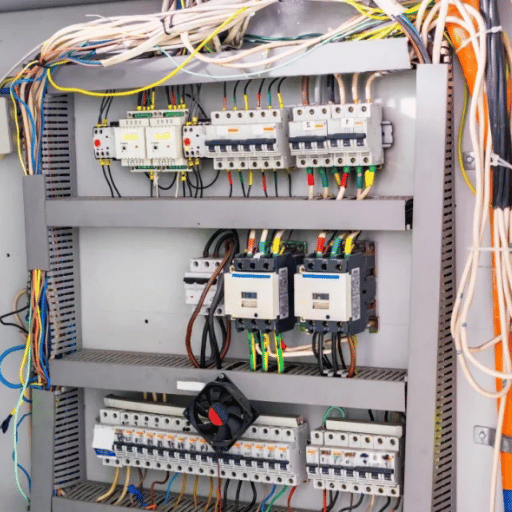
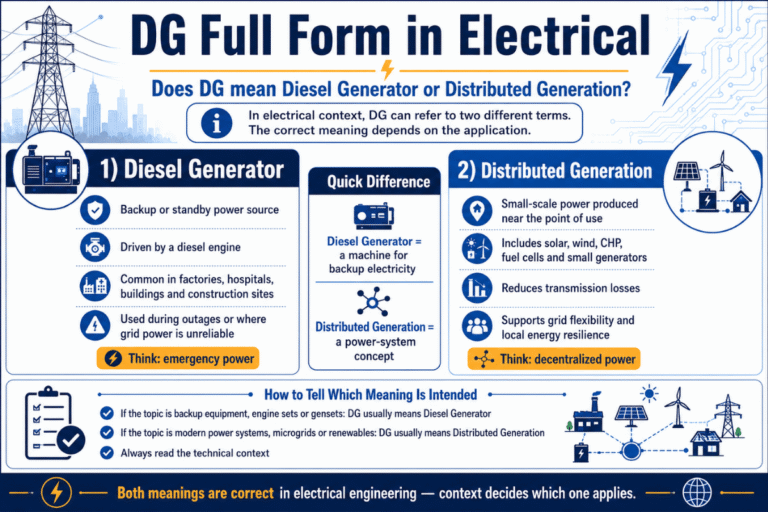
In electrical work, DP stands for Double Pole, a device with two poles (two contact sets) that switch two conductors at once. It’s the most common reading on a switchboard, used for double-pole switches, MCBs, isolators, RCCBs, and RCBOs. The second most common meaning is Distribution Panel (the board that splits incoming power into circuits), and two related-but-different fields use “DP” for DisplayPort and Differential Pressure.
Context decides which one applies: if the word sit next to a breaker, switch, or rating in amps, it’s Double Pole; if it names an enclosure or board location, it’s the Distribution Panel.
| “DP” stands for | Field | How to tell from context |
|---|---|---|
| Double Pole | Power wiring (primary) | Next to a switch, MCB, isolator or an amp rating (“32 A DP”) |
| Distribution Panel | Building power distribution | Names a board, enclosure or location (“the DP in the basement”) |
| DisplayPort | Electronics / IT | Next to a monitor, cable, or “DP port” |
| Differential Pressure | Instrumentation | Next to a transmitter, flow meter, or filter (“DP sensor”) |
| Dynamic Positioning | Marine / offshore | Next to a vessel, thruster, or station-keeping system |
Sourced from common usage observed across electrical sources and the IEC low-voltage standards, e.g. IEC 60947-3 for double-pole switches and isolators.
What Is a Double Pole (DP) Device?
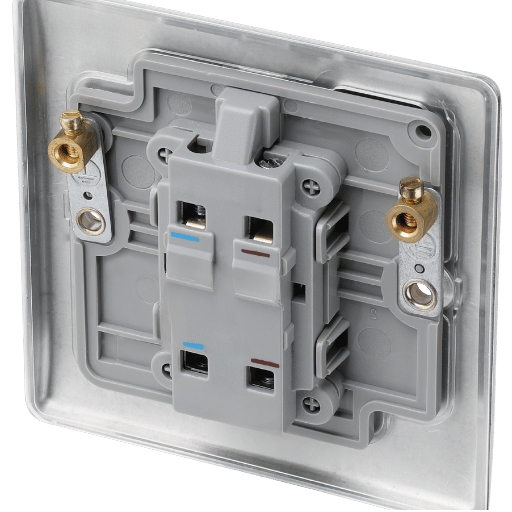
A double-pole device has two poles, two independent contact sets, ganged onto a single actuator so they make and break together. Because it switches two conductors at once, throwing the device leave no energized conductor at the load. A single-pole device switches one conductor and leave the other connected.
Why two conductors? Complete isolation. When a device breaks only the live and leave the neutral connected, the appliance can still sit at a dangerous potential if the neutral isn’t truly at zero volts. Field engineers put it bluntly: you cut the neutral because “neutral isn’t always zero”: on a floating-neutral supply, an IT earthing system, or a circuit wired with reversed polarity, the neutral can carry voltage. So what: a DP device gives you a verifiably dead circuit for service, not just a probably-dead one.
📐 Engineering Note
A “pole” is a separate switched current path; a “throw” is a position a pole can connect to. “Double pole” describes how many circuits the device controls (two), not how heavy-duty it is. One actuator drives two isolated contact sets, that is the whole idea. UK practice calls the lever positions “ways”; US practice talks in “poles.” Per IEC, isolating switches are covered by EN IEC 60947-3.
⚠️ Common misconception
“Double pole” does not always mean “switches the neutral.” On a US 240 V split-phase circuit, a two-pole (DP) breaker switches two hot legs (L1 and L2 on opposite phases), and no neutral at all — many 240 V loads such as a NEMA 6-20 or 6-30 receptacle have no neutral conductor. In UK/IEC fixed-appliance wiring, the same two-pole device usually switches live + neutral. The device is “two-pole” either way; what it disconnects depends on the system.
Poles vs Throws: the 9-Notation SP/DP/TP Switch Framework
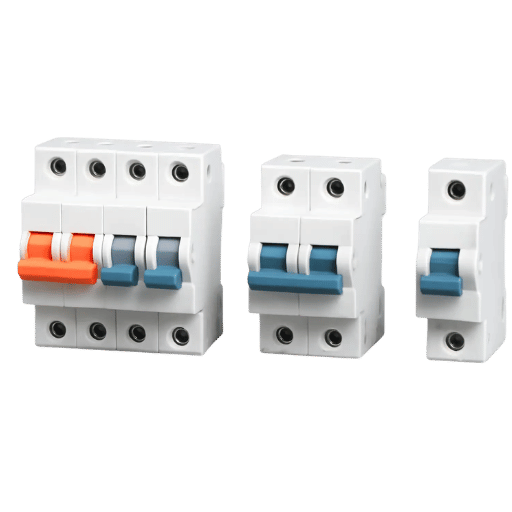
Switch and relay notation is built from two numbers: poles (how many separate circuits the device switches) and throws (how many positions each pole can connect to). Single, Double and Triple Pole (SP, DP, TP) set the first number; Single and Double Throw (ST, DT) set the second. Double pole sits in the middle of this family, two poles, usually one throw for a plain on/off isolator, or two throws for a changeover.
| Notation | Poles | Throws | Switched paths | Typical use |
|---|---|---|---|---|
| SPST | 1 | 1 | 1 on/off | Basic light switch |
| SPDT | 1 | 2 | 1 changeover | Two-way lighting; selector |
| SP3T | 1 | 3 | 1 of 3 | Mode/source selector |
| DPST | 2 | 1 | 2 on/off together | DP isolator; appliance disconnect |
| DPDT | 2 | 2 | 2 changeover | Polarity reversal; transfer switch |
| DP3T | 2 | 3 | 2 of 3 | Multi-source changeover |
| TPST (3PST) | 3 | 1 | 3 on/off together | Three-phase isolator |
| TPDT (3PDT) | 3 | 2 | 3 changeover | Three-phase changeover |
| 4PDT | 4 | 2 | 4 changeover | 3-phase + neutral transfer |
What does DPDT mean?
DPDT means Double Pole, Double Throw: two poles, each able to connect to one of two positions. It switches two circuits between two states at once, so it’s the standard choice for reversing the polarity of a DC motor, swapping a load between two sources, or building a manual transfer switch between mains and a generator.
For example, a 30 A DPDT toggle can flip both conductors of a two-wire feed from “source A” to “source B” in a single throw.
The Double-Pole Device Family
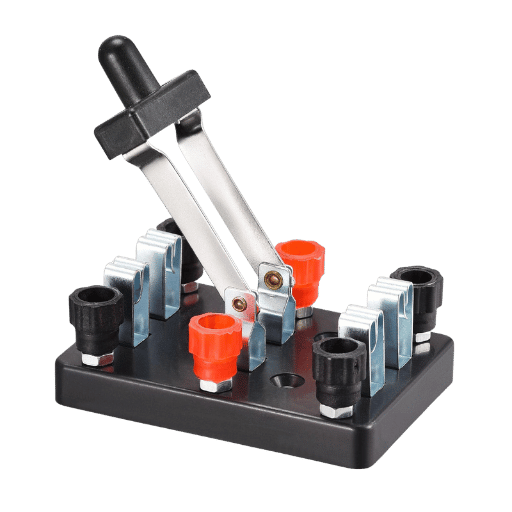
“Double pole” is a contact arrangement, not a single product, it appears across switches, breakers, isolators and relays, each adding a different protective function on top of the same two-pole framing. The roster below sorts the common ones by what they actually do.
| Device Type | Function | Protects against | Typical rating | Standard |
|---|---|---|---|---|
| DP Switch | Manual isolation only | Nothing (no fault response) | 16–45 A, 240 V | IEC 60947-3 |
| DP MCB | Isolation + auto trip | Overload, short circuit | 6–63 A, 6–10 kA, Type B/C/D | IEC 60898 |
| DP Isolator / Main Switch | Board main on/off | Nothing (isolation) | 63–100 A | IEC 60947-3 |
| DP RCCB | Earth-fault trip | Leakage / shock | 25–63 A, 30 mA | IEC 61008 |
| DP RCBO | Overcurrent + earth-fault | Overload, short, leakage | 6–40 A, 30 mA | IEC 61009-1 |
| DP Changeover / Transfer Switch | Source selection (mains/genset) | Back-feed | 40–125 A | IEC 60947-3 |
| DP Contactor | Remote load switching | Nothing (control) | 9–40 A, coil-driven | IEC 60947-4-1 |
| DPDT Relay | Two-circuit changeover signalling | Nothing (logic) | 5–16 A contacts | IEC 61810 |
| DP Switched Socket | Outlet with two-pole switch | Nothing (isolation) | 13–16 A | National wiring rules |
Standards per IEC low-voltage device series; ratings are typical product ranges.
What is the difference between a DP switch and a DP MCB?
A DP switch and a DP MCB look alike on a board, but they do opposite jobs. A DP switch is a manual isolator: you operate it by hand, it disconnects two conductors for safe service, and it does nothing when a fault occurs, it has no thermal or magnetic trip. A DP MCB is an automatic protective device: it carries the load current and trips by itself on overload (thermal) or short circuit (magnetic), then resets by hand.
In practice they are complementary, the isolator gives you a guaranteed-dead circuit to work on, while the MCB protects that circuit while it runs. Per the standards, isolating switches fall under IEC 60947-3 and household MCBs under IEC 60898.
Single Pole vs Double Pole: When Do You Actually Need DP?
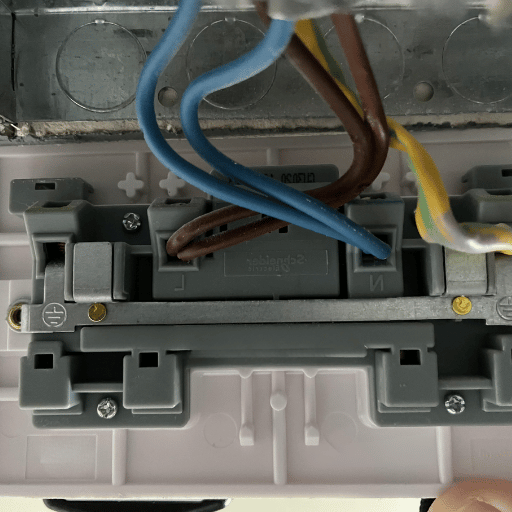
Single pole is cheaper and fine for most lighting and standard outlet circuits; double pole costs more but isolates both conductors. The decision isn’t about power alone, it’s about whether the neutral (or second hot) needs to be broken for safety, code, or fault containment.
✔ Double Pole — advantages
- Breaks both conductors, no live or floating neutral left at the load
- Required for many 240 V and fixed-appliance circuits
- Safe isolation for service of metal-cased equipment
⚠ Double Pole — limitations
- Higher unit cost and two module widths on the rail
- Overkill for a 120 V lighting branch with a solidly grounded neutral
- Doesn’t add protection on its own (a plain DP switch only isolates)
Neutral-Switching Decision Line
Use a double-pole device when:
- The load is 240 V split-phase (US) — a two-pole breaker switches both hots
- A fixed appliance need full isolation for service, water heater, geyser, oven, AC unit
- Supply polarity may be uncertain or the neutral may float (TT/IT systems, portable supplies)
- Two single-pole circuits share one neutral (a multi-wire branch circuit)
A single-pole device is enough for a standard home lighting or 120 V outlet branch on a reliably grounded neutral.
The shared-neutral case is the one DIYers get wrong. When two circuits share a single neutral, a multi-wire branch circuit, practitioners warn that the neutral can stay live from the other circuit even after you switch off “your” breaker. The fix is a two-pole breaker (or two single-pole breakers joined by a handle-tie) so both hot legs open together; under the US National Electrical Code (NFPA 70, Article 210.4), simultaneous disconnection of a multi-wire branch circuit is required for exactly this reason.
📐 Engineering Note
Code framing differs by region. Under IEC/UK practice, double-pole isolation is standard for fixed appliances, and the neutral is switched on TT or uncertain-polarity supplies. Under US/NEC practice (NFPA 70), 240 V loads use a two-pole breaker that switches two hot legs, and the grounded neutral is generally not switched. Same hardware, different conductor switched. A lockable double-pole isolator also gives the single, securable disconnection point that OSHA 1910.147 lockout/tagout depends on.
Is a DP switch required for an AC?
For a fixed air-conditioning unit, a double-pole isolator is the normal and often code-required choice. An AC condenser is a permanently connected, higher-current load, frequently on a 240 V circuit, and a maintenance technician need to be sure both conductors are dead before opening the unit.
A 20 A or 32 A DP isolator near the unit provides that guaranteed disconnection independent of the main board. A plug-in portable AC on a standard outlet doesn’t need a dedicated DP switch, its plug is the disconnect. Always confirm against your local wiring rules and the unit’s rating plate before selecting the device.
From Double Pole to Dual Channel: How DP Logic Scales to Machine Safety
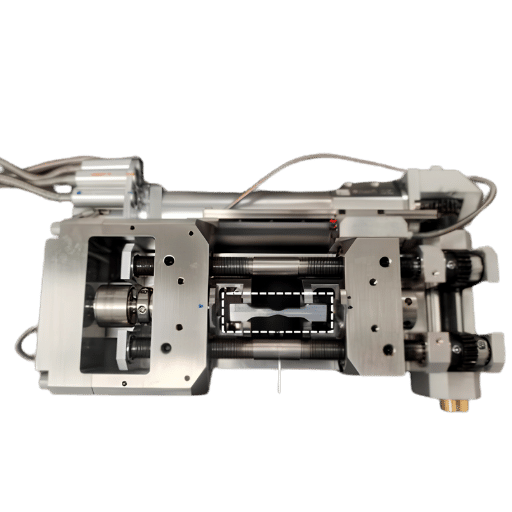
The double-pole idea, two contacts mechanically linked so they move together, is also the foundation of industrial machine-safety relays, where it grows into a Two-Poles-to-Two-Channels Scale-Up. A safety relay doesn’t just gang two contacts for convenience; it forces the contacts to be mechanically linked so a failure in one is detectable in the other, then runs two such channels in parallel for redundancy.
The component at the heart of this is the force-guided (positively driven) relay, defined by EN 50205 (carried forward today as IEC 61810-3): the normally-open and normally-closed contacts are mechanically tied so that if a normally-open contact welds shut, the linkage physically prevents the normally-closed contact from closing, and a monitoring circuit detects the discrepancy.
In our own SR-Series safety relay modules at CCH Sensing (QJKH), this principle is implemented as two independent relays with force-guided contacts per EN 50205, cross-channel diagnostics, a monitored start input, and a feedback input that checks the downstream contactor has actually dropped out. The result is a unit rated up to SIL 3 / PL e / Category 4 under EN ISO 13849-1, IEC 62061 and IEC 61508, with 24 V DC control, 6 A / 250 V AC (resistive) outputs, and a 22.5 mm housing, the industrial descendant of the humble two-pole switch.
“A standard relay lets its contacts move independently, so a welded contact can hide a dangerous failure. The whole point of a force-guided, dual-channel design is that the two contacts, and the two channels, cannot disagree without the monitoring circuit catching it. That is the difference between a relay that switches and a relay you can trust with a person’s hand.”
CCH Shanghai Sensing technical team
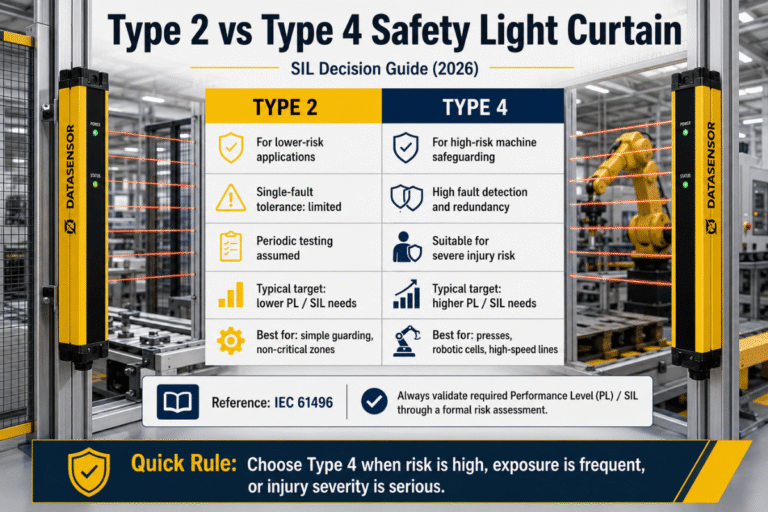
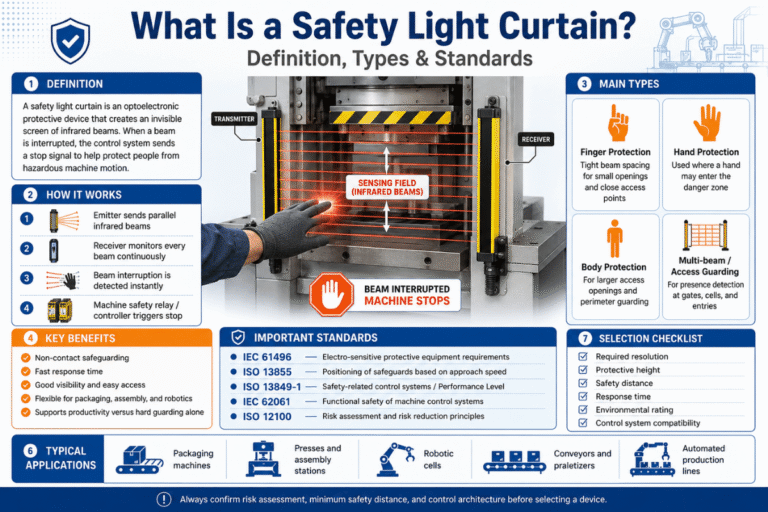
If you’re specifying that interface, an emergency stop, a light curtain safety relay wiring chain, or an emergency-stop safety relay circuit, the selection rules live in our safety relay modules range, and the safety relay module selector matches a model to your performance level. The governing framework is set out in the functional safety standards for machinery.
Industry Outlook: Double-Pole Protection Is Moving to RCBO and AFDD
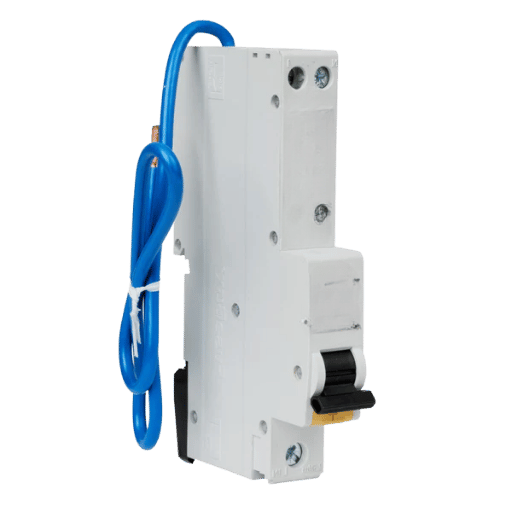
The plain double-pole MCB is being absorbed into smarter modules. Three shifts are visible through 2026:
- ✔ Consolidation into DP RCBOs. A double-pole RCBO combines overcurrent and earth-fault protection in one module under IEC 61009-1:2024, replacing a separate DP MCB plus RCD.
- ✔ AFDD adoption. Arc-fault detection devices are expanding into final circuits under the updated IEC 60364-4-42:2024, and the AFDD market is growing at roughly an 8% compound annual rate as wiring rules widen their required use.
- ✔ Integration and metering. Combined AFDD+RCBO modules and communicating (“smart”) breakers are reaching the market, putting arc-fault, leakage, overload and short-circuit protection, and remote status, into one two-pole unit.
Reader action: before swapping a DP MCB like-for-like, check whether your local wiring rules now call for a double-pole RCBO or an AFDD on that circuit, a same-rating replacement may no longer be code-compliant.
Frequently Asked Questions
Q: What is the full form of DP in an MCB?
View Answer
In an MCB, DP is the full form of Double Pole. A DP MCB is a two-pole miniature circuit breaker: it has two switched contacts that trip together, so it isolates and protects two conductors at once. Depending on the system, those two conductors are live + neutral or two 240 V hot legs. It is rated in amps (6–63 A) with a trip curve of Type B, C or D, under IEC 60898.
Q: What is a 32A DP switch?
View Answer
A 32A DP switch is a double-pole isolating switch rated to carry and disconnect 32 amps. It manually breaks two conductors at once, giving a fully dead circuit for service, but it offers no overload or short-circuit protection of its own. The 32 A rating suits higher-current fixed appliances such as cookers, water heaters and some air-conditioning units, and it is governed by IEC 60947-3 for isolating devices.
Q: What does DP mean on a circuit breaker?
View Answer
On a circuit breaker, DP means Double Pole, the breaker has two poles that trip and reset together. It is used where two conductors must be broken together: a 240 V split-phase load in US systems (where it switches two hot legs), or a fixed appliance in IEC systems (where it commonly switches live and neutral).
A double-pole breaker take two module widths on the DIN rail and is the standard choice for higher-power or two-conductor circuits, as opposed to a single-pole breaker that switches one conductor.
Q: What is the difference between SP, DP, and TP?
Read the Answer
SP, DP and TP describe how many poles, separate switched conductors, a device has. SP (Single Pole) switches one conductor, typically the live of a 120/230 V single-phase circuit such as a lighting branch. DP (Double Pole) switches two conductors together, used for 240 V split-phase loads or for live-plus-neutral isolation of fixed appliances. TP (Triple Pole) switches three conductors, used for the three line conductors of a three-phase supply.
A related TPN variant adds a switched neutral pole. The pole count rise with the number of conductors that must be broken at once, so the device matches the supply: one pole for single-phase live, two for split-phase or live-plus-neutral, three for three-phase.
Q: Is DP the same as a Distribution Panel?
View Answer
Not in most wiring contexts — there, DP means Double Pole. But “DP” can also abbreviate Distribution Panel (the board that splits power into circuits). Context decides: a device or rating means Double Pole; a board or location means Distribution Panel.
Q: What is an SPN breaker, and how is it different from DP?
Show Answer
SPN means Single Pole and Neutral: it protects only the live conductor but switches the neutral through a solid (unprotected) link. A DP (Double Pole) device protects or isolates both conductors. SPN is common in Indian-standard boards for economy; DP is chosen where both conductors need full isolation.
Q: SP vs DP socket, what’s the difference?
View Answer
An SP (single-pole) switched socket switches only the live conductor; a DP (double-pole) switched socket switches both the live and the neutral, so it isolates the appliance completely. DP sockets give safer isolation and are preferred for higher-load or wet-area outlets, such as those near a sink or fed from an outdoor supply.
Why We Wrote This
We build force-guided, dual-channel safety relay modules, so the two-pole, mechanically-linked-contact principle behind a DP switch is the same idea we certify to SIL 3 every day. We wrote this glossary to settle the questions our distribution partners actually ask, especially the one most explainers get wrong: a double-pole device doesn’t always switch the neutral. Reviewed by the CCH Shanghai Sensing technical team.
References & Sources
- EN IEC 60947-3:2021, Low-Voltage Switchgear: switches, disconnectors, switch-disconnectors — IEC / CENELEC
- EN IEC 60947-2:2025, Low-Voltage Circuit-Breakers — IEC / CENELEC
- IEC 61009-1:2024, RCBOs (residual current breakers with overcurrent protection) — IEC System of Conformity Assessment (IECEE)
- AFDD protection under IEC 60364-4-42:2024 — Electrical Installation Wiki
- Difference Between 1-Pole and 2-Pole Breakers, NEC & IEC — Electrical Technology
- US 2024/0274389 A1, Electrical protection devices and systems (mechanically coupled switching, 2024) — Google Patents
- DE 10 2012 004 843 A1, Safety relay circuit (redundant relays) — Google Patents
- OSHA 29 CFR 1910.147, The Control of Hazardous Energy (Lockout/Tagout) — U.S. Occupational Safety and Health Administration
- Device standards cited by designation — IEC 60898-1 (household miniature circuit-breakers), IEC 61008-1 (RCCBs), IEC 61810 (electromechanical relays), and IEC 60947-4-1 (contactors) — International Electrotechnical Commission