Get in touch with QJKH Company

Making a choice between a Type 2 or Type 4 safety light curtain isn’t often much of a free choice – the answer is dictated by the risk graph in ISO 13849-1, the IEC 61496-1 ESPE standard, and the machine-type specific Type-C standard for your application. This article unpacks how those standards align, explains why Type 4 hardware is around 15-30% pricier than Type 2 hardware but often cheaper over five years, and how to run the four-step selector that our application engineers run prospects through before providing a quote for an ENT Series light curtain. We end with the changes in regulation due to EU Machinery Regulation (EU) 2023/1230 coming 20 January 2027.
Reviewed against IEC 61496-1, ISO 13849-1:2023, ISO 13855:2024, IEC 62061, OSHA 29 CFR 1910.217, and EU Regulation 2023/1230(accessed 2026-05-06).
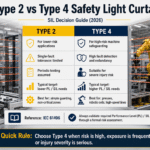
Quick Specs — Type 2 vs Type 4 at a glance
| Reference standard | IEC 61496-1 + IEC 61496-2 (ESPE / AOPDs) |
| Achievable safety level | Type 2 → SIL CL 1 / PL c · Type 4 → SIL CL 3 / PL e |
| PFHd window (per hour) | PL c: 1×10⁻⁶ – 3×10⁻⁶ · PL e: 1×10⁻⁸ – 1×10⁻⁷ |
| Self-diagnostics | Type 2: periodic self-test · Type 4: continuous dual-channel cross-check |
| Effective Aperture Angle | Type 2: ±5° · Type 4: ±2.5° |
| Resolution coverage | Type 2: hand 30 mm + body 40-70 mm · Type 4: finger 14 mm + hand 30 mm + body 40 mm |
| Hardware price index | Type 4 typically 15-30% above Type 2 for comparable height (industry guides) |
| Where it usually fits | Type 2: low-risk auxiliary equipment, perimeter assist · Type 4: power presses, robot cells, finger-detection at point of operation |
QJKH ENT Series specs referenced where applicable (response time 14 ms, IP65, protective height 160-1827 mm).
1. At a Glance — Type 2 vs Type 4 Side-by-Side
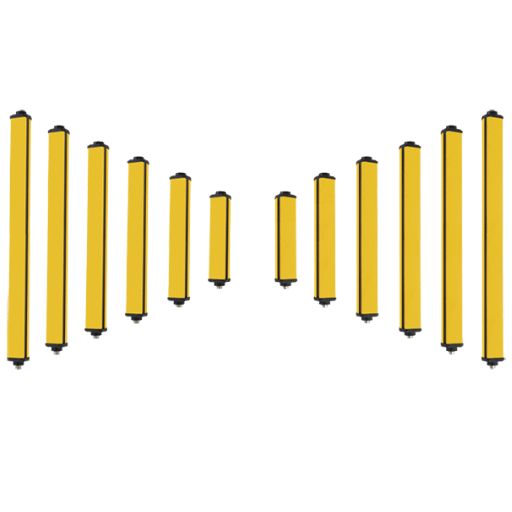
If time’s short, then here’s the comparison that most procurement decisions are based on. Application-specific selective choice of a safety device is ultimately limited by your machine’s Type-C standard — but this nine-row table explains why Type 4 dominates point-of-operation safety guarding while Type 2 light curtains offer cost savings on lower-risk perimeters. The difference between Type 2 and Type 4 reduces to two numbers: the achievable level of protection (PL c versus PL e) and the self-test cadence.
| Dimension | Type 2 Safety Light Curtain | Type 4 Safety Light Curtain |
|---|---|---|
| Reference clauses | IEC 61496-1 + -2, Type 2 requirements | IEC 61496-1 + -2, Type 4 requirements |
| SIL CL (IEC 62061) | SIL CL 1 | SIL CL 3 |
| PL (ISO 13849-1) | PL c | PL e |
| Internal architecture | Single-channel CPU + periodic self-test | Dual-channel CPU + continuous cross-check |
| Single-fault tolerance | Detects between scheduled tests | Detects continuously, fail-safe in milliseconds |
| Effective Aperture Angle | ±5° (higher optical short-circuit risk near reflective surfaces) | ±2.5° (tightened against optical short) |
| Detection resolution | Hand 30 mm + body ≥40 mm | Finger 14 mm + hand 30 mm + body 40 mm |
| Hardware cost premium | Baseline | +15-30% over Type 2 of comparable height |
| Typical role in safety architecture | Secondary or perimeter access on low-risk machinery | Primary point-of-operation guarding on high-risk machinery |
Type 3 (PL d / SIL CL 2) is recognised by IEC 61496-1/-2:2020 in a third middle category. Type 3 falls under IEC 61496-3, which covers active opto-electronic protective devices responding to diffuse reflection (AOPDDR) — more often safety laser scanners than photoelectric light curtains. For curtains, it remains a one-way choice between the faster, more reliable and more expensive Type 4 and the lower cost Type 2.
2. How IEC 61496 Defines Type 2 and Type 4
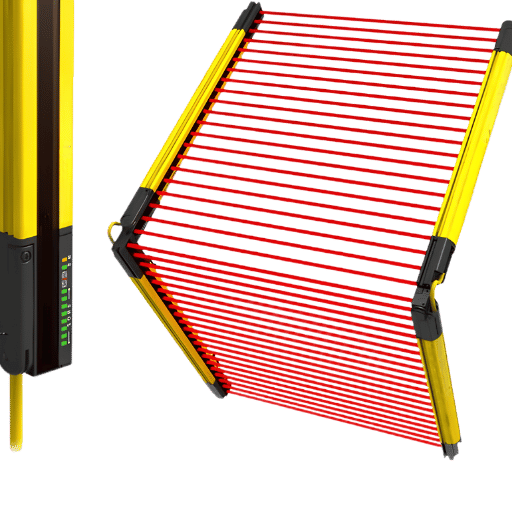
IEC 61496-1 is the main standard for electro-sensitive protective equipment (ESPE) — the broad class that every type of light curtain, light grid, and laser scanner falls under. It is the standard through which two principles determine Type classification: the measures taken to ensure a device fails safely if it detects a single-fault, and the frequency of the device’s self-tests. According to IEC 61496-1, the applicant defines the hazardous state and the factory standards for function and electrical implementation; the device is just one element of the overall safety function defined by the relevant machinery safety standards.
IEC 61496 itself is made up of four parts – taking all four into account stops even application-wide comparisons from sounding simplified marketing brochures. For completeness, the safety light grid family is also part of IEC 61496-2 – like light curtains, they use a hand- or finger-resolution grid of multiple closely spaced infrared transmitter and receiver pairs, and sense a break in the beam pattern. However, they only have 2-4 light beams widely spaced apart rather than a dense grid:
| IEC 61496 Part | Scope | Typical device |
|---|---|---|
| Part 1 | General requirements for all ESPE | Applies to every Type |
| Part 2 | Active opto-electronic protective devices (AOPDs) — emitter+receiver beam arrays | Photoelectric safety light curtains (Type 2 + Type 4) |
| Part 3 | AOPDs responsive to diffuse reflection (AOPDDR) — time-of-flight zone scanning | Safety laser scanners (Type 3) |
| Part 4 | Vision-based protective devices (VBPDs) — added in 2021 | Camera-based machine vision safety |
Within Part 2, Type 2 is designed to detect a single fault at the next scheduled self test (every 100-500 ms in modern setups), while Type 4 will leave the device in a safe state if a single fault occurs and not wait for the next test cycle. That difference necessitates the dual processor dual channel OSSD output architecture seen specified on every Type 4 datasheet; including QJKH’s ENT Series.
OSHA accepts IEC 61496 parts 1 and 2 (adopted in the United States as ANSI/UL 61496) as the standard-equivalence validation for safety light curtains used on regulated machinery, according to OSHA’s Machine Guarding eTool. Each of the standards’ certified curtains must be identified with their standard part number, the certification number, and the third party body that completed the type examination.
3. SIL & PL — What Type 2 (SIL CL 1 / PL c) and Type 4 (SIL CL 3 / PL e) Actually Mean
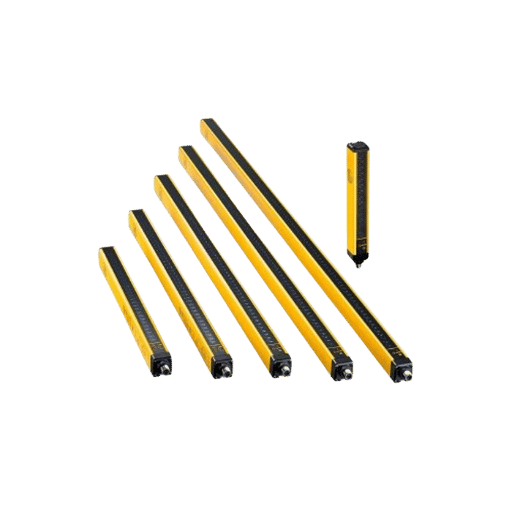
Most articles break down this layer into “SIL 2 vs SIL 3,” and that is the number one culprit for confusing a buyer. Type 2 light curtains are rated SIL CL 1 per IEC 62061- not SIL 2- and Type 4 light curtains are rated SIL CL 3. Why “CL” is important: it stands for claim limit, and it limits the maximum SIL a sub-system within an architecture specified by IEC 62061 can achieve. Bare “SIL” labels (without CL) are IEC 61508 / IEC 61511 function-level purity for the process industries, and “SIL CL” belongs to sub-systems of machinery. Interchanging the two is how purchasing consistently predicts wrong.
| Performance Level (ISO 13849-1) | SIL CL (IEC 62061) | PFHd window (per hour) | Light curtain Type that meets it |
|---|---|---|---|
| PL a | — | ≥10-5 to <10-4 | Below ESPE territory |
| PL b | SIL CL 1 | ≥3×10⁻⁶ to <10-5 | Type 2 (lower bound) |
| PL c | SIL CL 1 | ≥10-6 to <3×10⁻⁶ | Type 2 typical |
| PL d | SIL CL 2 | ≥10-7 to <10-6 | Type 3 laser scanners (per IEC 61496-3) |
| PL e | SIL CL 3 | ≥10-8 to <10-7 | Type 4 mandated for finger detection |
Translate the math: a PL e component – Type 4 in our world – averages up to one dangerous failure in 10 to 100 million operating hours. This means a properly maintained ENT Series Type 4 curtain experiences about one expected dangerous failure over an entire century of single-shift operation. PL c is one full order of magnitude less demanding. Whether that difference is relevant depends only upon the severity of the consequences of failure, which is what the next H2 explains.
For a side-by-side comparison in your own architecture our PL/SIL category mapper converts risk-graph output to the appropriate sub-system SIL CL using ISO 13849-1:2023 Annex A and IEC 62061 conversion tables.
4. Internal Architecture — Single CPU vs Dual CPU Self-Diagnostics
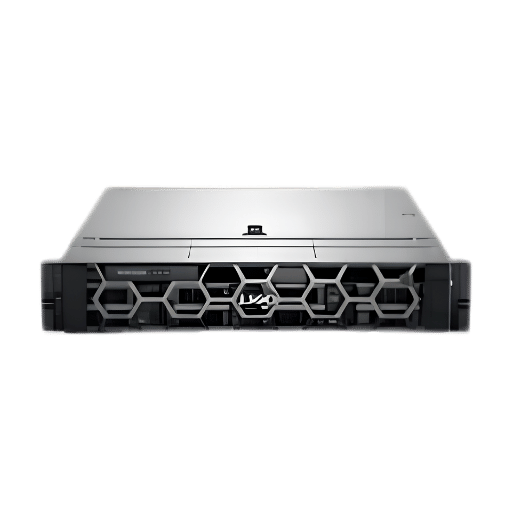
The difference in architecture is what physically gains the SIL CL difference. Type 2 curtains use a single processing channel with a self-test sequence at boot and regular intervals – vendors usually specify a 100-500 ms test period. If a beam circuit fails in between tests the curtain may continue to produce seemingly normal OSSD output until the next test detects the error. For applications where this reduction in risk is acceptable the delay is tolerable.
Type 4 curtains have sister emitter, receiver, and processing pathways, each of which use a separate processor to compare the images across each beam frame. Dual-channel OSSD outputs are wired so that any individual component failure causes both channels to fall to the safe state within the curtain’s declared response time — typically under 14 ms in current designs including the QJKH ENT Series. Extra Device Monitoring (EDM) provides further assurance by resetting the contactor feedback after every safety stop- a welded contactor is detected before the next start.
“A key component of a safety light curtain is the output signal switching devices (OSSDs), which are typically solid-state transistor components used to switch a safety relay to control the machinery causing the dangerous motion.”
— Derek Charge, Global Product Manager — Safety, Sensing & Industrial Components, Rockwell Automation (via A3 Industry Insights)
Diagnostic Coverage (DC) and Mean Time to Dangerous Failure (MTTFD) are the two ISO 13849-1 numbers that quantify the architectural gap. Type 2 designs typically deliver DC in the 60-90% band (“low” to “medium”), while Type 4 designs deliver DC ≥99% (“high”). MTTFD on a Type 4 ENT Series circuit sits in the ISO 13849-1 “high” category at 30-100 years per channel — the standard caps reportable MTTFD at 100 years even when component analysis suggests longer — which is what makes the PFHd math close out at PL e for the protected hazardous area within the broader machine safety system.
5. Risk Assessment — When Does the Standard Push You to Type 4?
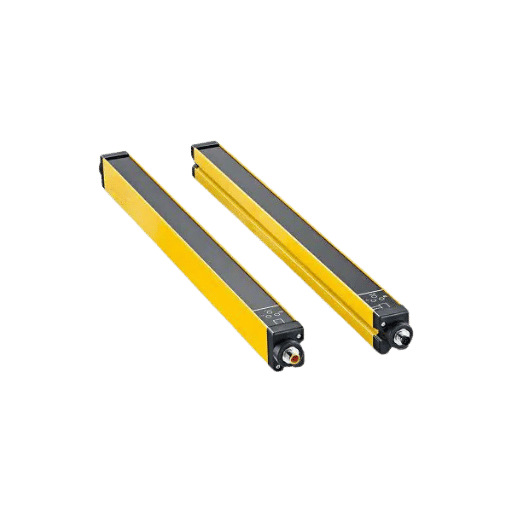
ISO 13849-1:2023 itself states without qualification that it does not specify the Performance Level needed for any specific application, that the decision is based on the risk assessment for the specific machine, and that “[i]f a particular application requires, ISO 13849-1:2023 specifies the application-specific Type-C standard (for example: ISO 14118 for unexpected start-up; ISO 12100 for general safety design principles).” What ISO 13849-1:2023 does specify is a risk-graph matrix Annex A that takes three axes and outputs a required PL.
Q: What does safety category 4 mean when referring to a light curtain?
“Category 4” is an integration standard describing the architecture of the safety-related portions of the control system, according to ISO 13849-1:2023, not the light curtain alone. A Type 4 light curtain is intended for use in a Category 4 / PL e arrangement: two OSSD outputs lead to dual safety-relay channels, and at the plug/end-to-end, the entire chain sensor-to-actuator is rated to the PFHd of the weakest link. When you select a Type 4 curtain, you haven’t necessarily selected a Category 4 arrangement or vice-versa; relays, voltaging, wiring topology, and EDM feedback must match.
Within the Annex A matrix you address three questions in order: severity (S), frequency/duration of exposure (F), and possibility of avoiding injury (P). Output from each combination (a-e) is a required PL; that PL may be used as your guidance for itepick light curtain or may be supplanted by application-specific Type-C standards.
“Light curtains, typically, are a Category 4, SIL 3, PLe safety element, used where a door or other barrier is not preferred for the application’s access needs, but they also can be accommodated within the stop-time limits of the hazard they are protecting.”
— Steve Lange, Technical Application Engineer, Schmersal Canada (via A3 Industry Insights, 2024)
The seemingly-driven risk table turns out to have answerable questions, but it is in fact a framework for agency assessment. Two engineers reviewing the same light curtain hazard can arrive at different scores, and ISO 13849-1:2023 clarifies that possibility of post-avoidance assessments may vary. A pragmatica assessment of a QJKH: if actual worst-case injury results in an irreversible loss (S2), exposure is more than a negligible chance (F2), and the operator cannot protect themselves in time (P2), the method makes the common-sense decision for you: PL e, and the light curtain equipment selection becomes Type 4-if architecture; Category 4.
6. Application Map — Where Each Type Fits
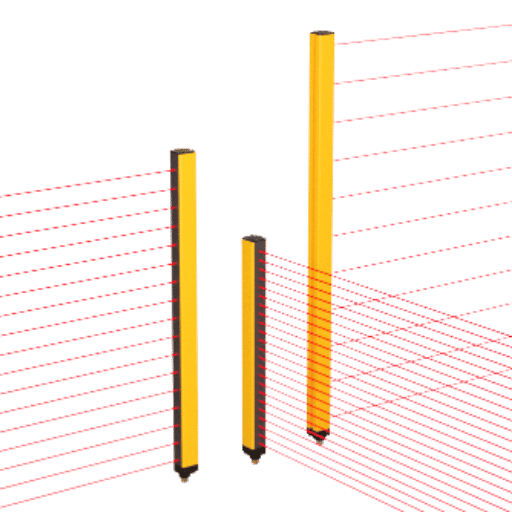
The rows below layout wherein each Type in the categories is implemented today in applications through mechanical, automation, and intralogistics design. Use of “PL e” refers to the risk graph more or less consistently, results in PL e for the application; alternative approaches (two-hand controls, pullback tension devices, fixed guards) are often regulator-accepted replacements.
| Application | Risk graph commonly maps to | Recommended Type |
|---|---|---|
| Mechanical power press, 14 mm finger detection (29 CFR 1910.217 PSDI mode) | PL e | Type 4 |
| Hydraulic press brake (ANSI B11.3-2022 — multiple safeguarding paths permitted) | PL d–e | Type 4 light curtain or two-hand / pullback / restraint |
| Robot cell perimeter access, ISO 10218 | PL d–e | Type 4 (perimeter mode) |
| Collaborative robot finger zone, ISO/TS 15066 | PL e | Type 4 + force-limited control |
| Packaging line muting (product pass-through) | PL d | Type 4 with muting safety light curtain arms |
| Palletising cell, EN 415 family | PL d | Type 2 or Type 4 depending on stop-time and reach analysis |
| AGV / AMR gateway access, EN ISO 3691-4 | PL d | Type 3 laser scanner primary; Type 2 curtain as gate-assist |
| Light curtains are suitable for conveyor pinch-point body protection at low energy | PL b–c | Type 2 |
The OSHA Machine Guarding eTool for power press brakes recognises four equivalent safeguarding methods — presence sensing devices (light curtains), two-hand controls, pullback devices, and restraint devices — and lets the employer’s risk assessment decide which is most workable. That is why the press-brake row above offers more than one path. ANSI B11.3-2022 governs the device-level requirements once a method is chosen.
7. Performance Specs Compared — Response Time, MTTFD, DC, Resolution
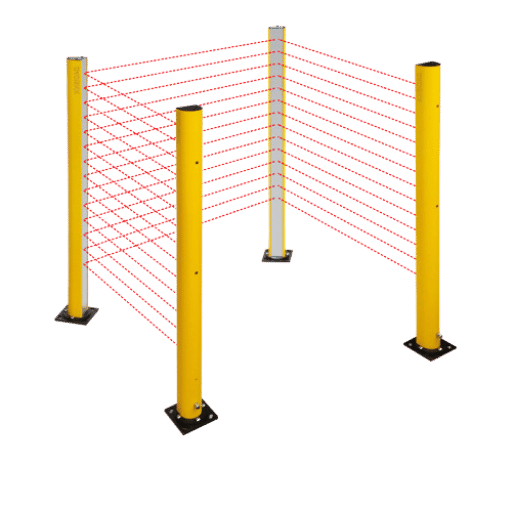
Once we have defined the Type, a set of 7 specs determine its actual compatibility to the machine. An example for the short ENT Series is shown on the right column.
| Spec | Type 2 typical | Type 4 typical | QJKH ENT Series |
|---|---|---|---|
| Response time | 15-30 ms | 8-20 ms | ≤14 ms |
| MTTFD per channel (ISO 13849-1 categories) | 10-30 years (medium) typical | 30-100 years (high) — capped at 100 | 30-100 years (high) |
| Diagnostic Coverage (DC) | 60-90% | ≥99% | ≥99% |
| Detection resolution | 30 mm hand / 40-70 mm body | 14 mm finger / 30 mm hand / 40 mm body | 14 / 30 / 40 mm selectable |
| Effective Aperture Angle | ±5° | ±2.5° | ±2.5° |
| Protective height range | 160-1800 mm | 160-1830 mm | 160-1827 mm in 150 mm steps |
| Ingress protection | IP54-IP65 | IP65-IP67 | IP65 standard, IP67 waterproof variant |
Industry biometric resolution conventions for hand and body protection — based upon IEC 61496-2 detection capability classes and ISO 13857 reach-through distances — translate detection resolution to body parts as follows: 14 mm for finger, 30 mm for hand, 70 mm for leg, >70 mm for entire body presence — values referenced against ISO 13857 reach distances and the curtain emitter and a receiver pair generating infrared light beams along the protected area. These values appear consistently on Type 4manufacturer datasheets including the QJKH ENT Series. Correct resolution is whatever body part could reasonably be expected to enter the protected zone most quickly – finger on a press, hand and torso on a robot cell perimeter, entire body on a palletiser.
Using a body resolution curtain ‘to save money’ on a finger-exposure risk is the kind of mismatch that results in an inspection citation.
8. Cost & Total Cost of Ownership
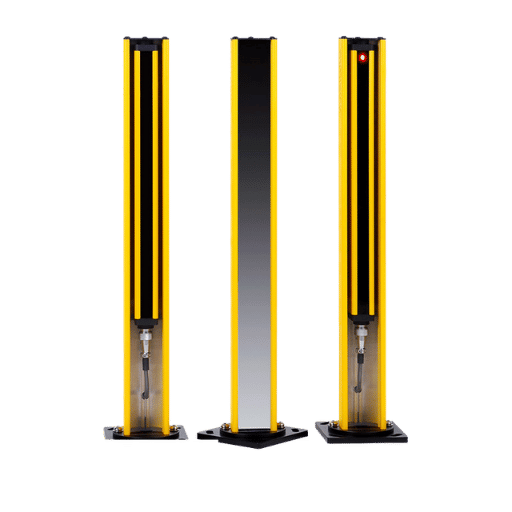
Q: What is the price of a Type 4 safety light curtain?
Industry guides listed before 2024 frequently reference a 15-30% hardware-premium for Type 4 as compared with a similar-height Type 2 curtain,though list pricing can vary significantly by manufacturer, number of beams, and connector choice, and newer integrated Type 4 incarnationsmay have closed much of that gap. In QJKH’s ENT Series catalogue, the delta between a Type 2 (SIL CL 1) and a Type 4 (SIL CL 3) implementation of the same recommended safety height is of that order. A five-year total cost of ownership far more helpful than list pricing usually reflects an opposite relationship.
It sets the stage for our high-throughput machine TCO of:
5-Year TCO Components — Light Curtain Sub-system
- The equipment – emitter + receiver + safety relay + cable. A baseline of Type 4 +15-30% on Type 2.
- Type 2 Nuisance-stop downtime. Type 2’s wider EAA increases the chance of an optical short circuit, with known downtime costs generally exceeding hardware costs within a year on high-throughput lines.
- Yearly functional safety audit – over- classified Type 2 in a Type 4-required application has audit findings that are more expensive to fix than the hardware delta.
- Insurance & OSHA / EU regulatory exposure – under-classified protective devices continue to be a reporting trend towards greater citation severity in machine guarding inspection documents.
- Replacement / mission time — both Types are typically rated for a 20-year mission time per ISO 13849-1, but the wider EAA on Type 2 often drives earlier replacement in dusty or reflective environments.
Customers can run their own numbers in our Type 2 vs Type 4 cost comparison calculator, which weights hardware delta against nuisance-stop frequency and an industry-typical labour rate.
9. Common Selection Mistakes from the Field
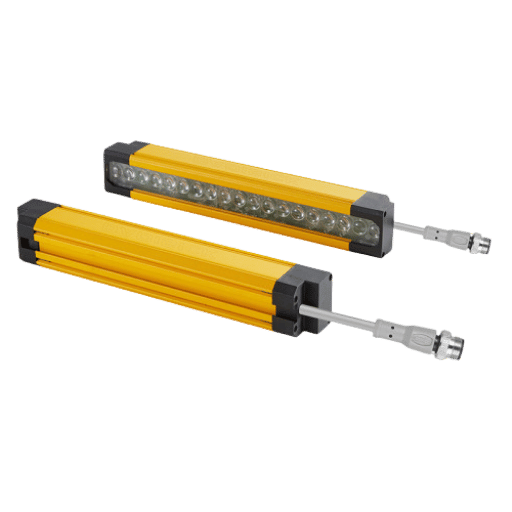
From two decades of application engineering and over fifty countries of ENT Series deployments, six selection patterns repeat. None are abstract — each has shown up in real RFQs and audit reports.
- ⚠️
1. Specifying Type 2 for a PL e application. Most common upstream mistake. A Type 2 curtain in a PL e architecture caps the achievable PL of the entire safety function at PL c, no matter what the downstream contactors are rated. Audit-finding magnet.
- 2. Leaving EDM wiring out of the guard/reach/relay race. Without EDM the safety function can take an old welded contactor as valid input; the published PFHd no longer applies. EDM is simply one additional return wire – removing it is a paperwork shortcut, not an engineering one.
- ⚠️
3. Skipping the ISO 13855:2024 minimum-distance calculation (or EN ISO 13855:2025 for EU markets). The general form
S = K × T + Cuses the hand-speed constantK = 2000 mm/sfor normal approach and total system response timeT; the additional distanceCdepends on detection capabilitydand approach direction per the standard’s positioning clauses (for normal approach with finger/hand resolution,C = 8 × (d − 14 mm)with an 850 mm fallback for body-only resolution). Mounting too close means the operator’s hand reaches the hazard before the curtain has stopped the machine. Use our safety distance calculator to avoid this. - 4. Using a body-resolution device rather than a finger/hand resolution device at the point of operation. OSHA is explicit in issuing its machine-guarding eTool – a 70 mm body resolution curtain misses a hand or finger entering at the wrong height. To reach into the point of operation with purpose, a finger-resolution device must be used; at best a hand-resolution device can only be verified at the top that it may or may not detect a worker at the bottom.
- ⚠️
5. Estimating stop time instead of measuring it. Total system response time
Tin the safety-distance formula must include the brake response, not the catalogue figure. We require a measured stop-time test on every commissioning; estimated values lose roughly half the safety margin by the time the brake actually wears. - 6. Misapplying muting to a Type 2 rated curtain. Industry users routinely issue nuisance trips on palletising lines. One failed muting retry of a Type 2 rated curtain on a palletising line translated to a Type 4 rated machine with correctly sequenced muting sensors. Muting should never compromise achievable PL requirements of the protected function.
10. Decision Framework — The 4-Step Risk-to-Type Selector
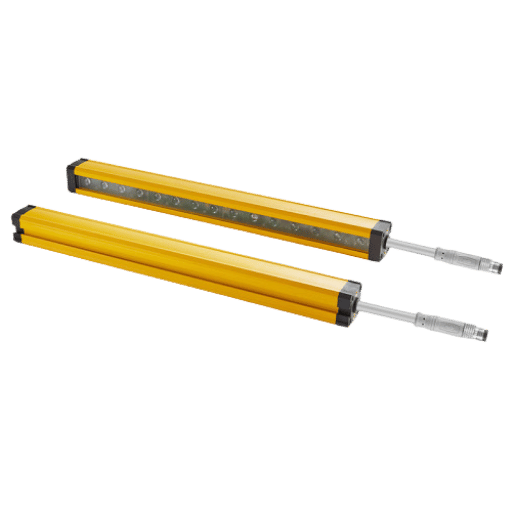
As a crew, our application engineers always run through this decision framework before quoting – first thoroughly adapting the ISO 13849-1 Annex A methodology; then including IEC 61496 Type indication as part of our finally including your machine’s Type-C standard or the relevant harmonised standard.
📐 The 4-Step Risk-to-Type Selector
- Step 1 – Severity (S). If the worst-case injury is reversible and treatable on-site, S1. If irreversible disability or death is plausible, S2.
- Step 2 – Frequency & duration of exposure (F). If the worker is exposed less than once per shift and only briefly, F1. If exposure is both often and lengthy, F2.
- Step 3 – Probability of avoidance (P). If the worker can almost certainly clear the work zone in time with the logic of the machine’s stop time, P1. If no matter how quick the worker is or unwieldy the object, avoidance will be unreliable then P2.
- Step 4 – Map onto required PL, then map onto Type. S1/F1/P1 PL b. S1/F2/P1 PL c. S2/F1/P1 PL c. S2/F1/P2 or S2/F2/P1 PL d. S2/F2/P2 PL e. PL b-c equivalently maps to Type 2 in the majority of photoelectric ESPE applications; PL d-e equivalently maps to Type 4. Any purchase order should be cross-checked with the standard Type-C specification for the machine before execution.
“In quote reviews we repeatedly insist customer score S, F, and P aloud first so none as you stumble in the catalogue; when two engineers reach the same Type independently it convinces us the choice stands for the next OSHA or TV safety audit too. Running through these four steps takes less than ten minutes; we have saved $3M in wrong-Type orders every year thanks to our methodology.”
— QJKH application engineering team, ENT Series RFQ workflow
Customers comparing specific ENT Series part numbers can shortcut Step 4 with the ENT model selector, which maps the four-step output directly to a recommended part number and beam count.
11. Industry Outlook — Where Light Curtain Standards Are Going (2025–2027)
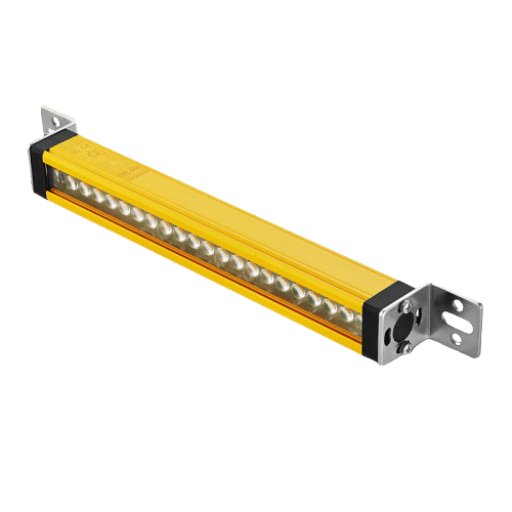
Four advances potentially useful to every safety engineer with a near-term horizon await. None of the four reduces the Type 2 / Type 4 boundary; all four reshape what a Type-2- or Type-4-compliant safety function will comprise around the curtain.
- EU Machinery Regulation (EU) 2023/1230 enters into force on 20 January 2027. It replaces the Machinery Directive 2006/42/EC [2] that was transposed into the national legislation in each Member State. The new regulation is directly applicable in all MS, widens the scope of components considered safety-related and defines the applicable criteria for AI related safety functions and cyber-security requirements.According to EU-OSHA’s regulation summary, any machinery placed on the EU market after that date must comply with the new conformity-assessment routes.
- ISO 13849- 1:2023 (4 th edition). The new edition of April 2023 (replacing i.e. ISO 13849-1:2015) was developed nearer it more nearly resembles IEC 62061.It has been out there from outside perspective identifies a calculation route that is known by some as a safe leeway – engineers writing and engines safety requirements spec should mention that discussion.
- ISO 13855:2024 replaces the 2010 version (published in E.U. territory as EN ISO 13855:2025). If your minimum-distance calculations still refer to ISO 13855:2010, modify the references; the 2010 version has been discontinued.
- Cobot integration with ISO/TS 15066. Force-optimized collaborative robots increasingly employ safety light curtains that survey the workplace with proximity or force sensors. Visual protective devices (IEC 61496-4) are still unapproved substitutes for ESPE for finger-detection work; regulatory-dependent light curtains ensure safety by default.
For OEMs getting gear ready for delivery to the EU in 2027, hands-on list of things to do is simple: re-baseline the risk assessment to ISO 13849-1:2023; do any necessary revision of minimum-distance calculations to ISO 13855:2024, and validate that the ESPE Type nominated still passes the new Annex III essential health and safety requirements.
Frequently Asked Questions
Q: Are light curtains considered machine guarding under OSHA 1910.212?
View Answer
Yes. OSHA 29 CFR 1910.212(a)(1) mandates “one or more methods of machine guarding” wherever a machine part, function or process being made, or repaired can cause injury to a worker. IEC 61496 family compatible safety light curtains meet this requirement once properly Typed for the application, mounted at the ISO 13855 minimum safety distance, and wired into the machine stop circuit.
Q: How do safety light curtains work?
View Answer
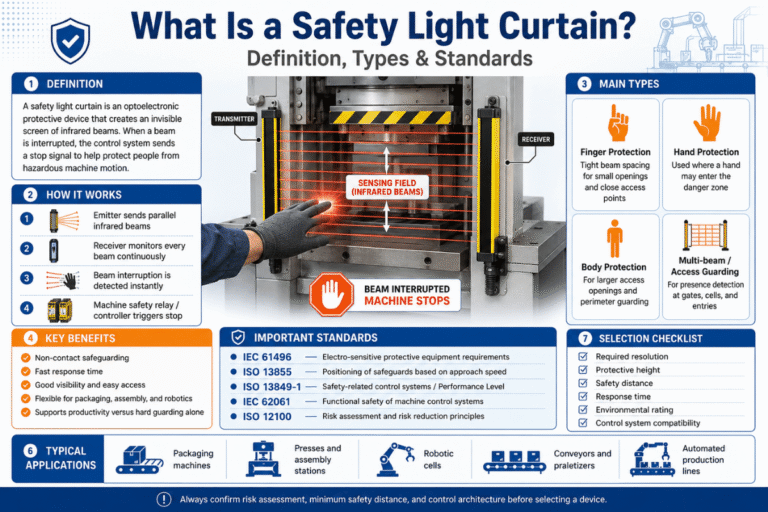
A transmitter unit projects an array of synchronised infra-red beams over the area to be protected. The receiver unit opposite the transmitter continuously checks each beam. If an object crosses one or more beams, the OSSD outputs of the curtain (Output Signal Switching Device) go to a safe state which disconnects power to the dangerous motion via a downstream safety relay.
Q: Can a Type 4 light curtain be used where Type 2 is required?
View Answer
Yes- a higher-Typed device is always able to supply a lower-Type requirement- and on common integrator practice will do this throughout the plant. Many integrators also standardise on Type 4 across the plant as additional extra cost is saving on spare inventory. Reverse direction should never be allowed: a Type 2 device can’t achieve a Type 4 requirement, because it caps the ceiling of the achievable PL of the safety function at PL c whatever sub-architecture it is plugged into.
Type 2 curtains are suitable if you’ve ended up with the risk graph in the PL b or PL cregions- most often with low-energy conveyor pinch points, light machinery perimeters, or auxiliary kit where stop-time calculations confirm the larger effective aperture angle won’t be an issue. The only reason not to over-Type is hardware cost; in finger-detection applications the resolution and EAA bandwith advantages also favour Type 4 even where the risk graph would dictate PL c a Type 2 is equal in cost to a Type 4..Light curtains do provide one other cost-saving factor over-s-Typing lines- they also give a common type number across all the fleets..Practical experience has however shown many fleet owners specify Type 4 everywhere, living with that 15-30% overcost as inventory simplifier, especially when finger or hand-hole and full body use of the same height light-certificate stations co-exist.
Q: Is Type 2 cheaper than Type 4?
View Answer
The hardware list price of a comparable protective height Type 2 is usually 15-30% below a Type 4 depending on the guide. Five-year total cost of ownership usually flips the picture once nuisance stops, audit findings, and replacement are added.
Q: How do you align safety light curtains?
View Answer
Begin by mounting both columns on rigid, parallel surfaces, facing each other with the emitter and receiver windows within the published optical alignment tolerance for the curtain. if the curtain has the alignment LEDs or laser pointer accessor, use that piece, tilt a column until all the beams are ‘aligned’, then lock the columns, and make sure the receiver shows a steady ‘all beams clear’ message. Commissioning is complete with a field re-test at the calculated minimum safety distance.
About This Analysis
This comparison was authored by the QJKH application engineering team, using over 20-years’ experience designing photo-electric safety sensors out of our Hangzhou plant, supplemented with on-site data from ENT Series projects in over fifty nations. The Type 2 / Type 4 terms cited here are based on IEC 61496-1 and -2, ISO 13849-1:2023, and ISO 13855:2024; the indicated regulatory references were last verified on 6 May 2026.
Request a Free Type 2 / Type 4 Sample & Quote →
References & Sources
- Presence Sensing Devices — Machine Guarding eTool — Occupational Safety and Health Administration (OSHA), U.S. Department of Labor
- Powered Press Brakes Safeguarding Methods — OSHA Machine Guarding eTool
- Regulation (EU) 2023/1230 — Machinery — European Agency for Safety and Health at Work (EU-OSHA)
- ISO 13849-1:2023 Safety of machinery — Safety-related parts of control systems — Part 1 — International Organization for Standardization
- ISO 13855:2024 Safety of machinery — Positioning of safeguards with respect to the approach speeds of parts of the human body — International Organization for Standardization
- IEC 61496-1:2020 Safety of machinery — Electro-sensitive protective equipment — Part 1: General requirements and tests — International Electrotechnical Commission
- Industry Insights: Light Curtains, Safety Applications and Emerging Trends — Association for Advancing Automation (A3), 2024
- ISO 13849-1 Analysis — Part 1: Start with Risk Assessment — Compliance inSight Consulting (Doug Nix)
Related Articles
- Type 4 Safety Light Curtain Guide — SIL3/PLe specification deep-dive
- Machine Guarding Light Curtain — Mounting, distance, and stop-time playbook
- Finger and Hand Protection Light Curtain — 14 mm and 30 mm resolution selection
- Muting Safety Light Curtain — Sequenced muting sensor design without compromising PL