Get in touch with QJKH Company

Quick Specs, Safety Light Curtain Selection at a Glance
| Resolution (detection capability) | 14 mm (finger) · 30 mm (hand) · 40 mm (arm) · 50 mm+ (body / perimeter) |
| Protective height | 160 mm – 1,827 mm (QJKH ENT Series) |
| Response time | ≤ 14 ms (QJKH ENT) — feeds the safety-distance calculation |
| Type / safety level | Type 2 (SIL2 / PLc) or Type 4 (SIL3 / PLe), per IEC 61496 |
| Environment | IP65 (IP67 / washdown variant) · −10 °C to +55 °C |
| Functions | Muting · blanking · external device monitoring (EDM) · restart interlock |
When a Safety Light Curtain Is the Right Safeguard (and When It Isn’t)
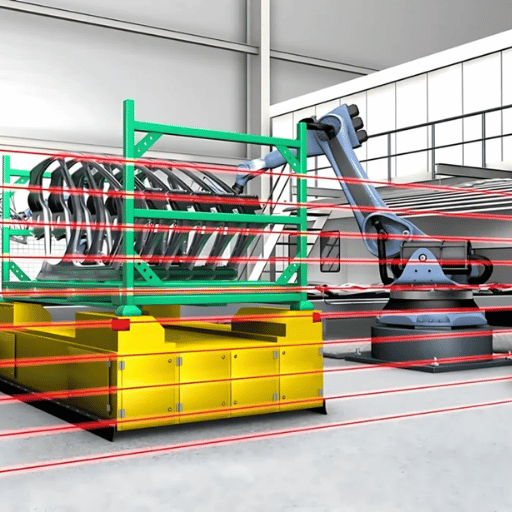
A safety light curtain is a non-contact presence-sensing safety device, an electro-sensitive protective equipment (ESPE) that creates an invisible screen of light beams across an opening. It earns its place when operators need frequent, fast access to a hazard and a physical guard would slow production or block visibility.
Safety light curtains offer that access without a physical barrier, which is their core advantage. It’s the wrong choice in several specific situations, and knowing those up front saves a failed risk assessment later.
Use the decision map below to confirm a light curtain fit before you spend time specifying one. Your first question is whether the hazardous machinery can actually be stopped on demand, if it can’t, no presence-sensing device is appropriate.
| Safeguard | Best when | Detects | Watch out for |
|---|---|---|---|
| Fixed hard guard | Rare access; ejected parts/sparks/coolant | Physical barrier | Slows changeover; removed = unguarded |
| Interlocked movable guard | Occasional access; full enclosure | Door open/closed | Wear on switches; defeat risk |
| Light curtain — Type 4 (14/30 mm) | Frequent hand access to point of operation | Finger / hand | Must clear ISO 13855 distance; no ejected parts |
| Light curtain — Type 2 (30 mm) | Lower-risk access, slight-injury outcome | Hand | Periodic self-test only; not for high-risk |
| Safety light grid (2–4 beam) | Perimeter / access guarding | Whole body | Coarse; not for finger/hand points |
| Single-beam barrier (AOPD) | Simple presence in a doorway | Body interruption | One plane only |
| Safety laser scanner | Irregular zones; mobile robots / AGVs | 2D area presence | SIL2/PLd ceiling; more setup |
| Two-hand control | Single-operator manual feed | Both hands occupied | Protects operator only, not bystanders |
Detection-capability and AOPD-use conditions per EN ISO 13855 and IEC 61496.
Two disqualifiers are easy to miss. First, a curtain must never guard a process that can eject parts, slag, or fluidthe beam stops a person reaching in, not a fragment flying out. Second, on mechanical power presses, the U.S. Occupational Safety and Health Administration is explicit: a presence-sensing device can’t be used on machines using full-revolution clutches (see the OSHA Machine Guarding eTool). Part-revolution clutch presses can use one, but only as a certified presence-sensing-device-initiation (PSDI) arrangement with its own rules, covered in the standards section below.
Are light curtains considered machine guarding?
Yes. OSHA recognizes presence-sensing safety devices as one accepted method of safeguarding the point of operation under 29 CFR 1910.212. OSHA calls them “non-separating” guards: they detect a person and command a stop rather than form a barrier. That distinction matters, because a non-separating guard only works if the machine reliably stops before the operator reaches the hazardous areawhich is exactly what the safety-distance calculation guarantees.
How a Light Curtain Works, Just Enough to Spec One
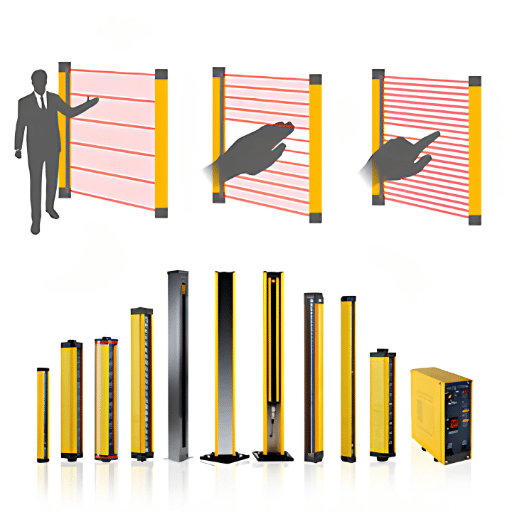
A safety light curtain has two units: an emitter that projects an array of synchronized infrared light beams, and a receiver tuned to recognize only those beams (which rejects ambient light). When a finger, hand, or body interrupts one or more beams, the receiver’s output signal switching devices (OSSDs) change state and signal the machine to stop.
That multi-beam optical principle behind the array is documented in industrial light-curtain sensor patents. That’s the whole working principle, the engineering is in the parameters around it.
How do safety light curtains work in a safety system?
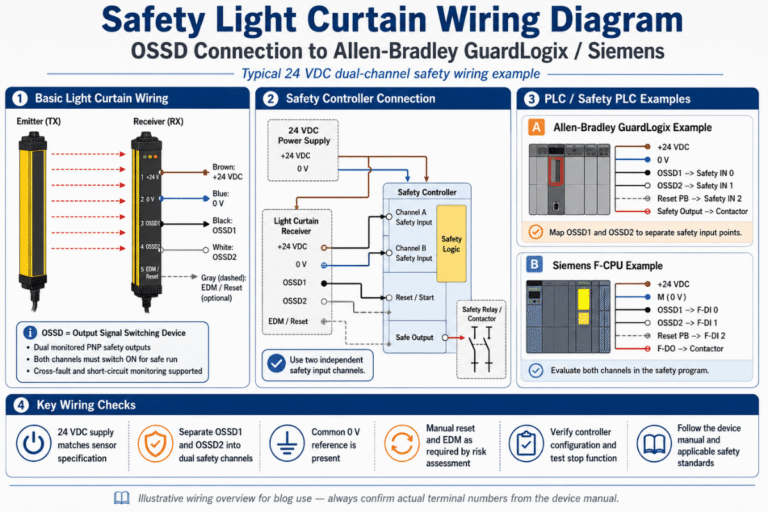
The curtain itself is a sensor; it doesn’t break the motor circuit. Its two OSSD outputs feed a safety relay or safety controller, which de-energizes the contactors that actually remove power. That sender-and-receiver-plus-controller chain is why “response time,” “safety distance,” and “restart interlock” all interact, and why five parameters decide whether a device is fit for your machine: resolution, protective height, safety distance, type/safety level, and functions. This guide takes them in that order.
Resolution & Protective Height: Sizing the Detection Field
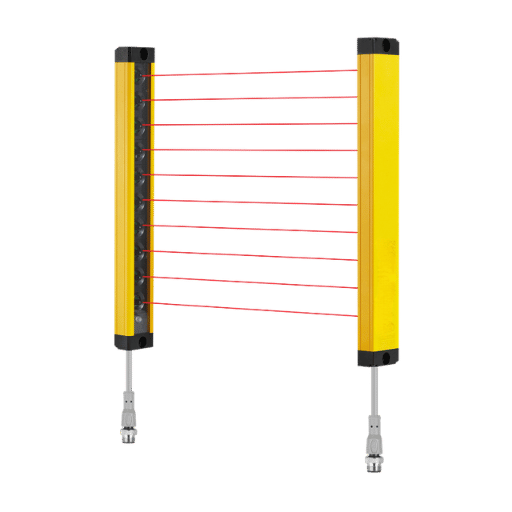
Resolution is the distance between two adjacent beams, the smallest object the curtain reliably detects anywhere in the field. It is the parameter that decides whether a device is rated for finger, hand, or body detection. EN ISO 13855 fixes the biometric values, and they map directly to a 30 mm or 14 mm choice.
| Resolution | Detects | Typical use | Distance effect (C) |
|---|---|---|---|
| 14 mm | Finger | Point of operation, close mounting | C = 0 mm (mount closest) |
| 30 mm | Hand | Hand-fed presses, robot cells | C = 128 mm |
| 40 mm | Arm | Larger access openings | C = 208 mm |
| ≥ 50 mm | Leg / body | Perimeter / access guarding | Uses body-approach formula |
| 2–4 beam grid | Whole body | Long-range perimeter (up to 60 m) | Fixed beam heights (500/800/900 mm) |
Biometric detection values per EN ISO 13855; C is the intrusion add-on used in the safety-distance formula.
Protective height is the span between the first and last beams (160 mm to 1,827 mm on the QJKH Type 4 safety light curtains), and it must be tall and wide enough that an operator can’t reach over, under, or around the field. Beam count follows from height and resolution, sized for a given opening so an operator cannot reach over or under the field. For finger and hand applications specifically, the deeper trade-offs come down to matching 14 mm resolution to the smallest part that must be detected.
Safety Distance: The ISO 13855 Calculation Most Buyers Get Wrong
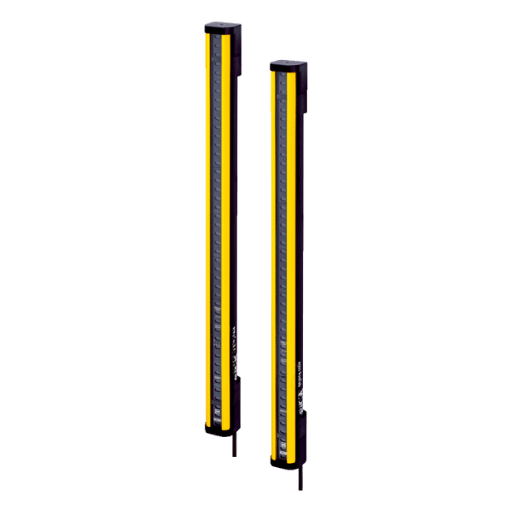
This is the step that separates a compliant installation from a dangerous one. Every light curtain must be mounted far enough from the hazard that the machine completes its stop before a hand that has just broken the beam can reach the moving part. Mount it too close and the curtain is decorative. Industry guidance is blunt about this being the most common field error, curtains are too often “set too close to the press.”
The international rule is ISO 13855, which gives the minimum safety distance as S = (K × T) + C, where S is the distance in mm, K is the human approach speed in mm/s, T is the total stopping time in seconds, and C is the intrusion add-on from resolution. For perpendicular approach with a 14–40 mm resolution curtain, that resolves to:
📐 Engineering Note — Worked Example
S = 2000 mm/s × T + 8 (d − 14) mm
Take a 30 mm hand-detection curtain on a press whose measured total stopping time is T = 0.30 s. The intrusion factor C = 8 × (30 − 14) = 128 mm. So S = (2000 × 0.30) + 128 = 728 mm. The same machine with a 14 mm finger curtain gives C = 0, so S = 600 mm, finer resolution actually lets you mount closer. Change nothing else but let the stop time drift to 0.45 s and the 30 mm curtain now needs 1,028 mm. The lesson: distance is driven by response time, not by buying “more beams.”
Note that “T” is not just the curtain’s reaction speed, it is a budget (more on that below), and it must be re-measured with a stop-time analysis whenever the machine changes. Run your own numbers with the ISO 13855 safety distance calculator before you drill a single mounting hole.
Type 2 vs Type 4, SIL & PL: Matching the Risk Assessment
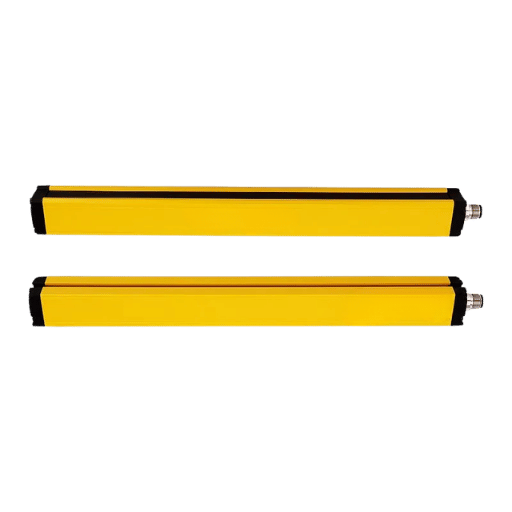
IEC 61496 defines two common type 4 and Type 2 ratings by how the device tests itself. A Type 2 curtain runs a periodic self-test and is accepted up to SIL2 / PLc for lower-risk work where an accident would cause a slight injury. A Type 4 curtain self-tests continuously with high fault tolerance and meets the highest levels, SIL3 / PLe, for high-risk points of operation. That choice is not about budget, it is the output of a risk assessment per ISO 12100, which sets the required performance level (PLr) or safety integrity level, and that in turn fixes the Type.
One subtlety buyers miss: the revision of IEC 61496-1 tightened where Type 2 devices may be used, so Type 2 is not simply “a cheaper Type 4” you can drop into a higher-risk application. We compare the two ratings in depth, including the pl and SIL mapping and where each saves money, in our dedicated Type 2 vs Type 4 safety light curtain comparison.
Functions That Change Throughput and Cost: Muting, Blanking, EDM, Cascading
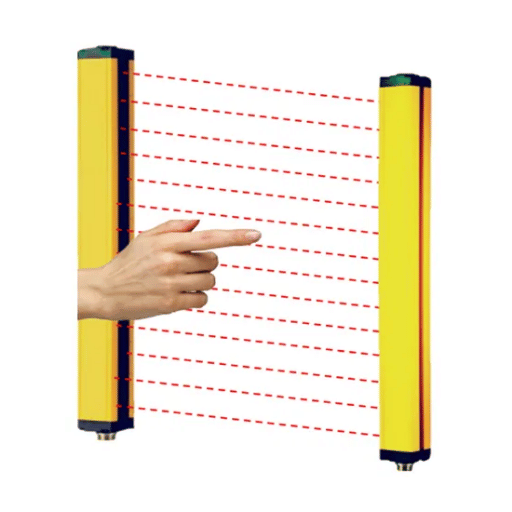
Once the safety basics are fixed, functions decide how well the curtain fit your process, and a few carry compliance strings.
- ✔Mutingtemporarily and automatically suspends the curtain so material (a pallet on a conveyor, say) can pass without a stop, using dedicated muting sensors that a person can’t trigger in the same sequence.
- ✔Blanking (fixed or floating) — ignores specific beams so a fixture or moving stock can sit in the field. Floating blanking effectively coarsens resolution.
- ✔External device monitoring (EDM)checks that the downstream contactors actually dropped out before allowing a restart; a core part of a fault-tolerant interlock.
- ✔Cascadingchains curtain pairs into L- or U-shaped fields. Each added pair adds response time (often a couple of milliseconds), which increases the required safety distance.
⚠️ Important — blanking is not allowed on PSDI presses
Muting and blanking are productivity features, but OSHA 29 CFR 1910.217(h)(9)(iv) states that “blanking of the sensing field is not permitted” when a light curtain is used in presence-sensing-device-initiation (PSDI) mode on a mechanical power press. Treat muting/blanking as ordinary-safeguarding features only, and check the PSDI rules before you enable them on a press. Our overview of muting safety light curtains covers correct muting-sensor geometry.
Wiring It to Actually Stop the Machine: OSSD, Safety Relays & Reaction Time

Because the curtain only change its OSSD outputs, it needs a device to convert that signal into removed power. As one field guide put it, “when the light curtain isn’t connected to a safety PLC, a dedicated safety relay interfaces the OSSD outputs to the machine’s stop circuit.” The chain is: curtain OSSDs → safety relay or safety controller → contactors that drop motor power, with EDM watching the contactors. Get the wiring right and the machine is a safety system; get it wrong and a green light means nothing.
📐 Engineering Note — the Stop-Time Reaction Budget
The “T” in the ISO 13855 formula is a sum, not a single number:
T = tcurtain (≤ 14 ms for the QJKH ENT receiver) + trelay/controller (≈ 10–20 ms) + tmachine stop (measured by stop-time analysis, usually the largest term). Every cascaded pair and every slow contactor adds to T, and every added millisecond pushes the curtain farther from the hazard. Budget T early; it is cheaper than re-mounting later.
How do you align and commission a safety light curtain?
Square the emitter and receiver first, measuring corner-to-corner in an X confirms they’re parallel, then use the built-in alignment indicators (LED endcaps or a signal-strength display) to peak the beam. After alignment, decide the reset behavior. An automatic reset is only safe where a person can’t stand inside the guarded zone; otherwise use a manual restart interlock.
This is the heart of a real-world blind spot: a vertical curtain stops someone entering the plane, but it may not detect a person who has already stepped past it. Where whole-body pass-through is possible, OSHA expects supplemental measures, a manual reset located outside the zone, double-acknowledgement, or horizontal area sensing, so a trapped worker can’t be “reset” back into danger. For the full wiring walk-through, see our safety relay module wiring guide.
Standards & Compliance: OSHA’s Mandate and the IEC/ISO Stack
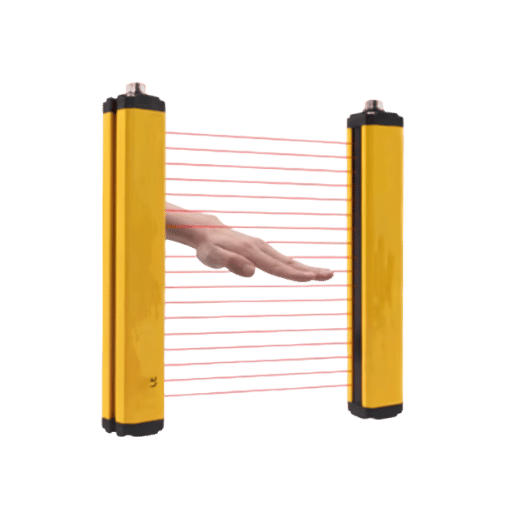
Machine safeguarding isn’t optional. OSHA’s Machine Guarding eTool estimates that machinery causes roughly 18,000 injuries a year (amputations, lacerations, crushing injuries and abrasions) plus more than 800 deaths, and the U.S. Bureau of Labor Statistics has put occupational amputations at on the order of 10,000 per year, the case for guarding the point of operation in the first place. Standards that govern a light curtain fall into a clear stack.
| Standard | Scope |
|---|---|
| OSHA 29 CFR 1910.212 | General duty to guard the point of operation (US) |
| OSHA 29 CFR 1910.217 | Mechanical power presses, incl. PSDI requirements |
| IEC 61496-1 / -2 (2020) | ESPE / AOPD product design, construction, test |
| ISO 13849-1 (2023) | Performance Level (PL) of the safety control system |
| IEC 62061 (2021) | SIL of the safety-related control system |
| ISO 13855 | Positioning / minimum safety distance |
| ANSI B11.19 | US performance criteria for safeguarding |
Sources: OSHA standards (osha.gov), IEC and ISO standards catalogs.
What standards apply to safety light curtains?
At device level, a curtain must meet IEC 61496-1 and -2 (the 2020 editions) as a Type 2 or Type 4 ESPE. At system level, the whole safety function, sensor, logic, and final switching, must be designed and validated to ISO 13849-1 (PL) or IEC 62061 (SIL); both were revised in 2021–2023 to reflect the state of the art.
Selecting a curtain with the right Type, response time, and OSSD outputs is necessary but not sufficient: the integrated safety function still has to be validated.
⚠️ PSDI is a special regulatory case
Using a light curtain to start a press cycle (PSDI) is governed by extra OSHA rules under 1910.217: no full-revolution clutches, no blanking, defined object sensitivity, test-rod checks, mandatory safety-distance verification, and third-party certification/validation. Treat PSDI as its own project, not a normal curtain install.
Cost Drivers and How to Vet a Supplier (Including OEM)
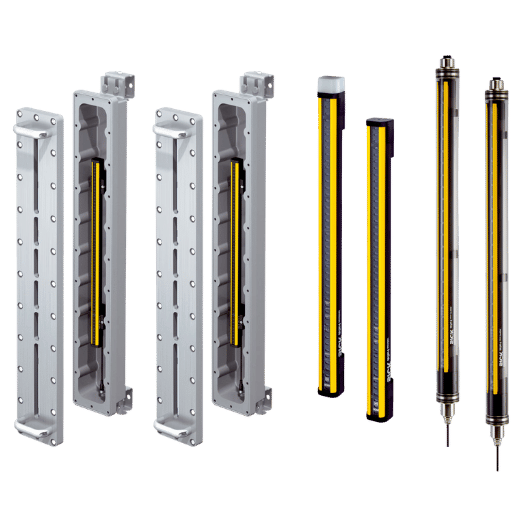
Light-curtain pricing is an open market, so rather than quote numbers that age badly, focus on what moves cost and how to judge a supplier. Cost climbs with finer resolution (more emitter/receiver pairs), taller protective height, Type 4 over Type 2, and added functions like muting or integral cascading. Note that the cheapest device is rarely the cheapest installation once you add the safety relay, mounting, and commissioning time.
Supplier Vetting Scorecard
- Third-party type-examination evidence (TÜV or equivalent) against IEC 61496-1/-2, ask for the certificate, not a claim.
- Published response time and resolution range you can put into the ISO 13855 formula.
- Application-engineering support for the safety-distance calculation and risk assessment.
- Lead time and spare-parts availability that match your maintenance window.
- For private-label or OEM needs, real customization (housing, beam spacing, firmware) — not relabeled stock.
This is the model behind QJKH: we design, build and certify our own ENT-series sensors at our factory rather than reselling other brands, run third-party testing to SIL3 / PLe, and provide the safety-distance calculation free during quotation. If you’re comparing the full product line, the QJKH safety light curtains page lays out the Type 2 and Type 4 options, and our machine-guarding ROI calculator frames the avoided-incident cost.
“A key component of a safety light curtain is the output signal switching devices (OSSDs), which are typically solid-state transistor components used to switch a safety relay to control the machinery causing the dangerous motion.”
Derek Charge, Global Product Manager for Safety, Rockwell Automation, in Automate.org’s light-curtain guide
Where Machine Safeguarding Is Heading (Cobots, AGVs & Smarter Curtains)
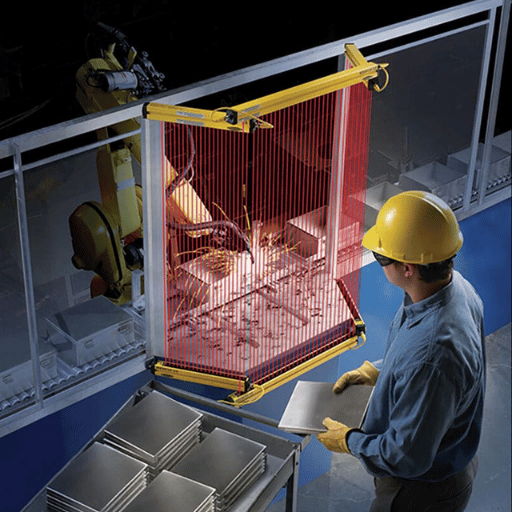
Market analysts size the global safety light curtain market at roughly USD 1.5–1.8 billion in 2025–2026, growing somewhere around 6 to 7 percent a year through the mid-2030s; the exact figures vary by research firm, but every estimate points the same direction, up, driven by factory automation and stricter machine-safety regulation. Three shifts matter for buyers specifying today:
- ✔Mixed sensing for mobile robots. Cobot and AGV cells increasingly pair curtains for fixed access with safety laser scanners for area presence, because each covers what the other can’t.
- ✔Smart diagnostics over IO-Link Safety. Plugging a curtain into an IO-Link Safety master (per IEC 61139-2) lets the controller configure, diagnose, and monitor it beam-by-beam, cutting downtime hunting for the blocked beam.
- ✔Safety on the network. CIP Safety over Ethernet/IP and similar protocols are bringing functional-safety devices into the plant data layer for predictive maintenance.
Action for 2026: when you write a curtain spec, ask whether the device supports diagnostic connectivity even if you don’t use it yet, retrofitting a “dumb” curtain into a smart line later is the expensive path.
Frequently Asked Questions
Q: What is the difference between a safety light curtain, a light grid, and a light barrier?
View Answer
All three are active opto-electronic protective devices, but they differ in beam count and purpose. A safety light curtain uses a dense, multi-beam array (14 mm or 30mm resolution) for point-of-operation finger and hand protection. A safety light grid uses just two to four beams spaced 300–500 mm apart for whole-body perimeter guarding. A safety light barrier is a single beam used for simple presence detection in a doorway or aisle. Choose by what you must detect.
Q: Do safety light curtains stop the machine by themselves?
View Answer
No. The curtain only switches its two OSSD outputs when a beam is broken. Those outputs must drive a safety relay or safety controller, which in turn de-energizes the contactors that remove power from the dangerous motion. A light curtain wired straight to a standard input — with no safety-rated logic in between — is not a compliant safeguard, regardless of how good the sensor is.
Q: What is the difference between a non-safety-rated area sensor and a safety light curtain?
View Answer
A standard photoelectric or area sensor detects presence but has no internal self-checking, no redundant channels, and no certified safety rating, so a single fault can leave it failing silently. A safety light curtain is built to IEC 61496 as a Type 2 or Type 4 device with self-testing and dual OSSD outputs, and it fails to a safe (stopped) state. Only the safety-rated device may be used to protect personnel.
Q: Can a safety light curtain be used outdoors or in washdown?
View Answer
Yes, with the right housing. Look for an IP67 or washdown-rated model and confirm the operating-temperature range (the QJKH ENT runs −10 °C to +55 °C). Match the IP rating to the real environment, then see our waterproof safety light curtain options.
Q: What are the maintenance and periodic-test requirements?
View Answer
Do a regular visual and functional check — confirm no physical damage, clean the optics, verify that the hazard can only be reached through the detection field, and test that interrupting a beam actually stops the machine. At least every six months, re-verify that nothing affecting the safety system has changed, that the OSSDs are correctly connected, and critically that the machine’s total response time has not crept above the value used in the original safety-distance calculation.
Q: How long do safety light curtains last, and what warranty applies?
View Answer
Because they are non-contact, light curtains typically outlast mechanical guard switches that wear with every cycle. Service life depends mainly on environment and mounting; warranty terms vary by manufacturer, so confirm them in writing along with spare-parts lead time.
Why We Wrote This
QJKH (CCH Shanghai Sensing Intelligence Technology) has designed and manufactured industrial safety sensors, including the ENT-series safety light curtains referenced above, since 2003, shipping to more than 50 countries. The selection logic, the ISO 13855 worked example, and the PSDI cautions in this guide reflect the safety-distance calculations our application engineers run for customers during quotation. Where this guide cites injury statistics or market figures, they come from the public sources listed below, not from our own files.
References & Sources
- 29 CFR 1910.212, General requirements for all machinesOccupational Safety and Health Administration
- 29 CFR 1910.217, Mechanical power presses (incl. PSDI)Occupational Safety and Health Administration
- Machine Guarding eToolOccupational Safety and Health Administration
- ISO 13855, Positioning of safeguards with respect to approach speedsInternational Organization for Standardization
- IEC 61496-1:2020, Electro-sensitive protective equipment, general requirementsInternational Electrotechnical Commission
- Light Curtains: Safety Applications & Emerging TrendsAssociation for Advancing Automation (A3)
- Case Studies of Robots and Automation as Health/Safety InterventionsPMC, National Library of Medicine
Related Articles
- Type 2 vs Type 4 Safety Light Curtainthe SIL/PL decision in depth
- ISO 13855 Safety Distance Calculator — run your own numbers