Get in touch with QJKH Company

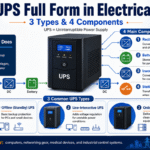
The UPS full form in electrical engineering is Uninterruptible Power Supply — a device with an internal battery that keeps connected equipment running the instant the main supply fail, sags, or spikes. In plain terms, a UPS is the bridge that holds power steady in the milliseconds before a generator start or until you can shut down safely.
Quick Specs, UPS at a Glance
| Full form | Uninterruptible Power Supply |
| Governing standard | IEC 62040 series (AC: 62040-3; DC: 62040-5-3) |
| Core components | 4 — rectifier/charger, battery, inverter, static transfer switch |
| Main types | 3 — standby (VFD), line-interactive (VI), online double-conversion (VFI) |
| Transfer time | 0 ms (online) to ~2–10 ms (standby) |
| Typical output | Regulated AC (DC-output UPS also exists, up to 1,500 V) |
What Is the Full Form of UPS in Electrical?
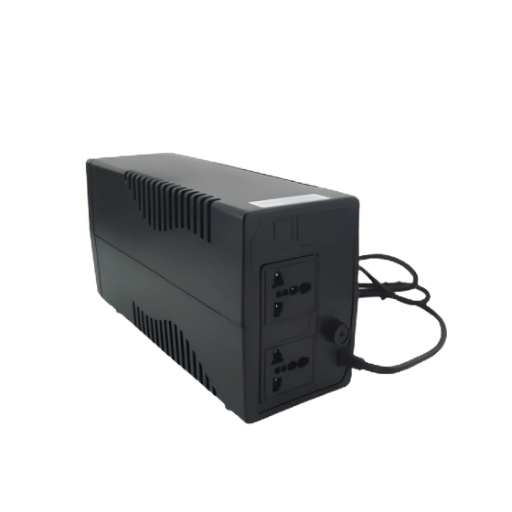
In electrical systems, UPS stands for Uninterruptible Power Supply — an apparatus that provide emergency power to a load the moment the input power source fails. The U.S. NIST defines it as “a device with an internal battery that allows connected devices to run for at least a short time when the primary power source is lost.” It isn’t the courier company of the same initials, in an electrical context, UPS always means uninterruptible power supply.
The U.S. Department of Energy is more precise. Its regulatory definition (10 CFR 430) calls a UPS a combination of “convertors, switches and energy storage devices, constituting a power system for maintaining continuity of load power in case of input power failure.” That single sentence names the four things inside every UPS.
The Power Problems a UPS Solves
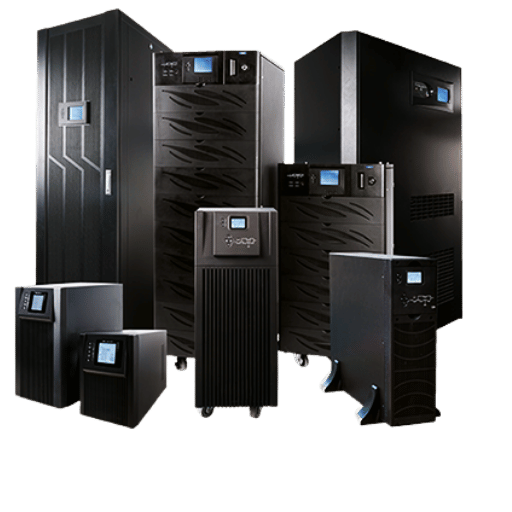
A UPS isn’t just a blackout battery. Drawing on stored battery power, it delivers continuous power and conditions the dirty electric power that the grid sends, guarding equipment between the power distribution panel and the load. According to the ENERGY STAR program run by the EPA, a UPS exists to “clean up dirty power” by correcting sags, surges, and frequency distortion, so it earns its keep even when the utility never fully fails.
Power-quality engineers group the disturbances a UPS guards against into a short list. A higher-grade UPS handles more of them:
- ✔ Power outage / blackout — total loss of mains from the power grid, the headline job.
- ✔ Sag & brownout — a sustained drop in voltage that stresses power supplies.
- ✔ Power surges & spikes — over-voltage events lasting microseconds to seconds.
- ✔ Electrical noise — high-frequency interference riding on the line.
- ✔ Frequency instability — drift away from 50/60 Hz, common on generators.
- ✔ Harmonic distortion — waveform departing from a clean sine.
How many of these a unit actually corrects depends on its topology, which the international standard pins down with a precise classification code.
The 4 Components of a UPS, the 4-Block UPS Power Path
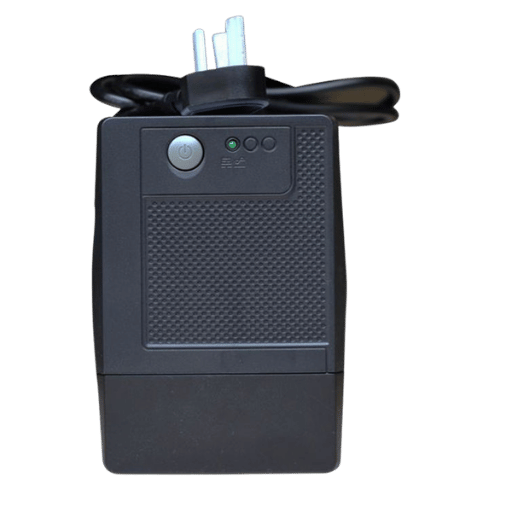
Every static UPS, from a 600 VA panel unit to a 1 MVA data-center frame, is built from the same four functional blocks. We call this the 4-Block UPS Power Path, and it’s confirmed by both the DOE definition above and multiple granted patents (for example USPTO US10116163B2).
| Block | Function | If it degrades |
|---|---|---|
| Rectifier / charger | Converts incoming AC to DC; keeps the battery charged. | Battery never fully recharges; runtime collapses. |
| Battery | Stores energy (VRLA or lithium-ion) for the outage window. | The single most common failure point; silent runtime loss. |
| Inverter | Converts DC back to a clean AC sine wave for the load. | Output waveform distorts; sensitive loads trip. |
| Static transfer switch | Routes the load between mains, inverter, and bypass. | Transfer fails; the load drops despite a charged battery. |
📐 Engineering Note
Battery chemistry sets the maintenance budget. Field guidance reports valve-regulated lead-acid (VRLA) cells last 3–5 years at 25 °C, while lithium-ion reaches 8–10 years with roughly one-third the mass. Heat is the killer: VRLA service life roughly halves for every 5 °C above 25 °C.
How Does a UPS Work?
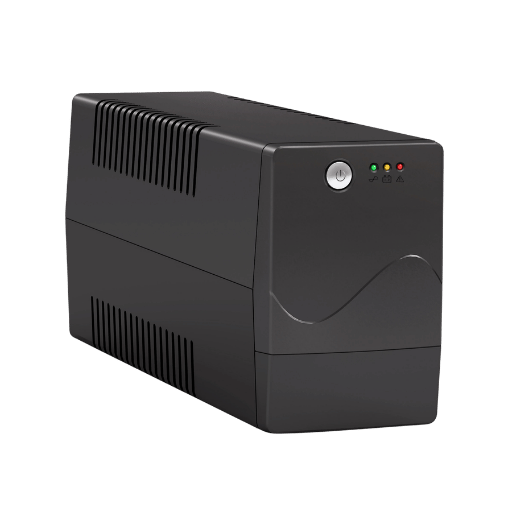
A UPS sits between the wall and your equipment. Under normal conditions it passes or reconditions mains power while trickle-charging the battery. When the input falls outside a set window, the unit draws on the battery through the inverter, instantly on an online unit, or after a brief switch on a standby unit, and reverts when the utility return.
Is a UPS AC or DC?
For the AC-output UPS defined by IEC 62040-3 — the type in offices, server rooms, and most factories, the answer is: input is AC, the internal bus and battery are DC, and the output is regulated AC. So the same unit is AC, then DC, then AC again.
The rectifier turns incoming AC into DC to feed the battery and inverter; the inverter turns that DC back into AC for the load. An online (double-conversion) unit performs this AC→DC→AC conversion continuously, so the battery is always in-line and the load never touches raw mains. Efficient designs hold the DC-bus voltage close to the battery’s full charge to cut conversion losses (USPTO US7560831B2). There is also a separate, standards-backed class of DC-output UPS covered by IEC 62040-5-3 (delivering DC up to 1,500 V), used where the load itself runs on DC, which matters for industrial control circuits.
The 3 Types of UPS, a 3-Topology UPS Decision Tree
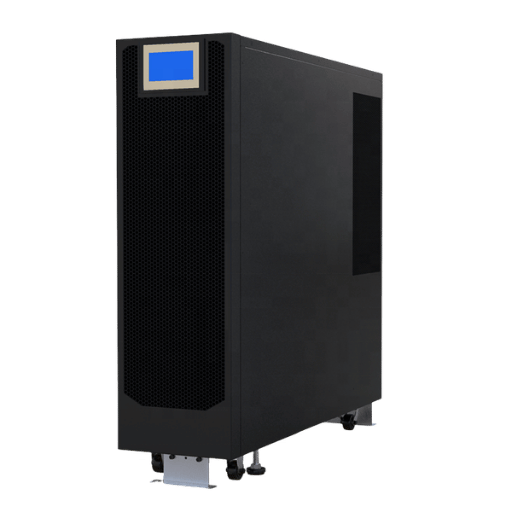
The three topologies, the standby UPS (also called the offline UPS), the line-interactive UPS, and the online UPS, carry marketing names, but the international standard classifies them more precisely. IEC 62040-3, which the DOE test-procedure rule adopts, uses an input-dependency code: VFD (Voltage and Frequency Dependent), VI (Voltage Independent), and VFI (Voltage and Frequency Independent). The standard itself recommends avoiding the loose term “online.” One caveat from the rule: the same physical unit can be classified VI or VFD depending on the manufacturer-declared input limits, so a topology label is test-condition dependent, not absolute.
| Dimension | Standby (offline) | Line-interactive | Online double-conversion |
|---|---|---|---|
| IEC 62040-3 class | VFD | VI | VFI |
| Transfer time | ~2–10 ms (up to 25 ms) | <4–6 ms | 0 ms |
| Voltage regulation | None | AVR ±8–15% | ±2–3% |
| Frequency regulation | No | No | Yes |
| Disturbances handled | 3 of 10 | 5 of 10 | All 10 |
| Typical efficiency | ~95%+ | 96–98% | 85–95% (eco up to 98%) |
| Typical VA range | <2 kVA | 0.5–6 kVA | 1 kVA–1 MVA+ |
| Power conditioning | Minimal | Partial | Full (regenerates sine) |
| Relative cost | Lowest | ~40% less than online | Highest |
| Best fit | Home / single PC | SMB / server room | Data center / mission-critical |
Efficiency figures synthesized from LBNL/DOE field data and IEC 62040-3 performance classes.
⚠️ Common misconception
“Online is the best in every dimension.” Not always. Granted patent US10116163B2 and field measurements from Lawrence Berkeley National Laboratory both show line-interactive efficiency (97–98%) is actually higher than online double-conversion (86–95%) — online buys total isolation at the cost of conversion losses. In a stable grid, line-interactive is often the lower-TCO default; online wins where the load is zero-tolerance or the power is severely distorted.
UPS vs Inverter vs Generator
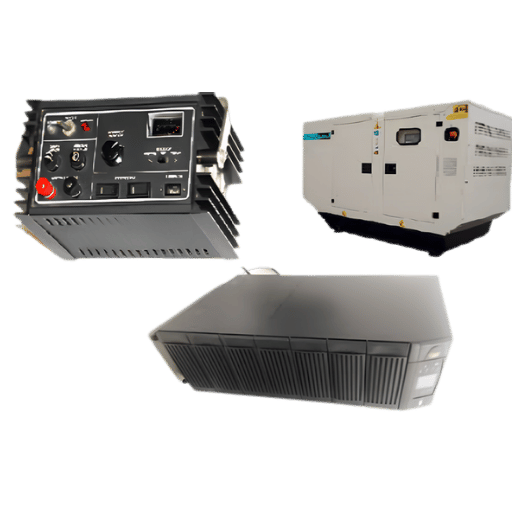
What’s the Difference Between a UPS and an Inverter?
An inverter only converts DC to AC; a UPS adds a charger, a battery, and an automatic transfer switch so it acts on its own the instant mains fails. A generator makes power but needs 10–20 seconds to start and stabilize. These are complementary roles, not interchangeable products, IEC 62909-1:2025 even formally excludes UPS from the grid-connected-converter category, confirming the UPS belongs to its own IEC 62040 family.
| Dimension | UPS | Inverter | Generator |
|---|---|---|---|
| Switchover | 0–10 ms | Seconds (manual/standalone) | 10–20 s start |
| Typical runtime | Minutes | Depends on battery | Hours–days (fuel) |
| Power conditioning | Yes (online) | Limited | No (raw output) |
| Energy source | Battery | External battery/DC | Fuel (diesel/gas) |
| Automatic on outage | Yes | Not inherently | Via ATS |
| Maintenance | Battery service | Low | High (fuel, engine) |
| Primary role | Bridge the gap | DC→AC conversion | Sustained backup |
| Governing standard | IEC 62040 | IEC 62109 (PV) etc. | ISO 8528 |
| Used together? | Yes — the UPS bridges the seconds before the generator carries the load; a single battery energy storage system (BESS) is now emerging to do both at hyperscale. | ||
So a generator doesn’t make a UPS optional. The generator’s start-up gap would drop the load without the UPS holding it, one granted patent (US9876354B2) even describes coordinating the two so the static switch ramps the generator in gradually while the inverter keeps feeding the load.
How to Size a UPS, the VA-to-Runtime Sizing Curve
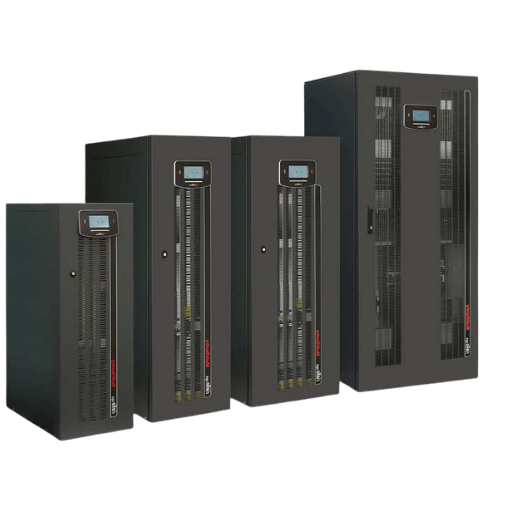
Sizing a UPS comes down to two independent numbers: the power rating that carries the load, and the battery capacity that sets runtime, plus one common error that conflates them. The power rating decides how much equipment can run at once; the battery decides for how long. Here is how to get both right for a real load.
What Size UPS Do I Need?
Sizing has two independent numbers, and conflating them is the classic mistake. VA (or watts) sets how much you can run at once; battery capacity sets how long. Start from the real load in watts, convert to VA using the power factor (VA = watts ÷ power factor), then add 20–30% headroom for inrush, growth, and battery aging. A 1,500 VA unit at 0.9 power factor supports about 1,350 W.
One nuance worth keeping: modern IT and electronic loads have a power factor near 0.9–1.0, so VA and watts are now close, the old “VA = watts × 1.6” rule of thumb is obsolete. But the DOE test procedure cautions that its near-unity reference load “aren’t fully representative of actual load equipment,” so for nonlinear or motor loads, keep a VA margin rather than assuming VA equals watts. Efficiency also falls once a unit runs below half load, so oversizing wastes energy (U.S. Department of Energy).
The VA-to-Runtime Sizing Curve — three checks
- Size the VA/W on measured load (all of it, I/O, relays, not just the power supplies), plus 20–30% headroom.
- Size the runtime on usable battery capacity after end-of-life derating, not nameplate.
- Avoid chronic oversizing, every topology is least efficient at 25–50% load, so an oversized unit quietly wastes energy.
Where UPS Systems Are Used
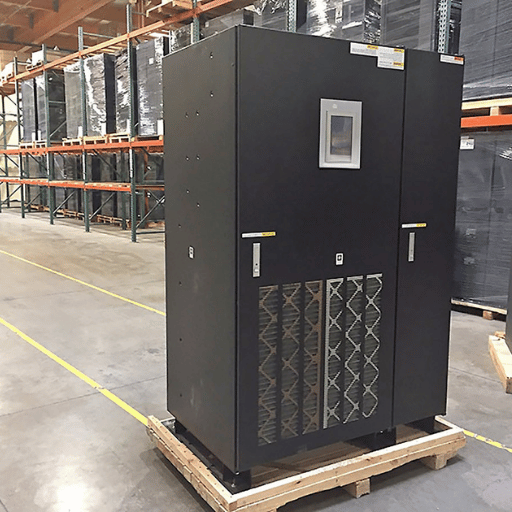
Anywhere a brief power gap is unacceptable. These uninterruptible power supplies, and the UPS batteries inside them, provide instant cover, and the largest UPS systems provide it for whole facilities. The biggest deployments are data centers, where the Uptime Institute attributes about 37% of outages to power issues and a sub-20 millisecond interruption can crash IT.
Runtime is provisioned by sector: hyperscale facilities hold 1–2 minutes, cloud and colocation around 5 minutes, and financial operations 10–15 minutes, just enough to ride to generator start or an orderly shutdown. Field studies of data-center power chains (Lawrence Berkeley National Laboratory) map where UPS losses and failure risks concentrate.
Beyond IT, UPS systems protect medical and life-support equipment, telecom, point-of-sale and ATMs, and industrial automation and machine-safety circuits, where the power requirements differ sharply from a server room.
UPS in Industrial Safety & Control Systems, the Safety-Circuit Power-Hold Window
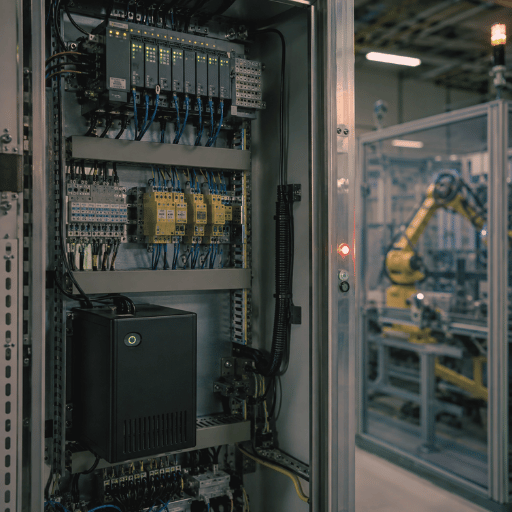
This is where a UPS specified like an office unit gets a factory into trouble, and where the question shifts from “keep it running” to “reach a defined safe state.” In safety-system integration, we frame the requirement as a Safety-Circuit Power-Hold Window: the minimum time a control-power source must hold a monitored safety function (a safety relay, an OSSD output, or a Category 3/4 architecture) long enough that the machine can complete an orderly safe stop on power loss, in line with IEC 60204-1 (the standard for electrical equipment of machines).
“For a safety circuit, the design question is never how long we can keep it powered, but how we guarantee a defined safe state when power goes. The control-power UPS only buys the milliseconds to seconds needed to get there.”
— CCH Shanghai Sensing (QJKH) functional-safety team
Three distinctions matter, and most consumer UPS guides skip all of them:
AC UPS vs DC UPS vs 24 VDC control power
Most control logic runs on 24 VDC. A DC-output UPS (IEC 62040-5-3) or a DIN-rail DC-UPS module is often more relevant than an AC unit, IOGP S-702 even specifies DC UPS for oil-and-gas procurement. A DC-UPS feeding a PLC’s high-speed card preserves encoder position; the same unit does nothing if the encoders run through a 3-phase VFD drive.
Continued operation is not always the safe state
On some equipment (induction furnaces are a classic case), engineers deliberately design reset-on-power-loss so the machine forces a full safety check before restart. Here a UPS that keeps everything energized would defeat the safety intent. The right move is to hold control power long enough to log and reach the defined safe state, not indefinitely.
📐 Engineering Note
A UPS installed inside an industrial control panel generally needs a UL 508 listing, and a computer-grade unit rated 0–40 °C with 5-year VRLA cells can lose its battery in under a year inside a 40–50 °C cabinet. Industrial wide-temperature UPS units (−30 to 65 °C, 10–12-year batteries) exist for exactly this reason. The 2025 amendment IEC 62040-1:2019/A2:2025 adds a drop test for “movable” UPS units of 18 kg or less, with EU implementation due by 31 March 2026.
If you’re matching control-power backup to safety relays and emergency-stop circuits, our safety relay modules and the guides on emergency-stop safety relays and functional safety standards cover how the safe-state logic is wired downstream of the power-hold window.
UPS Industry Outlook for 2026
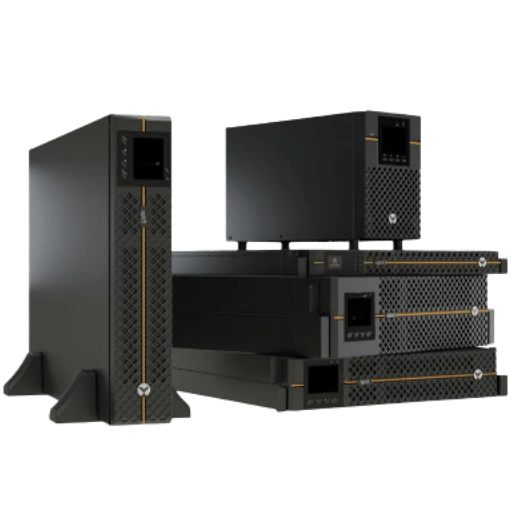
Two shifts define the current UPS market. First, chemistry: lithium-ion is rapidly displacing lead-acid in data-center UPS, trading a higher upfront price for a longer service life and lower lifetime cost, and industry coverage now describes it as the majority choice for new data-center deployments. Second, scale and demand: data-center electricity use is forecast to roughly double this decade as artificial-intelligence workloads grow (U.S. DOE / Lawrence Berkeley National Laboratory), which is pulling modular UPS architectures (added in 10–50 kVA increments) into the mainstream to keep units running near their efficient full-load point. The broader UPS market sits near USD 12–13 billion in 2025 and is widely forecast to grow at roughly 7–9% per year through the early 2030s.
The frontier worth watching: utility-scale battery energy storage (BESS) is beginning to absorb both the UPS bridging role and the generator’s sustained backup at hyperscale sites. For most industrial buyers in 2026, though, the practical action is simpler, verify which IEC 62040-3 class your application needs, confirm the battery chemistry and temperature rating fit the install, and right-size on real load.
Frequently Asked Questions
What is the full form of UPS in electrical?
View Answer
In electrical systems, UPS stands for Uninterruptible Power Supply. It is a device with an internal battery that delivers instant backup power to connected equipment the moment the main supply fails, sags, or spikes, then conditions that power until the grid returns or a generator takes over. The international standard for these systems is the IEC 62040 series, and in this context the acronym has nothing to do with the parcel courier of the same initials.
What are the 4 components of a UPS?
View Answer
A UPS has four functional blocks: a rectifier/charger that turns incoming AC into DC, the battery that stores energy, an inverter that converts DC back to clean AC, and a static transfer switch that routes the load. The DOE definition calls these convertors, switches, and energy-storage devices.
Is a UPS AC or DC?
View Answer
An AC-output UPS (IEC 62040-3) takes AC input, stores energy as DC on an internal bus and battery, and delivers regulated AC to the load. So it is both internally: AC in, DC in the middle, AC out. A separate class of DC-output UPS (IEC 62040-5-3) delivers DC directly, which suits 24 VDC industrial control loads.
What’s the difference between a UPS and a generator?
View Answer
A UPS responds in milliseconds from a battery but only lasts minutes; a generator needs 10 to 20 seconds to start and stabilise but then runs for hours on fuel. They are complementary, not interchangeable: the UPS bridges the start-up gap so the load never drops, and the generator then carries the extended outage. Sizing a generator without a UPS leaves a power gap that crashes sensitive equipment during every transfer.
How long does a UPS provide backup power?
View Answer
Usually only a few minutes, often five to fifteen at full load, which is enough to bridge to a generator start or allow a graceful shutdown. Actual runtime depends on battery capacity versus the real load drawn, not on the VA nameplate.
Can a UPS power industrial safety circuits?
View Answer
Yes, but with care. Industrial safety circuits — safety relays, OSSD outputs, Category 3/4 architectures — usually need control-power continuity only long enough to reach a defined safe state per IEC 60204-1, often via a 24 VDC UPS rather than an AC unit. A panel-mounted UPS needs a UL 508 listing and a cabinet-matched temperature rating; on some machines (induction furnaces, for example) a deliberate reset-on-power-loss is safer. Match the power-hold window to the safe-stop logic, not the longest runtime.
About This Analysis
QJKH (CCH Shanghai Sensing Intelligence Technology) builds machine-safety hardware, light curtains, laser scanners, and safety relay modules, not UPS units. We wrote this because the question we keep hearing from integrators is not “what does UPS stand for” but “how does backup power interact with a safety circuit,” and the standards answer (AC vs DC UPS, IEC 60204-1 safe states) is rarely explained in one place. The UPS specifications here are drawn from published standards and authorities; the safety-circuit guidance reflects our functional-safety integration work.
References & Sources
- Uninterruptible Power Supply, Glossary — NIST Computer Security Resource Center
- Uninterruptible Power Supplies (10 CFR 430) — U.S. Department of Energy
- Test Procedure for UPS, Final Rule (IEC 62040-3 Ed. 3.0) — U.S. DOE / Federal Register, 2024
- Reduce Energy Loss from UPS Systems — ENERGY STAR / U.S. EPA
- UPS: A Data Center Efficiency Opportunity (topology efficiency field data) — Lawrence Berkeley National Laboratory
- Power quality, load and efficiency in UPS installations — IEEE Xplore
- UPS DC load leveling, four-topology taxonomy (US10116163B2) — USPTO via Google Patents
Related Articles
- Safety Relay Modules — selecting and wiring control-power safety relays
- Emergency Stop Safety Relay — stop categories and monitored loops
- Light Curtain Safety Relay — OSSD-to-relay wiring
- Functional Safety Standards — IEC 61508 / ISO 13849 landscape
- ISO 13849 Performance Level — determining PL for a safety function