Get in touch with QJKH Company

A LiDAR sensor for a service robot has a different physics problem than a LiDAR on a warehouse forklift, and both face an easier physics problem than the LiDAR on a sidewalk delivery robot at high noon. Range, wide field of view, ambient-light immunity, vibration budget and safety class that matter depend on the robot class – not on the LiDAR vendor. This guide maps six typical LiDAR sensors for robotics across common robot classes to the spec envelope a LiDAR actually has to meet, then closes with a Robot-Type Model matri× you can use as a first-cut shortlist.
Since that doesn’t have a high impact on selection. Please see our technical companion piece: positioning LiDAR for AGV and AMR platforms
Quick Specs: What Each Robot Class Needs
| Robot Class | Range / FOV / Ambient Light |
| Indoor service | 5–15 m · 270°–360° · 3,000–10,000 lu× |
| Warehouse / logistics AMR | 20–30 m · 270° · 10,000 lu× (indoor LED) |
| Food delivery / sidewalk | 15–25 m · 270°–360° · ≥40,000 lu×, IP65+ |
| Inspection (slow-crawl) | 25–40 m · 270° · 0.1° angular resolution |
| Mower / outdoor mobile | 15–25 m · 270° · 100,000 lu×, IP65, vibration-rated |
Why Robot Type Drives LiDAR Selection
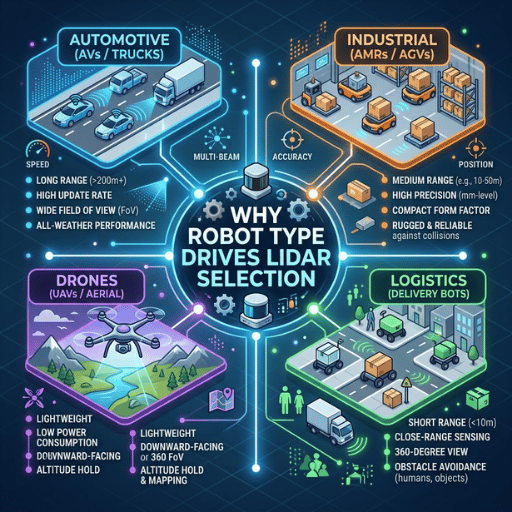
LiDAR sensor datasheets read as if every robot shares the same perception problem: emit light, measure return time, build a point cloud, feed it to SLAM — simultaneous localization and mapping. Light detection and ranging is the physics. Engineering job is very different. One hospital courier robot moving at 1.0 m/s through an indoor corridor, a sidewalk delivery robot dodging glare off wet concrete, and a substation inspection quadruped crawling at 0.3 m/s through a high-voltage yard need three very different LiDAR specifications—and the cost delta between the wrong choice and the right choice is measured in fleet-wide rework, not a sensor upgrade.
Three physical constraints flip time-of-flight LiDAR technology selection in indoor and outdoor environments:
- Ambient Light. Direct noonday sun on concrete can reach 100,000 lu×; typical industrial photoelectric sensors saturate at 3,000-5,000 lux (Rockwell Automation photoelectric application notes). A LiDAR performing perfectly indoors may become effectively blind outdoors without an ultra-high-lux specification.
- Payload and Speed. Need to detect 2 m in front of a 0.3 m/sec crawler to brake safely. Nearly 20 m in front of a 2.0 m/sec AMR. Range increases with speed, not with robot expense.
- Human proximity and safety class. A robot sharing space with unsupervised human beings requires at least an IEC 60825-1 Class 1 eye-safe laser, and in almost every jurisdiction a separate IEC 61496-1 safety-rated scanner for the stop function. Navigation LiDAR and safety scanner are NOT the same device.
The Three-Question LiDAR Selection Rule
- Is ambient light in excess of 40,000 lux at any time in the duty cycle? If yes, you’re an outdoor-capable LiDAR, not an indoor one—the sunlight immunity spec is the filter.
- Does the robot share floor space with untrained humans? If yes, you need a Class 1 navigation LiDAR and a separate IEC 61496-1 safety-rated scanner—the certification story is told in our guide to industrial safety laser scanners.
- Is speed payload above 0.3 m/sec 100 kg? If yes, you need a 20 m range, 25 Hz scan rate, and Dual-output (Ethernet point cloud + digital zone I/O).
Global service robot volumes put these stakes in context. According to the International Federation of Robotics reports that in 2023 professional service robot unit shipments totaled 205,000, a 30% YoY increase—and that in 2024 transportation and delivery robots shipments alone totaled 102,900. Every one of those units has at least one LiDAR. It’s cheaper to get the right class than waste engineering hours on a sensor decision.
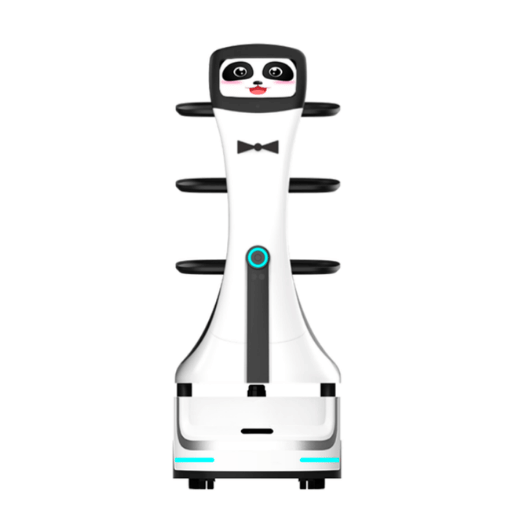
A LiDAR sensor for a service robot—the restaurant runner, the hotel concierge, the hospital courier, the reception bot—is first and foremost an indoor navigation sensor and second a safety layer. The robot evolves at 0.5-1.5 m/sec through corridors framed by walls, tables, wheelchairs and toddlers. That LiDAR unit must generate a clean 2D floor plan for navigation and mapping for realtime SLAM-mapping, issue obstacle flags with enought time for the compliance bumper to react, and happen to keep its composure when the sky light’s throws a 20,000 lux patch across the floor at 11:00 a.m.
Here is the spec envelope that fits the job:
- Range 5-15 m. Indoor corridors seldom extend past 20 meters between features; 15 meters affords the SLAM stack enough overlap to re-localize without wasting compute on distant walls.
- Horizontal FoV 270 or 360. Crowds arrive from any direction in a restaurant, so a narrow FOV is a liability.
- Angular resolution 0.3. If going less than 2 m/sec there is no reason to have 0.1 resolution it just creates processing overhead.
- Class 1 laser (IEC 60825-1:2014). Absolute requirement around people and children.
- 2D single-plane. A 3D point cloud of an empty corridor is wasted data.
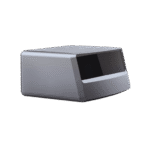
QJKH YB27-15CS and YB27-15CD fit comfortably in this envelope. Both provide 15 meters range at 0.3 angular resolution and 30 Hz scan rate, 270 horizontal FOV, Class 1 laser, and IP65 (overheating for indoors but excellent for the mixed case of a robot crossing an entrance vestibule in the rain). The 52 52 70 mm package makes all the difference—service robot chassis budgets are constrained, and a 30cm wide table runner cannot sustain a 10cm sensor cube on the front plate.
Do Service Robots Need 3D LiDAR?
Vast majority of indoor service applications demand 2D single-plane. Service robots move on level floors; the geometry they need to keep track of (walls, chair legs, shins, pallet corners) exists exclusively on a single horizontal plane 200-400mm above the ground level. A 3D solid-state sensor provides tens of thousands of points each scan describing an empty ceiling and the robot’s onboard compute must filter the data before feeding it into SLAM. Such filtering consumes Watts, generates heat and latency.
A high-performance 3D perception stack justifies itself on robots that must be taking into consideration overhead obstacles (dangling signage, floating lights, unlocking doors), multiple-floor transitions, or down-level dropoffs (such as down-going stairs). In those cases, a 2D horizontal lidar paired with a short-range RGB-D camera for the vertical dimension – which is exactly how most commercial indoor service robots ship these days, despite the push to climb-the-ladder 3D – kinematics. A hodgepodge of discussion of sensor fusion and when 2D LiDAR is sufficient exists at the 2D LiDAR versus 3D LiDAR trade-offs for mobile robot navigation.
Logistics and Warehouse Robots: Mid-Speed Transport
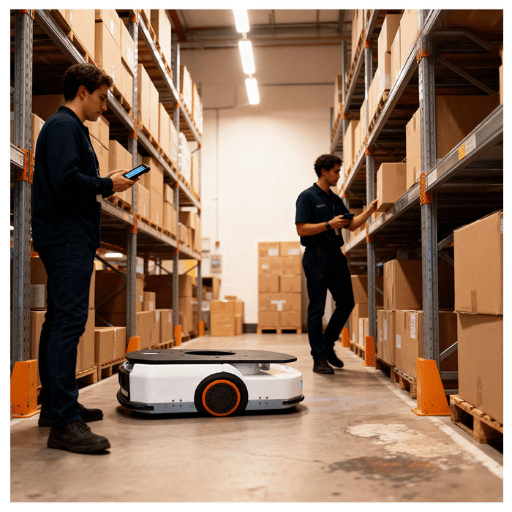
LIDAR for a logistics robot and the LIDAR for a warehousing robot live in the same design space. Today’s autonomous mobile robots build up spatial awareness from digital lidar point clouds feeding SLAM. An autonomous mobile robot ferrying totes from just-in-time station to packout conveyor, a high-precision pallet shuttle hauling 800 kg up and down the reserve rack and dockdoor, a case-pick autonomous mobile robot wandering aisles lined with mezzanine structures – the three founding constraints of warehouse automation – 15-25 m aisle lengths, 1.5-2 m/s travel speeds, and the single sensor that can run both SLAM navigation and fast safety zone switching – all demand.
Spec envelope:
- Range 20-30 m. Aisle length + margin for simultaneous localization and mapping (SLAM) re-localization in unstructured rack aisles.
- Scan rate 25 Hz. A robot traveling at 2m/s has a travel of 80mm per scan at 25Hz – perfectly acceptable for zone-stop decisions.
- Angular resolution 0.1-0.25. Clean edge detection is critical in short halts caused by pallet edges, rack upright bases, unexpected floor obstacles.
- Dual output. Ethernet UDP for the full point cloud + digital I/O (PNP/NPN) for the zone-stop layer, from a single sensor.
- IP65 minimum. Dust levels in warehousing are killers, and condensation on a dock-door approach can be anticipated.
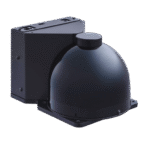
QJKH YB27-25HD hits all five. It delivers 25m range, 0.1 angular resolution at 25Hz for the measurement channel, 0.3 at 30Hz for obstacle detection, and Dual output on the same unit so the controller can consume an Ethernet point cloud for SLAM and a physical wire digital signal for the zone-stop layer without adding a second sensor to the fleet. For fleets that need a little more headroom, the YB27-35HD extends range to 35m without losing the Dual-output pattern. This “single SKU, two jobs” pattern is the principle reason that warehouse teams repeatedly consolidate their sensor BOM around the YB27-25HD / YB27-35HD pair – it takes a two-sensor architecture (nav LIDAR plus zone scanner) and reduces it to one.
📐 Engineering NoteOptional obstacle-avoidance models (YB27) support 16 user-definable zone groups that switch via four external inputs. This enables a warehouse AMR to swap its warning field and protective field shape as required during operation – e.g. shrink the warning zone during a tight turn in a picking aisle, then expand it again in an open cross-aisle – without changing a PLC program. Response time is 67 ms in the default 2-scan filter mode, within the ISO 3691-4 guidance envelope for driverless industrial truck braking response. Use this with a separate IEC 61496-1 Type 3 safety laser scanner to implement the PLd / SIL 2 stop function – we do not recommend using navigation LiDAR as a safety-rated scanner.
What Range Does a Warehouse Robot LiDAR Need?
Aisle geometry sets the floor. For a warehouse aisle 18 m rack-end to rack-end, expect 18 m of forward range so the SLAM stack can see both end-caps from a midpoint, keep the particle filter converged, and not switch to dead-reckoning. Add a 20% margin for feature-sparse rows where one side is an open dock door and you are at 22 m – hence the 25 m range tier as the warehouse default. Expect relocalisation failures in long straight aisles below 20 m, and pay for range that the SLAM stack cannot take advantage of in excess of 30 m because that is all range that the far walls contribute to the 0.1 angular resolution’s meaningful-accuracy cone.
For an in-depth discussion of range versus scan rate trade-offs in AMR and AGV platforms, see our guide to the positioning LiDAR for AGV and AMR.
Food Delivery Robots: Outdoor Urban, 100,000 Lux Matters
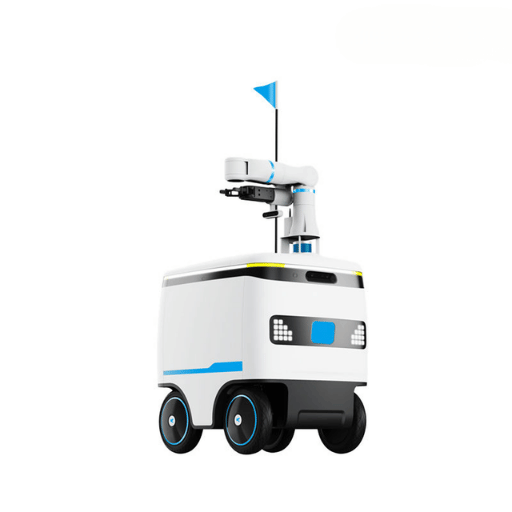
Depth perception and ranging matter most here: a sidewalk-based delivery robot’s LiDAR sensor sees in the worst optical conditions of all outdoor environments there are (a ground-based robot in broad daylight). Light level is 100,000 lux; that same light reflected in a puddle at a pedestrian crosswalk. Three delivery bots crossing one intersection will flood each other’s receivers with co-source interference. That high-powered sensor sits just 600-900 mm off the ground, inside the eye-level envelope of pedestrians — unlike a drone LiDAR or an autonomous vehicle roof rig mounted 1.5 m up, where the real-time point cloud has room to breathe.
IFR data puts this in perspective: transportation and delivery made up the single largest application category of professional service robots in 2024 with 102900 (14%) more units than the year prior – you can be sure that each and every one of those robots had to solve the sunlight problem.
Spec envelope:
- Range 15-25 m. Sidewalk horizon and intersection clearance; longer range does not improve position accuracy as buildings define the scene.
- Ambient light 40,000 lux immunity, 100,000 lux marginal performance. This is the hard limit for “indoor LiDAR marketed for outdoor use” and a true outdoor sensor.
- Ingress protection 65 minimum, 67 for coastal and wet-climate fleets. IEC 602529 ingress protection ratings; IP65 is a minimum not a maximum for wet-climate municipalities.
- Co-source interference robustness. A necessity with two or more co-located or co-present construction robots.
- Class 1 eye safety. Non-negotiable at pedestrian eye level.
QJKH Y B27-25HD and Y B27-35HD list 100,000 lux ambient light immunity – the same figure Panasonic published when it announced its first outdoor robot LiDAR, and the figure the RobotShop YRL3V2 series manual supplies as its outdoor-capable bar. For a frame of reference, Rockwell Automation reports that “typical photoelectric sensors will reach a point of saturation at approximately 5,000 lux”, hence the reason for outdoor-grade LiDAR simply ceasing to function when wheeled onto a concrete pad bathed in sunlight. The 33 headroom between indoor and outdoor LiDAR is not a marketing whitewash – it is the difference between a functioning sensor and a useless brick one.
Can LiDAR Work in Direct Sunlight?
Yes, but only if it was able to be used outdoors at all. LiDAR ranging depends on being able to distinguish a laser pulse return from the ambient photon flux hitting the receiver aperture. Indoors LED luminaires produce 300-1,000 lux at the floor; noonday on concrete can reach 100,000 lux, a factor of 100-300 increase. Receivers tuned for indoor duty has an analog front-end which saturates in that flux, and ceases to resolve pulse returns – the point-cloud just vanishes. Outdoors-rated LiDAR shifts the bandpass of the receiver narrower and tuned more tightly to the wavelength of the laser (typically 905 nm or 1550 nm), ramps up the pulse peak power subject to Class 1 eye-safety limits, and chooses photodetectors with wider dynamic ranges. One single number to look for on a datasheet is the ambient-light immunity number; anything below 40,000 lux will not operate in direct illumination, and 100,000 lux is currently the outdoor industrial benchmark.
Inspection Robots: Slow, Data-Quality Priority
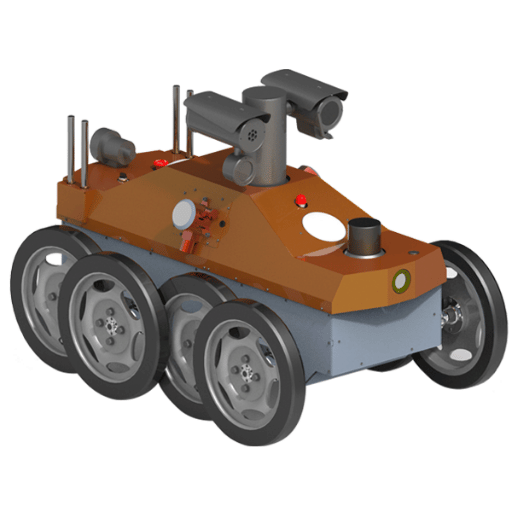
An inspection robot LiDAR looks at the spec sheet differently. Substation inspection quadrupeds working complex environments, solar-farm row pass robots, oil&gas plant walkers, tunnel crawlers and sewer bots all have a very similar physical profile: they progress slowly (0.2-0.5 m/s), operate in capex-heavy low-volume fleets, and are purchased by engineering departments which scrutinise every angular resolution to the nearest decimal. One temptation is to spec a 0.1 resolution LiDAR because inspection sounds like a measurement task.
📐 Engineering Note — Inspection ≠ MeasurementOn most inspection robots, the LiDAR is not the inspection sensor. A substation quadruped uses thermal imagery to find transformer hotspots; a pipeline crawler uses acoustic and ultrasonic reflectors for wall-thickness; a solar-farm bot uses a visible camera and an electroluminescence imager for cell defects. Its role is navigation, safe navigation and collision avoidance — not 3D mapping of transformer bushing tilt. Which means the resolution spec you are interested in is the one that prevents the robot from striking a tripped breaker or trundling over a fallen insulator cap – not the one which measures a cable sag to the millimeter using a high-density point cloud.
That reframe changes the envelope:
- Range 25-40 m. Its latter sibling is driven more by yards and tunnels than by travelling speed.
- Angular resolution 0.1-0.3. If the LiDAR is also a dimensional sensor (cable sag, liner deformation); then 0.1 is needed, otherwise 0.3 is sufficient.
- Scan rate can be low. 10-15 Hz is acceptable at 0.3 m/s – again an extra over engineering.
- Repeatability 4 mm @ 1. Repeatability figure is only important when the LiDAR is actually the measurement sensor.
- Operating temperature 10 to +50 C. Outdoor yards, unconditioned tunnels, unheated crawl spaces.
The QJKH YB27-35HE falls into the “LiDAR-as-measurement” subset: 35m range, 0.1° angular resolution at 25Hz, 2cm of deviation in the distance across the span, 4mm repeatability 1 measured to a 10% diffuse target at 600mm. For the more typical “LiDAR-as-navigation” inspection subset, a YB27-25HS or YB27-35HS in the obstacle-avoidance line is both cheaper and reliable enough and the budget is spent on the thermal or acoustic payload that does the inspect work.
Imagine a substation inspection quadruped running a 45-minute perimeter loop at 0.3 m/s. To safely brake from this speed it requires about 2-3 m of forward clearance; a LiDAR providing 10 m of usable range is already 3 overkill for the collision task. The 0.1 spec contributes zilch toward this task – unless that is the same robot simultaneously using that LiDAR for measuring transformer bushing tilt, in which case the 0.1 justifies its cost.
Specification the sensor to the task to be performed, not the nameplate of the robot.
Outdoor Mobile Equipment: Mowers, Perimeter and Rain
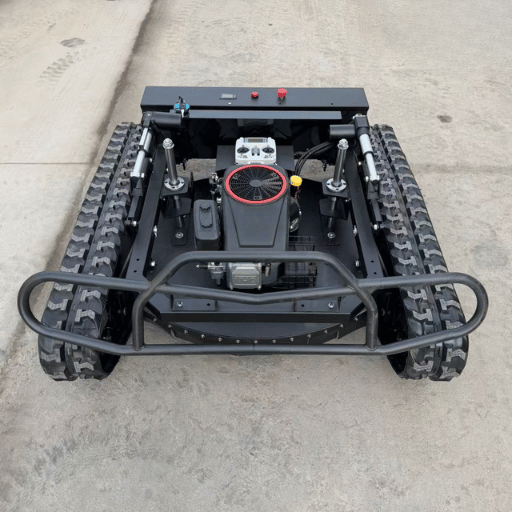
An automatic lawn mower LiDAR, the golf-course-keeping-bot LiDAR, the municipal park mower LiDAR, the solar-farm perimeter mower LiDAR, the agricultural-rows robot LiDAR, the snow-clearance-bot LiDAR—all these sit in the same bucket: outdoors, low—mid speed, exposed to ambient weather, on a chassis that transmits chassis vibration directly into the sensor mount. This LiDAR must take the physical beating that the indoor classes will never get.
The spec envelope:
- Range 15-25 m. For an open lawn bystander useful distance of detection ranges from 3-8 m (hedges, tree trunks, blind spots in children play zones) – rang beyond 25 m is wasted on a mower.
- Immunity to ambient light to 100,000 lux. Scene at a golf course at noon is worst case.
- Waterproofing: IP65 minimum, IP67 for the fleets coming from the coastal & wet-climate areas. Same rationale as for the delivery-robot case.
- Vibration rating. Mower chassis at 5-8 Hz drive-train fundamentals carried directly to sensor mount; 10-55 Hz vibration tolerance at 0.35 mm amplitude is the baseline set by industry standard.
- Impact rating. 10 g for 16 ms, 1,000 cycles in all 3 axes–that was the difference between rolling over a tree root and a warranty claim.
Its other QJKH YB27-25HS and YB27-35HS fit this profile. The 100,000 lux ambient-light immunity flies straight-flush something on a summer fairway; the 10-55 Hz / 0.35 mm vibration rating is the spec mower actually need (it is considerably more forgiving than the standard chassis-vibration-envelope needed for a commercial mower drivetrain); the 10 g16 ms impact number is the shock-envelope that a hit by a 25 mm exposed root at 0.8 m/s can otherwise tear a mower apart. IP65 is the default for this series, good enough for rain and grass-clipping thrown up; for salt-fog-beached coastal mowers an IP67 upgrade should be worth discussing.
Do Lawn Mower Robots Need LiDAR if They Have GPS-RTK?
Sales pitch for RTK mowers is ‘2cm accuracy’, which is really correct if the greenhouses had an unconditional line of sight to a perfectly sitting base station. In close canopy environments – just about every suburban lawn, city park and golf-course fringeline has one – even RTK fix solutions can wander to a few meters or jump straight to no lock at all. Oak, maple and sycamore canopies cause direct LOS blockages plus leave multipath reflections on every sun filled day.
LiDAR-based SLAM is the policy to prevent wandering off and cutting corners. Cold truth is that no public vendor listing for a commercial RTK mower publishes canopy multipath behaviours – the missing date from every product page speaks volumes. Any mower that has to work in close canopy surroundings needs LiDAR as its secondfix system, not its add-on.
Robot-Type × LiDAR Model Matrix
This matrix is only a first-pass, not a buying list. Every fleet introduces other constraints that can’t be expressed in the matrix – mounting geometry, integrator preferences, controller compatibility, serial versus Ethernet preference. Think of it as simply the first step towards a datasheet comparison.
| Robot Class | Range | Resolution | Ambient Light | IP | Recommended Model |
|---|---|---|---|---|---|
| Indoor service (restaurant, hotel, hospital) | 15 m | 0.3° | 100,000 lux | IP65 | YB27-15CS / YB27-15CD |
| Logistics / warehouse AMR | 25 m | 0.1° / 0.3° | 100,000 lux | IP65 | YB27-25HD (Dual) |
| Pallet shuttle / heavy AMR | 35 m | 0.1° / 0.3° | 100,000 lux | IP65 | YB27-35HD |
| Food delivery / sidewalk robot | 25–35 m | 0.1° | 100,000 lux | IP65 | YB27-25HD / YB27-35HD |
| Inspection (measurement-grade) | 35 m | 0.1° @ 25 Hz | 100,000 lux | IP65 | YB27-35HE |
| Inspection (navigation-only) | 25–35 m | 0.3° | 100,000 lux | IP65 | YB27-25HS / YB27-35HS |
| Commercial mower / outdoor mobile | 25 m | 0.3° | 100,000 lux | IP65 | YB27-25HS |
- Match range to aisle length or the autonomous navigation route horizon, not to marketing.
- Choose Dual-output if you need either a robot capable of SLAM point clouds, or rapid stopping.
- Always combine the navigation LiDAR with a second IEC 61496-1 scanner for any safety-rated stop function.
Browse the full YB27 lidar systems data sheets →
For robots working alongside nontrained humans on the factory floor, the navigation LiDAR is merely half of the equation – the other half is the safety-rated scanner (see our guide to industrial safety laser scanners for the certification, zone-stop and PLd / SIL 2 info)
Frequently Asked Questions
Q: What is the difference between a LiDAR sensor and a safety laser scanner?
View Answer
Navigation LiDAR creates a point cloud for SLAM and obstacle avoidance, a safety laser scanner is a functional-safety device rated to IEC 61496-1 (Type 3) PLd or SIL 2 for a stop function. They are not interchangeable. Navigation LiDAR cannot command an AMR to stop where humans are present without a redundant safety scanner running alongside.
See our guide to industrial safety laser scanners for that certification detail.
Q: How much does a robot LiDAR sensor cost?
View Answer
Industrial 2D navigation LiDAR in the 15-40 m range class range category can range from a couple hundred to a couple thousands of dollars per unit at OEM volumes, the biggest factors being the class of range tier, angular resolution, ability for dual output and the extent of certification desired. Below the industrial line, hobbyist grade 2D LiDAR (12 m range, bare Class 1, no industrial IP rating) would be less expensive but won’t pass a commercial deployment QA. Ask for the datasheet and a repeatability spec; if the vendor cannot provide both, you are looking at hobby hardware.
Q: Do service robots need 360° LiDAR or is 270° enough?
View Answer
270° is enough for most front-driven service robots because the trailing 90° is usually taken up either by the robot chassis itself or by a second short-range sensor — typically an ultrasonic array or an RGB-D camera — that handles reverse maneuvers. The robot’s ability to sense a person approaching from directly behind is what tilts the answer the other way. When that matters — inventory robots, retail shelf scanners, hospitals corridors with bidirectional foot traffic — a full 360° primary LiDAR starts to earn its BOM premium. In every other case, a 270° navigation LiDAR paired with a rear ultrasonic array reaches the same functional 360° awareness for roughly two thirds of the cost of a true 360° sensor, and the integrator gets to keep the spare channel for a bumper safety loop.
View Answer
Yes – if the LiDAR has a Dual output, which is exposing an Ethernet point cloud for SLAM, combined with a digital (PNP/NPN) feed for the zone layer, as the YB27-25HD / YB27-35HD / YB27-40HD do. This effectively merges what is normally a two-sensor combination into one. For a more involved analysis on how Dual-output solutions are integrated, refer to our AGV and AMR positioning LiDAR deep dive.
Q: What IP rating does an outdoor robot LiDAR need?
View Answer
IP65 is the bare minimum for outdoor robots, since the IEC 60529 provides this level of dust ingress and low-pressure water jet shielding – ideal for rain, dew, debris, and pressure-washed floors. IP67 is the increased investment worth securing for marine environments (salt fog), humid city versions (persistant ceaseless drizzle), or robots that will sometimes strip naked to step through standing water. IP68 is rarely mandated in land-based vehicles.
Q: Is 2D LiDAR enough, or do I need 3D?
View Answer
2D is enough for flat-floor navigation. 3D earns its place when overhead obstacles, multi-floor transitions, or drop-offs come into play. One common pattern is 2D horizontal plus a short-range RGB-D camera — 90% of the 3D benefit at a fraction of the compute.
About This Analysis
Model thresholds and highlighting recommendations in this article originate in QJKH’s YB27 navigation LiDAR offering, which the CCH Shanghai R&D team has launched on every vertical service, warehouse AMR, outdoor deliver and inspection bot client project since it’s inception. When referenced, any industry aggregate statistic (IFR service robot shipment rate, Rockwell photoelectric benchmark, Panasonic ambient light immunity test figure) is hyperlinked to the original so you may compare using your own data.
References & Sources
- Sales of Service Robots up 30% Worldwide — International Federation of Robotics (2024 press release)
- World Robotics 2024 — Service Robots: Sources & Methods — International Federation of Robotics
- IEC 60825-1:2014 — Safety of laser products — International Electrotechnical Commission
- IEC 61496-1 — Safety of machinery: electro-sensitive protective equipment — International Electrotechnical Commission
- IEC 60529 — Degrees of protection provided by enclosures (IP code) — International Electrotechnical Commission
- ISO 3691-4:2023 — Industrial trucks: safety requirements for driverless industrial trucks — International Organization for Standardization
- Mobile Robot Performance — Networked Control Systems Group — U.S. National Institute of Standards and Technology
Related Articles
- Positioning LiDAR for AGV and AMR — dToF ranging, SLAM and the 2D vs 3D trade-off for mobile robot navigation
- Industrial Safety Laser Scanners — IEC 61496-1, PLd / SIL 2 certification, and when you need one in addition to a navigation LiDAR
- SLAM Navigation for Mobile Robots (coming soon)
- Choosing IP65 vs IP67 for Outdoor Robotics (coming soon)
- Sensor Fusion: LiDAR + Camera + IMU (coming soon)