Get in touch with QJKH Company

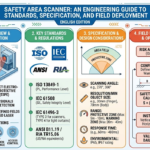
The safety light curtain for packaging lines that must let pallets go through in milliseconds and stop operator hands, arms, and bodies is a rare number – and the math behind it is rarely seen outside a standards committee. This primer is for any engineer, safety guy, or integrator who must specify, calculate, install, and verify a light curtain on a palletizer, stretch wrapper, case packer or cartoner – without a sales brochure. Every number below is derived from IEC, ISO, OSHA, or peer-reviewed safety literature. Every worked e×ample reveals the math. No vendor pimping until the last section on compliance documentation, and even then framed around what to demand from a supplier, not necessarily one vendor.
Quick Specs — The Numbers That Run This Article
| Standards corpus referenced | IEC 61496-1/-2 · ISO 13849-1/-2 · ISO 13855 · ISO 13857 · ISO 12100 · OSHA 1910.212 · ANSI B11.19 |
| ISO 13855 K constants | 2,000 mm/s (hand/finger) · 1,600 mm/s (body, recalculated only if S ≥ 500 mm) |
| Detection capability (d) classes | 14 mm finger · 30 mm hand · 40 mm limb · > 40 mm body |
| PFHd targets per IEC 61496-1 | Type 4 ≤ 10⁻⁷/h · Type 2 ≤ 10⁻⁶/h (10× difference in acceptable dangerous-failure rate) |
| Minimum safety-distance floor | 100 mm (absolute, per ISO 13855 §6.2, regardless of formula result) |
| US machine-guarding citations FY 2024 | 1,541 violations under 29 CFR 1910.212 — Top-10 OSHA citation category |
Before You Specify: A Hazard Zone Audit Every Packaging Line Needs
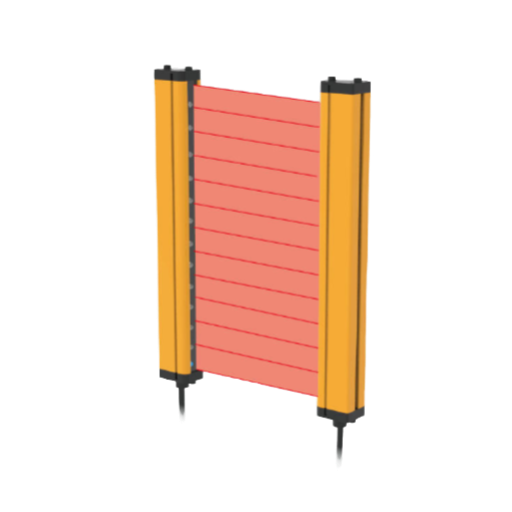
You do not select a safety light curtain first. Instead, you define the risk first, and the light curtain should fall out of this definition. Whenever the sequence of events is reversed, the wrong resolution is specified, the safety distance is no longer established, and the installation has to be forever redone at capital e×pense. ISO 12100 calls this e×ercise the hazard risk-map, and the single most skipped step on all packaging line safety projects.
The 5-step hazard audit would look like this: determine what the operator does to the machine (loads, clears jams, pulls samples, end-of-shift cleans); where the hazards e×ist that can reach the operator (breaking blades, clamp zones, robot dead-ends, layer tables); how fast people and product get to those hazards (approaches speeds); what the severity risk level is for each hazard (Dupasal’s_probability severity avoidance_risk-graph); and finally, make the documented signed risk assessment both end user and installer references.
A machine-guarding citation is not a theoretical risk. OSHA rule 29 CFR 1910.212 posted 1,541 citations in FY2024, ranking it among the Top 10 most-cited OSHA standards for the year. Packaging lines — where trays, totes, cartons, and pallets move through operator-visible guarded zones — are a persistent contributor to that total.
📐 Engineering Note — Approach Direction Matters More Than Operator Intent
ISO 13855 assumes stand perpendicular approach-to-detection plane. Bending that angle to 30 around a fi×ed barrier renders the effective reach to be greater than the given formula output, under-dimensioning your calculated safety distance. Queue time and approach angle recording with a hazard-zone audit is the only way to correct for this mistake.
Oops: assuming the curtain shop can give you a safety distance via email. No supplier can provide a safe distance without testing the machine’s measured stop time – including the curtain in the ring of sensitivity-05.
IMPORTANT: Unless you can hand an integrator a signed risk assessment, measured stop time, and approach-angle-map for every access, then your choice of a light curtain is premature.
The Safety Distance Formula E×plained: ISO 13855 with Three Worked Examples
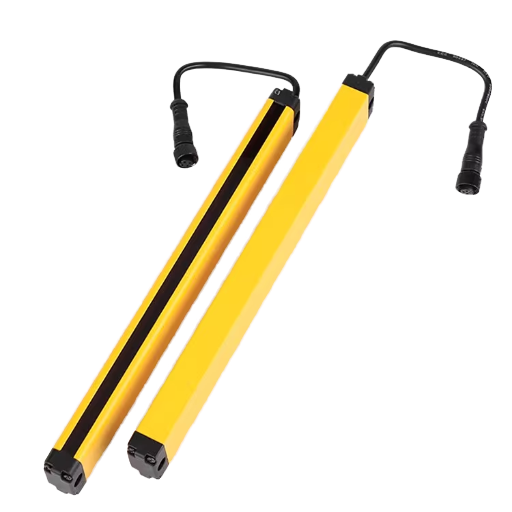
ISO 13855 is the only math the whole discipline is based on. The equation is simple when set on paper, but harsh in the field, because two of its parameters (stop time, resolution) govern the result, and one of them (stop time) only coming right in with the curtain is put into place.
The Formula
S = (K × T) + C
- Where; S = the minimum safe distance of detection plane from the closest hazard (mm);
- K= approach-speed constant; 2000 mm/sec for hand/finger approach 1600 mm/sec for body approach (see conditional rule below)
- T = total stop time[2], sec. – the sum of curtained response time, safety-relay transit time, and machine stop time as measured with the curtain in the signal chain
- C = intrusion-distance term, in mm; where for detection capability d 40 mm, (C) = 8 (d 14) with a minimum of zero; where for d > 40 mm (body detection) C = a larger value specified in the standard
This is the rule on K that the most engineers overlook: ISO 13855 specifies K = 2,000 mm/sec by default. This takes effect only if your computed S is 500 mm or more, and the hazard is unmistakably a body-approach (not a hand-reach). The change over rule is explained in step 4 of Rockwell Automations safety document AT-164; the identical conditional is found in Schmersal USAs technical note 1023 on safety distance computations.
What is C in the ISO 13855 safety distance formula?
C is hand/finger penetrated into detection plane before curtain detects it—done by curtain detection ability d. 14-mm-resolution curtain detects finger as it hits detection plane C = 0. 30-mm-resolution curtain detects finger until hand pushes into beam spacing C = 8 (30 14) = 128 mm. 40-mm-resolution curtain C = 208 mm. A single value C—the extent of hand penetraton before detection—markets higher resolution vs lower standoff.
Three Worked Examples — Same Formula, Three Packaging Machines
| Example Machine | Resolution d | Stop time T | C term | K × T | Minimum S |
|---|---|---|---|---|---|
| Palletizer outfeed (hand) | 30 mm | 150 ms | 8 × (30−14) = 128 mm | 2,000 × 0.150 = 300 mm | 428 mm |
| Case packer access window (finger) | 14 mm | 85 ms | 0 mm | 2,000 × 0.085 = 170 mm | 170 mm |
| Stretch wrapper entry (limb) | 40 mm | 220 ms | 8 × (40−14) = 208 mm | 2,000 × 0.220 = 440 mm | 648 mm |
The palletizer example illustrates why K cannot be reduce to 1,600 mm/sec the 428 mm which is below the 500 mm value indicates that the body-approach must have been explained an recalculations is not permitted. The case packer example rises above what is absolute 100-mm limit of ISO 13855 providing 170-mm is the answer. The stretch wrapper with 648-mm displays either a need to reduce the stop-time or constructing a platform away from the hazard.
Before quoting a safety distance to a machine supplier, measure the real stop time with the curtain in the signal chain. If a specification refers to stop-time tables at the manufacturer, it is just begging to be audited.
The escalation tree when S exceeds available floor space: tinker with the brake first (shortest T gain per dollar); change to a faster safety relay (5-15 ms gain); re-arrange guard layout so hazard is farther from access point; only then, as a last-ditch effort, change to a more fine-resolution curtain (costly per mm of protection height). Compare your scenario to a walk-through with the ISO 13855 safety distance calculator or the packaging-specific packaging safety distance calculator, both of which accept T in ms and d in mm and produce S directly.
Resolution Decision Logic: Why 14, 30, and 40 mm Are Not Arbitrary
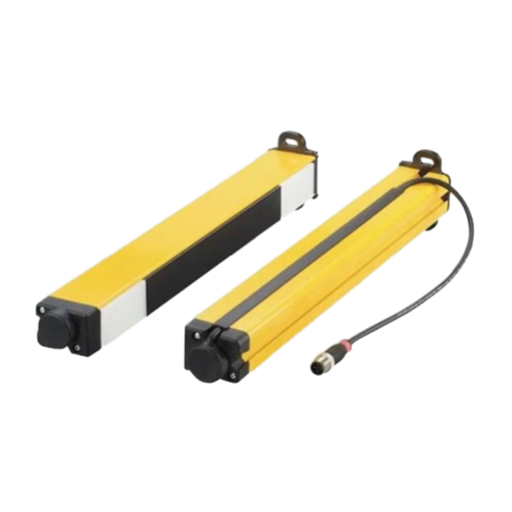
Detection capability numbers are anthropometric, not marketting. ISO 13857 – the companion standard which sets how far a human body part can reach through an opening of a given size – defines the physiologic border. ISO 13855 then slots those reach distances onto the light-curtain C term.
A finger at the joint averages about 14 mm wide; stopping it before it becomes a hand reaching through the guard requires a curtain whose beam-to-beam spacing detects that 14 mm cross-section. That’s why 14 mm resolution is used on case erectors, filler heads, and cartoner access windows where a single finger passing between carton guides can reach a glue gun or compression plate. The 30 mm resolution class catches a hand through the wrist-to-palm region and is the standard choice for palletizer access points and stretch wrapper infeeds. The 40 mm class handles for limb-level intrusion – the detection plane fires when any body part above the forearm crosses any beam – and is used on robotic cell perimeters and large body-approach zones.
Decision frame — Condition to resolution mapping
| Condition | Resolution choice |
| Fill-head or glue-gun access gap < 40 mm, finger-reach hazard | 14 mm (finger) |
| Palletizer or wrapper infeed, operator hand reach from platform | 30 mm (hand) |
| Robotic palletizing cell perimeter, walk-in body access | 40 mm (limb) |
| Cartoner side panel, finger-through-flap hazard | 14 mm (finger) |
Most common mistake – the “we only have bodies, not fingers” trap: choosing 40 mm for a palletizer infeed because operators walk up to it. If the operator’s hand can reach the hazard through a 35 mm gap between conveyor side-rail and pallet, a 40 mm curtain never fires. Resolution has to match the worst-case body part able to reach the hazard, not the most common one that actually does. The ENT light curtain sizing selector incorporates this reach-through check into its recommendation logic.
Muting Done Right: Why Most Palletizer Muting Installations Fail Validation
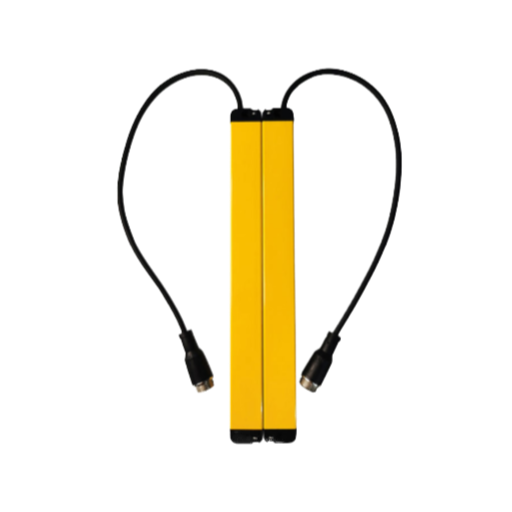
Muting is the control led, time-limited suspension of the curtain’s protective function to allow product to cross the detection plane without tripping the machine. Every textbook covers the four geometries – parallel 2-sensor, parallel 4-sensor, T-configuration, and L-configuration – but these are arrangements, not solutions. The operational discipline resides in the sequencing rules, the timer logic, and the failure modes that appear three months after startup.
ISO 13849-1 Annex I memorizes the principle: muting may only be initiated by the correct material, only at the proper time in the cycle, and must always time out. IEC/TS 62046, referred to in the Rockwell AT-136 safety-function paper, details the two-sensor L-configuration with explicit distance and timing constraints. The DGUV IFA Report 02/2017 on ISO 13849 application explores failure-mode analysis at the control-architecture level.
What is the correct muting-sensor distance from the light curtain?
Position the muting sensors so that it is impossible for anyone walking at a normal walking pace to duplicate the beam-break sequence generated by a pallet. In a two-sensor parallel configuration, this usually means 150-250mm separation between the muting-sensor beams, with both head-on both (or one behind the other so that multiple pallets do not throw off the counts) centered on where a pallet would be expected to peak, and both directed away from the curtain plane at a distance related to product length. The exact distances depend on how fast people walk and the features of your pallet dimensions, and the IEC/TS 62046 Annex has the derivation.
The test of a muting system is the following: during commissioning, a person attempts to walk through the do-not-mute countermeasures and the safety relay does not exit the safe state.
The Seven Failure Modes of Packaging Line Muting
- Distance between mute-sensor and curtain greater than the length of pallet – during ‘pallet’ window operator can move through it as the muting geometry knows/considers the human walk as the same pattern.
- Mute timeout too long – ISO 13849-1 It is expected that annex I closes the mute window as soon as the product clears. A 2-minute conservative timeout becomes a walk-through window.
- Cross-talk between neighbouring curtains on the same cell (i.e. the infrared light from one curtain is picked up by a receiver on an adjacent one). An SICK M4000 service note records an install where this was caused by a misaligned cross point (the fix was mechanical centreing rather than firmware update).
- Mute sensors common to both infeed and outfeed- without any directional logic, when a pallet leaves, it can meet the mute pattern set for an arriving pallet and the curtain will stay in mute while it is un-muted.
- No manual-override monitoring – a mute that was activated by hand for maintenance and never cleared so exists in production. Cat 4 /PL e safety logic shall detect and annunciatesa stale mute.
- Cycle reset can be validated against machine cycle time – a cycle reset occurring too early (before the machine has finished its dangerous motion) can cause the muting to auto-re-arm. ISO 13849 2 9 validation is in place to avoid this.
- Reflective-surface false trigger, stretch-wrap film—this is experience-based, rather than documentation-based. Anecdotal reports exist from contributors to automation discussion groups that stretch-wrap film reflects sufficient infrared back to the muting sensors in wrap cycles that the safety relay interprets wrap as a pallet-clear signal.
The palletizer-outfeed muting drop-out that is encountered on the publicly accessible PLC-engineering listservs—that “the muting turns off right away after it comes on”—almost always originates in one of the modes shown above as #1, 3, or 7. It is rarely the curtain’s fault; it is the muting architecture that was never validated.
⚠️ Important — muting documentation is not optional
OSHA 1910.212 and ANSI B11.19 characterize muting as a safeguarding function that must be defined per install—not per product. A machine-mount, Type 4 certificate does not document your type of muting layout. The muting safety light curtain configuration product documents relay-side logic for Category 4 on a packaging-line muting install.
Type 2 vs Type 4: Where the Extra Cost Is Actually Justified on a Packaging Line
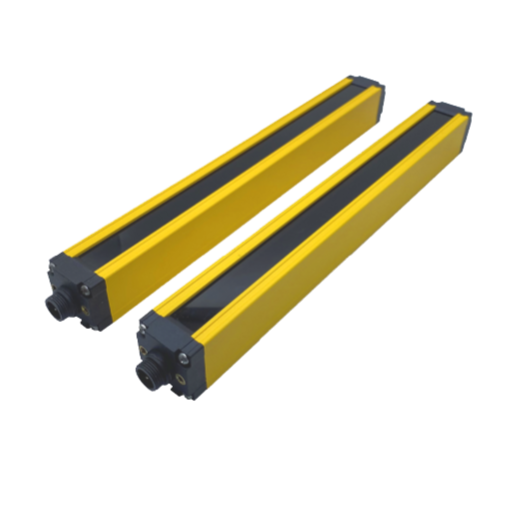
IEC 61496-1 categorizes electro-sensitive protective equipment onto two safety integrity classes. Type 2 gives a validset of pre-commissioning test-the behaviour of which is intrinsic to the ARTIEC 61496-1 type 2 test specified. Type 4 adds a second completely independent channel plus a designated diagnostic self-test sequence. That results in a211% sales-price deltafor an equivalent height of independent protection and a 10% improvement in the acceptable dangerous-failure rate.
Is a Type 2 safety light curtain legal for packaging use in the US?
Legal falls short of Adequate: while OSHA 1910.212 doesn’t explicitly demand Type 2 or Type 4compliances, it demands that the protectionstrip access to the hazard; however,ISO 13849-1 risk graph compliance projects consistantly rank most every packaging-line access concern{palletizer, wrapper, case packer, cartoner} wherever it probed asat Performance Level PL d or PL e. Achieving PL e on a single-channel Type 2 curtainis architecturally impossible. The legal answer is “Type 2 is enough for low-severity access only”; the pragmatic answer within packaging-plant estia is”Type 4 is the only class that clears the risk graph for conventional operator access.
✔ Type 4 delivers
- PFHd ≤ 10⁻⁷/h — roughly one dangerous-failure chance per ~1,140 years of continuous operation
- Diagnostic coverage > 99 %
- Dual-channel architecture (Category 4 per ISO 13849-1)
- Clears PL e on the ISO 13849-1 risk graph for most packaging hazards
⚠ Type 2 limitations
- PFHd ≤ 10⁻⁶/h — a 10× higher dangerous-failure rate than Type 4
- Diagnostic coverage ≥ 60 %
- Single-channel test architecture
- Caps out at PL d on the risk graph-in general inadequate for conventional operator accessin a packaging plant
The ASSP Professional Safety journal’s machine-safety article walks through this distinction at the test-method level and is one of the more readable peer-reviewed sources on the topic. For a tool-assisted look at how Type 2 and Type 4 curtains differ in diagnostic coverage, a side-by-side cost-comparison tool exists; the Type 4 safety light curtain specifications page shows the parameter set that closes the risk-graph gap.
False-economy warning: spending $300 on Type 2 curtains-a $300 per-curtain maximum potential savings-is virtually never an actual savings. An OSHA 1910.212citationaverages $16,131 (OSHA published penalty schedule, adjustedfiscal year 2024).A substantial lost-time packaging-line injury cost in pure direct cost exceeds that, and the indirect cost incurred during the incident investigation and subsequent downtime will generally exceed both.
Reading the Spec Sheet: 12 Parameters That Matter, and 5 That Do Not
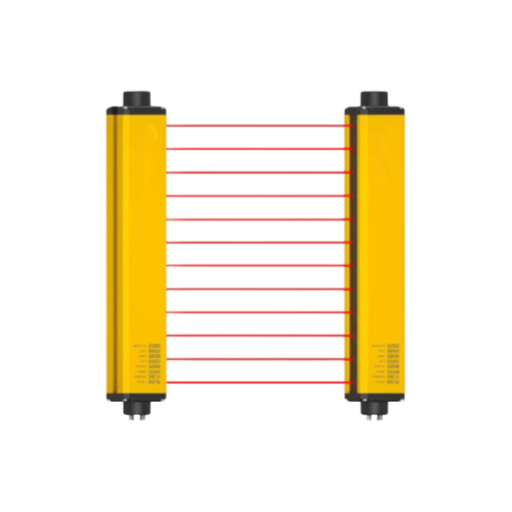
A spec sheet for a light-curtain is an engineer’s design and a marketing team’s cloaked sales-pitch. The following filter sorts the numbers that influence your installation from those that sell the product.
The 12 parameters that matter (and why)
- Detection capability d – sets the C terms in the safety-distance formula
- Response time including diagnostic self-test – sets T; an asterisk here is a high-alert indicator
- Protection height – have to correctly field-install that portion of the hazardous access zone immediately observable
- PFHd per hour — the functional-safety integrity baseline
- Diagnostic coverage DC – should be1 > 99 % for Type 4 curtains
- Ambient light immunity – minimum 10,000 lux sunlight for outdoor-facing installations
- IP rating -must carry minimum IP65 rating for outdoor use, minimum IP67 rating for wet wash, minimum IP69K rating for food-grade high-pressure wash
- Operating temperature range -freezer docks, oven-adjacent lines, and winter outdoor loading bays each raise this
- OSSD output characteristics—PNP or NPN, leakage current, load capacity; must match your safety relay or safety PLC
- Mounting angle tolerance—wider is better for long protection heights; 5 at full range is a reasonable benchmark
- Cascading capacity—for perimeter installs where multiple segments feed one safety output
- Certified stop-time contribution—the value you add to T when doing the ISO 13855 recalculation
The 5 parameters that matter far less than the marketing suggests
- Housing colour and cosmetic finish — zero safety impact
- “Response time” quoted without diagnostic self-test overhead—this is an incomplete spec, not a fast one
- Maximum detection distance beyond your use case—70 m range is a bragging metric when your machine is 3 m wide
- LED count — beam count matters, not LED count
- Brand name alone—without the type-examination certificate, the brand tells you nothing
Key takeaway: a spec sheet that hides the diagnostic-coverage number, the PFHd value, or the response time including self-test is a spec sheet to walk away from.
From Carton to Cert: The 14-Step Commissioning and Validation Checklist
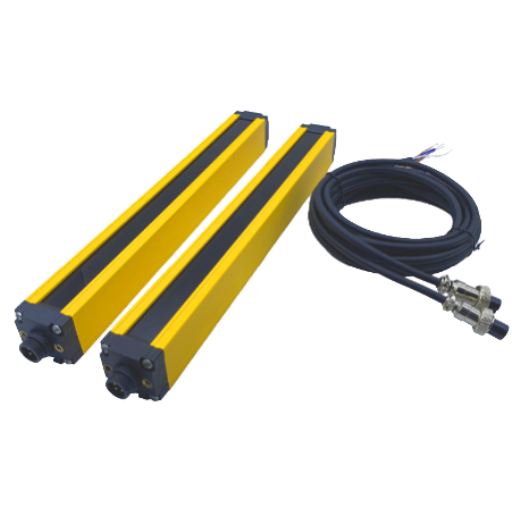
Commissioning a light curtain is not the same as installing one. ISO 13849-2 §9 requires a documented validation after the safety function is connected to its control architecture—not after the curtain is hung on the frame. The following 14-step workflow maps to the validation clauses and has been compressed from the DGUV IFA functional-safety application report and Rockwell AT-164.
- ✔ Pre-install (4):
- 1. Measure baseline stop time without curtain, under full-load worst case
- 2. Review signed risk assessment against each access point
- 3. Recalculate safety distance using the curtain’s certified response-time contribution
- 4. Prove safety-relay configuration matches muting, reset, and restart requirements
- ✔ Install (4):
- 5. Mount emitter-receiver pair within certified angle tolerance; check beam alignment with the curtain’s indicator
- 6. Route cable separately from variable-frequency-drive and high-current lines to avoid EMI pickup
- 7. Bond grounding and cable shielding at the single specified point; a double-grounded shield creates a loop
- 8. Place reset pushbutton where the operator has a full view of the hazard before pressing it
- ✔ Commissioning (3):
- 9. Walk each beam with a test rod matching the certified detection capability—every beam must trigger
- 10. Test each muting scenario: valid pallet, invalid pallet, operator walk-through; the relay must respond correctly to all three
- 11. Verify the curtain is wired into the machine E-stop chain and does not defeat other safeguards during reset
- ✔ Validation (3):
- 12. Re-measure stop time with the curtain in the signal chain; the new T replaces the pre-install value in the ISO 13855 recalculation
- 13. Run a production-speed simulation for a full cycle; verify no muting faults, no false trips, no mute-timeout anomalies
- 14. Sign and file the validation record per ISO 13849-2; retain for the life of the machine
📐 Engineering Note — The before-and-after T problem
Step 12 exists because the curtain and its relay add measurable time to T. A typical Type 4 curtain contributes 6-30 ms; a dual-channel safety relay contributes another 10-20 ms. If the safety-distance calculation used the pre-install T value, the final S may be under-dimensioned by 50-100 mm once the curtain is in the signal chain. Re-measure, then re-verify S.
When Muting Will Not Save You: Hazards That Need a Different Safeguard
Not every packaging safety problem is a light-curtain problem. Three environments defeat even a well-specified Type 4 install, and forcing a curtain onto the wrong problem invites both nuisance trips and real hazard exposure.
Operating temperature above 55 °C — most Type 4 curtains are rated to +55 °C maximum. Conveyors adjacent to shrink-wrap tunnels, heat-seal cartoners running warm-pack product, and oven-exit zones commonly exceed this. LED drift at high ambient accelerates diagnostic faults; the install looks fine for a month and then triggers false trips. The correct safeguard is usually a mechanical interlock on a hard-guard door that can tolerate the thermal environment.
Wash-down environments rated above the curtain’s IP class – food-grade packaging lines are increasingly specifying IP69K (high-pressure, high-temperature wash). A curtain certified to IP65 will eventually suffer moisture ingress at the gasket line and drift into a fault state. For these environments, an IP69K-rated presence mat or a ceiling-mounted safety laser scanner for area protection is a cleaner architectural choice than a curtain struggling at the edge of its IP rating.
Non-linear operator approach vector – ISO 13855 assumes perpendicular approach to the detection plane. On a robotic palletizing cell with multiple operator access directions (load side, reject side, maintenance side), a single curtain line does not cover all vectors. A safety laser scanner sweeping the entire floor area does, but requires different control-architecture and a different commissioning process.
Decision tree: if access is linear, temperature is within rating, and IP class matches environment, a light curtain is the right answer. If any one of those fails, route the problem to a different safeguard family before specifying more curtain.
The Compliance Document Pack You Must Receive from Your Supplier
A curtain on a loading dock is not the safeguard. The paperwork that proves it meets IEC, ISO, and OSHA requirements is the safeguard. Any supplier – domestic, imported, Tier-1-branded, or direct-manufacturer – should deliver this document pack to handover, unasked.
- Type-examination certificate issued by a notified body (TV, UL, Intertek or equivalent), referencing IEC 61496-1 and IEC 61496-2 Type 4
- ISO 13849-1 PL e declaration with numeric PFHd and MTTFd values – not a general statement
- IEC 61508 SIL 3 declaration for the functional safety integrity route
- EU Declaration of Conformity referencing Machinery Directive 2006/42/EC or Regulation (EU) 2023/1230
- OSHA / ANSI B11.19 compliance statement for US installations
- Safety-relay declaration (if muting is part of the install) – matched to the curtain’s OSSD outputs
- Factory test report with the serial number that shipped to you
Red flags: a supplier who offers a “certificate of quality” without a type-examination certificate; a PFHd value that is stated as a category but never as a number; an SIL declaration that does not reference IEC 61508. A QJKH packaging safety integration solution bundle bundles this compliance stack by default, but the buyer should demand the same from every supplier they evaluate – Tier-1 European brands included.
Frequently Asked Questions
Q: How do I measure stop time on a packaging machine for the ISO 13855 formula?
View Answer
Use a stop-time analyser that uses the motor-brake return signal plus the dangerous-motion signal at the same time. Measure at the worst-case load and speed combo of the machine, not idle. Shoot a mid-cycle emergency-stop to get the longest possible response. Record at least five measurements, record the slowest. Once the curtain is in place, re-measure with the curtain OSSD signal as the stop command; that second value is the T to plug into the ISO 13855 calculation. Record procedure and # per ISO 13849-2 9.
Q: Can a safety light curtain replace a physical guard on a stretch wrapper?
View Answer
Only if hazard is access-only. Wraps have rotating arms that eject film scraps, sometimes payload fragments – danger is ejection, not access. Compliant installs often have a fixed hard-guard over the arm-swing envelope protecting ejection, plus a Type 4 light curtain across the operator access window from load through unload preventing access during operation. Curry alone with a rotating arm and light curtain over access window will get you failed machinery-safety audit.
Q: What is the longest muting timeout I can use before it is non-compliant?
View Answer
ISO 13849-1 doesn’t specify maximum timeout value; it has to be “as short as reasonably practicable” for product-pass. Packaging plants traditionally range between 20 and 60 seconds, sized for the slowest valid pallet-clear scenario plus a 30% safety margin. A 120-second ‘just in case’ timeout is dangerous, not safe – it creates an operational window a worker could enter and pass behind a pallet before the curtain re-joins.
Q: Do I need a dedicated safety relay, or can a general-purpose PLC do the muting logic?
View Answer
A general-purpose PLC cannot be used as a Cat 4/PL e safety PLC. Safe logic must run on a functional-safety-rated logic solver – either dedicated safety relay certified to EN 60204-1 (and ISO 13849-1 for the category rating), or a TV-certified safety PLC. Both enable muting; relay simpler to commission, PLC scales to large multi-function cells more easily. In either case, the safe logic is separate from the production PLC.
Q: How often should a safety light curtain be revalidated?
View Answer
ISO 13849-2 recommends documented routine verification at least once annually, and after any change to the safety function – relay replaced, firmware updated, layout changed, or stop-time drift. High-cycle US lines often seek six-month periods. Validation is not identical to daily beam test, which many plants run every shift; validation requires a fully documented repeat of the commissioning checklist on a biannual or annual schedule.
Q: Is a light curtain enough on an automated palletizer, or do I need a scanner or fence as well?
View Answer
Linear access palletizers – where all operator access is through infeed/outfeed openings – are Cat 4/PL e with a curtain-and-muting method. Multi-side access robotic palletizer cells need a multiple-layer system: a curtain at the operator load-side opening, plus a safety laser scanner over the cell floor for non-linear approaches, and finally along the perimeter fence when neither curtain nor scanner is architecturally appropriate. ISO 10218-2 details the modal system for robot cells, and the layered method is the default method.
Require a functional-safety review of your casepack train-protection hazard zones, safety-distance calculations, and muting system design in advance of ordering hardware?
The Team Behind This Report
This ISO 13855 safety-distance walkthrough and packaging-line muting availability analysis was authored by QJKH’s functional-safety application engineering team, with individual members’ industrial safety-sensor design, test, evaluation, R&D and ESPE certification work behind projects of over two decades. All worked-example numbers are imaginary – a project would need to install real measured stop time values and allow for site-unique resolution performances. Cited standards are from 2019 – 2024; the article will be updated when IEC 61496 or ISO 13855 revisions hit the books. Several safety-function integrated examples are used to illustrate figures with reality.
References & Sources
- 29 CFR 1910.212 — General requirements for all machines — U.S. Occupational Safety and Health Administration
- Top 10 OSHA Violations 2024 Summary — Grainger KnowHow (OSHA citation data aggregation)
- IFA Report 02/2017 — Functional safety of machine controls: Application of EN ISO 13849 — DGUV (German Social Accident Insurance)
- Machine Safety — Professional Safety Journal, December 2015 — American Society of Safety Professionals
- Safety Function: Light Curtain and Configurable Safety Relay (AT-164) — Rockwell Automation Safety Publication
- Safety Function: Light Curtain with Muting — Two-Sensor L-Configuration (AT-136) — Rockwell Automation Safety Publication
- Calculating Safety Distances — Schmersal USA Technical Article
Related Articles
- Type 4 Safety Light Curtain Complete Technical Guide — PFHd, DC, and architecture breakdown
- Finger and Hand Protection Light Curtains — resolution-class selection at finer depth
- Elevator Light Curtain: Specification Differences from Industrial Models — where packaging-grade specs diverge from lift-door applications
- Safety Relay Modules for Muting and Reset Logic — the Cat 4 logic solver behind any compliant muting install