Get in touch with QJKH Company


In short: OSHA 1910.212 requires employers to provide one or more methods of machine guarding to protect operators from hazards such as the point of operation, ingoing nip points, rotating parts, and flying chips or sparks. The standard is performance-based and barely a few hundred words long, so the “how” comes from equipment-specific OSHA standards (1910.215, .217, .219) and consensus standards (ANSI B11, ISO 12100/13849).
Scope: this guide covers general industry (29 CFR 1910). Construction (29 CFR 1926.300–.303), maritime (1915–1918), and agriculture (1928) carry their own parallel machine-guarding rules. State Plan states may also impose additional or more stringent requirements.
Quick Specs, OSHA Machine Guarding at a Glance
| Primary standard | 29 CFR 1910.212 — General requirements for all machines |
| Subpart | 1910 Subpart O — Machinery and Machine Guarding |
| Length of the rule | A few hundred words; in place since the early 1970s |
| Equipment-specific standards | 1910.213 (woodworking), 1910.215 (abrasive wheels), 1910.217 (power presses), 1910.219 (power transmission) |
| Consensus standards | ANSI B11.0 / B11.19; ISO 12100, 13849-1, 13855, 14119, 14120 |
| Top cited provision | 1910.212(a)(1) — about two-thirds of all machine-guarding citations |
| Enforcement focus | National Emphasis Program on Amputations in Manufacturing (CPL 03-00-027, renewed 2025) |
Why Machine Guarding Is OSHA’s Most Persistent Workplace-Safety Gap
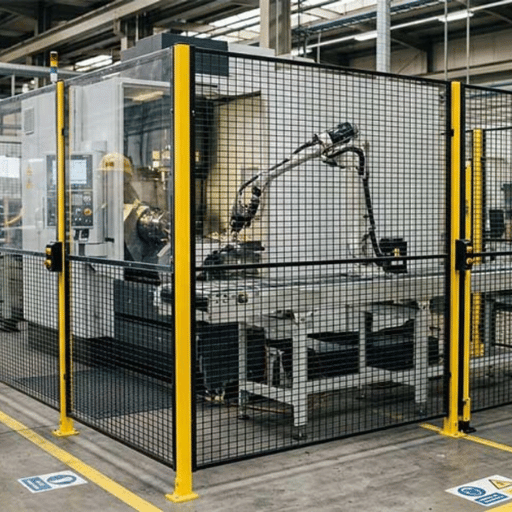
Unguarded machines crush, shear, and amputate, which is why the Occupational Safety and Health Administration treats them as a core safety and health priority. Machine guarding (1910.212) has ranked in OSHA’s Top 10 most-cited standards almost every year, moving between #9 and #10, and roughly 80% of those citations land on manufacturing employers (NAICS 31–33).
In raw numbers, the standard drew more than 1,600 violations in FY2023, about 1,540 in FY2024, and held the #10 spot again in FY2025, proof that employers keep getting it wrong year after year.
The financial exposure is steep before anyone is even hurt. OSHA’s own Safety Pays estimator puts the total cost of a single machine-related laceration near $45,931 (about $21,872 direct plus $24,059 indirect), and 2023 penalty schedules rose 7.7% with inflation while OSHA expanded “instance-by-instance” citations, meaning one inspection can stack multiple machine-guarding penalties.
⚠️ Common misconception
Many employers assume a brand-new machine arrives fully compliant, or that slow-turning shafts are too low-risk to guard. Both are wrong — and both are below.
What OSHA 1910.212 Actually Requires
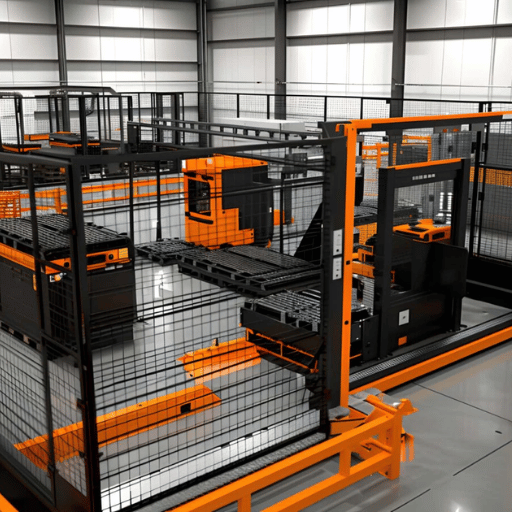
For all its weight, 29 CFR 1910.212 is performance-based, not prescriptive. It tells you that a hazard must be guarded, rarely how, and it applies to every machine in general industry rather than to any single type. The whole standard breaks into six core obligations, covering guarding methods, the point of operation, guard construction, revolving drums, exposed fan blades, and the anchoring of fixed machinery:
- ✔(a)(1) Types of guarding: provide one or more methods to protect employees from hazards such as the point of operation, ingoing nip points, rotating parts, and flying chips and sparks. Named examples: barrier guards, two-hand tripping devices, electronic safety devices.
- ✔(a)(2) General guard construction: guards must be affixed to the machine where possible (secured elsewhere if not) and must not create a hazard of their own.
- ✔(a)(3) Point-of-operation guarding: the area where work is performed on the material must be guarded whenever operation exposes an employee to injury.
- ✔(a)(4) Barrels, containers, and drums: revolving drums must be guarded by an enclosure interlocked with the drive mechanism, the one clearly prescriptive construction mandate in the rule.
- ✔(a)(5) Exposure of blades: fan blades less than 7 feet (2.1 m) above the floor must be guarded with openings no larger than 1/2 inch (13 mm).
- ✔(b) Anchoring fixed machinery: machines designed for a fixed location must be securely anchored to prevent walking or moving.
📐 Engineering Note
The only hard numbers inside 1910.212 itself are the 7-foot fan height and the 1/2-inch guard opening, plus the prescriptive interlocked enclosure for revolving drums in (a)(3). Everything else, gap sizes, materials, reach distances, is left to “any appropriate standards.” That deliberate vagueness is why OSHA has issued well over a hundred Letters of Interpretation on this single rule since the early 1970s, and why the General Duty Clause (Section 5(a)(1)) backstops hazards the standard doesn’t name.
Does OSHA require a written machine guarding program?
No, unlike lockout/tagout (1910.147), 1910.212 contains no explicit written-program mandate. It’s primarily a technical standard aimed at the design of machines and guards rather than paperwork. In practice, though, inspectors expect to see evidence that hazards were identified and controlled: a hazard assessment, a guard inventory, an inspection routine, training records, and corrective-action tracking. Documentation is how you demonstrate due diligence when a guard is found missing.
The Three Hazard Zones OSHA Wants Guarded
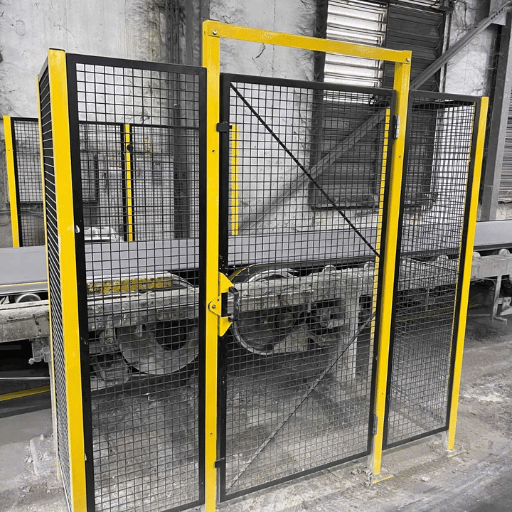
OSHA groups every machine hazard into three zones, with the power-transmission apparatus covered separately under 29 CFR 1910.219. Identify which zones exist on each machine, and the guarding requirement follows directly.
| Hazard zone | Hazardous motion type | Example equipment | Primary standard |
|---|---|---|---|
| Point of operation | Cutting | Band saws, circular saws | 1910.212(a)(3), 1910.213 |
| Point of operation | Punching / shearing | Power presses, shears, guillotine cutters | 1910.217 |
| Point of operation | Bending / forming | Press brakes, forming rolls, calenders | 1910.212(a)(3) |
| Point of operation | Grinding | Bench and pedestal grinders | 1910.215 |
| Power transmission | Rotating (belts, pulleys, shafts) | Line shafting, V-belt drives | 1910.219 |
| Power transmission | Ingoing nip points | Gears, sprockets, chain drives, rollers | 1910.219 |
| Other moving parts | Reciprocating | Slides, rams, planers | 1910.212(a)(1) |
| Other moving parts | Transverse / flying chips | Lathes, milling machines | 1910.212(a)(1) |
| Other moving parts | Revolving | Drums, barrels, mixers, centrifuges | 1910.212(a)(4) |
Source: 29 CFR 1910.212, .213, .215, .217, .219 (OSHA).
Guarding Methods OSHA Accepts, and the Four-Test Guard Adequacy Check
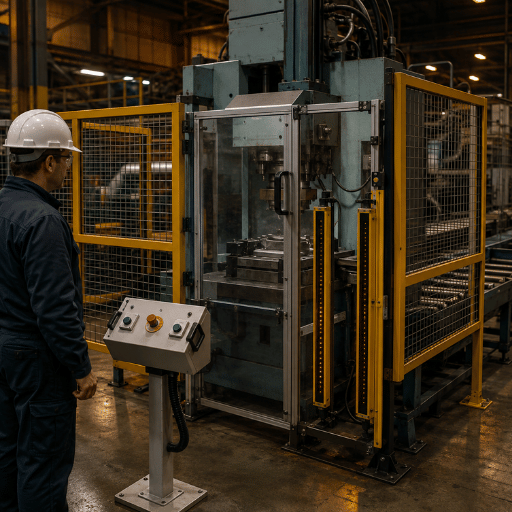
OSHA’s machine guarding eTool recognizes four broad guard types. Choosing among them is a trade-off between access frequency and protection, summarized in the selection grid below.
✔ Strengths by guard type
- Fixed —simplest, most durable; ideal for power transmission and rarely-accessed nip points.
- Interlocked —stops the machine when opened; best where operators need frequent access.
- Adjustable —accommodates varying stock on saws, drill presses, milling machines.
- Self-adjusting —moves with the material, as on a portable circular saw.
⚠ Limitations
- Fixed —requires tool removal, tempting to bypass for quick clears.
- Interlocked —needs maintenance and validation; a defeated interlock is a common citation.
- Adjustable —depends on operator setting it correctly every time.
- Self-adjusting —may not provide maximum protection; the opening still admits some exposure.
Whatever type you choose, OSHA judges adequacy by whether a worker can still reach the hazard. We call it the Four-Test Guard Adequacy Checka compliant guard must pass all four:
The Four-Test Guard Adequacy Check
- Overcan the operator reach over the top into the danger zone?
- Undercan a hand pass beneath the guard?
- Aroundcan someone reach around the side or end?
- Throughis any opening large enough to admit fingers, a hand, or an arm at the working distance?
If a guard fail any one of the four, it isn’t compliant, no matter how solid it looks.
When Safeguarding Devices Replace Physical Guards
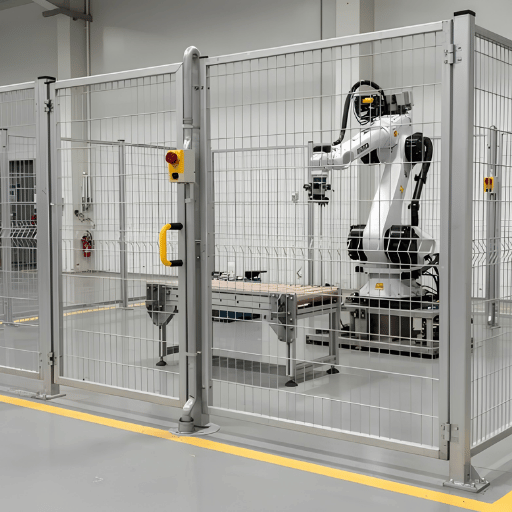
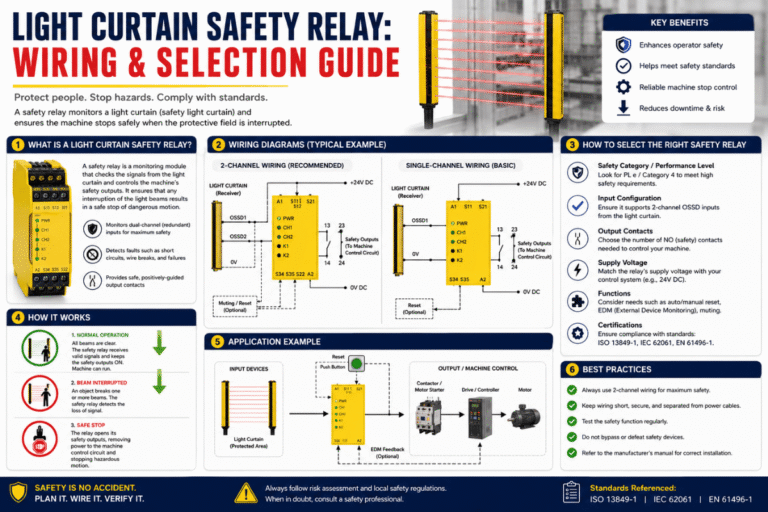
1910.212(a)(1) explicitly names two-hand tripping devices and electronic safety devices as acceptable guarding methods. That’s the legal opening for presence-sensing safeguardinga safety light curtain, a safety laser scanner, two-hand controls, or interlocked gates, in place of, or alongside, a physical barrier.
Can a light curtain satisfy OSHA? Yes, but only when it is mounted at or beyond the minimum safe distance, so the machine stops before a hand can reach the hazard. For a press, OSHA’s formula is Ds = 63 in/s × Ts (the 63 in/s hand-speed constant equals about 1,600 mm/s), where Ds is the safety distance in inches and Ts is the machine stop time in seconds. The consensus equivalent in ISO 13855 is S = (K × T) + C.
Two cautions matter here. First, that distance math governs approach detectionhow far back a device must sit so an approaching worker cannot beat the stop. ISO 13855:2024 notes its derived distances do not, by themselves, cover devices used solely for static presence sensing, so the mounting analysis must match the application. Second, an electronic device guards the operating cycle, it does not isolate energy. During setup, cleaning, or maintenance you still owe full lockout/tagout under 1910.147. A safety relay module or safety controller is what monitors the device and commands the stop. Note too that presence-sensing-device-initiation (PSDI) is tightly restricted on certain mechanical power presses under 1910.217(h).
What machines require point-of-operation guarding?
1910.212(a)(3)(iv) lists the usual suspects: guillotine cutters, shears, alligator shears, power presses, milling machines, power saws, jointers, portable power tools, and forming rolls and calenders. But the list is illustrative, not exhaustiveany machine whose operation exposes an employee to injury at the point of operation must be guarded. When you compare a hard guard against a presence-sensing device, weigh access frequency and throughput: hard guards win where access is rare; presence-sensing safeguarding wins where operators load and unload constantly.
OSHA vs ANSI vs ISO: The Machine Guarding Standards Crosswalk
Because 1910.212 says so little about “how,” engineers reach for ANSI and ISO standards. But keep one distinction sharp: only the OSHA standards are enforceable lawa consensus standard such as ISO 14119:2024 is guidance, not regulation. ANSI and ISO are consensus standards, OSHA can use them to define what an “appropriate standard” looks like or to support a General Duty Clause citation, but they are guidance, not regulation, on their own.
| Topic | OSHA (enforceable law) | ANSI / ISO (consensus guidance) |
|---|---|---|
| General machine guarding | 1910.212 | ANSI B11.0; ISO 12100 |
| Risk assessment | General Duty Clause 5(a)(1) | ANSI B11.0; ISO 12100 |
| Performance of safeguards | 1910.212(a)(1)–(a)(3) | ANSI B11.19-2019 (R2024) |
| Control-system reliability | (none specific) | ISO 13849-1 (PL); IEC 62061 (SIL) |
| Fixed and movable guards | 1910.212(a)(2) | ISO 14120 |
| Interlocking devices | 1910.212(a)(4) | ISO 14119:2024 |
| Safe mounting distance | 1910.217(c) (presses) | ISO 13855:2024; ANSI B11.19 |
| Electrical safety | 1910 Subpart S | IEC 60204-1 |
| Power transmission | 1910.219 | ANSI B11 series |
Sources: OSHA 29 CFR 1910 (enforceable); ANSI B11 / ISO standards (consensus guidance). A consensus standard is not an OSHA regulation; cite the OSHA clause for the legal duty.
The Machines OSHA Cites Most, Grinders, Presses, Saws
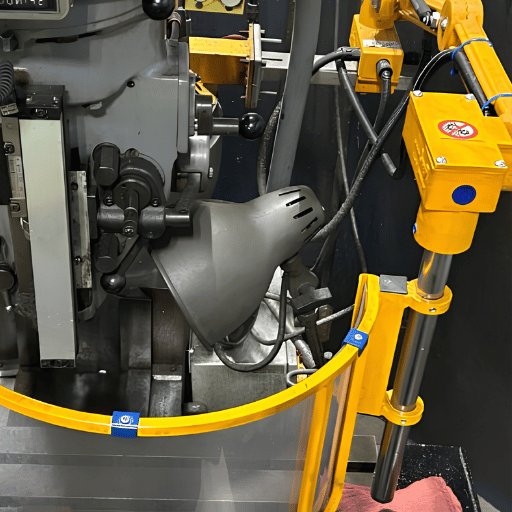
When a 1910.212 citation lands, it’s usually on a familiar machine. Three carry their own numeric requirements worth memorizing.
📐 Engineering Note — the clearances inspectors measure
- Bench and pedestal grinders (1910.215): the work rest must be kept adjusted to within 1/8 inch (about 3 mm) of the wheel, and the adjustable tongue guard within 1/4 inch (about 6 mm). Inspectors carry a probe to check both.
- Mechanical power presses (1910.217): the point of operation must be guarded, with brake monitoring and strict limits on presence-sensing-device initiation.
- Power-transmission apparatus (1910.219): exposed belts, pulleys, gears, and shafting less than 7 feet (2.1 m) above the floor must be guarded.
These small numbers drive a surprising share of penalties. A grinder work rest backed off to 1/4 inch instead of 1/8 inch, or an adjustable tongue guard left wide after a wheel change, is one of the most routine machine-guarding citations OSHA writes.
How OSHA Inspects and Enforces Machine Guarding

OSHA’s enforcement is data-driven, and the data points to a few clauses. Of the more than 1,600 machine-guarding violations cited in FY2023, just five provisions accounted for about 98% of them, what we call the Most-Cited Machine Guarding Gap Map.
| Provision | What it covers | FY2023 violations | Share |
|---|---|---|---|
| 1910.212(a)(1) | Types of guarding (a method must exist) | 1,089 | 66% |
| 1910.212(a)(3) | Point-of-operation guarding | 402 | 24% |
| 1910.212(a)(2) | Guard construction / attachment | 60 | 4% |
| 1910.212(b) | Anchoring fixed machinery | 57 | 3% |
| 1910.212(a)(4) | Revolving drums / interlocked enclosure | 13 | 1% |
Source: OSHA FY2023 enforcement data (via VelocityEHS).
The enforcement pressure is intensifying, not easing. In June 2025 OSHA renewed its National Emphasis Program on Amputations in Manufacturing (directive CPL 03-00-027), keeping it in force for five years. The renewal updated the targeted industry (NAICS) list and lets facilities inspected in the previous 24 months without an amputation drop off the programmed list, a direct incentive to fix guarding before the inspector arrives.
What is quietly shifting is the consensus layer beneath the rule. ISO published a new edition of ISO 14119 in September 2024, ISO 13855 was updated to its 2024 edition, and ANSI reaffirmed B11.19 as the 2024 revision, while 1910.212 itself has not changed since 1973. The gap between a frozen federal rule and modernizing guidance is widening, and recent patents (for dynamic light-curtain muting, robot-presence control, and zoned exclusion) point to where safeguarding is heading: adaptive, sensor-driven presence detection rather than fixed steel alone.
“OSHA’s machine guarding requirements provide no exemption from guarding based on shaft size or speed (rpm).”
OSHA, Standard Interpretation letter, January 9, 2006
That interpretation kills a stubborn myth: a slow or small rotating shaft is not too minor to guard. Under 1910.219(c)(2)(i), exposed horizontal shafting is covered regardless of how fast it turns.
💡 Compliance self-audit checklist
- Is every point of operation, nip point, and rotating part below 7 feet guarded?
- Does each guard pass the Four-Test Check (over / under / around / through)?
- Are grinder work rests within 1/8 inch and tongue guards within 1/4 inch?
- Is any presence-sensing device mounted at or beyond the calculated safe distance?
- Is lockout/tagout used, not just the guard or device, during maintenance?
- Do you’ve hazard-assessment, inspection, and training records to show?
What is OSHA’s most-cited machine guarding violation?
OSHA’s most-cited machine guarding violation is 1910.212(a)(1) — the requirement that a guarding method simply exist. With 1,089 citations in FY2023, that single clause accounts for roughly two-thirds of all machine-guarding violations. In plain terms, OSHA’s most common finding isn’t a poorly designed guard but no guard at all where one was required.
Frequently Asked Questions
Q: Does OSHA require machine guards?
View Answer
Yes. Under 29 CFR 1910.212(a)(1), employers must provide one or more methods of machine guarding to protect operators and other employees from hazards such as the point of operation, ingoing nip points, rotating parts, and flying chips or sparks. The requirement is mandatory wherever a machine hazard can expose an employee to injury, and it applies across general industry. Failing to provide that guarding is the single most-cited machine safety violation OSHA writes each year.
Q: Can machine guards be temporarily removed for maintenance?
View Answer
Only by authorized personnel following full lockout/tagout under 1910.147. An interlocked guard or a light curtain is not a substitute for energy isolation — those devices guard the operating cycle, not stored or residual energy. The guard must be reinstalled and verified before the machine returns to service, and the work should be documented.
Q: How often should machine guards be inspected?
View Answer
OSHA sets no fixed interval, but the accepted practice is a two-tier routine: a daily visual check by the operator before use, and a more detailed periodic inspection by maintenance covering mounting points, interlock function, and overall guard integrity. A pre-shift task hazard assessment is the simplest way to catch a guard knocked loose or set out of tolerance, and documenting those checks is how you demonstrate due diligence if an inspector ever asks.
Q: Who is responsible for machine guarding compliance?
View Answer
The employer. Even when a machine builder or robot integrator supplies safeguarding, OSHA holds the employer accountable for verifying that installed guards meet 1910.212 and remain effective in your specific application. That responsibility cannot be handed off to the supplier, and it continues for the full service life of the machine, including after any modification or relocation.
Q: What are the legal requirements for machine guarding?
View Answer
The core duty is 29 CFR 1910.212, supplemented by equipment-specific standards (1910.213, .215, .217, .219) and, for hazards none of those address, the General Duty Clause. Together they require guarding of every hazard that can injure an employee, and State Plan states may layer stricter rules on top of the federal baseline.
Q: Is 1910.212 the only machine guarding standard?
View Answer
No. It is the general rule that applies to every machine, but 1910.215, .217, and .219 add machine-specific requirements for grinders, presses, and power transmission, and construction (1926), maritime (1915), and agriculture (1928) each carry their own separate guarding standards.
Q: Does a guard you can reach around still count?
View Answer
No. If a worker can reach over, under, around, or through it to reach the hazard, the guard fails OSHA’s adequacy test, no matter how solid or well-built it looks. The size of every opening has to be matched to the safe distance from the moving part.
Why We Wrote This
QJKH (CCH Shanghai Sensing) builds the presence-sensing safeguarding that 1910.212(a)(1) recognizes, light curtains, safety laser scanners, and safety relay modules deployed in more than 50 countries. This guide reflects what our application engineers see when retrofitting those devices onto real machine cells: the gap is rarely the device, and almost always a point of operation left open or a guard set out of tolerance. We cite OSHA and consensus-standard text directly so you can verify every requirement.
References & Sources
- 29 CFR 1910.212, General requirements for all machinesOSHA
- 29 CFR 1910.215, Abrasive wheel machineryOSHA
- Machine Guarding eTool and StandardsOSHA
- NEP on Amputations in Manufacturing renewed (CPL 03-00-027), June 2025U.S. Department of Labor
- Standard Interpretation: no exemption based on shaft size or speed (2006-01-09)OSHA
- ISO 14119:2024, Interlocking devices associated with guardsISO
- ANSI B11 Machine Guarding StandardsASSP