Get in touch with QJKH Company

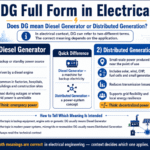
The DG full form in electrical refers to two different terms, not one: Diesel Generator and Distributed Generation. A Diesel Generator (or “DG set”) is a diesel engine coupled to an alternator that makes backup electricity on site. Distributed Generation is a grid model where many small sources produce power near where it’s used. Which one “DG” means depends entirely on context, and most pages explain only one. This guide cover both, then shows you how to tell them apart in seconds.
DG, Quick Reference
| Full form | Diesel Generator (DG set) | Distributed Generation |
| In one line | Fuel-burning standby genset | grid of many small sources near the load |
| Typical scale | 5 kVA – 3+ MVA | 1 kW – ~10 MW per unit |
| Governing standard | ISO 8528 / NFPA 110 | IEEE 1547 |
| Context giveaway | kVA, fuel, standby, ATS | net metering, feeder, interconnection |
What Does DG Stand For in Electrical Engineering?
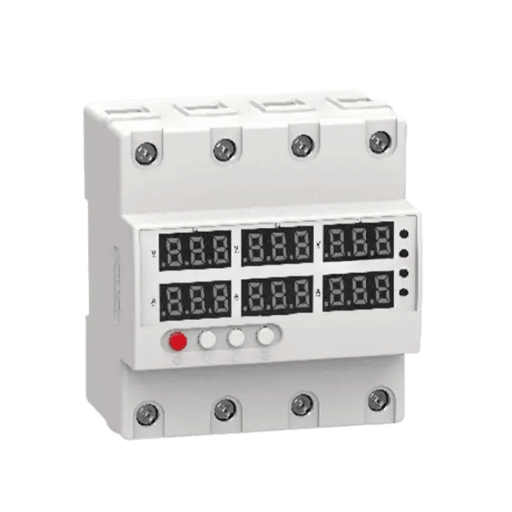
DG is an abbreviation, not a single device, and in electrical work it points to two very different ideas. The first is the Diesel Generatora machine you can touch, hear, and refuel. The second is Distributed Generationa way of organizing where electricity is made. Outside electrical engineering, DG can also mean Director General or Dangerous Goods, but on a wiring drawing, a power study, or an energy bill, it’s almost always one of the two power meanings below.
The Two-Power-Worlds DG Split
Here’s the cleanest way to hold both meanings at once. One DG consumes fuel to create power locally, on demand; the other is a philosophy of generating across many small points instead of one central plant. A Diesel Generator is a single source you own and start. Distributed Generation is a network pattern that may include diesel generators, rooftop solar, wind, fuel cells, and batteries. So a diesel generator can be one building block of distributed generation, which is exactly why the abbreviation collides. Geography tilts the odds, too: in U.S. utility and grid documents, DG almost always means Distributed Generation, while across India, the Middle East, and much of Asia, “DG set” is everyday shorthand for a Diesel Generator.
💡 Pro Tip
If a sentence treats DG as a thing with a fuel tank and a kVA rating, read “Diesel Generator.” If it treats DG as a strategy tied to the grid, feeders, or net metering, read “Distributed Generation.”
DG = Diesel Generator: The “DG Set” Meaning
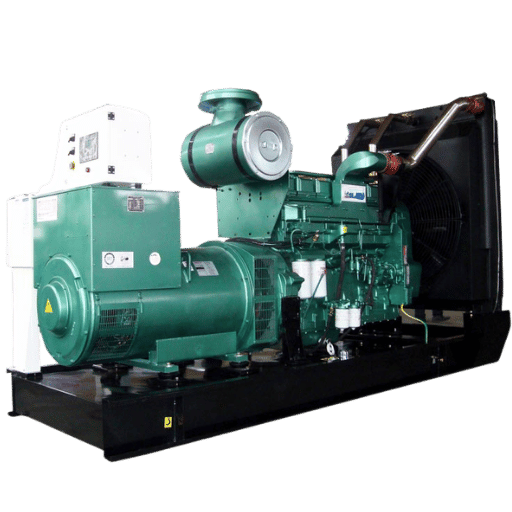
A Diesel Generatorwritten “DG set” in much of Asia and the Middle East, converts the chemical energy in diesel fuel into electricity. A compression-ignition diesel engine spins an alternator, and the alternator’s rotating magnetic field induces alternating current in its windings. Unlike a petrol set, diesel uses heat from compression instead of a spark to ignite the fuel . DG sets are the workhorses of standby power in hospitals, data centers, factories, construction sites, and off-grid locations.
How Does a Diesel Generator (DG Set) Work?
A diesel generator works by burning diesel inside an engine to spin an alternator that produce electricity. Fuel enters the cylinders, compression heats it until it ignites, and the expanding gas drive the pistons. That mechanical rotation turn the alternator, whose output is regulated by an automatic voltage regulator (AVR) before it reaches the load. Spin the engine faster and the frequency rise, which is why genset speed is locked to the grid frequency.
The DG-Set 8-Block Build
Strip a DG set down and you find eight functional blocks, each doing one job:
- ✔ Diesel enginethe prime mover (compression ignition)
- ✔ Alternatorconverts rotation into AC electricity
- ✔ AVRholds output voltage steady under changing load
- ✔ Fuel systemtank, pump, filters, injectors
- ✔ Cooling systemradiator and coolant to shed engine heat
- ✔ Control panelstart/stop, metering, protection, often an ATS interface
- ✔ Exhaust systemsilencer and after-treatment for emissions
- ✔ Base frame / skidfuel-tank base, anti-vibration mounts, optional enclosure
Two numbers come up constantly. Genset capacity is quoted in kVA, but usable power is kW: at the standard 0.8 power factor, a 750 kVA set delivers 600 kW (kVA × 0.8 = kW) . And the engine speed is locked to frequency by the relation F = (P × N) / 120, so a 4-pole alternator runs at 1500 rpm for 50 Hz or 1800 rpm for 60 Hz. Fuel burn scales with load, a 100 kW set uses roughly 2.6 gal/hr at quarter load and 7.4 gal/hr at full load .
📐 Engineering Note
Bigger isn’t safer. Running a diesel set far below its rating causes wet stackingunburned fuel glazes the cylinders and exhaust, leading to fouling and eventual engine failure . This is why data centers keep load banks on hand and why a US patent for hybrid diesel-PV systems specifically applies dummy loads to prevent wet stacking . Size a DG set to its real load, not to a comfort margin.
Two standards govern this side of DG. ISO 8528 defines the application, rating, and performance of reciprocating-engine generating sets, and NFPA 110 sets the performance rules for emergency and standby power systems.
DG = Distributed Generation: The Decentralized-Grid Meaning
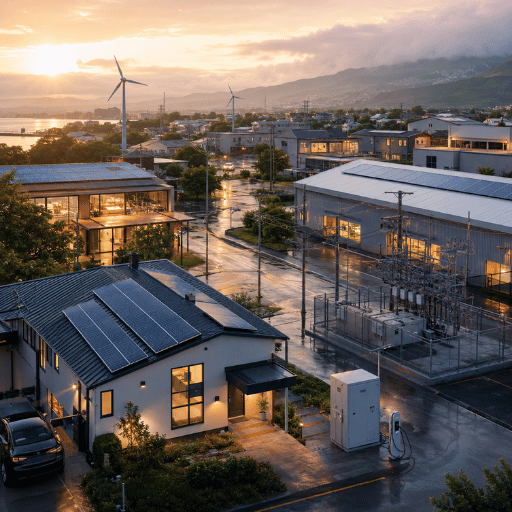
Distributed Generation is electricity generated at or near the point where it’s used, rather than at a large central power plant. The U.S. EPA defines it as technologies that “generate electricity at or near where it will be used, such as solar panels and combined heat and power” . Because the power is made close to the load, less is lost in transmission, and customers can keep critical equipment running during outages when storage or a genset is present.
What Is Distributed Generation, With Examples?
Distributed generation is any small generator that feeds power near the place it’s consumed instead of from a distant plant. Examples include rooftop solar, a hospital’s combined-heat-and-power unit, a campus microgrid, a fuel cell behind a factory meter, and yes, a backup diesel generator.
The U.S. EIA frames it as generation that “connects to the electric grid and is meant to directly offset retail sales” . The scale is real and growing: U.S. small-scale solar capacity rose from 44 GW to 55 GW through 2024, and California alone has installed over 20,520 MW of distributed generation.
| DG source | Prime mover | Typical scale | Dispatchable? |
|---|---|---|---|
| Rooftop solar PV | Photovoltaic panels | 1–20 kW | No (weather) |
| Commercial solar | PV array | 100 kW–5 MW | No (weather) |
| Small wind | Wind turbine | 1 kW–1 MW | No (wind) |
| Microturbine | Gas turbine | 30 kW–1 MW | Yes |
| Reciprocating gas engine | IC engine | 50 kW–10 MW | Yes |
| Fuel cell | Electrochemical | 1 kW–3 MW | Yes |
| Small hydro | Water turbine | 100 kW–10 MW | Partly |
| Biomass / biogas | IC engine / turbine | 100 kW–5 MW | Yes |
| Battery storage | Inverter + cells | 5 kW–20 MW | Yes (limited) |
Scale bands compiled from EIA, NREL, and IEEE 1547 source classifications.
“Distributed generation is a most interesting concept in that it benefits those who employ it, and eventually benefits those who don’t… lower energy cost, more continuous power availability, and in many instances, cleaner power than what is commercially available.”
Sheldon Steiner, PE, “The ABC’s of DG,” Consulting-Specifying Engineer
Connecting any of these sources to the utility grid is governed by IEEE 1547, the interconnection standard for distributed energy resources.
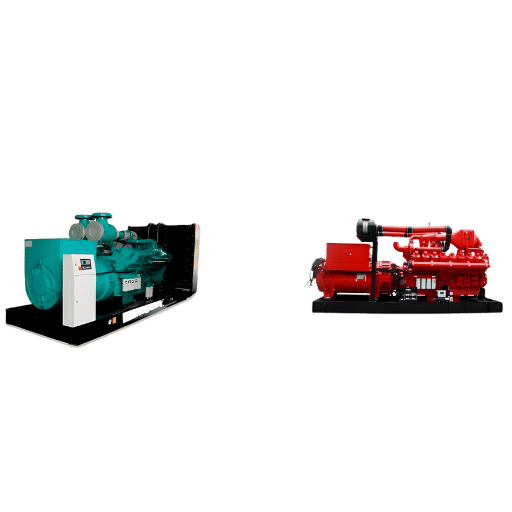
Diesel Generator vs Distributed Generation: 9-Axis Side-by-Side
| Axis | Diesel Generator (DG set) | Distributed Generation |
|---|---|---|
| What it is | A machine | A grid model |
| Scale | 5 kVA – 3+ MVA | 1 kW – ~10 MW units |
| Prime mover | Diesel engine | Solar, wind, engine, fuel cell, storage |
| Location | On site, single point | Many points near loads |
| Primary role | Backup / standby power | Offset grid supply, resilience |
| Dispatchable | Yes, on demand | Mixed (solar/wind are not) |
| Emissions | Diesel exhaust (Tier 4) | Often low / zero (renewables) |
| Typical owner | Facility / building owner | Owner, utility, or community |
| Governing standard | ISO 8528, NFPA 110 | IEEE 1547 |
Overlap is real here: a backup diesel generator that can export to the grid is a form of distributed generation. What differs is framing, one word names the hardware, the other names the strategy of where power generation happens. Each side also answers to its own rulebook: ISO 8528 and NFPA 110 for the diesel set, IEEE 1547 for grid-tied distributed generation.
How to Tell Which DG a Document Means
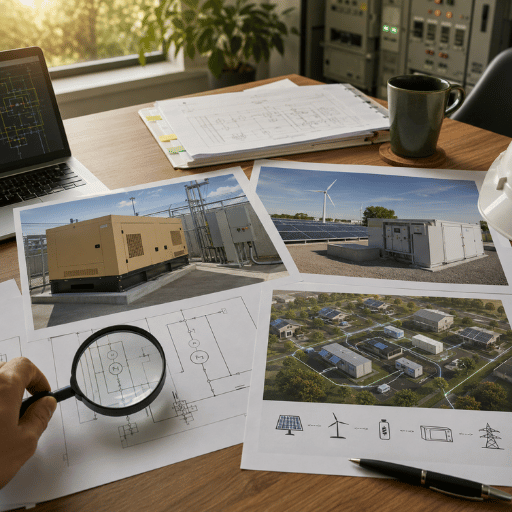
When a spec, drawing, or report says “DG” without spelling it out, the surrounding words almost always give it away. Most readers’ first guess, that DG always means diesel, is fair in a building-services drawing but wrong in a grid-interconnection or renewable-energy document. Use the clues below.
| If you see nearby… | DG most likely means |
|---|---|
| kVA / kW rating, fuel tank, litres/hour | Diesel Generator |
| “standby,” “prime,” ATS, transfer switch | Diesel Generator |
| sound enclosure, radiator, exhaust silencer | Diesel Generator |
| NFPA 110, ISO 8528, Tier 4 | Diesel Generator |
| net metering, feed-in tariff | Distributed Generation |
| feeder, interconnection, IEEE 1547 | Distributed Generation |
| rooftop solar, PV, inverter, behind-the-meter | Distributed Generation |
| microgrid, DER, penetration, decentralized | Distributed Generation |
| utility, retail sales offset, grid-tied | Distributed Generation |
| U.S. DOE / NREL / FERC or grid-code document | Distributed Generation |
| Indian / Asian “DG set,” tender, pollution-control NOC | Diesel Generator |
| shipping manifest, government org chart | Neither (Dangerous Goods / Director General) |
Practitioners hit this ambiguity often. On one electrical forum, a member reading a drawing asked plainly whether “DG” meant Diesel Generator, exactly the moment this table is built for . When the document is a grid-interconnection study, the governing reference is IEEE 1547; when it’s a standby-power spec, it’s NFPA 110.
DG in Industrial Power Systems, and Where Electrical Safety Fits
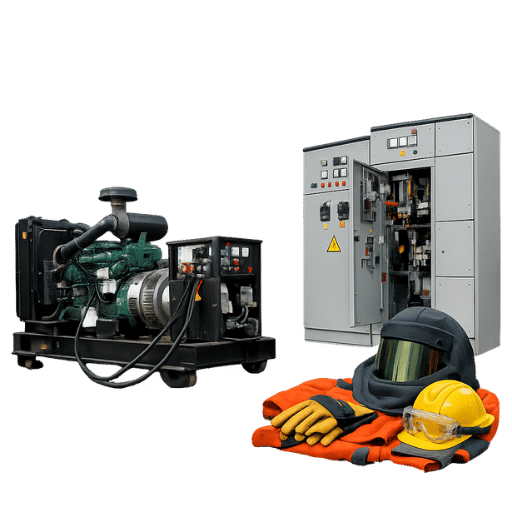
Inside a factory, both DGs show up. A diesel generator sit as standby behind the main supply, and many plants are adding on-site distributed generation, rooftop solar, storage, sometimes a small microgrid, to cut cost and ride through outages. Often the two work together: a DG set covers the gap until grid power or renewable output returns.
This is where power and machine safety meet. When a facility transfers from grid to genset, or runs partly on its own distributed generation, the machinery on the floor must stay safe through the switchover. The industrial machine safety solutions that protect operators, light curtains, safety relay modules, and emergency stops, depend on a clean, predictable power feed and a defined restart behavior.
📐 Engineering Note
Across an automatic transfer switch (ATS) event, confirm that safety circuits do not auto-restart guarded machinery on power return. Machine electrical equipment is governed by IEC 60204-1, and the safety functions themselves by ISO 13849 performance level and IEC 61508, a different compliance layer from the power-system standards (NFPA 110, IEEE 1547) that govern the DG source itself. Verify that genset frequency and voltage match each machine’s nameplate before re-energizing the line.
Industry Outlook: Why Both DGs Are Growing (2025–2026)
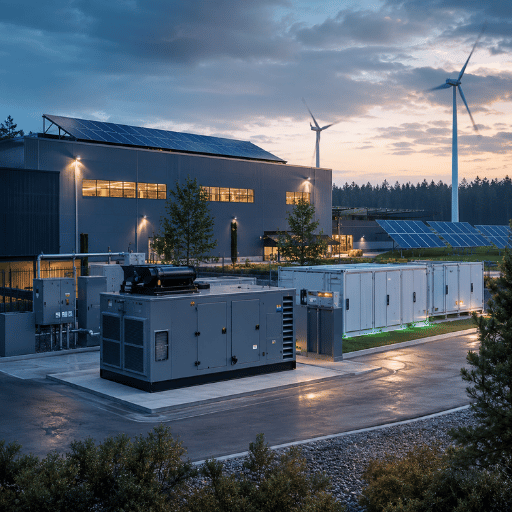
Search and market data point the same way: both meanings of DG are rising, for different reasons. On the diesel side, the AI-driven data-center buildout has pushed backup demand hard, installed diesel generator capacity at U.S. data centers nearly tripled from about 20 GW in 2018 to 55 GW in 2024. The diesel generator market is projected to grow from USD 19.33 billion in 2025 to USD 40.99 billion by 2033, a 9.9% CAGR . One caveat worth reading carefully: rising capacity isn’t rising runtime. Under U.S. EPA stationary-engine rules, an emergency standby genset may run unlimited hours in a true emergency but only about 100 hours a year for maintenance and testing , which is part of why so many DG sets spend their lives lightly loaded, and why wet stacking keeps showing up.
On the distributed-generation side, growth is driven by falling solar costs, microgrids, and decarbonization targets, backed by tighter interconnection rules. IEEE 1547 gained its 1547a amendment in 2020, and NFPA 110 reached a 2025 edition adding reliability-centered maintenance. The practical takeaway for buyers: state which DG you mean in every RFQ and spec, because the wrong reading turns a backup-power request into a grid-interconnection project.
Frequently Asked Questions
Q: What does DG mean in electricity?
View Answer
In electricity, DG has two full forms: Diesel Generator and Distributed Generation. A Diesel Generator is an engine-driven machine that makes backup power on site. Distributed Generation is a grid approach where electricity is produced near where it is used, from sources such as solar, wind, fuel cells, and gensets. The correct reading depends on context.
Q: What is the full form of DG power backup?
View Answer
In a power-backup context, DG stands for Diesel Generator, often called a DG set. It is a diesel engine coupled to an alternator that supplies electricity when the main grid fails. DG sets are rated in kVA, sized to the connected load, and are common in hospitals, data centers, and industrial facilities for standby and emergency power.
Q: What is the principle of DG?
View Answer
For a Diesel Generator, the principle is energy conversion: a diesel engine burns fuel to create rotation, and an alternator converts that rotation into electricity. For Distributed Generation, the principle is location: generate power close to the load to cut transmission losses and add resilience, instead of relying only on a distant central plant.
Q: Is DG only diesel?
View Answer
No. DG most often means Diesel Generator in backup-power contexts, but in grid and energy documents it means Distributed Generation, which includes solar, wind, fuel cells, and battery storage. Outside electrical engineering entirely, DG can also stand for Dangerous Goods or Director General.
Q: What size DG do I need for a facility?
View Answer
Size a DG set to your real connected load in kW, not to a comfort margin. Oversizing a diesel generator causes wet stacking and engine damage, so a correctly loaded set is both safer and cheaper to run over its service life. For a precise figure, total the running and starting loads it must carry.
Q: How does DG interact with the main grid?
View Answer
A standby Diesel Generator usually runs islanded, taking over through an automatic transfer switch when the grid drops, so it is never synchronized to the utility or feeding power back. Distributed Generation is the opposite: a source that exports to the grid must follow the IEEE 1547 interconnection standard, which sets voltage, frequency, and protection requirements for connecting safely. That contrast — islanded backup versus grid-tied export — separates the two DGs.
About This Explainer
We build industrial safety sensors, not generators, so this guide stays neutral and source-led. We wrote it because our engineers kept seeing “DG” used for both Diesel Generator and Distributed Generation across the same plant documents, and no single reference disambiguated the two. The definitions, standards, and figures here are drawn from EPA, EIA, IEEE, NFPA, and ISO. Reviewed by the CCH Shanghai Sensing (QJKH) technical team.
References & Sources
- Distributed Generation of Electricity and its Environmental ImpactsU.S. EPA
- Distributed GenerationU.S. Energy Information Administration (EIA)
- IEEE 1547, Interconnection of Distributed Energy ResourcesIEEE Standards Association
- NFPA 110, Emergency and Standby Power SystemsNational Fire Protection Association
- ISO 8528, Reciprocating IC Engine Driven AC Generating SetsInternational Organization for Standardization
- The ABC’s of DGConsulting-Specifying Engineer (Sheldon Steiner, PE)
- Understanding Stationary Engines (RICE) RulesU.S. EPA
Related Articles
- Functional safety standardshow IEC 61508, ISO 13849, and IEC 62061 fit together
- Emergency stop safety relaystop categories and safe restart after power loss
- Machine guarding requirementsOSHA rules for safeguarding powered machinery