
Get in touch with QJKH Company

A muting safety light curtain is a presence-sensing safeguard specifically designed to allow the protection afforded by the beam to be “faded out”—temporarily suppressed—when permissioned material (usually a pallet on a conveyor) enters the opening, while retaining the ability to sense a human who tries to walk through with it. How simple does that sound? Doing the engineering to a level where you can pass an OSHA inspection, a ISO 13849 Performance Level audit, and the rough-and-tumble of forklift traffic is a whole different project.
This article was written for the plant engineer, EHS professional, or controls integrator who already knows about wiring a muting kit and needs to field tougher questions: when, if ever, should muting be used, which standards actually apply, what failures have been documented by OSHA, what needs to be in the report to the auditor? If you need product-level directions for setting up a certain kit, our QJKH muting safety light curtain systems page will help you. Our engineering principles behind the hardware are outlined below.
Quick Specs: Muting at a Glance
| Primary design standard | IEC 62046:2018 (Application of protective equipment) |
| Muting circuit Performance Level | Per ISO 13849-1 — must equal PL of suspended safety function |
| Hardware classification | IEC 61496-1:2020 Type 2 or Type 4 AOPD |
| Minimum muting sensors | 2 independent signals (4 for bidirectional pallet flow) |
| Maximum muting time | 4 seconds after first muting sensor clears |
| Test-cylinder rejection | 500 mm matt-finish cylinder must not trigger muting |
| Typical d5 ceiling | <= 200 mm (derived from ISO 15534-3 285 mm 95th-%ile foot) |
What Muting Actually Does (And Why Cycle Economics Demand It)

This formal engineering standard is IEC 61496-1, which states – among other things – muting is a “temporary automatic suspension of a safety function by safety-related parts of the control system”. ISO 13849-1 Section 5.2.5 contains the corollary every design professional commits to learning—”Muting shall not result in any person being exposed to hazardous situations. During muting, safe conditions shall be provided by other means.”
muting sensors—at least two, wired as separate hardwired safety signals —must respond to a material feature which cannot arise “by accident” from a human walking through. When both signals assert within a properly timed window, the light curtain’s shielding function is temporarily suspended. Once material clears, full protection automatically reinstates. During muting, the OSSD outputs return to the ON state, making the function “safe” in the ISO sense: the controller has actively confirmed the absence of a person.
Why does this function have a place in a Body of safeguard standards that make an effort to take bypass off the table? Because the packaging line on a 12 second pallet transit at 90 cycles per hour wastes about nine hours per week in point less stops; and because such costs encourage users to bypass the safeguard on the sly which is the default state-by-state outcome we want to avoid. Muting is the legal way out of that trap. A system that can pass muster presumes your scratch-the-head alternatives in the ISO 12100 safeguarding hierarchy (fixed guards, interlocked gates, other engineering controls) have failed in a specific material flow geometry.
| Aspect | Muting | Blanking |
|---|---|---|
| Trigger | Real-time muting-sensor sequence | Fixed-beam configuration at setup |
| Suspension scope | Entire protective field, temporarily | Specific beams, permanently masked |
| Intended use | Dynamic material flow (pallets, totes) | Static obstructions (machine fixtures) |
| Governing clause | IEC 62046:2018 + ISO 13849-1 Section 5.2.5 | IEC 61496-1 supplier configuration |
The Standards Landscape: IEC 62046, ISO 13849, and Regional Variations
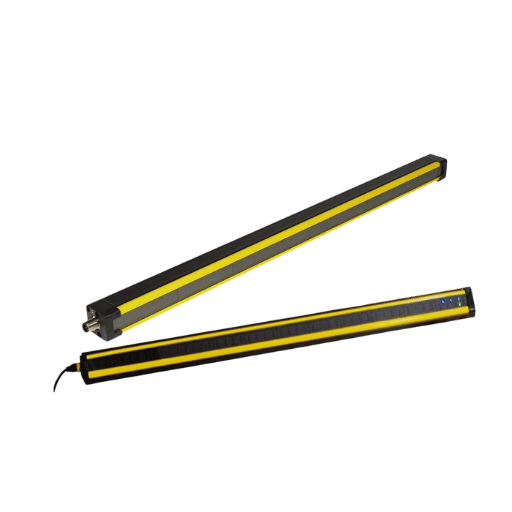
This muting function is the point where three international standards and a loose federation of regional regulations collide. Getting the geometry right in a body of standards that otherwise criticizes bypass has its own complications, but the other half of the equation is you having the right clause when an inspector questions why you cited that dimension.
Q: What safety standards apply to a muting light curtain system?
IEC 62046:2018, the application standard for person detection protection equipment. Our design bible for muting: sensor geometry (informative Annex D), sequence timing, 4 sec. max muting time, the 500 mm test-cylinder rejection rule, the muting lamp annunciator. One hidden nuance that always trips up the competition, Annex D is Informative (not normative).
The geometry figures are an informative illustration only; all the examiner determines (for approval / type test purposes) is the 500 mm object-detection test and sequence logic.
ISO 13849-1- functional safety of control systems. This is the stage where the muting circuit is tested. There is only one regulation that is as critical as the safety of the muting circuit- Performance Level of muting logic must be greater than or equal to the Performance Level of the safety function being muted.
What is showsification of a curtain with a PLd rated controller to a PLe-rated curtain reduces the overall safety integrity. Structural parameters- Category, MTTFd, Diagnostic Coverage, Common Cause Failure- work in conjunction to produce an achievable PL which then has to be compared to the PL required by the risk assessment.
IEC 61496-1:2020—classification of hardware. Type 2 AOPDs are allowed for muting at lower risks, with type 4 being required where the risk assessment dictates it (all but the most press, robotic-cell and high-cycle palletising examples).
| Region | Primary legal instrument | Consensus standards commonly cited | Enforcement posture |
|---|---|---|---|
| United States | OSHA 29 CFR 1910.212 (general machine guarding); 1910.217(c)(3)(iii)(d) (press muting) | ANSI B11.19, ANSI/RIA R15.06 | Defers to consensus standards under General Duty Clause; willful bypass triggers Severe Violator Enforcement Program |
| European Union | Machinery Directive 2006/42/EC (and successor Regulation 2023/1230) | EN 62046 (harmonised), EN ISO 13849-1, EN 61496-1 | CE marking requires presumption of conformity through harmonised standards; non-conformity blocks market access |
| Ontario, Canada | Ontario Regulation 851 (under OHSA) | CSA adoptions of ISO/IEC; Pre-Start Health & Safety Review | Employer obligation to prevent hazard access; PSR required on line changes |
| China (baseline) | GB/T equivalents of ISO/IEC | GB 5226, GB/T 16855 (ISO 13849 equivalent) | Baseline alignment with IEC/ISO; detail enforcement varies by province |
The US case warrants a little more examination because it’s where OSHA’s position is the most misinterpreted by non-US purchasers. OSHA itself signs only a little muting specific regulation text; the lone federal direct mention is 29 CFR 1910.217 which allows muting of a presence sensed device on a mechanical press “during the upstroke of the press slide (… for) parts ejection, circuit checking and feeding”—so long as the die isn’t more than 1/4” above the workpiece. For every other use, OSHA relies on the General Duty Clause and the consensus standards in ANSI B11.19.
It’s that third party outlook which makes the American enforcement story less about “breaking IEC 62046” and more about whether the bussiness worker followed an established care standard.
The Muting Decision Framework: When Should You Use It?

This Framework below integrates criteria from IEC 62046, principles from the ISO 12100 risk-assessment, and field-engineering norms, that you should use to guide your risk assessment, not substitute it. Only a formal risk assessment can produce a defendable design.
To be sheer right,’the setup must satisfy four combined conditions: the opening is one of high-time-to-move-through-cycle;’the material’s geometric signature is relatively repeatable’;the operator is truly at risk of reach-over into the muted zone;and,the down-time penalty of pro-muted operation would be sufficiently great to make informal defeat tempting. If use of a given safeguarding strategy can’t meet one of those four–most must score higher than muting on the ISO 12100.
Three red flags tell you muting is the wrong answer. variable load geometry – 1200 mm long now, 600 x 800 shrink-wrapped carton stack on the line tomorrow – makes both your variable load profile test bars and your variable load geometry test cylinders a worth less roulette wheel of false passes. operator Workstation in range of the muted zone – reach-around risk jumps from the factory floor to the human factor as soon as a person operates inside the muting circle for a reason outside the material. no documentation or training program to justify in-canvas muting as the ultimate test of a reliable installation – muting is the safeguarding strategy that table-stakes the greatest lifetime nagging validation effort, and a shop unwilling to write a functional test method for a muted line should not own one.
“Our engineering team reviews every ENT-series muting light curtain request using these four filters before we agree to execute the installation. At that point a significant percentage of questions are better solved with a presence-sensing device interval-startup retrofit or a gated interlock – the fact that muting can be engineered is irrelevant without evidence that it should.”
Muting Appropriateness Decision Matrix
| Application scenario | Best-fit strategy | Why |
|---|---|---|
| Fixed-size pallet, exit-only, >60 cycles/hr | Muting (L-config) | Predictable geometry + high cycle rate justify the audit burden |
| Bidirectional pallet flow, mixed load sizes | Muting (T-config or 4-beam) | Direction-discrimination required; 4-beam gives length validation |
| Operator loads parts at the opening between cycles | Two-hand control + dual curtains (alternating mute) | Personnel access is the use case; muting alone leaves reach-around risk |
| Press-feeding / part ejection cycle | PSDI (Presence-Sensing Device Initiation) | Eliminates the pedal; cycle-triggered by curtain break-and-clear |
| Irregular or unpredictable material geometry | Interlocked gate or tunnel guard | 500 mm cylinder rejection cannot be guaranteed across load mix |
| Fixed obstruction in the beam field (machine fixture) | Blanking (fixed) — not muting | Static obstruction, no dynamic material flow |
Sensor Configurations Decoded: Cross, Parallel, 4-Beam — and How Each Fails Differently
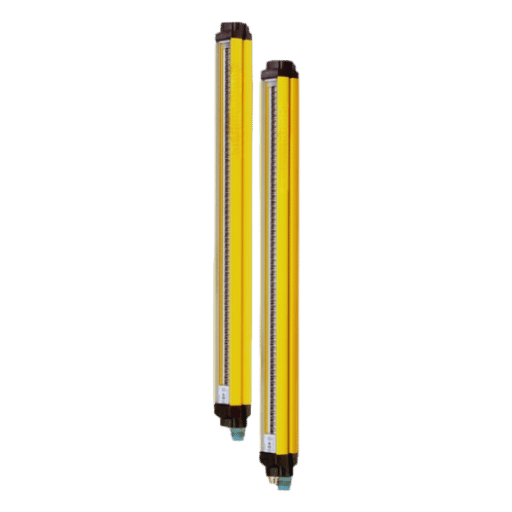
IEC 62046 Annex D presents three acceptable arrangements of sensor – each addresses a different shape problem and each has a known failure mode that design engineers should assume will occur, not that might.
Q: What is cross muting, and how does it differ from parallel muting?
Cross muting – the T-configuration – uses two single-Alyuu safety-rated sensors with two Naloughs in the dangerous space. The two Naloughs within the danger zone have to open at exactly the same time for muting to occur, and a genset-control led timer maintains the 4-second envelope. This T-config is the IEC 62046 example for bidirectional pallet flow, with a reliable failure mode called cross point drift where an impact or a midway pallet pushes the sensor just far enough out of alignment that the intersection point is outside the danger zone. In the field, things look fine at the paper level but a person can follow load right through the gap.
Parallel muting – the L-configuration – puts two sensors on one side of the curtain, time ordered by a genset. When loads reach the J7dotiig, one S systems see between the load. They then see-one, then two whole S Systems, then the curtain extension. Should the first S system see a person before the second, the muting controller faults. The L-configarrangement is the IEC 62046 reference for outbound-only flow with inbound ingress hazards, with a known failure mode of sequence spoofing, where a person moves a hand across the J3it7o% without really having to go in.
There is no comparison of safety ranking in these two arrangements. they each fit a specific molar flow pattern – T-arrangement for bi-directional, L-arranged for outbound only. I order to decide safety-performance you are asking the wrong question.
Four-beam parallel T-configuration is the high-assurance option—four sensors, two pairs, bidirectional flow with length validation, keeping d1 and d3 below 200 mm, while maintaining a d2 over 250 mm between the two inner sensors. Four sensors operate as a bundle for just a moment, in a sequence d1d2d3 spaced so that the overlaps are correct. Failure signature here is a calibration-drift multiplying effect: four sensors, thus four potential misalignments, which an quarterly field check can peek around better than an annual schedule can.
📐 Engineering Note — The 200 mm Rule Has a Body Behind ItThe 200 mm ceiling on d1 and d5 isn’t just for fun, nor was it a ‘thought-out’ decision. It is actually an explicit reference back to the functionally anthropometric of the ISO 15534-3, which has a 95-percentile human foot length of 285 mm. Anyone taking a pallet into the muted zone would have to plant his or her leading foot in the sensor envelope in the moment before crossing the threshold of the zone—an obvious no-go.
Keep the d5 as short as possible along the given mechanical layout; 200 mm ceiling, not target.
All of our ENT muting systems (except laterally separated MAPs) are engineered to get d5ME under 150 mm, which is more restrictive than IEC 62046 requires (with a maximum of 200 mm). Conveyor retrofit field data shows that keeping a tighter spacing prevents the emergence of nuisance trailing-edge detection faults that would otherwise motivate operators to develop work-arounds.
No matter what combination you finally settle on, the rule is immutable: it must be possible to mount the muting sensor with the lowest beam just barely be above the lowest beam of the corresponding protective curtain. The integrity of the installation is challenged by a simple test: a 500 mm matt-finish test cylinder with the ISO-125 sliding down each sensor, fed up from the floor to the sensing field, cannot cause isolation on its own – that has to be established during commissioning, and then repeated annually. If that line does not pass with flying colors, you have no justificable installation, no matter what your paperwork says.
Retrofitting muting function to an existing Type 4 light curtain?
Consult our Type 4 safety light curtain guide first—the wrong hardware class at the beginning undoes everything downstream.
Why Muting Installations Fail: Documented Failure Patterns
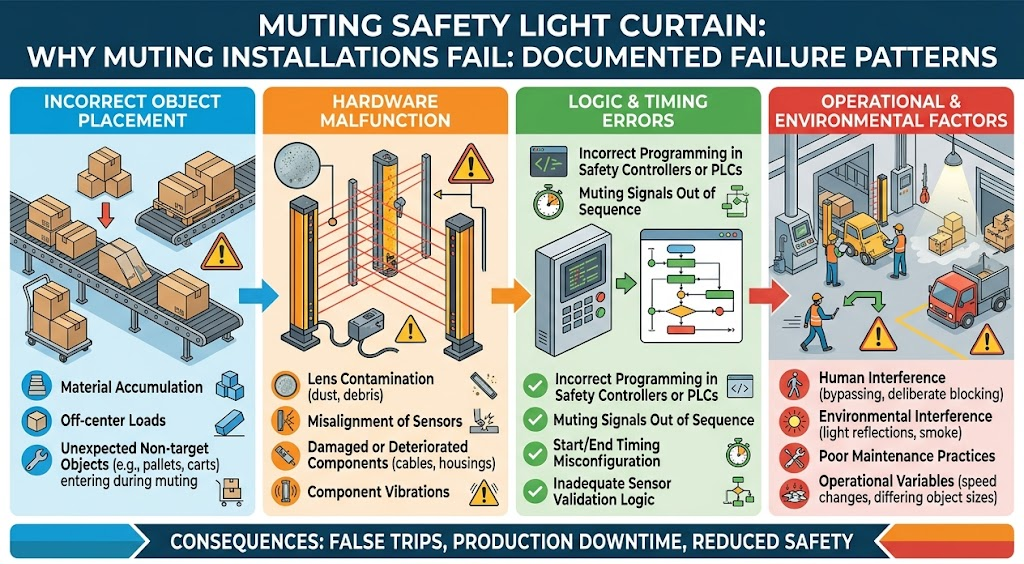
The most instructive failure signal in this US record is not a sensor drift, it is a fairly marked cultural one. As of May 2023, the US department of labor has added United Hospital Supply corp. of Burlington, New Jersey to the OSHA severe violator enforcement program following an incident in November 2022 in which a new employee, on his first day, has a three-finger amputation at a press brake. The OSHA finding was clear: a willful violation was identified due to “supervisors and employees intentionally circumventing the press brake light curtain which resulted in the amputation.” The proposed penalty summed to $498,464, and was distributed over three willful violations, 17 serious violations, and one other-than-serious violation.
Previous OSHA inspections in 2010 and 2015 had already identified the machine-guarding deficiencies.
This case is worth mentioning not because it is exotic, but because it is normative.Industry audit findings from professional-engineering firms agree: a small number of failure modes dominate what we call cluster failure, falling into two groups–static technical failures, and overt policy failures.
The silent technical failures
Our most dangerous consequence category is photo-eye dual-misalignment. Jason IP, P.Eng. (Controls Engineering), traces the fault pattern with a Sick UE410-MU muting relay–if two pallets bump the muting eyes simultaneously, the controller receives a dual-blocked muting signal, and workers may pass freely through the curtain without triggering shutdown. Standard IEC 61496-1, and ISO 13849-1 fault-detection demands manage only this class of failure when an appropriately configured fault-logic is employed–a step vendor default settings can sometimes bypass.
This second silent failure mode is crosspoint drift in T-configurations. One forklift bump, or a series of pallet nudges, induces 2-5 degrees of Kadalth rotator travel, swinging the beam intersection outside the hazard zone while appearing to function normally. Because the PLC-sighted beams come to rest as scheduled, no fault appears.
Subtle cabling failures round out the set. A field technician, posting on the PLCtalk forum, documented an all-day troubleshooting process searching for a muting system prone to not-latch. One answer: a stubborn 120 V pilot bulb, substituted for a 24 VDC one, starved a muting relay’s required 25 mA signal current. No ANSI/ASSE/OSHA (or IEC 61508) standard mandated this particular error, but an acceptance test that reads actual input current on every muting input sparks the component’s readiness before we put it on the frame.
Overt policy failures
Professional-engineering firms around the world auditing field conditions constantly mention a few spared-from-design failures–resources always on muting using touch controls or relays; a single sensor wired into both safety channels to defeat the dual-signal requirement; hyper-timed safe windows extremely liberal at allowing a worker to tailgate a pallet through the muted field; nonstop muting lamps; and light curtains spaced too close to the hazard to allow machine stop in time. Each is an explicitly considered policy decision, not a component failure. Each is what an OSHRC hearing intones as a willful violation when an accident occurs.
⚠️ The Cultural Failure Signal
The three softsteps that occur in advance of a hard muting failure: jealous operator complaints about “nuisance trips,” a maintenance log note tracking muting-sensor realignment, and a shop-floor dialogue where “we just tape it” and “the jumper makes it work” show up one day. Either one makes for an intervention to happen before the next accident, not the next inspection.
Installation Validation & Documentation: The Audit Trail
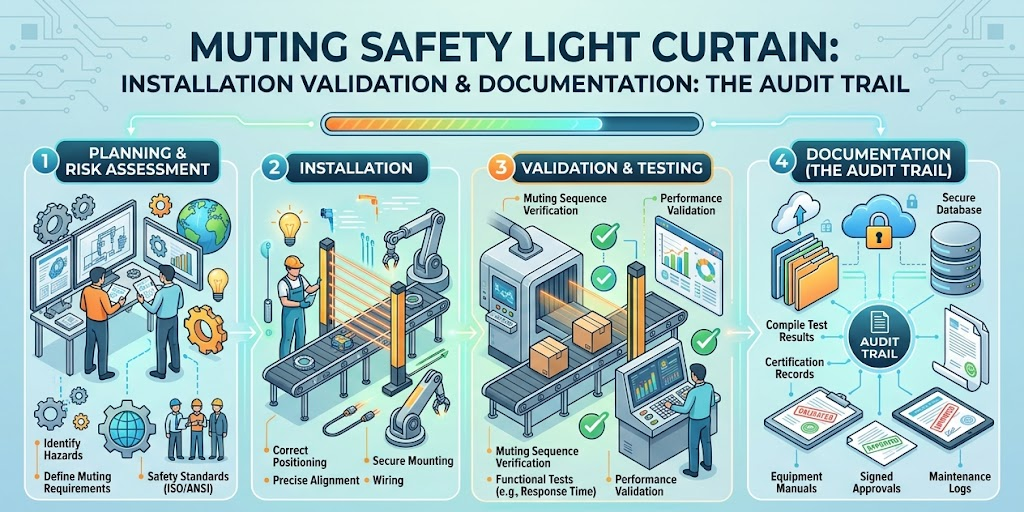
Safety-rated muting can kits with integrated SRB-2A1B safety relays are not enough to make a compliant, world-class installation. Their compliance documentation is what inspectors, CE technical file reviewers, and risk engineers engaged in can make sense of. Hereinafter our consent-formative inspection bill: confirm before production, confirm through commissioning, then confirm periodically after.
- ✔
Pre-commissioning. Documented hazard assessment per ISO 12100; required PL derived from the risk graph (S1/S2, F1/F2, P1/P2); hardware-class justification for Type 2 or Type 4 AOPD; sensor-placement engineering review with conveyor-speed timing calculation. - ✔
Commissioning test protocol. 500 mm matt-finish cylinder test at floor level and at each beam increment; sensor-sequence fault injection (reverse order, single-sensor, dual-blocked); muting-timer verification using a calibrated timer at the fastest conveyor speed; OSSD response-time measurement under muted and un-muted states; muting lamp visibility from the intended operator vantage point. - ✔
Records set. Risk assessment record, PL calculation worksheet with MTTFd / DC / CCF inputs, installation drawings including all d1/d2/d5 dimensions, wiring diagrams for dual-channel independence, commissioning functional test log, operator and maintenance training records. - ✔
Periodic revalidation. Functional test (full commissioning protocol repeated) at an interval consistent with the mission time assumed in the PL calculation — field practice across professional-engineering audits lands near 12 months for single-shift operations and 6 months for multi-shift. Sensor alignment check quarterly for T-setups.
One rule rules all 4 check point: if you cannot provide an record on demand, safeguarded shop still in non-compliance at the point when the knowpower still in within range. Auditors substitute non-existing paperwork with the same reliability it substitutes absent safeguard:
Frequently Asked Questions
Q: Are muting safety light curtains required by law?
View Answer
No standard compels you to use muting- but if you require material bypass a safeguarded blank space without halting the line, international consensus standards (IEC 62046, ISO 13849-1) demand that any suspension of protection be implemented as a compliant muting function rather than a kluge. EU CE marking under the Machinery Directive mandates presumption of conformity via EN 62046. In the US, OSHA’s General Duty Clause operationalises consensus standards indirectly via ANSI B11.19.
Q: Is it legal to bypass a muting light curtain to clear a jam?
View Answer
Deliberate bypass is a willful OSHA violation, and a violation of the employer’s lockout/tagout responsibility as defined in 29 CFR 1910.147. United Hospital Supply Corp.(DOL, 2023) applied $498,464 in potential fines and Severe Violator Enforcement Program placement, after a supervisor-enabled bypass resulted in an amputation. Jam clearance belongs in a lockout/tagout procedure with hazardous energy isolated, not a muting-defeat exploit.
Q: What Performance Level does a muting circuit need to meet?
View Answer
ISO 13849-1 Sec 5.2.5 requires PLe of the muting circuit equals PLe of the safety function being suspended. A PLe-rated light curtain muted powered by a PLd controller yields a PLe-d overall system- the weak link rules. Most industrial muting installations ground at PLe or PLe in practice, driven by the risk-graph parameters of the implementation application.
Q: Is cross muting safer than parallel muting?
View Answer
Both configurations are equally safe. T-setup (cross) accommodates bidirectional pallet traffic; its signature risk is crosspoint drifting from mechanical contact. L-setup (parallel) handles exit-only traffic; its signature risk is sequence spoofing. The relevant question is which traffic pattern does your conveyor actually have- pick the configuration that matches it, then engineer out its characteristic failure mode.
Q: How often must a muting light curtain installation be revalidated?
View Answer
No ISO/IEC standard specifies a uniform calendar interval. ISO 13849-1’s mission-time specification drives the calculations- the PFHd assumption in your PL calculation establishes an upper bound on its useful life. Technical practice among professional engineering audit vendors settles on 12 months for single-shift fabrication, 6 months for multi-shift, with a sensor-alignment check each quarter on T-setup. Log your chosen interval into the technical file and stick with it.
Q: Can operators add muting to a non-muting light curtain themselves?
View Answer
Retrofit is viable only if the curtain’s safety relay or controller permits dedicated muting inputs that satisfy the dual-channel hardwired-signal condition. Affixing generic photo eyes to a standard-duty relay does not constitute a compliant muting function, no matter how the wiring appears on the schematic. Retrofit is a new safety function- complete withits own risk assessment, PL calculation, commissioning test and records- treat as new installation, not a modification.
Q: What is the difference between muting and override functions?
View Answer
Muting is automatic and sensor-triggered – no operator action Overrideis a deliberately triggered operator command that is normally key-switch-authorised and time-limited to 15 seconds to 60seconds (example), and used to clear a specific fault condition (example) such as a jammed pallet requiring the muting cycle to be broken mid-cycle. Overrideis governedby separate IEC 62046 clauses and should be recorded. Never ignore random overrides – they are the governor that stands between you and an OSHA willful-violation citation.
Sourcing and Scope of This Muting Guide
This muting safety light curtain guidewas provided by the QJKH engineering team from more than two decades of manufacturing experience in industrial safety sensors (standard reference material from IEC 62046:2018 and ISO 13849-1), and several open-source enforcement records from OSHA and the US Department of Labor. In places where a specific statement is attributable to field audit practice not a normative clause, the article notes it as afootnote – an honest confirmation that “it depends” is an engineer’s code, not a license to skip engineering duty.
References & Sources
- IEC 62046:2018 – Safety of machinery: Application of protective equipment to detect the presence of persons – International Electrotechnical Commission
- ISO 13849-1 – Safety of machinery: Safety-related parts of control systems – International Organization for Standardization
- IEC 61496-1:2020 – Electro-sensitive protective equipment, Part 1 – International Electrotechnical Commission
- ISO 15534-3 – Ergonomic design for the safety of machinery, Part 3: Anthropometric data – International Organization for Standardization
- OSHA 29 CFR 1910.212 – General requirements for all machines – U.S. Occupational Safety and Health Administration
- OSHA Machine Guarding eTool – Presence Sensing Devices – U.S. Occupational Safety and Health Administration
- OSHA Directive CPL 02-00-147 – Machine Guarding – U.S. Occupational Safety and Health Administration
- DOL Press Release 23-971-NEW – United Hospital Supply Corp. Severe Violator placement (May 2023) – U.S. Department of Labor
- IFA Report 2/2017e – Functional safety of machine controls (Application of EN ISO 13849) – DGUV (German Social Accident Insurance)
- A3 Association for Advancing Automation – light curtains: Safety Applications and Emerging Trends – Automate.org
Related Articles
- Type 4 safety light curtain: Selection & Standards Guide – classification logic for hardware class before specifying muting
- Finger- and Hand-Protection light curtain: Optics Deep Dive – resolution selection (14/30/90 mm) for point-of-operation guarding
- Elevator light curtain: Standards & beam-Count Guide – companion application for adjacent code requirements
- QJKH safety light curtain product family – full product range including muting, Type 4, and elevator variants