Get in touch with QJKH Company

Quick Specs: Safety Laser Scanners for AGV & AMR
- Protection Range: 3–9 m (model dependent)
- Warning Range: 20–40 m
- Scanning Angle: 270°–300°
- Safety Rating : IEC 61496 Type 3 SIL 2 PLd Cat 3
- Governing Standard: ISO 3691-4:2023 (driverless industrial trucks)
- Market Size : $532 million in 2026, forecast 6.2% CAGR through 2031
A safety laser scanner for AGV and AMR systems is the single most critical sensor in any mobile robot deployment where humans share the workspace. Unlike bumpers that detect contact after it happens or warning lights that depend on human attention, a safety-rated laser scanner continuously maps the environment and triggers protective stops before a collision occurs. Yet selecting the right scanner — and configuring it correctly — involves engineering decisions that most product datasheets do not explain.
This guide breaks down the underlying safety laser scanner technology, specifications that matter to AGV and AMR applications, the standards for compliance your installation must meet, and the zone configuration approach that determines if your scanner prevents collisions or produces nuisance stops. Whether you’re an AGV integrator, plant safety engineer, or procurement manager choosing among scanner suppliers, I wrote the info below for you.
In This Guide
- How Safety Laser Scanners Work
- Why AGVs and AMRs Require Dedicated Safety Scanning
- Important AGV and AMR Scanner Specifications
- Safety Standards Decoded
- Sizing and Configuring Safety Zones
- Typical Mistakes in AGV and AMR Safety Integration
How Safety Laser Scanners Work — Time-of-Flight Technology Explained
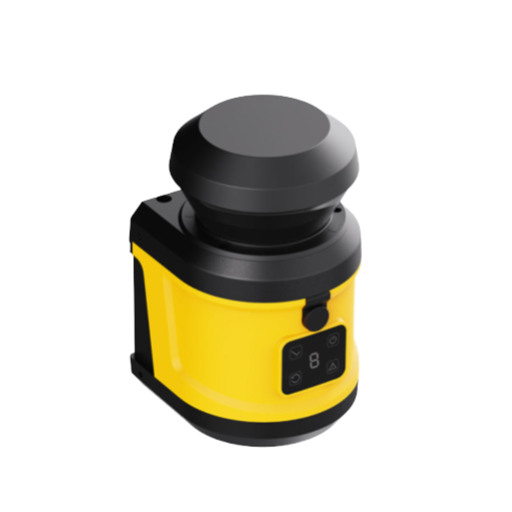
A safety laser scanner is classified under IEC 61496-3 as an Active Opto-electronic Protective Device responsive to Diffuse Reflection (AOPDDR). It operates on the time-of-flight (ToF) principle: the scanner emits short pulses of infrared laser light — at a wavelength of 905 nm, classified as Class 1 (eye-safe) — and measures how long each pulse takes to return after reflecting off objects in its field.
Inside the housing, a rotating mirror sweeps the optical assembly to sweep these pulses across a wide arc, 270° to 300°, at rates exceeding 40,000 measurement points per second. Each return pulse provides a distance measurement. Combined across one full rotation, these measurements produce a two-dimensional point cloud that maps every object within the scanner’s range — from a warehouse wall 30 meters away to a worker’s ankle 2 meters ahead.
What makes ToF scanning superior to camera-based or triangulation methods for safety-rated applications is its independence from ambient conditions. A ToF scanner does not rely on visible light, surface color, or texture contrast. Per IEC 61496-3, a compliant scanner must detect a test piece as small as 70 mm in diameter with a surface reflectivity as low as 1.8% — roughly equivalent to a matte black object. This physical requirement ensures reliable detection in dusty warehouses, dimly lit production halls, and outdoor loading docks where vision-based systems would struggle.
There are two configurable zones around the vehicle. An inner protection zone sends a safety-rated stop via dual-channel OSSD (Output Signal Switching Device) outputs wired back to the AGV safety PLC. An outer warning zone sends a slowdown command via auxiliary outputs with no safety rating. The combination of these two zones affords the AGV autonomous deceleration to prepare for any eventual emergency stop.
Key Point: Safety laser scanners work by measuring the time of flight of infrared light, not by interpreting images. They can operate reliably in environments that would swamp a camera.
Why AGVs and AMRs Need Dedicated Safety Scanning
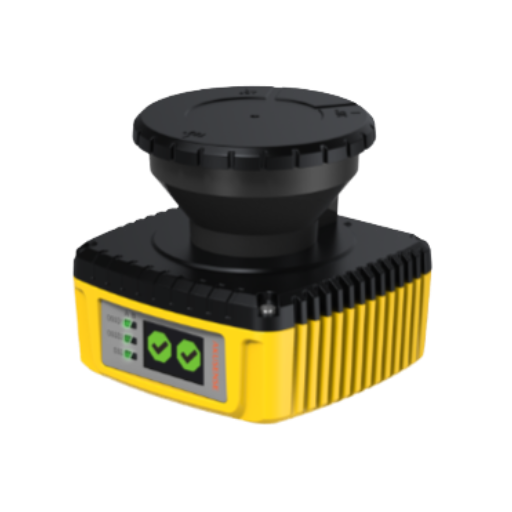
Automated guided vehicles and autonomous mobile robots represent a unique safety risk that no other industrial equipment creates: they are mobile heavy equipment moving through humanaccessible space, on ever-changing paths that can cross through production and storage areas. A CNC machine is fixed in one place and can be enclosed in a safety fence. An AGV drives through a plant floor.
Market growth data reflects how rapidly this challenge is scaling. According to Mordor Intelligence, the global safety laser scanner market is valued at $532 million in 2026 and growing at a compound annual growth rate of 6.2%, projected to reach $720 million by 2031. The AGV-specific segment is growing even faster, with some market analyses estimating a CAGR of 13.6% through 2033.
AGV and AMR warehouse or production floor runs are normally in the 1.0-3.0 m/s range when transporting loads from 200 kg to over 2000 kg. At these speeds and mass, a collision with a person results in severe trauma. Bumper-based sensors only work if contact occurs, when the vehicle is already imparting a potentially lethal level of energy. A safety laser scanner configured for AGV and AMR applications can reliably detect obstacles at ranges of 3-9 meters to enable vehicle deceleration – minimizing injury risk – before the collision happens.
Industry deployment data indicates that AGV fleets equipped with safety-rated area scanners experience collision incident reductions in the range of 70% to 90% compared to installations relying on warning horns or bumpers alone. Throughput impact cuts both ways: while a well-configured scanner prevents collisions, a poorly configured one generates false stops that can reduce effective throughput by 15–20%.
📐 Field Example: A third-party logistics center operating 12 AGVs across two shifts found that after upgrading from bumper-only protection to scanner-equipped vehicles, their monthly collision log dropped from an average of 8 events to fewer than 1. The operations manager observed that the real change was behavioral: workers stopped treating AGV corridors as exclusion zones and began sharing the space with greater confidence, because the scanners gave the vehicles visible situational awareness.
What Is the Difference Between an AGV and an AMR?
An AGV (Automated Guided Vehicle) follows fixed paths defined by magnetic tape, wires, or painted lines embedded in the facility floor. An AMR (Autonomous Mobile Robot) navigates dynamically using onboard sensors, maps, and algorithms — it can plan alternative routes in real time when obstacles appear. From a safety scanner perspective, the key difference is this: AGVs travel predictable paths, so zone configurations can be tuned to known corridor geometries. AMRs travel variable paths, requiring zone configurations that work across a wider range of environments. Both require IEC 61496-compliant safety scanning for personnel protection under ISO 3691-4.
Key Point: AGV and AMR paths and speeds make collisions potentially deadly, and safety laser scanners are the only collision protection device to have on the vehicle at all times, capable of detecting obstacles before contact.
Key Specifications That Determine Scanner Performance
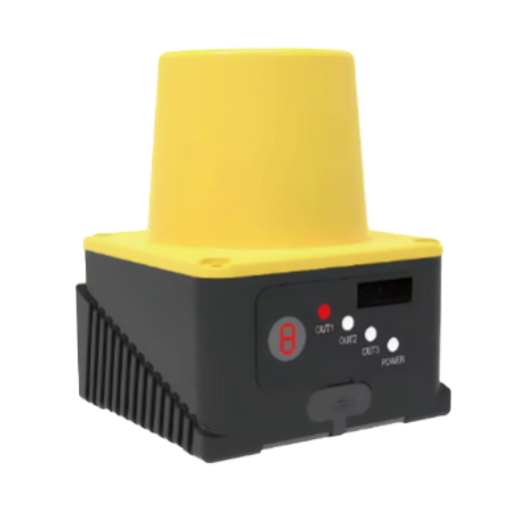
A safety laser scanner datasheet has dozens of data points. The data points listed below are critical for AGV and AMR applications, as they are the specifications that determine whether the scanner protects your team members or produces nuisance stops. I explain what each one means to you, not just what the number is.
| Parameter | What It Means | Why It Matters for AGVs | Typical Range |
|---|---|---|---|
| Protection Range | Maximum distance at which the scanner detects a 70 mm object at 1.8% reflectivity and triggers a safety-rated stop | Must exceed your AGV’s braking distance at maximum speed | 3–9 m |
| Warning Range | Maximum distance for non-safety auxiliary detection (slowdown trigger) | Gives the vehicle distance to decelerate before protection zone entry | 20–40 m |
| Opening Angle | Horizontal arc the scanner covers in one rotation | 270° covers front + both sides; a single corner-mounted scanner eliminates the need for a second unit on simple AGVs | 270°–300° |
| Angular Resolution | Smallest angular increment between measurement points | Finer resolution (0.1°) detects narrow objects like pallet legs or human ankles at longer range | 0.1°–0.5° |
| Response Time | Time from object detection to OSSD output switching | Directly adds to your minimum braking distance calculation | 40–120 ms |
| Simultaneous Zones | Number of independently configurable protection/warning zone sets | More zones = more speed-based switching options for different corridors and speeds | 4–128 |
| IP Rating | Ingress Protection against dust and water | IP65 for indoor dust; IP67 required for washdown or outdoor environments | IP54–IP67 |
In 20 years of deploying safety scanners, we have experienced a greater number of AGV projects that have failed due to undersized warning zones than due to hardware failure. In almost every situation the scanner hardware functions fine; it is the the shape of warning zones that makes the difference for ability to operate in real-world application.”
⚠️ Scanner Selection Decision Guide
- In two decades of safety scanner deployments, we have seen more AGV projects fail due to undersized warning zones than due to hardware issues. The scanner hardware almost always operates correctly; it is the zone geometry that affects practical implementation.
- Indoor warehouse AGV, 1.8 m/s, narrow aisles Give high priority to compact size, 270 degree FOV, multiple zone sets (4+), IP54 minimum
- Production floor AMR, multi-zone switching Give high priority to resolution of 0.1, multiple zone sets (8+), EtherNet/IP interface, IP65
- Outdoor forklift AGV, in weather such as rain and sun Give high priority to IP67 requirements, IEC 62998 outdoor certification, 9 meter+ protection range, 40 meter warning zone
Cleanroom or pharmaceutical environment Give high priority to sealed enclosure, chemical resistant surfaces, IP67, Class 1 laser certification
📐 Engineering Note: IEC 61496-3 mandates detection of a 70 mm diameter test piece — roughly the width of a human ankle — at the scanner’s rated protection range, with as little as 1.8% surface reflectivity. This is the physics floor: any scanner claiming safety-rated performance must prove detection against this exact benchmark in a certified laboratory. A scanner that meets this requirement at 5 m protection range provides fundamentally different assurance than one rated at 3 m.
Safety Standards Decoded — IEC 61496, ISO 3691-4, SIL, and PL Ratings
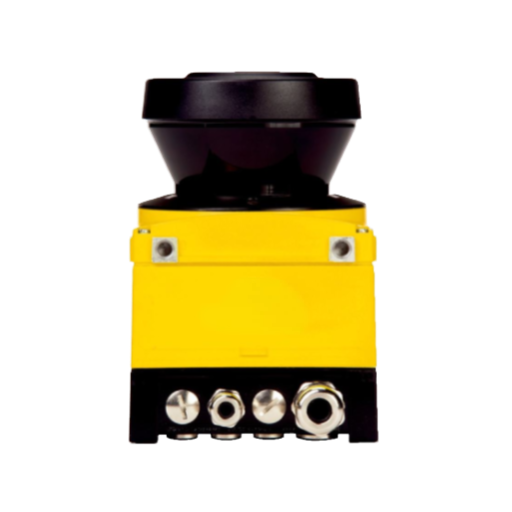
For a side-by-side comparison of CCH SLS series safety laser scanners with specific model-by-model requirements, please visit our product page.
The standards hierarchy works from component to system level:
-
- IEC 61496-3 — defines the scanner device itself. Type 3 specifies requirements for AOPDDRs: minimum detectable object (70 mm), reflectivity threshold (1.8%), dual-channel OSSD outputs, self-test cycles, and response time validation. This is the scanner’s “birth certificate.”
-
- ISO 3691-4:2023 — defines the complete driverless industrial truck system. It mandates that every AGV operating in shared human spaces must include functional safety-rated personnel detection. The standard specifies that a risk assessment determines which safety functions are required and their required performance levels.
- When comparing safety laser scanners for AGV use, one is often faced with a confusing hierarchy of standards, each one relevant to a different aspect of the overall system. From the devicelevel performance requirements of the scanner, to the ultimate safety goals of the entire AGV system, understanding the different requirements can be difficult. Understanding this hierarchy can be essential for procurement engineers tasked with specifying appropriate systems and audit documentation.
- ISO 13849-1 – defines Performance Level category (PL). The majority of AGV safety functions require PLd Category 3, which involves a dual-channel architecture and no single component failure can result in a safety function failure.
📐 Field Example: A European automotive manufacturer discovered during a CE audit that their AGV fleet’s safety scanners lacked complete IEC 61496 Type 3 documentation. The scanners functioned correctly and had never caused a safety incident. However, without the certification paper trail, the entire AGV installation was technically non-compliant with the Machinery Directive 2006/42/EC. The resulting retrofit — replacing scanners, re-certifying the installation, and documenting the updated risk assessment — cost approximately three times the original scanner procurement budget. The lesson: in compliance auditing, the documentation is what the auditor verifies, not the scanner’s actual performance.
What SIL Rating Do You Need for an AGV Safety Scanner?
IEC 61508 – defines Safety Integrity Level. The level SIL 2 used by the IEC 61508 function indicates probability of dangerous failure on demand of 10 to 10. For AGVs running below 3 m/s in standard warehouse environments, SIL 2 / PLd Cat 3 remains the standard target.
Regional compliance differences matter. In Europe, CE marking under the Machinery Directive requires conformity with harmonized standards including ISO 3691-4 and ISO 13849-1. In North America, ANSI/RIA 15.08 governs industrial mobile robots with overlapping but not identical requirements. If your AGV fleet ships to both markets, your scanner must carry documentation satisfying both frameworks.
SIL 2 applies to the majority of applications involving warehouse and production AGVs operating below 3 m/s in mixed human-robot systems. SIL 3 applies in high-consequence applications (DDC zones, explosion risk zones such as ATE×). MIGs with significant consequence (multiple deaths) would require SIL 3 / PLd best case; even in those cases most agv safety laser scanners are SIL2 / PLd Cat3 rated. If your delivery station is indoors at a typical warehouse speed, SIL 2 is the mostly appropriate requirement.
How to Size and Configure Safety Zones for Your AGV
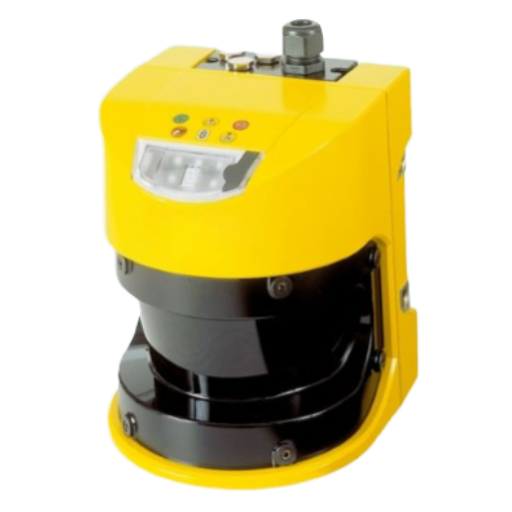
Key takeaway: If a safety laser scanner does not have IEC 61496 Type 3 certification, it should not be used as the primary awn on any AGV. The certification document (not brand) is what the auditor reads.
The fundamental calculation starts with your AGV’s braking distance. The minimum protection zone radius must exceed the total stopping distance of the vehicle from the moment an obstacle is detected. The formula, derived from ISO 13855, is:
The AGV Braking Distance Formula
Choosing which model of scanner to use represents the first half of the equation. The second half – the majority of implementation time – lies in setting the protection and warning zones to match actual AGV operating circumstances. Zone configuration is where most integration projects succeed or fail silently.
- v = AGV travel speed (m/s)
- S_min= (v t_r) + (v / (2 a)) + C
- a = measured deceleration rate under load (m/s²)
- t_r= total system response time-scanner response time+PLc processing time+brake activation time(sec)
Worked example: a 500 kg warehouse AGV traveling at 1.5 m/sec: Scanner response time =80 ms, PLC + brake actuation =120 ms (total t r = 0.20 sec). Measured deceleration rate if fully loaded =2.0 m/sec: Safety margin C = 200 mm.
S min = (1.5 0.20)+ (1.5 / (2 2.0)) + 0.20 = 0.30 + 0.5625 + 0.20 =1.06 m
So the AGV’s protection zone must be at least 1.06 m in front of the vehicle when traveling at 1.5 m/sec. Using a measurement of 0.8 m – a figure that looks OK on a datasheet – causes the vehicle’s physical envelope to be unable to stop anywhere near a detected person.
📐 Field Example: A food processing plant configured their AGV fleet’s protection zones for the standard 1.0 m/s travel speed. However, the AGVs were programmed to accelerate to 1.5 m/s on a 30-meter straight corridor between two production halls. At 1.5 m/s, the AGV’s actual braking distance exceeded the configured protection zone radius by 0.4 meters — meaning the scanner triggered a stop, but the vehicle could not physically stop in time. The fix was speed-based zone switching: the scanner automatically activates a wider protection field when the encoder reports speeds above 1.2 m/s, and contracts the zone for low-speed maneuvering in tight areas.
For AGV performing at different speeds, dynamic speed-matched zone switching is not optional. Most new designs offer from 4 to 128 different configuration combinations, each saved with an encoder speed input channel. The protection zone is expanded with increasing vehicle speed, or collapsed to the minimum for docking and narrow-aisle work. Without this capability, designers must preset the protection zone based on maximum vehicle speed, producing a large exclusion area at slow speeds that hinders throughput.
For coverages of an entire perimeter, a two- or four-scanner configuration built into opposite diagonal corners allows overlapping detection 360 degrees around the vehicle. One 275 will provide an 85 rear blind spot – suitable for AGV moving only forward, but not for reversing or rotating vehicles.
Can light curtain zone settings get tricky when your AGV shape is different from standard? Consult the CCH safety scanner design engineers for application-specific assistance.
Common Integration Mistakes and How to Avoid Them
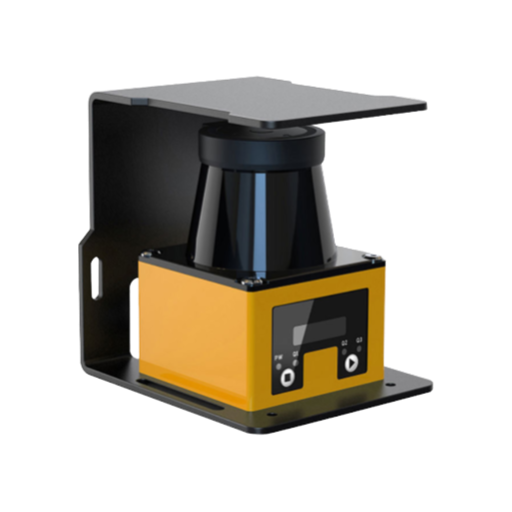
A common expensive-safety scanner problem is not hardware failure, but mis-configuration, which can take months for a root cause to emerge. The following five principles are drawn directly from realworld field engineering logs and manufacturer guidelines.
| Mistake | Root Cause | Fix |
|---|---|---|
| Scanner mounted too high | Mounting bracket placed for mechanical convenience, not detection geometry. Misses floor-level obstacles — dropped pallets, debris, low carts | Mount at 150–300 mm from floor level with slight downward tilt. Verify coverage with physical walk-through test |
| Protection zone undersized for actual speed | Zones configured for catalog-rated speed, but AGV actually runs faster on empty returns or straight corridors | Calculate from measured (not rated) braking distance at maximum observed speed. Add ISO 13855 margin |
| Excessive false stops in dynamic environments | Rack reflections, shiny floors, and transient particles (dust, insects, weld sparks) trigger protection field | Enable multi-echo processing. Adjust zone geometry to avoid aiming directly at reflective rack faces. Set appropriate sampling count |
| No preventive maintenance schedule | Optical window gradually accumulates dust film, reducing effective detection range from rated 10 m to as low as 7 m without triggering fault alarms | Quarterly window inspection and cleaning with manufacturer-approved materials. Monthly signal-strength baseline monitoring |
| Single scanner with rear blind spot | Single front-mounted 270° scanner leaves 90° rear gap. Vehicle reverses or rotates without rear coverage | Dual-scanner configuration (front + rear) or quad-scanner for full 360° coverage. Match to vehicle travel modes |
How Do You Reduce False Stops on AGV Safety Scanners?
False stops are the number one throughput complaint in AGV applications. They can be caused by multi-path object reflection from racking, fog or dust particles flowing through the scan plane, or zones overly-sharp shapes extending into fixed infrastructure. Solutions include: (1) turn on multi-echo filtering in the scanner (which delivers conditional individual frame trigger on12+ consecutive detections), masking them out of system-aware via-point if possible, (2) redefining zone polygons to aim adjacent higher coverage zones away from reflections off of chrome rack posts, and (3) establish the best optical maintenance practices – industry standard recommends quarterly lens inspections and cleaning, with weekly cleaning in very dusty environments. Anything over 2-3 false stops/hour indicates that a zone re-evaluation should be undertaken, rather than ad-hoc adjustments.
The key to most AGV scanner failures is not the hardware, it’s the physical design and zone configuration. Correct installation height, speed-optimized zone matches, multi-echo filtering, and scheduled maintenance will eliminate 95+% of integration problems.
Frequently Asked Questions
What is the typical protection range of a safety laser scanner for AGVs?
View Answer
Range varies by model tier for most safety-rated models, with 3-9 meters coverage and 20-40-meter warning zones available depending on model. When establishing desired detection range, determine your vehicle’s maximum operating speed, coupled with the measured braking distance, to select the ideal range.
Can safety laser scanners work in dusty or outdoor environments?
View Answer
Yes, with the right specifications. Indoor dust environments must have IP65 minimum with multiple-echo particle filtering. For outdoor operation, an IP67 rated product must also be IEC 62998-certified, demonstrating it can remain operational in sunlight, rain and background clutter. Not all scanners are IEC 62998-certified so confirm this particular certification before specifying an outdoor-mounted AGV scanner.
Do AGVs still need bumpers if equipped with a safety laser scanner?
View Answer
For travel-path collision avoidance, a certified safety laser scanner replaces bumper function with a much more reliable pre-contact detection. Certain integrators will keep bumpers at docking stations as a last-resort backup for very-low-speed contact. You must define whether redundant bumpers are necessary by conducting a ISO 3691-4 risk assessment specific to your application.
How often should safety laser scanner zones be validated?
View Answer
Weekly scan-field integrity checks in high-traffic paths. Monthly validation that the safety PLC responds to ensure correct stop response when OSSD outputs are energized. Quarterly inspection of optical windows and alignment. All validation logs must be maintained to meet audit trail for ISO 3691-4 and CE certification.
What is the difference between SIL 2 and SIL 3 for AGV scanners?
View Answer
SIL 2 -with a probability of dangerous failure on demand between 10 and 10 – governs most warehouse and production AGVs traveling less than 3 m/s in human-occupied spaces. SIL 3 safety means a higher-hazard situation such as an explosion zone (ATE×) or outdoor rapid transit system. The vast majority of commercial safety laser scanners for AGVs are dedicated to SIL 2 / PLd Cat 3 operation.
Can safety laser scanners be retrofitted to existing AGVs?
View Answer
Yes, as long as the AGV controller can receive external safety-rated inputs – usually dual-channel OSSD outputs. The retrofit process includes mounting space on the chassis, safety PLC wiring, and safety zone calibration based on the AGV’s weight, maximum speed, and braking potential. It is not uncommon for a scanner retrofit to occur as part of a fleet retrofit moving to scanner-based safety from bumper-only safety.
Seeking a Safety Laser Scanner for Your AGV or AMR Fleet?
CCH Sensing supply IEC 61496 Type 3-approved scanners with 3-9m protection zones, SIL2 / PLd Cat 3 engineering records and customized zone setup service. 20+ years of industrial safety engineering from China.
About this article: It was written by the CCH Sensing content team, in partnership with our applications engineering staff. Manufacturer market data comes from independent third-party published market studies as listed in the reference section below. IEC 61496, ISO 3691-4 & ISO 13855 manuals provide standardized technical data. Where exact data was not available, we have used qualified language and have footnoted the source. CCH Sensing makes safety laser scanners- our product specifications are based on the engineering experience of our team and should not be taken as the sole recommendation. Consider multiple suppliers when selecting the best product fit for your application.
Back to Content: Review by the CCH Sensing Engineering Group– With more than 20 years of experience designing, manufacturing, and deploying industrial safety sensors, the CCH Sensing engineering team in Hangzhou has supported advanced safety scanner integrations around the globe in warehouse logistics, automotive manufacturing, pharmaceutical production and port facilities.
References & Sources
- ISO 3691-4:2023 — Industrial Trucks: Safety Requirements for Driverless Trucks — International Organization for Standardization
- ISO 13855:2010 — Safety of Machinery: Positioning of Safeguards — International Organization for Standardization
- IEC 61496-1 Machine Safety: Electro-sensitive Protective Equipment — American Society of Safety Professionals
- Safety Laser Scanner Market Size, Trends & Forecast 2026–2031 — Mordor Intelligence
- ISO 3691-4:2023 — Driverless Industrial Trucks Safety Standard — ANSI Blog
- ISO 3691-4 Updated Edition Published: AGV Safety Requirements — Pilz Safety Technology
- Safety Laser Scanner Market Size & Share, Industry Analysis 2032 — Global Market Insights