
Get in touch with QJKH Company

Light Curtain vs. Safety Mat: Engineering Comparison of Type 4 Optical Guards, ISO 13856-1 Floor Mats, and Machine Safety
In a light curtain vs safety mat comparison, an IEC 61496-2 Type 4 safety light curtain projects an infrared beam barrier across an access opening. Typical models deliver 14 mm or 30 mm resolution, response times as fast as 5 ms, and Category 4, PL e / SIL 3 compliance. An ISO 13856-1 pressure-sensitive safety mat monitors floor presence using internal contact plates. It requires a 1,200 mm parallel floor step-stride allowance under ISO 13855 and pairs with Category 3, PL d controllers.
Quick engineering facts: Light Curtain vs. Safety Mat
- Point-of-operation plane: Choose a Type 4 optical curtain when your risk assessment requires Category 4, PL e / SIL 3. Use 14 mm finger resolution right at the hazard window.
- Interior floor occupancy: Choose an ISO 13856-1 pressure-sensitive safety mat when an operator must stand inside an access zone during loading or maintenance up to Category 3, PL d.
- Floor-space setback penalty: Under ISO 13855 parallel floor equations, a floor-level safety mat (H = 0 mm) adds a 1,200 mm step-stride constant. A 25 mm light curtain needs only C = 88 mm (319.4 mm total setback on a 100 ms stop-time press).
- Series cascading ceiling: Up to 10 four-wire safety mats can wire in series to one controller channel when loop impedance stays within the controller’s rated diagnostic window.
Light Curtain vs. Safety Mat at a Glance: 2D Optical Trip Plane vs. 2D Pressure-Sensitive Floor Zone
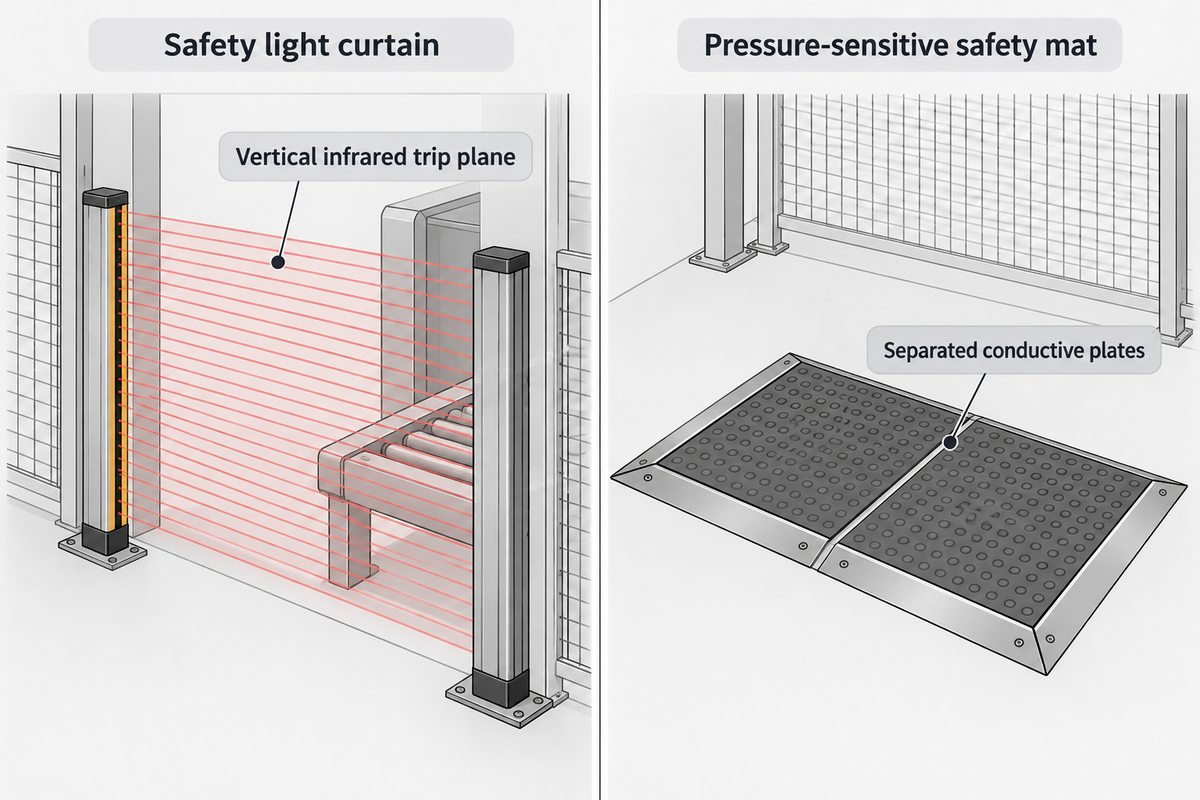
A safety light curtain projects a vertical infrared trip plane between an emitter and a receiver to detect reach-through entry. On the other hand, a pressure-sensitive safety mat uses two separated conductive plates. Foot pressure on the plates creates continuity across a defined area.
Both technologies serve as presence sensing safety devices in industrial machine guarding, but their detection geometry is not interchangeable. Both help protect operators from hazardous motion and moving parts when engineers implement a compliant layout. As mentioned in the Datasensing white paper on optoelectronic protective devices, A safety light curtain covers a controlled height from 150 mm up to 3 m or more. Standard resolution pitches are 14 mm for fingers and 30 mm for hands. Body access models use 2, 3, or 4 beams across spans up to 30 meters. Engineers who want to select the right safety light curtain specify IEC 61496-2 Type 4 safety light curtains for point-of-operation guarding.
What differentiates a floor mat from an optical barrier? As described in the Rockford Systems ANSI B11.19-2019 safety mat selection guide, a pressure-sensitive safety mat is a passive, normally open switch that is anchored to the floor. Stocked single-piece sizes run from 12 inches by 12 inches up to 48 inches by 72 inches. As described in the Tapeswitch Safety Zone heavy-duty mat specification sheet, industrial mats use two rigid metal plates separated by spacer buttons and housed in virgin vinyl. They operate on 4-conductor fail-safe wiring and stop the machine when stepped on.
What is the purpose of a safety mat versus a safety light curtain?
The function of a safety light curtain is to guard a vertical entry plane and trip within milliseconds as a finger, hand, or body passes through the beam line. The purpose of a safety mat is to monitor floor occupancy inside a work zone and prevent machine startup while a worker stands on the mat.
A vertical light curtain acts as a perimeter tripwire. Once an operator walks completely past the vertical infrared beams, the optical path clears again. However, a safety mat maintains an active stop command as long as the operator’s weight is on the active floor surface. Below, our 3-Gate Safeguarding Architecture Selector preview diagram and 10-dimension specification table compare both devices.
| Engineering Dimension | Safety Light Curtain (Through-Beam Optical) | Pressure-Sensitive Safety Mat (Floor Contact) |
|---|---|---|
| 1. Governing Standards | EN IEC 61496-1:2020, IEC 61496-2, IEC 62046 | ISO 13856-1, ANSI B11.19-2019 Section 8.3, OSHA 1910.212 |
| 2. Sensing Principle | Synchronized infrared LED emitter and phototransistor receiver beams | Two separated conductive metal plates that close under foot pressure |
| 3. Detection Geometry | 2D vertical or horizontal optical trip plane (150 mm to 3 m height) | 2D floor-mounted rectangular or custom polygon surface (12″×12″ to 48″×72″) |
| 4. Sensitivity / Resolution | 14 mm (finger), 25–30 mm (hand), or 2, 3, 4 beams (body access) | Foot compression across active surface; narrow inactive perimeter edging |
| 5. Typical Response Time | 5 ms to 20 ms (fast solid-state OSSD switching) | Controller pulse-evaluation plus mechanical plate closure delay |
| 6. ISO 13849-1 / IEC 62061 Ceiling | Up to Category 4, PL e / SIL 3 (Type 4) or PL c / SIL 1 (Type 2) | Typically Category 3, PL d / SIL 2 with self-checking 4-wire controller |
| 7. ISO 13855 Intrusion Constant (C) | C = 8 × (d – 14) mm for d ≤ 40 mm (0 mm for 14 mm; 88 mm for 25 mm) | C = 1,200 mm at floor level (H = 0 mm parallel approach formula) |
| 8. Series Cascading Limit | 2 to 4 optical segments via master-slave bus (adds 2–5 ms per segment) | Up to 10 mats in series if total loop resistance stays within 100 to 200 ohms |
| 9. Output & Fault Monitoring | Dual-channel 24 VDC PNP OSSD with continuous dark-pulse self-test | 4-wire cross-short monitoring between upper and lower conductive plates |
| 10. Primary Shop-Floor Vulnerability | Optical misalignment from frame shock or reflective bypass near shiny chutes | Forklift wheel crush, metal swarf puncture, and unanchored mat shifting |
IEC 61496-2 Type 4 Light Curtains vs. ISO 13856-1 Safety Mats: Why PL e Favors Solid-State OSSD
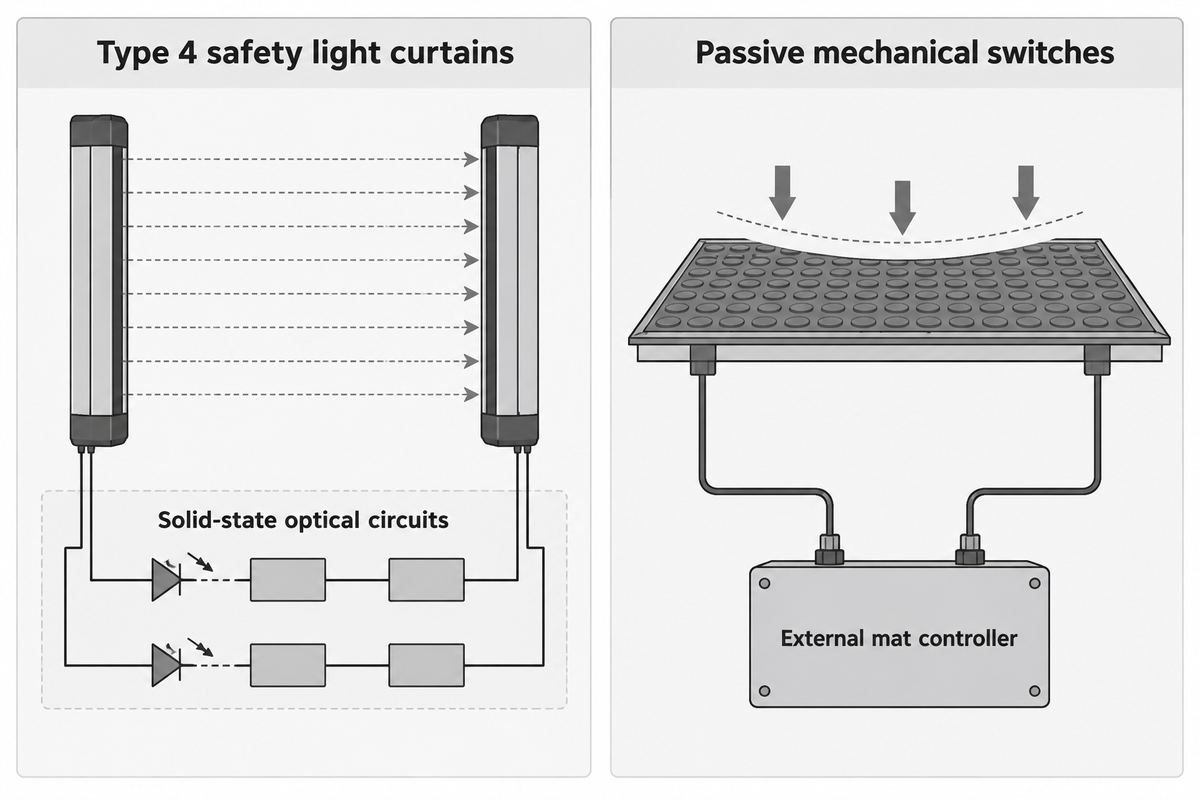
Type 4 safety light curtains achieve ISO 13849-1 Category 4, PL e and IEC 62061 SIL 3 natively because solid-state optical circuits detect any single fault within the reaction time. Pressure-sensitive safety mats are passive mechanical switches that depend on an external controller and typically rate to Category 3, PL d.
Understanding how international safety standards classify both devices prevents costly audit failures and increases reliability in the long term. According to the CENELEC catalog for EN IEC 61496-1:2020, this harmonized standard supersedes EN 61496-1:2013 and cross-references EN ISO 13849-1:2023 to ensure consistent fault evaluation. As explained in the Datasensing functional safety correlation guide, PL c corresponds to SIL 1, PL d to SIL 2, and PL e to SIL 3. For a deeper breakdown of subsystem failure calculations, see our ISO 13849-1 Performance Level PL a to PL e architecture and B10d guide.
What are the different types of light curtains used for safety, and how do they compare to ISO 13856-1 mats?
Safety light curtains are classified as Type 2 (limited to PL c / SIL 1 with a ±5.0° optic angle) and Type 4 (certified to PL e / SIL 3 with a ±2.5° optic angle). ISO 13856-1 safety mats use passive contact plates whose safety category is governed by the external mat controller and mechanical wear.
According to Leuze’s IEC 61496-1 engineering reference, a Type 2 light curtain performs periodic tests and allows a transmit/receive opening angle up to ±5.0° at 3 m. Loss of protective function can occur between test cycles. A Type 4 light curtain limits its opening angle to ±2.5° at 3 m. A Type 3 device permits up to ±3.5° at 3 m and achieves PL d / SIL 2.
How do pressure-sensitive safety mats compare? Per the Rockford Systems controller rating analysis, the mat itself is a passive switch. Specifying a Category 3 or Category 4 controller does not automatically make the entire mat subsystem Category 4. Every mechanical compression cycles the internal metal plates, meaning engineers must track mechanical fatigue and series loop resistance in the safety validation file. The IEC 61496-2 vs. ISO 13856-1 Fault-Masking & B10d Wear Matrix below details these diagnostic boundaries.
| Safeguard Subsystem Architecture | Max Performance Level & SIL | Optical Aperture or Plate Structure | Fault Detection & Diagnostic Mechanism | Mechanical Wear & Fault-Masking Boundary |
|---|---|---|---|---|
| IEC 61496-2 Type 4 Light Curtain | Category 4, PL e / SIL 3 | ±2.5° max opening angle at 3 m | Continuous dual-channel OSSD dark-pulse diagnostics within reaction time | Solid-state optical path; zero mechanical cycle wear |
| IEC 61496-2 Type 2 Light Curtain | Category 2, PL c / SIL 1 | ±5.0° max opening angle at 3 m | Periodic test at power-up, reset, or sensor activation | Fault between periodic tests can temporarily delay shutdown |
| ISO 13856-1 4-Wire Safety Mat + Cat 3 Controller | Category 3, PL d / SIL 2 | 2 separated rigid conductive plates + 4-lead fail-safe cable | Controller pulses both plates to detect broken wires or plate shorting | Series resistance >100–200 ohms across >10 mats defeats self-checking |
| 2-Wire Terminating-Resistor Safety Mat | Category 2, PL c / SIL 1 | 2 conductive plates + end-of-line resistor | Single-channel current monitoring across terminating resistor | Lead-to-lead short circuit mimics normal foot actuation |
Minimum Safety Distance Calculation (ISO 13855:2024): Hand-Reach Intrusion vs. 1,200 mm Step-Stride Factor
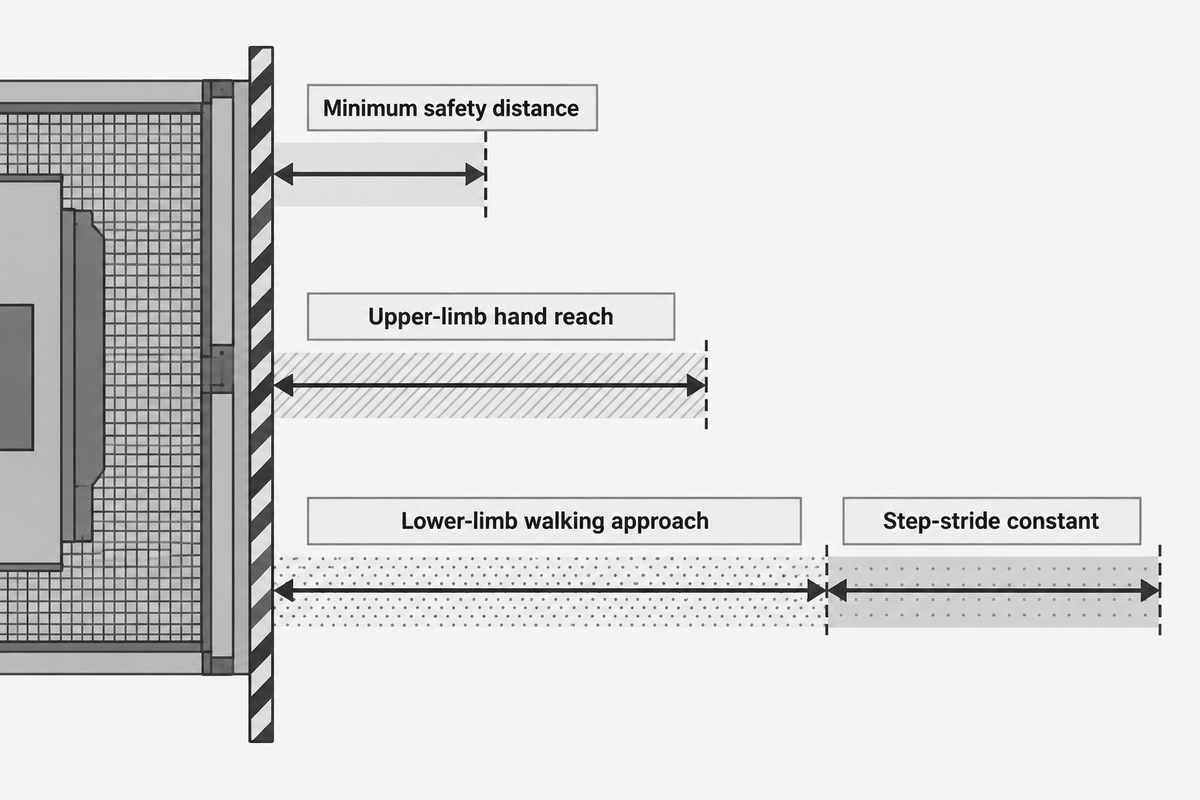
Under ISO 13855, a floor-mounted safety mat requires over 1 meter more mounting depth than a finger- or hand-resolution safety light curtain on the same machine. A vertical light curtain with d ≤ 40 mm uses C = 8 × (d – 14) mm, whereas a floor-level parallel detector requires a 1,200 mm step-stride constant.
Machine builders typically think laying a safety mat in front of a machine takes less floor space than bolting down light curtain columns. However, normative safety distance equations show that this is not the case. According to Leuze’s ISO 13855 and IEC 62046 calculation guide, the minimum safety distance SRT is governed by:
S = (K × T) + C — Use K = 2,000 mm/s (2.0 mm/ms) for upper-limb hand reach. Recalculate at K = 1,600 mm/s if S exceeds 500 mm, keeping at least a 500 mm floor. Use K = 1,600 mm/s (1.6 mm/ms) for lower-limb walking approach. Here T is total system stopping time (plus at least 10 % under IEC 62046 for brake deterioration), and S ≥ 100 mm is the absolute minimum distance.
The minimum safety distance in North American mechanical power presses, as specified by OSHA 29 CFR 1910.217 (c)(3)(iii)(e), is Ds = 63 inches/second x Ts, where 63 inches per second (1.6 m/s) is the hand speed constant. You can verify your vertical optical clearance with our online ISO 13855 safety light curtain distance calculator.
Why does a floor safety mat require so much extra depth? See Keyence’s ISO 13855 engineering examples and Leuze’s parallel approach rules. When a protective field is arranged horizontally at height H above the floor (H ≤ 1,000 mm), penetration distance C follows C = 1,200 mm – 0.4 × H (with Cmin = 850 mm). For a safety mat resting on the floor reference plane (H = 0 mm), C equals the full 1,200 mm step-stride allowance.
Worked Engineering Example: Orthogonal Light Curtain vs. Parallel Floor Zone (t2 = 100 ms Machine Stop)
- Case A — 14 mm Finger Type 4 Light Curtain (CCH ENT14, t1 = 15 ms, Relay = 15 ms, T = 0.130 s):
Because d = 14 mm ≤ 40 mm, C = 8 × (14 – 14) = 0 mm. Using K = 2,000 mm/s: S = 2,000 × 0.130 + 0 = 260 mm. - Case B — Verified 25 mm Hand Light Curtain Benchmark (Keyence GL-R60H, d = 25 mm, t1 = 15.7 ms, t2 = 100 ms):
As per Keyence Calculation Example (1)-1, C = 8 × (25 – 14) = 88 mm. With T = 0.1157 s: S = 2,000 × (0.1157) + 88 = 319.4 mm. - Case C — Verified Parallel Near-Floor Guard Benchmark (Keyence GL-R30L at H = 200 mm, t1 = 10.5 ms, t2 = 100 ms):
Per Keyence Calculation Example (2)-1, C = 1,200 – 0.4 × 200 = 1,120 mm. With K = 1,600 mm/s and T = 0.1105 s: S = 1,600 × (0.0105 + 0.1) + 1,120 = 1,296.8 mm. - Case D — Floor-Level Safety Mat (H = 0 mm, C = 1,200 mm, T = 0.145 s with controller):
At H = 0 mm, C = 1,200 – 0.4 × 0 = 1,200 mm. With K = 1,600 mm/s: S = 1,600 × 0.145 + 1,200 = 1,432 mm (+1,172 mm deeper into the aisle than a 14 mm light curtain).
Worked ISO 13855 setback values assume a 100 ms machine stopping time (t2) plus the device response time (t1) and relay or controller delays specified per case. Always verify actual stopping time with a brake monitor under worst-case load.
The ISO 13855 Step-Stride vs. Reach-Intrusion Setback Table below compares these four worked cases alongside a standard 30 mm hand-resolution light curtain so layout engineers can size aisle clearance accurately.
| Safeguard Configuration | Resolution / Height | Approach Speed (K) | Total Stop Time (T) | Intrusion Constant (C) | Required Safety Distance (S) |
|---|---|---|---|---|---|
| 14 mm Type 4 Light Curtain (Orthogonal) | d = 14 mm (finger) | 2,000 mm/s | 0.130 s (130 ms) | 0 mm | 260 mm (Compact baseline) |
| 25 mm Type 4 Light Curtain (Keyence Ref.) | d = 25 mm (hand) | 2,000 mm/s | 0.1157 s (115.7 ms) | 88 mm | 319.4 mm (+59.4 mm vs. 14 mm) |
| 30 mm Type 4 Light Curtain (Orthogonal) | d = 30 mm (hand) | 2,000 mm/s | 0.130 s (130 ms) | 128 mm | 388 mm (+128 mm vs. 14 mm) |
| Parallel Horizontal Curtain at H = 200 mm | H = 200 mm above floor | 1,600 mm/s | 0.1105 s (110.5 ms) | 1,120 mm | 1,296.8 mm (Parallel approach) |
| Floor Safety Mat at H = 0 mm | H = 0 mm floor plane | 1,600 mm/s | 0.145 s (145 ms) | 1,200 mm | 1,432 mm (+1,172 mm floor penalty) |
Stand-Behind Protection (IEC 62046), Muting, and Blanking: When to Combine a Light Curtain with a Safety Mat
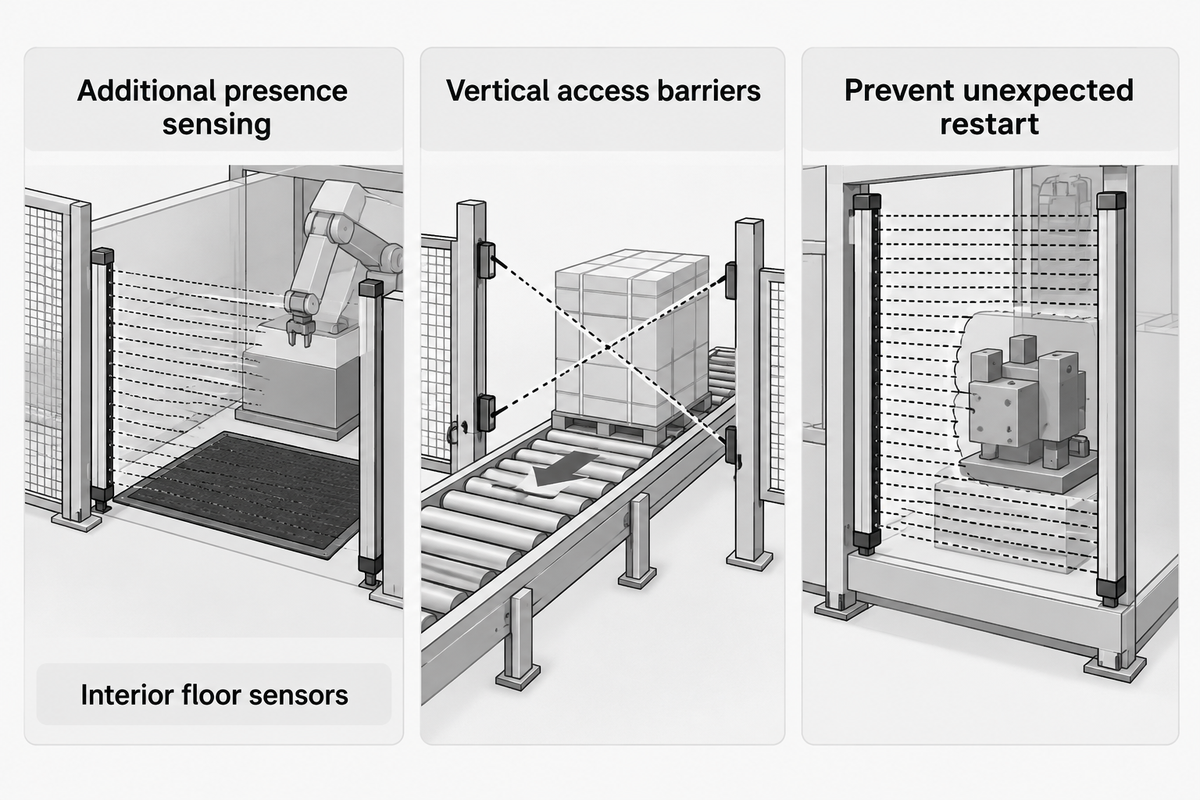
Where a vertical safety light curtain is positioned far enough away from a hazard that an operator can stand behind the optical plane undetected, IEC 62046 and ANSI B11.19-2019, Section 8.5 require the use of additional presence sensing means. A floor safety mat or horizontal optical sensor in that gap would prevent unexpected restart of the equipment.
As mentioned in the Rockford Systems perimeter integration guide, a complete perimeter guarding system for an automated cell typically couples multiple light curtains with interior floor sensors to isolate machine hazards. A vertical light curtain at the entry gate trip point secures the machine in a millisecond reaction time when an operator crosses the threshold. That early trip provides the drive additional stopping time. Once a person enters the access zone, safety system floor mats let the control system know a person is in the zone. Likewise, OSHA’s presence-sensing device eTool also stipulates guarding for unprotected areas outside the primary sensing field.
When designing vertical access barriers, Leuze’s IEC 62046 installation standard summary states there are strict limits to beam heights to prevent access via crawling underneath or stepping over:
- Bottom beam height limit: The lowest beam must sit no higher than 300 mm above the floor reference plane (up to 400 mm for 2-beam devices where risk assessment permits).
- Top beam height limit: The top beam must sit at least 900 mm above the reference plane, with a maximum permissible vertical distance of 500 mm between adjacent beams.
- External reset interlock rule: When used together, a vertical light curtain with a floor safety mat, the manual reset button must be located outside the hazard zone and in full view of the cell.
What is muting in regard to safety light curtains, and can a safety mat act as a muting or presence sensor?
Muting is the automatic, momentary disablement of a protective function of a safety light curtain by 2 or 4 auxiliary sensors, to allow a pallet or workpiece to move through on a conveyor without stopping the machine. A floor safety mat cannot mute a conveyor load, since the weight of the pallet would trip the mat.
Muting sensors verify the length and timing of a moving pallet on an automated palletizing conveyor to bypass the vertical light curtain. When specific IR beams are blocked by a stationary fixture or a press tie-bar, engineers use monitored blanking or floating blanking (which decreases effective resolution by one beam pitch). To learn more, read our light curtain muting vs. blanking commissioning guide.
| Workcell Scenario | Primary Entry Guard | Interior / Material-Flow Solution | IEC 62046 & ANSI B11.19 Compliance Rule |
|---|---|---|---|
| Walk-In Press or Robot Access Zone | Vertical Type 4 Light Curtain | Interior 4-Wire Floor Safety Mat | Curtain trips on entry; floor mat blocks reset while operator stands inside. |
| Spark / Swarf Walk-In Cell | Vertical Type 4 Light Curtain | Horizontal Light Curtain or 2D Scanner | Non-contact interior presence detection avoids hot slag burning floor mats. |
| Automated Pallet Conveyor Portal | Vertical Type 4 Light Curtain | 2- or 4-Sensor Optical Muting Array | Crossed or sequential muting beams let pallets pass while blocking human entry. |
| Press Brake with Moving Sheet Stock | Vertical 14 mm / 30 mm Curtain | Monitored Fixed or Floating Blanking | Tolerates 1 to 2 moving sheet beams; recalculates S for +1 beam resolution pitch. |
Machine Guarding Applications: Press Brakes and Stamping Presses vs. Robotic Welding Cells and Palletizers
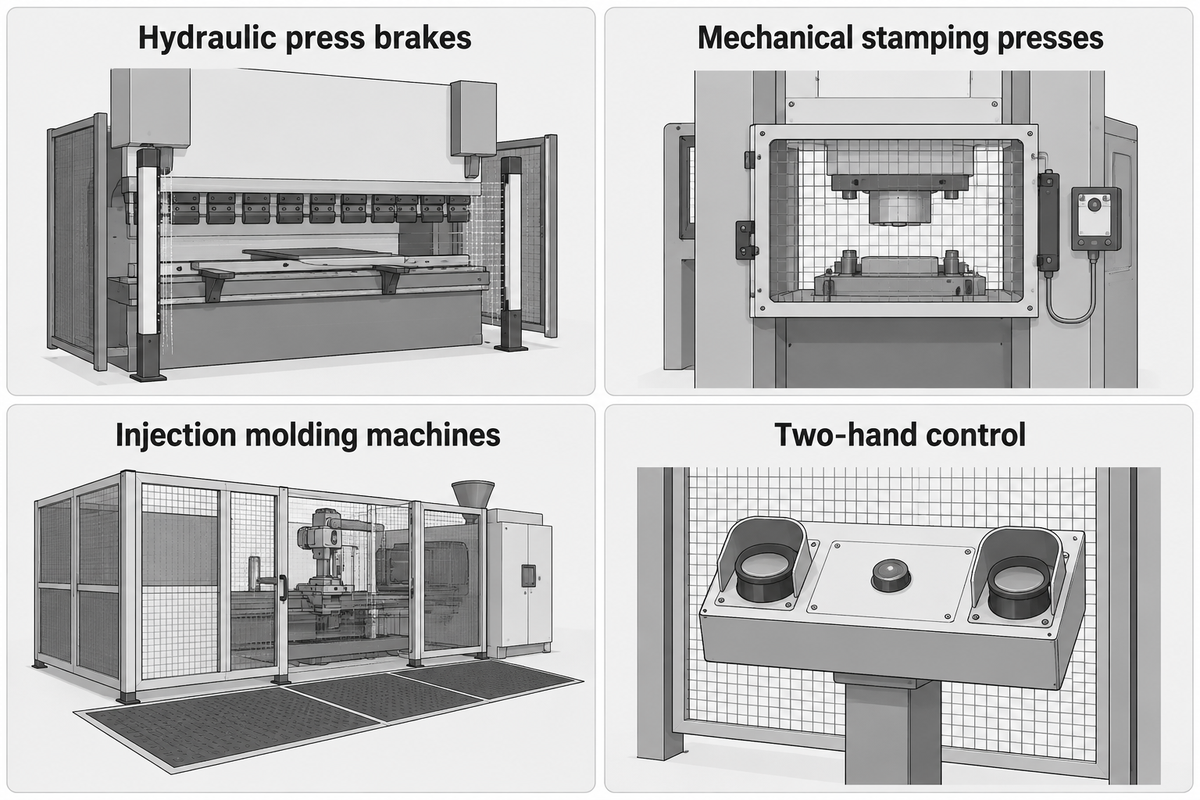
High-speed hydraulic press brakes, mechanical stamping presses, and manual assembly work windows require Type 4 safety light curtains for 5 ms finger or hand detection at the point of operation. Walk-in robotic welding cells, and low-traffic maintenance bays, on the other hand, make use of a hybrid curtain and mat system.
Combining the safeguard with the machinery prevents both operator fatigue and unwanted stops. As reported in GTRIC’s machine guarding benchmark, presses, spot welders, and injection molding machines use safety light curtains at the operator station to detect finger entry within 5 ms. In addition, Leuze’s IEC 62046 control specification states that whenever electro-sensitive protective equipment initiates a machine stroke (in single or double cycle mode), its resolution must not exceed 30 mm. Under OSHA 29 CFR 1910.217, mechanical power presses using presence-sensing devices must also incorporate a brake monitor that allows no more than a 10 percent or 10 milliseconds stopping-time increase.
How do light curtains and safety mats compare to two-hand control and hard guarding? A two-hand control (ISO 13851 Type IIIC for PL e) protects only the single operator holding both pushbuttons and requires constant button actuation every cycle. Physical hard guarding with interlocked gates blocks flying chips but increases manual part loading time. On high throughput lines, see our safety light curtain selection for high-speed packaging and palletizing lines and our collaborative robot cell presence sensing and speed separation safety guide.
| Industrial Machine / Station | Safety Light Curtain | Pressure-Sensitive Safety Mat | Two-Hand Control / Hard Guarding | Recommended Engineering Architecture |
|---|---|---|---|---|
| 1. Hydraulic Press Brake / Stamping Press | Recommended (14 mm / 30 mm Type 4) | Not Recommended (1,200 mm C penalty; no finger detection) | Suitable for single-operator slow cycles | 14 mm Type 4 light curtain at 260–388 mm setback; ≤30 mm required for PSDI. |
| 2. Multi-Operator Assembly Window | Recommended (25–30 mm hand curtain) | Not Suitable (cannot detect reach-over) | Requires separate pedestal per worker | Single Type 4 light curtain pair protects all operators simultaneously. |
| 3. Walk-In Robotic Welding Cell | Recommended at entry portal | Suitable for interior floor (if slag-shielded) | Perimeter hard guarding + interlocked gate | Hybrid perimeter fencing + entry light curtain + interior presence mat/scanner. |
| 4. Automated Conveyor Palletizer | Recommended with 4-sensor muting | Not Recommended (forklifts crush floor mats) | Perimeter fencing around transfer bay | Multi-beam Type 4 light curtain with pallet muting sensors. |
| 5. Overhead Crane Mold Loading Bay | Not Suitable if crane cables block vertical plane | Recommended around die-setter standing zone | Removable hard barrier panels | Heavy-duty 4-wire floor safety mat with tapered aluminum ramp trim. |
| 6. High-Speed Packaging / Carton Line | Recommended (14 mm or 30 mm Type 4) | Not Recommended (washdown & cart traffic) | Interlocked transparent polycarbonate doors | Type 4 light curtain for instant jam-clearing access without gate latch wear. |
OSSD Output Wiring vs. 4-Wire Short-Circuit Monitoring and Safety Relay Integration
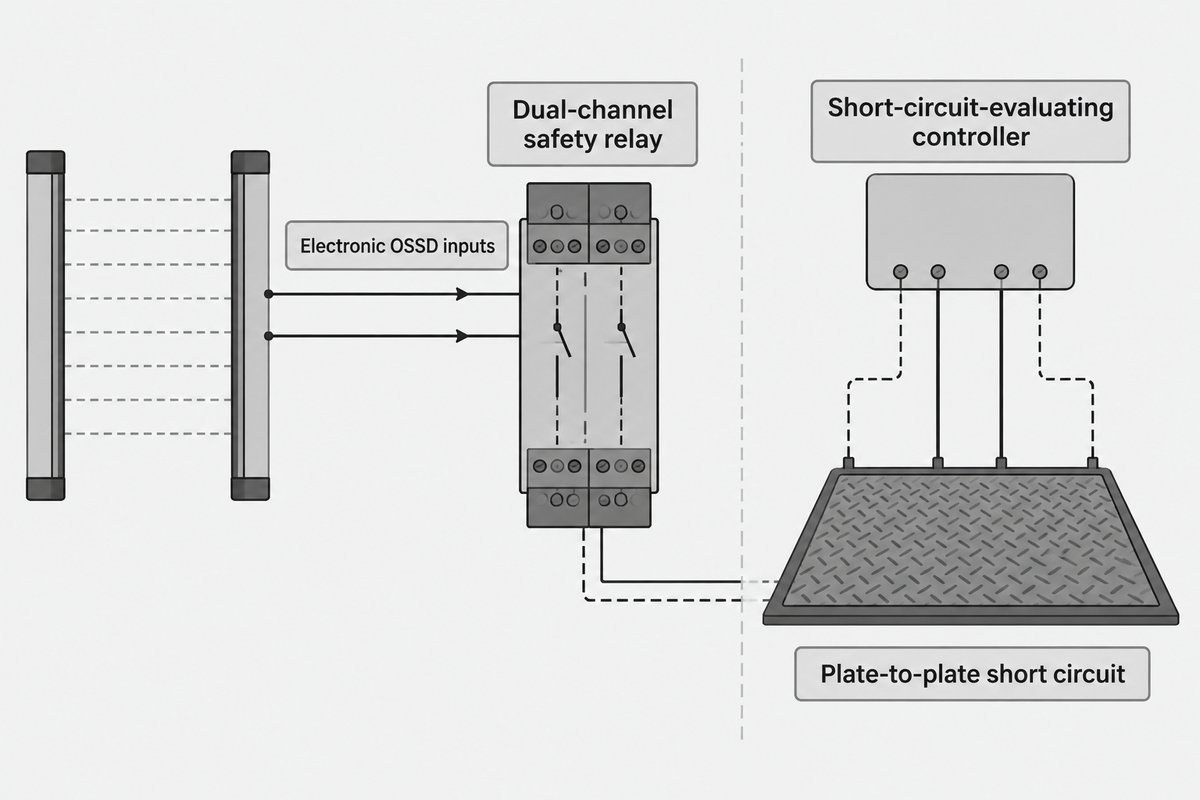
A safety light curtain outputs two self-monitored 24 VDC PNP sourcing signals (OSSD1 and OSSD2) that wire directly into a safety relay or a safety PLC. A 4-wire safety mat creates a deliberate plate-to-plate short circuit when stepped on and requires a dedicated short-circuit-evaluating controller.
Wiring mistakes between optical sensors and floor mats cause immediate commissioning lockouts, so following electrical best practices is essential for modern safety architectures. Ensuring signal compatibility between your sensor outputs and evaluation unit streamlines panel design and makes troubleshooting smarter. When a safety light curtain is blocked, both the 24 VDC PNP outputs open (go to 0 VDC) to de-energize the machine’s primary contactors. These two outputs can be terminated to dual-channel SRB safety relay modules with EDM monitoring, a Rockwell Guardmaster relay, a Logix PLC safety input card, or a Wieland safety controller.
Can safety light curtains and 4-wire safety mats be wired directly to the same safety relay as an E-Stop?
A safety light curtain’s dual PNP OSSD outputs can wire directly into a dual-channel safety relay that accepts electronic OSSD inputs, similar to a dual-channel E-Stop. A 4-wire safety mat cannot wire into a standard E-Stop cross fault relay, since stepping on the mat shorts the two channels together.
Why does a standard E-Stop relay not accept a 4-wire safety mat? On a dual-channel emergency stop button, pressing the mushroom head opens two normally closed contacts. If Channel 1 shorts to Channel 2, the safety relay detects a cross-loop wiring fault and takes a lock-out action. On a 4-wire safety mat, the upper conductive plate carries Channel 1 and the lower plate Channel 2. When a user steps on a safety mat, it brings upper and lower plate together in a deliberate cross channel short. Therefore, such 4-wire mats need a safety mat evaluation unit. Or you can use a configurable safety controller from SICK, Rockwell or Wieland and program it to respond to cross-shorts as a stop command and treat an open circuit as a fault.
Follow this series-wiring rule from the Rockford Systems safety circuit engineering guide. You can connect up to 10 safety mats in series to one input channel on a Keyence GC or Banner XS-26 controller, as long as total series resistance stays within 100 to 200 ohms. Connecting more mats or long home-run cables that exceed 100 to 200 ohms doesn’t cause an obvious alarm, but it pushes the loop resistance outside the controller’s diagnostic window and renders cross-short self-checking useless.
| Electrical Parameter | Type 4 Safety Light Curtain (OSSD) | 4-Wire Fail-Safe Safety Mat | 2-Wire Terminating-Resistor Mat |
|---|---|---|---|
| Normal Run State (Unactuated) | Both OSSD1 & OSSD2 HIGH (+24 VDC PNP sourcing) | Upper & lower plates separated; continuity verified across 4 leads | plates separated; trickle current flows through end-of-line resistor |
| Actuated State (Tripped) | Both OSSD1 & OSSD2 drop LOW (0 VDC open circuit) | Foot pressure shorts upper plate (Ch A) to lower plate (Ch B) | Foot pressure shorts out the terminating resistor |
| Compatible Evaluation Unit | Standard OSSD safety relay (CCH SRB, Guardmaster) or Safety PLC | Dedicated 4-wire cross-short mat controller (Keyence GC, Banner XS-26) | 2-wire resistor evaluation relay (Category 2 / PL c max) |
| Series Cascading Limit | 2 to 4 optical pairs via digital cascade bus (preserves PL e) | Up to 10 mats in series if total loop resistance stays ≤100 to 200 ohms | Limited by resistor tolerance buildup; single-fault masking risk |
| Network & PLC Diagnostics | Direct IO-Link, EtherNet/IP, or PROFIsafe beam-level telemetry | Relay dry-contact output or controller bus gateway to Logix PLC | Single discrete relay output; zero per-mat fault localization |
Harsh-Environment Durability: Forklift Traffic, Metal Chips, Cutting Fluids, and Weld Spatter
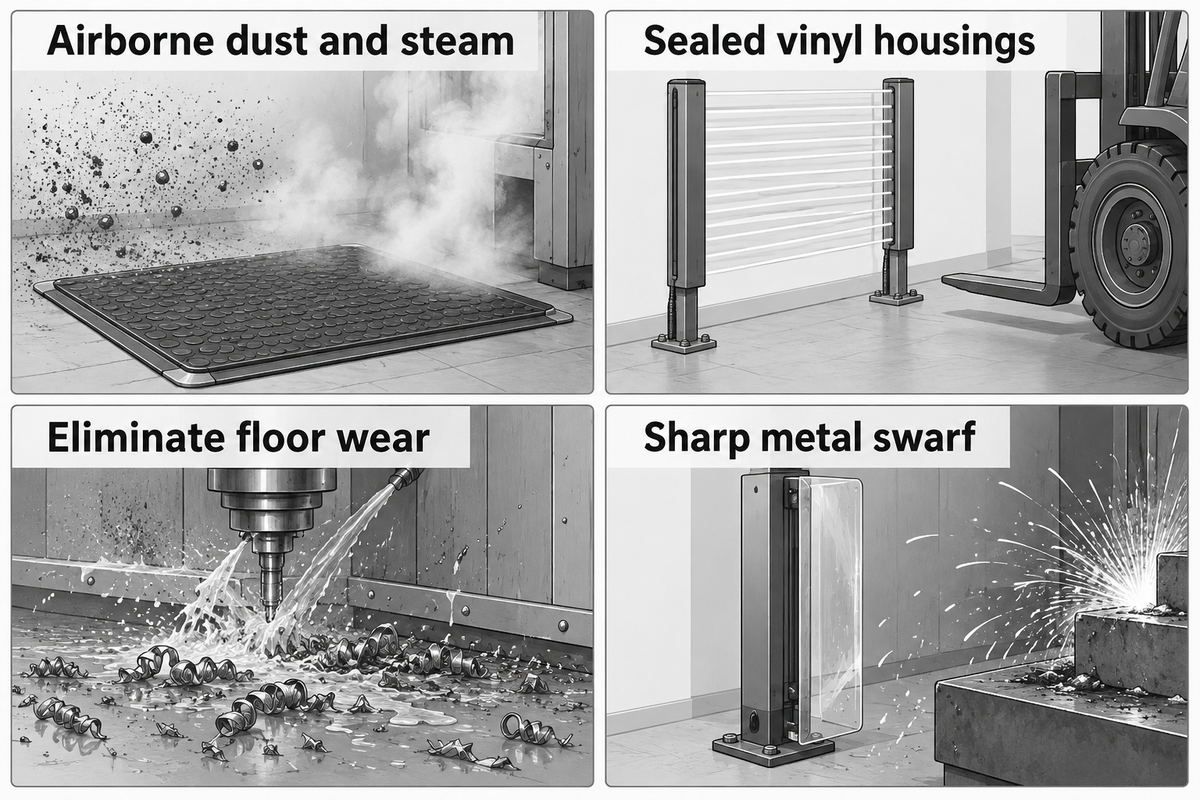
Pressure-sensitive safety mats withstand heavy airborne dust, steam, and welding smoke that can attenuate optical beams, and feature NEMA 6 and IP67 sealed vinyl housings. However, vertical safety light curtains eliminate floor wear completely where forklifts, pallet jacks, or sharp metal swarf operate.
Both technologies face distinct shop-floor failure modes. As noted in the Omron industrial presence-sensing comparison and EHS Today’s area guarding analysis, safety floor mats perform reliably in abundant dirt, smoke, steam, or bright ambient glare because no optical path exists to block. Per the Tapeswitch Safety Zone datasheet, molded virgin vinyl mats are rated to NEMA 6 and IP67 across -31 to 122°F (-35 to 50°C) and resist acids, alkalis, and cutting fluids.
Heavy manufacturing floors have several mechanical hazards with floor-mounted safety mats. They are as follows:
- Wheeled Traffic and Point Loads: The metal contact plates of standard vinyl safety mats are short-circuited by point loads and wheeled traffic from driving a loaded forklift or hard-wheel pallet jack across the mat.
- Sharp CNC swarf and hot welding slag: Hot metal chips and stamping slugs rest on the floor and eventually puncture elastomer mat jackets, allowing ingress of coolant.
- Ramp trim and floor flatness: According to the Rockford Systems ANSI B11.19-2019 installation rules, an unanchored mat shifts under foot traffic and creates unmonitored gaps, so it requires tapered aluminum ramp rails that are expansion bolted to the floor.
What about optical sensors in dusty or vibrating cells? Under USPTO patent US11624823B2, modern optoelectronic protective devices adjust receiver detection sensitivity by at most 30% from their initial commissioning baseline to compensate for progressive window dust before forcing a safe maintenance stop. In addition, GTRIC’s vibration field study notes that selecting safety light curtains with built-in alignment LEDs and auto-teach cuts setup time by more than 60% while preventing vibration false trips. When mounting a vertical light curtain near shiny metal chutes, always maintain the IEC 61496-1 minimum clearance to reflective surfaces so infrared beams cannot bounce around an obstruction.
| Shop-Floor Environmental Stress | Type 4 Safety Light Curtain | ISO 13856-1 Pressure-Sensitive Safety Mat | Engineering Mitigation Best Practice |
|---|---|---|---|
| Forklift & Hard-Wheel Pallet Jacks | Immune (columns mounted off the traffic floor) | High Failure Risk (wheel loads crush internal spacers) | Use overhead/vertical light curtains in forklift and cart aisles. |
| Sharp CNC Metal Swarf & Stamping Slugs | Immune (non-contact infrared beam plane) | Vulnerable (metal chips puncture vinyl/polyurethane surface) | Avoid elastomer mats under chip conveyors; use vertical optical barriers. |
| Heavy Airborne Welding Smoke & Steam | High excess gain up to 30 meters; dense smoke can cause false trips | Immune (sealed mechanical contact switch ignores smoke) | Use high-power curtains with weld-shield glass or shielded floor mats. |
| Cutting Fluids & Wet Washdown | IP65 standard; IP67 / IP69K available in sealed housings | NEMA 6 & IP67 molded virgin vinyl (-35°C to 50°C per Tapeswitch) | Specify eurodot or ribbed non-slip mat surfaces in oily zones. |
| Machine Vibration & Frame Shock | ±2.5° Type 4 optical cone requires rigid brackets and alignment LEDs | Immune to optical misalignment; must be anchored against creep | Anchor mat perimeter with tapered aluminum ramp rails and bolts. |
| Layout Changes & Cell Relocation | Easy to relocate (unbolt 2 brackets and realign beams) | Difficult to relocate (custom floor footprint & bolted trim) | Choose optical guarding on modular lines that retool frequently. |
Hardware Price, Perimeter Ramp Trim & 5-Year Total Cost of Ownership (TCO)
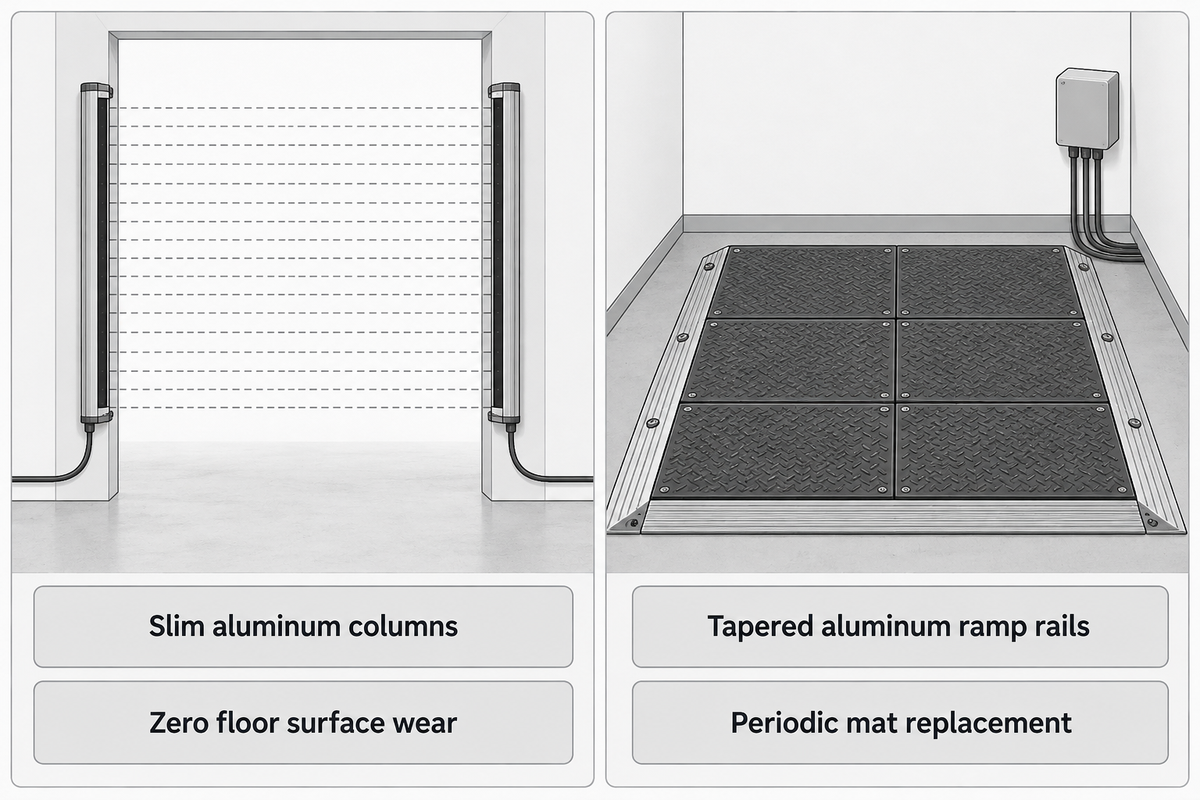
A floor safety mat installation adds tapered aluminum ramp rails, floor anchors, a 4-wire mat controller, and periodic mat replacement under heavy floor wear.
Procurement teams evaluating a safety light curtain versus a safety mat system must consider the total bill of materials, not just the bare sensor components. See the Rockford Systems sizing and configuration guide. In ANSI B11.19-2019 Section 8.3, a mat array must cover the entire hazard floor with no unprotected gaps, anchored by tapered ramp rails and blunt edging with mat connectors. Additionally, Omron’s lifecycle analysis highlights that safety mats cannot be easily relocated or resized when a machine layout changes, and become expensive across large or irregular areas.
By contrast, a non-contact Type 4 light curtain pair guards an entire rectangular machine opening up to 30 meters wide using just two slim aluminum columns. Two M12 cables connect the columns to an existing safety relay or PLC with zero floor surface wear. Comparisons of total cost of ownership (TCO) over a five year period, consider square footage of mat, length of perimeter aluminum ramp rail, and abrasion by wheeled carts and metal swarf.
5-Year Total Cost of Ownership (TCO) Scope Ledger: Light Curtain vs. 4-Wire Safety Mat System
Use this six-line Total Cost of Ownership Engineering Ledger to compare all hardware, mounting, control, and 5-year wear components before you issue a purchase order:
| Lifecycle Cost & Scope Component | Type 4 Safety Light Curtain Pair (IEC 61496-2) | 4-Wire Pressure-Sensitive Safety Mat System (ISO 13856-1) |
|---|---|---|
| 1. Primary Sensor Hardware Scope | 1x Emitter + Receiver optical pair (150 mm to 3 m height; request quote) | 1x to 10x floor mat tiles (12″×12″ to 48″×72″ standard or custom; request quote) |
| 2. Perimeter Trim, Brackets & Anchoring | 2x machine-frame swivel brackets (or 2x floor stands; zero floor ramp trim) | Tapered aluminum ramp rails, mitered corners, blunt edging & expansion anchors |
| 3. Safety Controller & Relay Interface | Direct dual-channel PNP OSSD connection to standard safety relay (e.g., CCH SRB) or PLC | Dedicated 4-wire cross-short safety mat controller (100 to 200 ohms max loop limit) |
| 4. Commissioning & Alignment Labor | 2-column mounting + optical alignment (faster setup with built-in alignment LEDs per GTRIC) | Floor surface prep, multi-mat butt-joint wiring, ramp rail bolting & loop resistance test |
| 5. 5-Year Wear & Reconfiguration | Zero floor mechanical wear; brackets unbolt and relocate in under 1 hour | Periodic mat replacement under heavy cart/swarf wear; non-reusable if zone shape changes |
| 6. 5-Year TCO Engineering Verdict | Lowest 5-year TCO for vertical reach openings & reconfigurable lines | Best restricted to low-wear walk-in zones requiring smoky/misty floor presence |
How to Choose: The 3-Gate Safeguarding Architecture Selector, 2D Laser Scanner Alternatives & Supplier Checklist
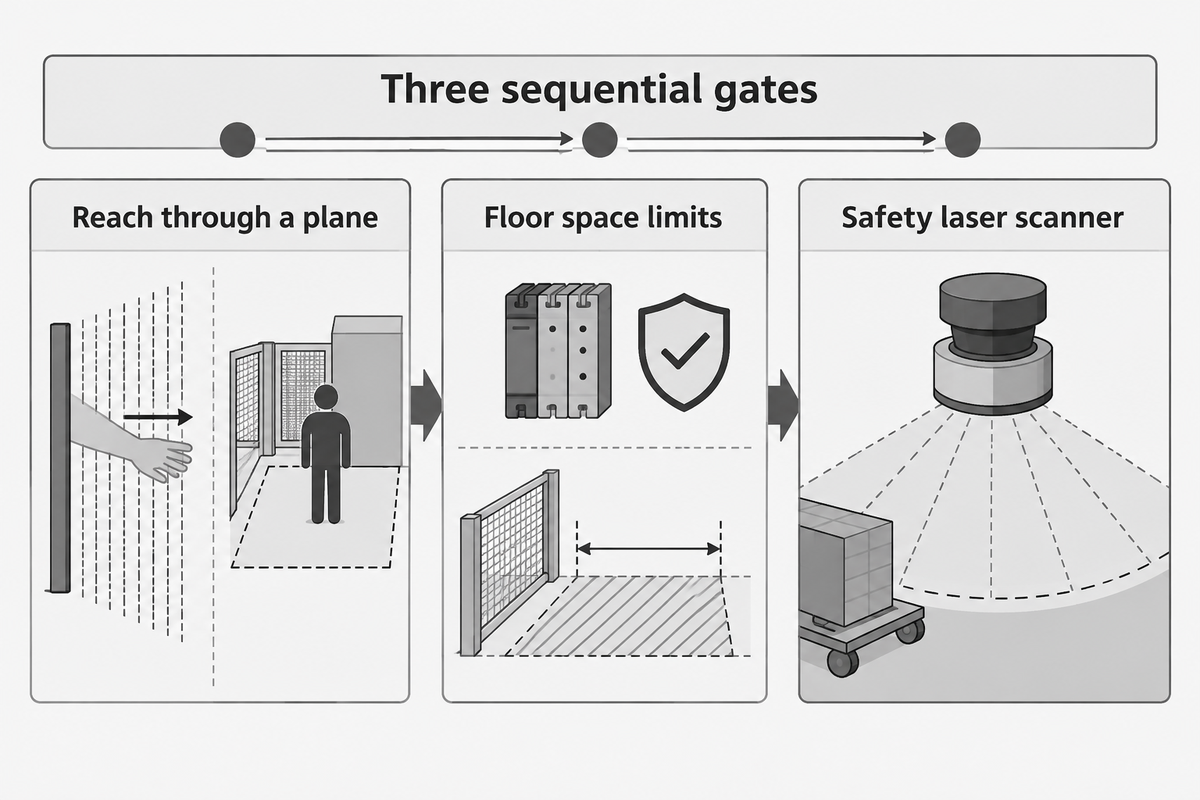
Activate the right safeguard by walking your station through three sequential gates. First, check whether operators reach through a plane or stand inside a zone. Second, verify PL e and ISO 13855 floor space limits. Third, replace high-wear floor mats with a 2D safety laser scanner when wheeled traffic or layout changes occur.
As summarized in Leuze’s application guide to ISO 13855, the safety distance S to the point of operation must always be at least 100 mm. This floor holds even if the formula calculates a lower value. When plants upgrade aging safety mats in robotic cells or forklift bays, they increasingly evaluate non-contact 2D safety laser scanners (such as the CCH SH27-03S or Omron OS32C). For a full optical comparison between linear curtains and radial LiDAR, consult our Type 4 safety light curtain vs. Type 3 2D safety laser scanner comparison.
| Sequential Engineering Decision Gate | If Your Engineering Assessment Is YES… | If Your Engineering Assessment Is NO… |
|---|---|---|
| Gate 1: Reach-Through Plane vs. Walk-In Occupancy Can the operator reach the hazard with fingers or hands through a defined opening without stepping inside the cell? |
Specify a Type 4 Safety Light Curtain (14 mm or 30 mm). A floor mat cannot detect hands reaching over the mat edge and adds a 1,200 mm step-stride setback. | Proceed to Gate 2 (your operator walks completely inside the access zone, requiring interior presence detection). |
| Gate 2: PL e Mandate & Available Floor Depth Does the machine require Category 4, PL e / SIL 3 at the entry portal, OR is available setback tighter than 1,200 to 1,450 mm? |
Specify a Vertical Type 4 Light Curtain at the Entry Portal paired with an interior presence sensor (floor safety mat or horizontal optical scanner) to prevent stand-behind reset. | Proceed to Gate 3 (Category 3, PL d / SIL 2 area guarding with ≥1,432 mm floor depth is permissible). |
| Gate 3: Floor Traffic, Swarf & Layout Flexibility Do forklifts, pallet jacks, or sharp metal chips cross the floor zone, OR will the cell layout change within 3 years? |
Replace Floor Safety Mats with a Non-Contact 2D Safety Laser Scanner (or overhead horizontal light curtain) to eliminate floor crush wear and ramp rails. | Specify a 4-Wire ISO 13856-1 Safety Mat System with tapered aluminum ramp trim (especially in heavy welding smoke or steam). |
The manufacturer comparison table below summarizes the key features of leading industrial suppliers of safety light curtains, pressure-sensitive safety mats, 2D safety laser scanners, and safety relay controllers.
| Manufacturer | Safety Light Curtain Series | Safety Mat / Area Scanner Series | Safety Relay & Controller Ecosystem |
|---|---|---|---|
| CCH (Industrial Safety Sensor) | ENT Series (ENT14 / ENT25 / ENT45 Type 4) | SH27-03S & SE Series 270° 2D Laser Scanners | SRB Series Dual-Channel Safety Relay Modules |
| Rockwell Automation | Guardmaster 450L-B & 450L-E Series | MatGuard 4-Wire Safety Mats & SafeZone Scanners | Guardmaster Safety Relays & GuardLogix PLC |
| Omron Automation (STI) | F3SG-SR / F3SG-RE Type 4 & Type 2 | UM Series Universal Safety Mats & OS32C Scanners | G9SA / G9SP Safety Relays & NX Safety Controllers |
| Keyence | GL-R & GL-S Heavy-Duty Type 4 Series | SZ-V 2D Safety Laser Scanners | GC Series Safety Controllers (supports up to 10 mats) |
| Banner Engineering | EZ-SCREEN LS & SGS Multi-Beam Grids | SX5 275° Safety Laser Scanners | XS26-2 Expandable Safety Controllers (100–200 Ω mat input) |
| Tapeswitch Corporation | Guardsman & Defender Light Curtains | Safety Zone Heavy-Duty Mats (IP67, 147 N) | SIM & PRSU 4-Conductor Fail-Safe Interface Modules |
| Rockford Systems | Point-of-Operation Light Curtain Packages | PSM Series Mats (12″×12″ to 48″×72″) | Category 3 PL d Safeguarding Interface Controls |
| SICK AG / Leuze / Wieland | SICK deTec4 & Leuze MLC 500 Series | SICK microScan3 & Leuze RSL 400 / LBK Radar | SICK Flexi Soft & Wieland samos PRO Controllers |
8-Item Machine Safeguarding RFQ & Engineering Specification Checklist
Include the following eight technical parameters in a request for engineering review or quote for the CCH ENT Series Type 4 light curtains, SRB safety relay modules, or the SH27-03S 2D safety laser scanners. Application engineers at CCH Shanghai Technology and Intelligence Co., Ltd., review all requests.
- 1. Required Performance Level (PLr / SIL): State whether your ISO 13849-1 risk assessment mandates Category 4, PL e / SIL 3 (Type 4 light curtain) or permits Category 3, PL d / SIL 2.
- 2. Detection geometry and resolution (d): Specify 14 mm finger resolution (ENT14), 25–30 mm hand resolution (ENT25), 45 mm body resolution (ENT45), or interior 2D floor presence monitoring.
- 3. Measured machine stopping time (t2): Indicate the longest brake stopping time plus relay dropout time (in msec) for full machine load.
- 4. Stand-behind gap and reset location: Describe whether the vertical curtain is placed far enough back for an operator to stand behind it, requiring a secondary floor mat or horizontal scanner, and an external reset button.
- 5. Protected opening or floor dimensions: Give vertical protective height (150 mm to 3 m) and optical span (up to 30 meters) or floor zone width and length.
- 6. Material flow muting or blanking: List if 2 or 4 sensor muting is required for pallet conveying, if fixed/floating blanking is required for press tools, or if PSDI is used for cycle initiation.
- 7. Controller and PLC interface: Confirm dual-channel 24 VDC PNP OSSD inputs into a CCH SRB safety relay or Logix PLC, or 4-wire cross-short mat controller loop count.
- 8. Shop-floor environment: Identify forklift/pallet-jack wheel traffic, CNC metal swarf, cutting fluids, welding smoke, or washdown (IP65 vs. IP67) so our engineers can tailor mounting brackets and enclosures.
Frequently Asked Questions
Can a pressure-sensitive safety mat achieve ISO 13849-1 PL e like a Type 4 safety light curtain?
An IEC 61496-2 Type 4 safety light curtain achieves Category 4, PL e / SIL 3 natively, whereas most ISO 13856-1 pressure-sensitive safety mat systems are rated to Category 3, PL d.
This performance gap stems from continuous solid-state dual-channel OSSD dark-pulse diagnostics versus passive mechanical contact plates that wear under cyclic compression. Even with a high-diagnostic 4-wire evaluation unit and strict cycle-life tracking to B10d, a contact mat typically reaches PL d, not PL e. Engineers also have to limit series cascading to prevent masking a fault due to cable and plate resistance.
Why does a floor-mounted safety mat require a larger ISO 13855 safety distance than a finger-resolution light curtain?
A floor-mounted safety mat must add a 1,200 mm step-stride intrusion constant (C = 1,200 mm at H = 0 mm), whereas a 14 mm vertical finger light curtain has zero hand-intrusion allowance (C = 0 mm).
Under ISO 13855 (S = K × T + C), an orthogonal finger-detection curtain blocks reach-through immediately at the beam line. Combining a 15 ms sensor response and 15 ms relay dropout on a 100 ms stop-time press yields a compact 260 mm setback. Conversely, a floor-mounted mat must detect a walking operator’s foot compression after a full step into the zone, requiring 1,432 mm of guarded floor depth.
How much does an orbital or multi-sided safety light curtain cost compared to a floor safety mat?
A single-plane Type 4 light curtain requires only one emitter-receiver pair and two brackets, whereas multi-sided optical or multi-tile floor mat layouts add corner mirrors, aluminum ramp rails, and 4-wire controllers.
Because the infrared beams of long-range models span up to 30 meters between two thin columns, optical hardware cost scales with height rather than floor area. Multi-sided or wraparound optical guarding around a press or robot cell adds corner deflecting mirrors or cascaded pairs plus floor stands. By contrast, a multi-tile 4-wire safety mat adds perimeter ramp rails, floor anchors, a dedicated short-circuit evaluation controller, and recurring replacement costs in high-wear zones.
Can forklifts or pallet jacks drive over industrial pressure-sensitive safety mats?
No, standard industrial safety mats will crush or short-circuit under forklift or hard-wheel pallet-jack point loads.
Concentrated wheel loads deform the internal elastomeric spacers between the conductive plates, so high-traffic aisles should use non-contact overhead light curtains or 2D safety laser scanners instead.
When must you use both a vertical safety light curtain and a floor safety mat on the same machine?
You must combine a vertical safety light curtain with an interior floor safety mat (or horizontal optical scanner) whenever an operator can step past the vertical beams and stand undetected between the curtain and the hazard.
This dead-zone hazard arises on deep presses, robotic welding cells, and assembly stations where the mounting setback leaves standing room behind the vertical optical plane. Because a vertical light curtain functions purely as a perimeter trip plane, its infrared beams clear as soon as the operator steps past the emitter-receiver line, allowing the OSSD outputs to turn back ON. If another worker presses the external reset button while the operator remains inside the cell, the machine can restart unexpectedly. Adding an ISO 13856-1 floor mat or horizontal optical scanner inside that rear access zone maintains an active stop signal until the operator exits the cell. That dual-device layout satisfies IEC 62046 and ANSI B11.19-2019 Section 8.5 complementary safeguarding rules.
What is the difference between a 2-wire and a 4-wire safety mat circuit?
A 4-wire safety mat monitors two separate leads per plate to detect cross-shorts up to Category 3, PL d, while a 2-wire mat uses an end-of-line resistor capped at Category 2, PL c.
A 2-wire safety mat places a terminating resistor across the plates for single-channel current monitoring. Stepping on the mat shorts that resistor, which caps fault detection at ISO 13849-1 Category 2 (PL c) because a cable short mimics normal actuation. In a 4-wire fail-safe circuit, the controller sends alternating test pulses across all four leads so any broken cable or unintended short is detected immediately.
References & Sources
- CENELEC / IEC TC 44 — EN IEC 61496-1:2020 Safety of machinery – Electro-sensitive protective equipment – Part 1: General requirements and tests (Superseding EN 61496-1:2013 & Referencing EN ISO 13849-1:2023)
- Rockford Systems, LLC – Safety Mat Selection Guide: ANSI B11.19-2019 Section 8.3 & 8.5, PSM Sizes (12”x12” to 48”x72”), Ramp Trim, and 10-Mat / 100-200 Ohm Series Limit
- Tapeswitch Corporation — Safety Zone Heavy-Duty Safety Mats Specification Sheet: 33 lbs (147 N) Actuation Force, 4-Conductor Fail-Safe Wiring & NEMA 6 / IP67 Rating
- Leuze Electronic Specialist Knowledge — Electro-Sensitive Protective Devices & Safety Mats (IEC 62046 & ISO 13855): Type 2/3/4 Angles, Parallel C = 1,200 – 0.4H Formula, +10% Stop Time & 100 mm Minimum S
- Keyence Safety Knowledge — Calculating the Safety Distance According to ISO 13855: Worked Orthogonal (d = 25 mm, 319.4 mm) and Parallel (H = 200 mm, 1,296.8 mm) Examples
- Datasensing Technical White Paper — Safety Light Curtains or Safety Laser Scanner (WPD-85): 14 mm / 30 mm Resolution, 150 mm to 3 m Height, and PL c / PL d / PL e to SIL 1 / 2 / 3 Mapping
- U.S. Occupational Safety and Health Administration (OSHA) — 29 CFR 1910.217 Mechanical Power Presses: Ds = 63 in/s (1.6 m/s) × Ts Safety Distance Formula and 10% / 10 ms Brake Monitor Limit
- US OSHA eTools – Machine Guarding: Presence-Sensing Devices and Supplemental Safeguarding Requirements
- Omron Automation – Safety Scanner or Safety Mat? Harsh Environment Performance vs. Layout Reconfiguration Analysis
- EHS Today – An Area-Guarding Puzzle: Comparing Safety Mats, Light Curtains, and Area Scanners in Industrial Workcells
- GTRIC Industrial Automation – Safety Laser Scanner vs. Safety Light Curtain: 5 ms Press Detection and 60% Alignment Setup Time Reduction
- United States Patent and Trademark Office – US11624823B2 Optoelectronic Protective Device with ≤30% Contamination Sensitivity Adjustment
- Automation World – Programmable Safety Controllers and Rockwell Guardmaster 450L-B Light Curtain Integration