
Get in touch with QJKH Company
Injection Molding Machine Safety
Safety Light Curtains for Injection Molding Machines
Injection molding machines combine high-force clamping, mold movement, sliding or rotary tables and frequent operator interaction during insert loading and part removal.
Where the mold or worktable remains accessible through a defined opening, a safety light curtain can monitor operator access and provide a safety-related signal when the protective field is interrupted during hazardous machine motion.
This does not make the light curtain a complete safeguarding system by itself. Safety doors, fixed guards, interlocks and other protective measures may still be required around other parts of the machine.
01
Where Are the Main Hazards on an Injection Molding Machine?
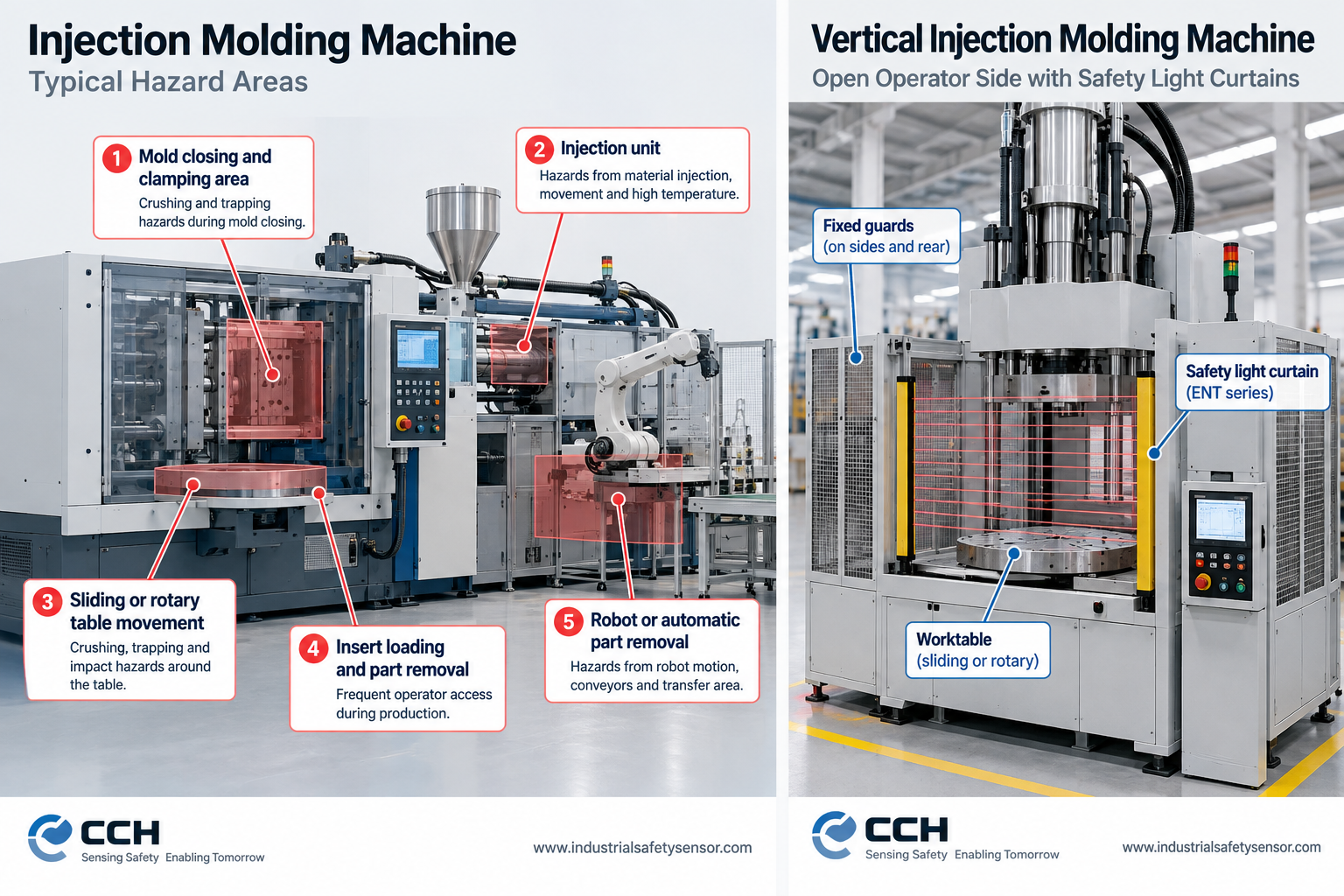
Different parts of an injection molding machine create different mechanical hazards. Safeguarding should therefore begin with where the operator actually works, what movement can be reached from that position, and when access is required during the production cycle.
Mold Closing and Clamping Area
During mold closing, the platens and mold halves move together with substantial force. A hand, arm or other part of the body entering this area at the wrong time may be exposed to crushing or trapping hazards.
Sliding or Rotary Table Movement
Vertical injection molding machines may use sliding or rotary worktables so that insert loading and molded-part removal take place away from the active molding position.
This can improve productivity, but table movement introduces additional crushing, trapping and impact hazards around the operator station.
Insert Loading and Part Removal
Insert-molding applications may require an operator to place metal inserts, electrical components or other parts into the mold before each cycle. Finished molded parts may also be removed manually after the mold opens.
Because these tasks are repeated throughout production, the front access area becomes an important part of the machine-safety design.
Robot or Automatic Part Removal
Many injection molding machines are integrated with robots or automatic take-out systems for part removal, insert placement or transfer to the next process.
Once automation is added, the hazardous area may extend beyond the mold opening into the robot work envelope, conveyor or transfer area. The complete cell then needs to be considered rather than the molding machine alone.
02
Where Are Safety Light Curtains for Injection Molding Machines Used?
Safety light curtains are particularly useful at openings that operators use frequently during normal production but that also provide access to hazardous machine motion.
On a vertical injection molding machine, for example, the rear and sides may be protected by fixed guards or machine panels while the operator side remains accessible for insert loading, part removal or interaction with a sliding or rotary table.
Where this access route is straight and clearly defined, a light curtain can form a protective sensing plane between the operator and the mold or moving table.
If the field is interrupted while hazardous movement is possible, the machine safety system can respond according to the designed safety function.
The same principle can be used where most of the machine is physically guarded but one opening needs to remain available for normal production. Fixed guarding prevents unnecessary access from other directions, while the light curtain monitors the working opening.
The Light Curtain Must Match the Access Geometry
This approach works best when the access path is predictable and can be covered by a straight protective field.
The installation also needs to consider whether a person could reach over, underneath or around the field, or pass through it and remain inside the safeguarded area.
03
Why Vertical Injection Molding Machines Are a Typical Application
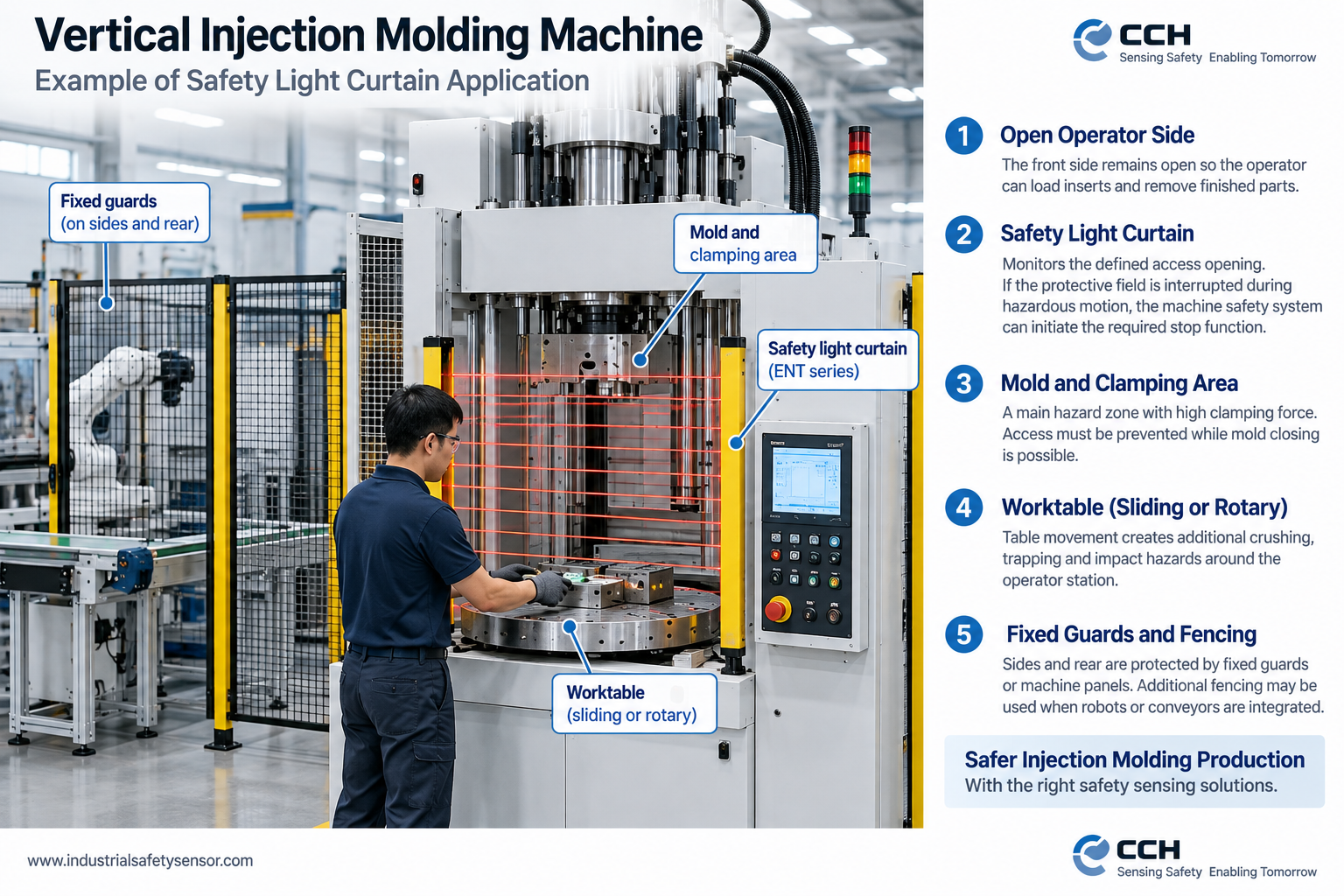
Insert molding is a good example. A component may need to be positioned before each cycle, followed by removal of the molded part when the cycle is complete.
In a process built around frequent manual loading, repeatedly opening and closing a physical door may not be the most practical arrangement. A light curtain can keep the working side physically open while still monitoring access during hazardous movement.
Rotary and Sliding Table Machines
Rotary and sliding tables can separate the operator loading position from the active molding position. An operator may load inserts or remove parts at one station while another station is used for molding.
This arrangement improves production flow, but table movement, mold closing and the operator access opening still need to be considered together in the safeguarding design.
Frequent Access Still Requires a Controlled Safe Response
Frequent operator access does not mean hazardous movement can continue while the opening is occupied.
The protective device needs to be integrated with the machine safety control system so that an access event during a hazardous condition produces the required safe response.
Restart behavior also matters, particularly where a person could pass completely through the sensing field and remain inside the safeguarded area.
04
A Safety Light Curtain Is Only Part of the Safeguarding System
Protecting one open side of an injection molding machine does not address every hazard around the equipment.
The overall safeguarding concept may also need to cover the injection unit, moving table, mold-changing area and any auxiliary equipment connected to the machine.
Fixed Guards and Safety Doors
Areas that do not require frequent operator access may be better protected by fixed guards or machine panels.
Where access is needed occasionally for setup, maintenance or mold changing, an interlocked safety door may be more appropriate than leaving the area continuously open.
The guard and machine safety control system should work together so that hazardous movement cannot continue under an unsafe access condition.
05
Robot Unloading and Automated Injection Molding Cells
Robots, take-out devices, conveyors and downstream automation can extend the hazardous area beyond the mold and clamping zone.
Once these systems are integrated, the safety concept needs to account for the complete work envelope and the ways personnel can approach the cell.
Defined Access Openings
A straight, clearly defined entry point can often be monitored with a safety light curtain. Fixed fencing or machine guarding can prevent access elsewhere while the protected opening remains available for normal production or operator interaction.
Irregular or Multi-Direction Approach Areas
A safety laser scanner may be more suitable where the approach geometry is irregular, personnel can enter from several directions, or a configurable floor-level protective field is required.
The decision should not be based simply on the physical size of the cell. A wide but straight opening may still be well suited to a safety light curtain. The scanner becomes more relevant when the shape and direction of access are difficult to cover with one straight sensing plane.
Access Detection and Presence Inside the Cell Are Different Problems
Detecting someone crossing the boundary of an automated cell does not automatically confirm that the person has left the hazardous area again.
Where an operator can pass completely through a protective field and remain inside the cell, restart behavior and any required presence detection need to be considered separately.
ENT and SH for Different Access Geometries
Within a CCH safeguarding solution, an ENT safety light curtain can be considered for straight and clearly defined machine or cell access openings.
An SH safety laser scanner can be considered where access is irregular, personnel may approach from several directions, or a configurable floor-level protective field is required.
FAQ
Frequently Asked Questions
Can a safety light curtain be used on an injection molding machine?
Yes. It can be used to monitor suitable access openings, particularly where the operator needs frequent access to the mold, clamping area or worktable.
Why are safety light curtains used on vertical injection molding machines?
Vertical machines often involve repeated insert placement and molded-part removal. A light curtain can protect the open operator side without requiring a physical door to be opened and closed for every cycle.
Can a safety light curtain replace the machine safety door?
Not everywhere. A light curtain may be appropriate for a frequently used open access point, while other areas still require fixed guards, interlocked doors or physical containment.
Can a safety light curtain be used with a rotary-table injection molding machine?
It can be considered where access to the rotary or sliding table is clearly defined and can be covered by a straight sensing field. Table movement and mold closing still need to be included in the overall safety design.
When is a safety laser scanner useful around an injection molding cell?
A safety laser scanner may be appropriate where the approach area is irregular, personnel can enter from multiple directions, or a configurable floor-level protective field is required.
PROJECT SUPPORT
Discuss Your Injection Molding Machine Safety Application
The appropriate safeguarding method depends on the machine layout, how the operator accesses the mold area, whether a rotary or sliding table is used, and whether robots or other automation are integrated with the machine.
CCH can support injection molding applications with ENT safety light curtains, SH safety laser scanners and SRB safety relay modules according to the required machine-safety architecture.
Useful application information includes a machine photo or layout drawing, access-opening dimensions, operator working position, table movement, robot or take-out equipment and the hazardous motion that needs to be controlled.
With these details, we can better evaluate whether a safety light curtain, safety laser scanner or combined safeguarding arrangement is appropriate.