
Get in touch with QJKH Company

10 Safety Light Curtain Failure Modes—and Why the Sensor Is Not Always the Problem
Safety light curtain problems are not always caused by the sensor itself. This guide covers 10 common failure modes involving contamination, alignment, wiring, stopping time, muting, access geometry and internal device faults.
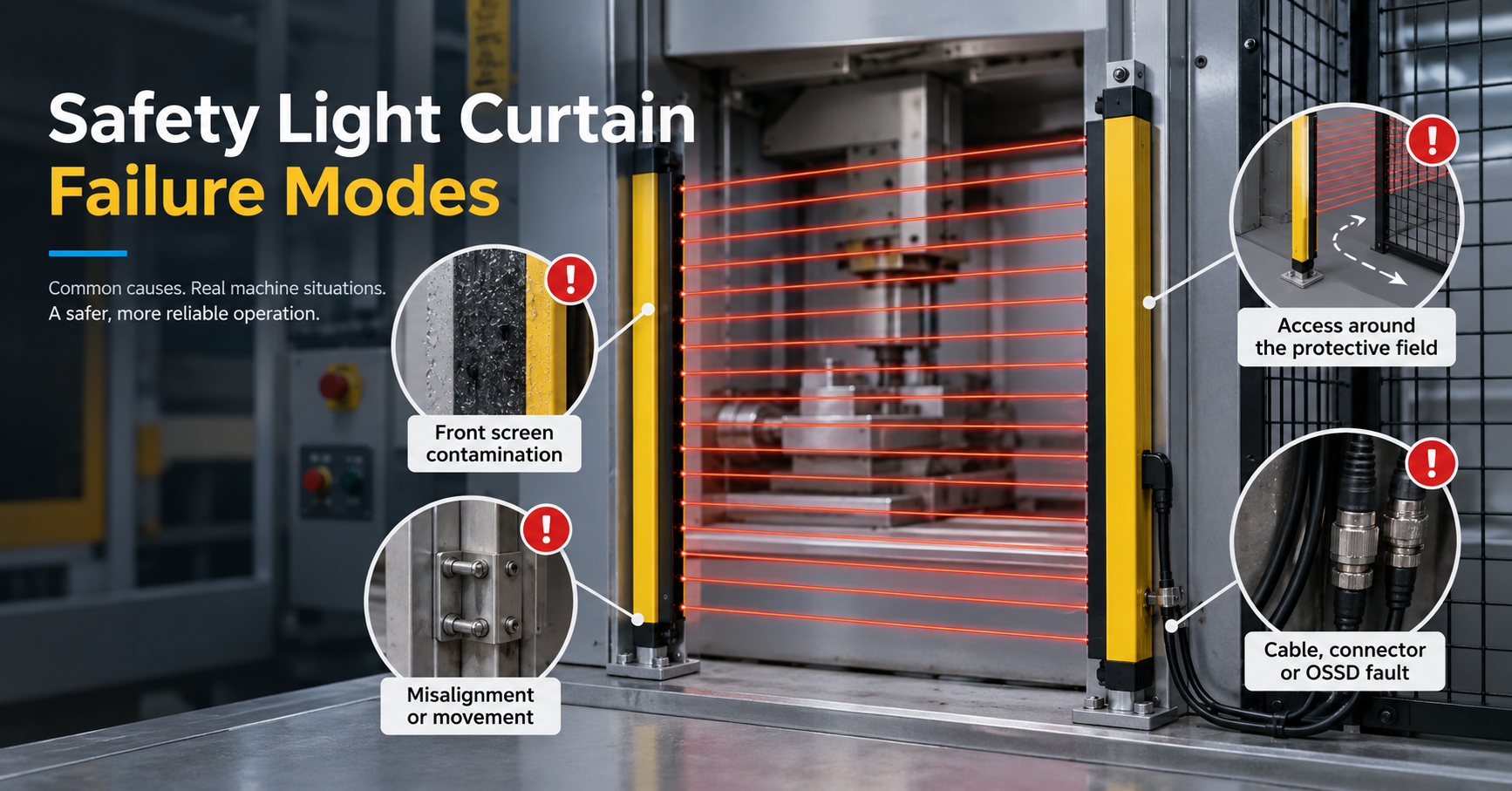
Safety light curtain failure modes are not always caused by a failed sensor. When a machine begins stopping unexpectedly or the expected protection is no longer available, the actual problem may be somewhere else in the safeguarding system.
Alignment, contamination, wiring, stopping performance, machine geometry and safety logic all affect the final result. A light curtain may be working exactly as designed while the overall safeguarding arrangement is still inadequate.
The ten situations below cover both device faults and the less obvious installation, integration and application problems that are often found during troubleshooting.
1. Front Screen Contamination
Dust, oil mist, coolant, water droplets, smoke and other deposits can gradually build up on the optical surfaces of a safety light curtain. This is common on machine tools, woodworking equipment, welding stations and other processes where the surrounding air is not clean.
The first symptom may not be a permanent fault. As the optical margin decreases, the machine may begin to stop intermittently or the light curtain may become more sensitive to small alignment changes before eventually switching to a safe OFF state.
Cleaning the front screens is the obvious first step, but the condition of both the emitter and receiver should be checked. If the device provides alignment or diagnostic indicators, those can also help identify a gradually deteriorating optical condition. Cleaning intervals should reflect the real environment rather than a generic maintenance schedule.
Related guide: Waterproof Safety Light Curtains and Protection in Harsh Environments .
2. Misalignment or Mechanical Movement
Correct alignment at commissioning does not mean the installation will remain aligned for the life of the machine. Vibration, impact, loose fasteners, bracket movement or deformation of the machine structure can shift the emitter or receiver over time.
Long light curtains deserve particular attention. A small angular movement at one end can create a much larger displacement at the opposite end.
One useful clue is timing. If the fault appears mainly while the machine is running, vibrating or moving through a particular part of its cycle, inspect the mounting before replacing the sensor. Also look for recent changes to guards, brackets or machine structures that may have altered the original geometry.
3. Obstruction, Bypass or Deliberate Defeat
A normal obstruction and a defeated safeguard are two different problems. If an opaque object enters the protective field, the expected response is for the safety outputs to switch to the safe state.
The more serious situation is when the safeguarding function has been worked around. Temporary covers, fixtures, stored material or unauthorized machine changes can all interfere with the intended protection. Repeated nuisance trips can also create pressure to find shortcuts instead of correcting the original problem.
During an inspection, pay particular attention to:
- Tape, labels, fixtures or material placed within or close to the protective field.
- Temporary maintenance measures that remained in place after work was completed.
- Alternative access routes that allow the hazard to be reached without proper detection.
If production depends on regularly passing material through the opening, the answer is not to defeat the light curtain. The safeguarding concept itself may need to be reviewed.
4. Mutual Interference and Optical Interference
Problems can also appear when several optical protective devices are installed close together. Light from one transmitter may reach a receiver belonging to another system, depending on the product design and installation geometry.
Some light curtains manage this with beam coding or different transmission channels. Other installations use opposite transmission directions, more physical separation or an opaque barrier between systems.
Nearby infrared sources and reflective surfaces should not be ignored either. The installation manual for the specific light curtain should determine the acceptable arrangement; there is no single spacing value that applies to every product.
One detail is easy to miss: on some devices, enabling an interference-prevention mode such as beam coding can change response time or operating range. If that happens, the existing separation-distance calculation may also need to be reviewed.
5. Incorrect Separation Distance
A light curtain can detect a person correctly and still fail to provide adequate protection if it is installed too close to the hazard.
Detection is only the beginning of the safety function. The machine must still reach the intended safe condition before the person can reach the hazardous area. That is why the light curtain’s response time alone is not enough to determine its mounting position.
ISO 13855:2024 addresses the positioning and dimensioning of safeguards, including detection zones for electro-sensitive protective equipment.
For an existing installation, review at least four points:
- Was the light curtain position based on an applicable separation-distance calculation?
- Does that calculation include the complete safety-system response and machine stopping time?
- Were detection capability and the expected direction of approach considered?
- Has the calculation been reviewed since the machine or safeguarding system was modified?
For the calculation process, see our ISO 13855 Safety Distance Calculator .
6. Machine Stopping Time Has Changed
This failure mode is different from installing the light curtain at the wrong distance in the first place. The original design may have been correct.
The problem develops later. Brake wear, pneumatic or hydraulic changes, increased machine load, mechanical adjustment or control-system modifications can increase the time required for hazardous motion to stop.
The light curtain has not moved, but the machine behind it is no longer behaving exactly as it did when the safeguarding system was validated.
In this situation, compare the current stopping performance with the values used in the original design. Measured stopping performance is more meaningful than adding together nominal component response times from datasheets.
The relevant time belongs to the complete safety function: detection, safety-related control and the final machine response.
7. Cable, Connector and OSSD Wiring Problems
Not every apparent optical fault is optical. Damaged cables, loose connectors, contamination inside a connector, incorrect supply voltage or a problem in the safety-output circuit can all produce repeated faults.
Safety light curtains commonly use dual outputs such as OSSD1 and OSSD2. These outputs must be connected to compatible safety inputs according to the device and safety-control documentation.
A quick electrical inspection should cover the basics:
- Cuts, crushing, abrasion or excessive bending of the cable.
- Loose, contaminated, corroded or damaged connectors.
- Supply voltage and the connection of both OSSD channels.
Repeated OSSD faults should never be “solved” by bypassing one channel. That removes the symptom without addressing the cause.
For more detailed wiring guidance, see our Safety Light Curtain Wiring Diagram Guide .
8. Muting, Blanking or Reset Is Configured Incorrectly
These three functions are often discussed together, but they do very different jobs. Muting temporarily suspends a protective function under defined conditions. Blanking allows defined beams or object conditions to be ignored. Reset and restart logic controls how the machine returns to operation after an interruption.
The common risk is not the existence of these functions. It is using them to solve the wrong problem.
For example, blanking should not become a convenient way to hide an opening created by poor mechanical design. Muting should operate only under the intended material-transfer conditions. And a cleared protective field should not cause an unexpected restart where a person may have passed through the light curtain and remained inside the hazardous area.
These are application and control-logic questions, so validation must consider the real access arrangement rather than only the settings visible in the device configuration.
Related guides: Safety Light Curtain Muting and Safety Light Curtain Blanking .
9. The Hazard Can Be Reached Without Crossing the Protective Field
Sometimes the light curtain works perfectly, but the person does not need to pass through it at all.
Reaching over, under or around the sensing field can make an otherwise functional installation ineffective. Platforms, machine structures, conveyors, stored materials or gaps beside the light curtain may create access paths that were not obvious in the original layout.
During a safeguarding review, look at the protected area as a person approaching the machine would see it. The selected protection height and mounting position must match the actual geometry, not just the nominal dimensions of the machine opening.
Where positioning alone cannot prevent access around the sensing field, fixed guards or other complementary protective measures may be needed.
10. Internal Device Faults and Missed Functional Testing
Of course, genuine device faults also occur. Optical components, electronics, internal connections or output circuits can develop problems during the operating life of the light curtain.
Built-in diagnostics are important, but they do not tell the whole story. A diagnostic system inside the light curtain cannot by itself validate mounting geometry, stopping performance or every external wiring and machine condition.
That is why functional testing remains important. It should go beyond checking whether indicator LEDs are illuminated.
- Review diagnostic indicators or fault codes according to the manufacturer’s instructions.
- Inspect the housing, front screen, connectors and mounting hardware for visible damage.
- Interrupt the protective field and confirm that the machine reaches the intended safe condition.
Summary of Safety Light Curtain Failure Modes
| Failure Mode | Main Source | Possible Effect | First Check |
|---|---|---|---|
| Front screen contamination | Environment | Reduced optical margin or intermittent interruption | Inspect and clean optical surfaces |
| Misalignment or mechanical movement | Installation | Unstable operation or safe shutdown | Check alignment and mounting |
| Obstruction, bypass or defeat | Operation / application | Safe stop, or ineffective protection if the safeguard is defeated | Inspect the field and access routes |
| Mutual or optical interference | Integration | Unintended stop or disrupted protective function | Check nearby optical devices |
| Incorrect separation distance | Safeguarding design | Hazard may be reached before it is controlled | Review the calculation |
| Changed stopping time | Machine / control system | Original positioning may no longer be sufficient | Measure stopping performance |
| Cable, connector or OSSD fault | Electrical | Repeated fault or safe OFF state | Inspect wiring and safety inputs |
| Incorrect muting, blanking or reset | Configuration | Protective function may be weakened or suspended incorrectly | Review the safety logic |
| Access around the sensing field | Safeguarding design | Hazard can be reached without detection | Review access geometry |
| Internal device fault | Device | Diagnostic fault or safe shutdown | Follow manufacturer diagnostics |
Troubleshoot the Safeguarding System, Not Just the Sensor
When a light curtain problem appears, start with the symptom but do not stop there. Check the protective device, its wiring and safety-control interface, the machine’s stopping performance and the physical access to the hazard.
Restoring production is not the same as restoring the safety function. The final check is whether interrupting the protective field still causes the machine to reach the intended safe condition.
Need help selecting or integrating a safety light curtain? Contact our engineering team →
Frequently Asked Questions
Can a safety light curtain have a problem without showing an obvious fault?
Yes. The device may be operating normally while the separation distance, stopping performance or access geometry is inadequate. Contamination, loose connections and marginal alignment may also appear first as intermittent problems.
Why does my safety light curtain keep stopping the machine intermittently?
Start with contamination, alignment and wiring. Vibration, loose connectors and optical interference from nearby devices are also common causes of intermittent behavior.
Can two safety light curtains interfere with each other?
They can. The risk depends on the product and mounting arrangement. Follow the manufacturer’s requirements for beam coding, transmission channels, mounting direction and separation.
How often should a safety light curtain be inspected or tested?
There is no single interval for every machine. Use the manufacturer’s instructions, machine safety documentation, operating conditions and the applicable risk assessment to determine the inspection and test schedule.