
Get in touch with QJKH Company
Woodworking Automation Safety
Safety for Automatic Panel Loading and Unloading in Woodworking
Automatic loading and unloading systems can reduce manual handling and improve production efficiency around CNC routers, nesting machines, panel saws and other woodworking equipment.
At the same time, automation introduces new moving zones around the machine. Panels may be lifted, pushed, transferred or discharged by powered conveyors, gantry systems, vacuum handling equipment or other automatic mechanisms.
Safety needs to consider not only the machine itself, but also how people can approach the automatic material-handling area during loading, unloading and normal production.
01
Where Are the Hazards in Automatic Loading and Unloading?
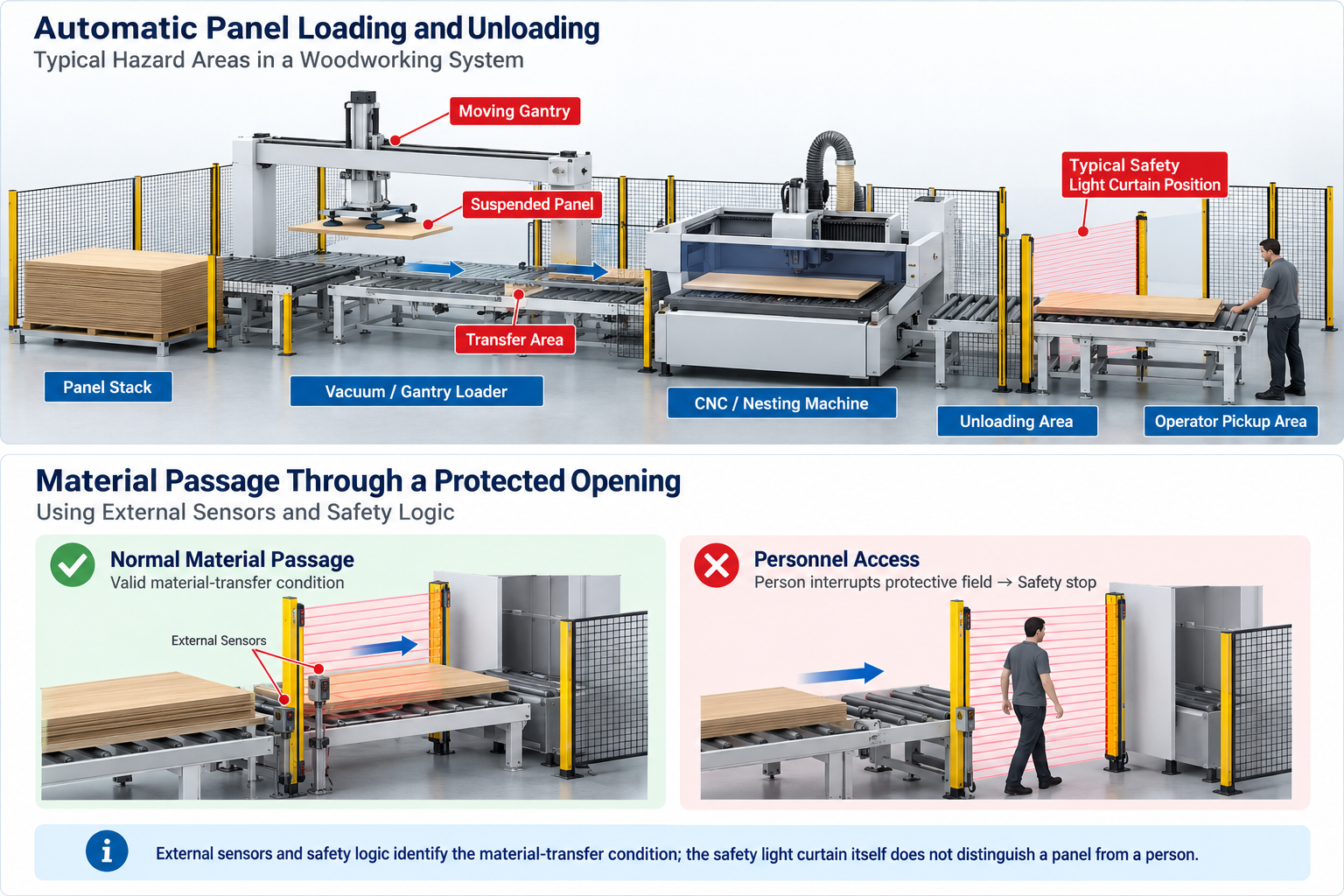
Instead of manually lifting every panel onto and off the machine, the material may be moved automatically between a panel stack, processing machine, conveyor, transfer table or unloading position.
This reduces manual handling, but it also creates additional hazardous motion outside the main machine enclosure.
Moving Panels and Powered Transfer Equipment
Large MDF, plywood, particle board or other panels may move automatically through the loading and unloading system.
Depending on the machine design, the panel may be pushed, pulled, lifted or transported by a powered conveyor or transfer mechanism.
A person entering the transfer area while this movement is active may be exposed to crushing, trapping or impact hazards between the moving panel and fixed machine structures.
Gantry and Vacuum Loading Systems
Some woodworking cells use a gantry or portal system equipped with vacuum grippers to pick panels from a stack and place them onto the machine.
In these systems, the hazard area is not limited to the panel itself. The moving gantry, lifting mechanism and suspended workpiece can all create hazardous motion within the loading zone.
Automatic Unloading and Panel Discharge
After machining, finished panels or nested parts may be pushed onto an unloading table, transferred onto a conveyor or moved toward an operator pickup area.
The point where automatic movement ends and manual handling begins is an important part of the safety design.
Operators may need frequent access to remove parts, clear scrap or prepare the area for the next production cycle.
This means the unloading side may need to remain accessible without allowing personnel to enter the hazardous automatic transfer zone while movement is active.
Robot or Automatic Handling Cells
Some production lines use robots or other automatic handling equipment to transfer panels between woodworking machines.
The hazardous area may extend beyond the footprint of one individual machine and include the transfer path between several pieces of equipment.
The safety concept should therefore be based on the complete cell layout, including all directions from which personnel can approach the automatic handling area.
02
Where Can a Safety Light Curtain Be Used?
A safety light curtain can be a practical solution where an automatic woodworking cell has a clearly defined opening that personnel may use to approach the loading or unloading area.
Defined Loading Openings
A loading station may have fixed guarding around most of the automatic handling area while leaving one clearly defined opening where panels are introduced into the process.
Where personnel can approach the hazardous area through this opening, a safety light curtain may be used to monitor access.
This arrangement is particularly suitable when the access path can be protected by a straight and clearly defined sensing plane.
Automatic Unloading or Pickup Areas
On the unloading side, the machine may automatically move finished panels toward an area where the operator removes them.
A safety light curtain can be considered where the boundary between the automatic transfer area and the operator pickup position is clearly defined.
Openings Between Fixed Guards
In many automated woodworking cells, fixed fencing or machine panels prevent access from most directions.
Safety light curtains can then be used at the remaining open access points where frequent production access is required.
This can be more practical than attempting to use one protective device around the complete loading and unloading system.
The Opening Must Match the Safeguarding Method
A safety light curtain is most suitable when the access route is predictable and can be monitored by a straight protective field.
If people can approach the automatic handling area from several directions, or if the access boundary is irregular, a different safeguarding technology may be more appropriate.
03
When a Safety Laser Scanner May Be More Suitable
A safety light curtain creates a defined protective plane between an emitter and receiver. This works well when the access opening is straight and clearly defined.
A safety laser scanner works differently. It can monitor a configurable two-dimensional protective area at floor level.
This can make a scanner more suitable where the approach area is irregular, where personnel can enter from multiple directions, or where the protective field needs to follow the actual shape of the accessible area.
Typical Situations for a Safety Laser Scanner
A safety laser scanner may be considered where:
- the operator approach area has an irregular shape;
- personnel can approach the automatic handling system from several directions;
- the protected area needs to follow a floor-level boundary;
- the protective field needs to be configured around fixed structures or machine geometry.
The distinction is therefore not simply based on the physical size of the area.
A wide but straight and clearly defined opening may still be suitable for a safety light curtain. The advantage of a safety laser scanner becomes more relevant when the required protective area is irregular or needs a configurable two-dimensional shape.
ENT and SH for Different Access Geometries
Within a CCH safeguarding solution, an ENT safety light curtain can be considered for clearly defined loading or unloading openings where a vertical protective field is appropriate.
An SH safety laser scanner can be considered where the approach area is irregular, personnel can enter from several directions, or a configurable floor-level protective field is required.
The choice should follow the actual access geometry and machine risk assessment rather than a simple assumption that one sensing technology is always better than the other.
04
When Material Must Pass Through the Protective Opening
Automatic loading and unloading systems create an important safeguarding challenge: the same opening may be used for normal material transfer while also providing a possible access route for personnel.
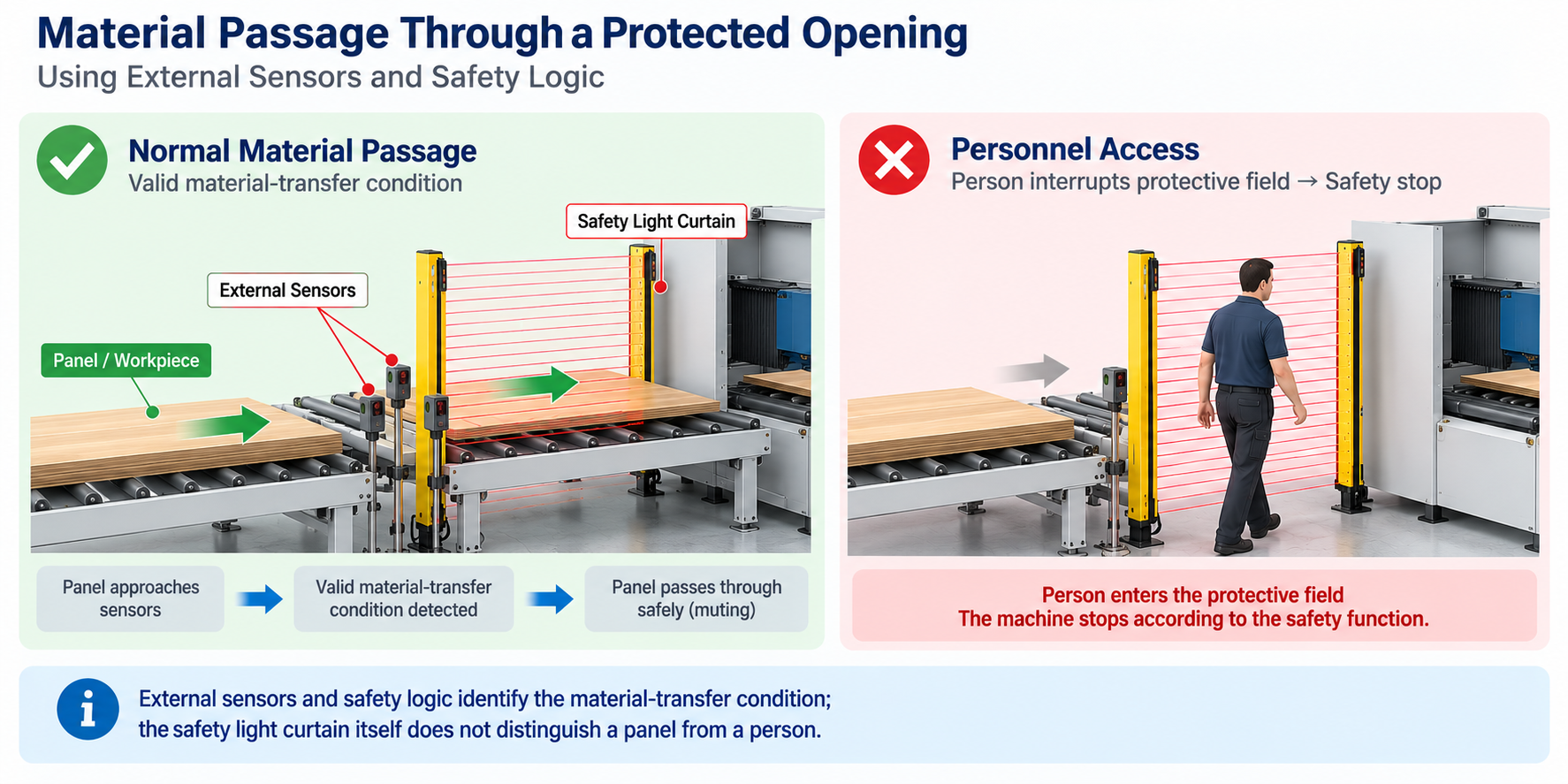
A panel may need to move through the protected opening as part of the normal production cycle. If the material interrupts a safety light curtain in the same way as a person, the machine would otherwise respond to every normal panel transfer as an access event.
In applications where material must pass through the protective field, additional sensing and safety logic may therefore be required to identify an intended material-transfer condition while maintaining personnel protection.
Material Passage and Muting
Muting is one method that may be used in suitable applications.
During a valid material-transfer condition, external sensors provide information to the safety control system so that the temporary passage of the workpiece can be handled according to the designed safety logic.
Once the material has passed, normal protective monitoring should resume.
This does not mean that the safety light curtain itself identifies whether the object is a person or a panel. The distinction depends on the additional sensing arrangement and the safety-control logic used in the application.
Not Every Loading or Unloading Opening Requires Muting
Muting should not be treated as a standard requirement for every automatic woodworking system.
If the safety light curtain protects an operator access opening that is not crossed by the normal material flow, ordinary access protection may be sufficient.
Muting becomes relevant when the workpiece itself must pass through the protective field during normal automatic operation.
The required arrangement depends on the actual direction of material movement, the opening geometry, the machine-control sequence and the risk assessment.
ENT, SRB and External Sensors
For a CCH application, an ENT safety light curtain can be combined with an SRB safety relay module and external photoelectric sensors where the application requires a suitable muting function.
The external sensors detect the intended material-transfer condition, while the safety relay evaluates the required safety logic.
The ENT safety light curtain should not be described as independently recognizing panels or distinguishing material from personnel.
The complete function depends on the sensing arrangement, safety logic and machine integration.
05
Dust, Panel Handling and Installation Conditions
Automatic woodworking cells often operate in environments where MDF dust, sawdust, chips and other process contamination are present.
At the same time, the safety devices may be installed close to moving panels, conveyors, vacuum lifters, carts or other handling equipment.
The installation should therefore consider both the optical environment and the possibility of mechanical damage.
Keep Optical Devices Away from Unnecessary Contamination
Where possible, a safety light curtain or safety laser scanner should not be positioned directly in the heaviest cutting or dust-generation zone.
A mounting location outside the most contaminated area can reduce the amount of dust reaching the optical surfaces and make regular inspection easier.
Consider the Panel Movement Around the Sensor
Large sheets of MDF, plywood or particle board can extend well beyond the machine table during loading or unloading.
The emitter, receiver or scanner should therefore be positioned so that normal panel movement does not easily strike the device or its mounting brackets.
The same consideration applies where forklifts, carts, vacuum lifters or other handling equipment operate close to the protective device.
Inspection and Cleaning
Optical surfaces should be inspected and cleaned as part of the normal maintenance routine.
The required frequency depends on the actual production environment. Continuous MDF processing may create significantly more contamination than an application with lighter or intermittent woodworking operations.
After maintenance, adjustment or accidental impact, the protective device should also be checked to confirm that its position, alignment and safety function remain correct.
FAQ
Frequently Asked Questions
Where can a safety light curtain be used in an automatic woodworking loading system?
A safety light curtain can be considered where personnel approach the automatic loading or unloading area through a straight and clearly defined opening. Typical locations include loading stations, operator pickup areas and openings between fixed guards.
Can a safety light curtain protect an unloading area?
Yes. A safety light curtain can be used where the boundary between an automatic unloading zone and an operator pickup area is clearly defined. The safeguarding design should consider how the finished panel moves and where the operator needs to stand during normal part removal.
When should a safety laser scanner be used instead of a light curtain?
A safety laser scanner may be more suitable where the approach area is irregular, personnel can enter from multiple directions, or the protective field needs to follow a configurable floor-level boundary.
The choice is not based simply on the physical size of the area. A wide but straight opening may still be suitable for a safety light curtain.
How can panels pass through a safety light curtain?
If the normal material flow must pass through the protective field, additional sensors and safety logic may be used to identify the intended material-transfer condition.
In suitable applications, this may be implemented through a muting function. The exact arrangement depends on the machine layout, material movement and safety-control design.
Does every automatic loading system require muting?
No. Muting is only relevant when the normal material flow needs to pass through the protective field.
If the safety device protects a separate personnel access point that is not crossed by panels or other workpieces, ordinary access protection may be sufficient.
Explore more applications in our Woodworking Machinery Safety Solutions overview.
PROJECT SUPPORT
Discuss Your Automatic Loading or Unloading Application
The most suitable safeguarding method depends on how the panels move, where operators approach the system and whether material must pass through the same opening used for personnel protection.
CCH can support woodworking automation projects using ENT safety light curtains, SH safety laser scanners and SRB safety relay modules according to the required machine-safety architecture.
Useful information for application evaluation includes the machine or cell layout, loading and unloading direction, accessible sides, panel size, operator working position and whether the material must pass through the protective field.
With this information, we can better evaluate whether a safety light curtain, safety laser scanner or a combined safeguarding arrangement is more appropriate.