
Get in touch with QJKH Company
Machine Safety in Lithium-Ion Battery Manufacturing: Risks, Safeguarding and Sensor Selection
Lithium-Ion Battery Manufacturing
Machine Safety in Lithium-Ion Battery Manufacturing
A process-by-process guide to machinery hazards, safeguarding strategies and sensing technologies used from electrode production to cell assembly, module/PACK manufacturing and automated intralogistics.
Lithium-ion battery manufacturing combines continuous web handling, high-force rollers, cutting systems, compact automated machinery, robots, conveyors and increasingly autonomous material transport. The machinery changes significantly from one process to the next, and so does the safety problem.
A protective method that works well at a frequently accessed assembly station may make little sense around an inaccessible calender roll nip. A laser-based sensor used to navigate an AMR may detect objects very well but still perform a completely different function from a safety-rated protective device.
For that reason, this guide starts with the machine and the hazard rather than with a particular sensor.
Machine Safety Is Only One Part of Battery Plant Safety
Discussions about lithium-ion battery safety often focus on electrolyte handling, electrical hazards, fire prevention, thermal events or ventilation. Those issues are important, but a battery factory also contains a large amount of conventional industrial machinery.
Electrode material passes through rollers and cutting equipment. Cells are positioned, pressed and transferred automatically. Robots move components between stations. Conveyors transport trays through production lines, while AGVs and AMRs move materials between different factory areas.
These systems can create familiar machinery hazards such as drawing-in, crushing, cutting, trapping, impact and unexpected movement.
A battery filling station, for example, can present two very different safety questions at the same time: how to manage electrolyte-related process risks, and how to keep a person away from moving fixtures, indexing mechanisms or transfer equipment.
The first question belongs mainly to process, chemical and fire-safety engineering. The second belongs to machinery safety.
This article concentrates on the machinery side: how people interact with hazardous movement, how access can be controlled and where different safeguarding or sensing technologies may fit.
Start With the Hazard — Not the Sensor
One of the easiest mistakes in machine safeguarding is to begin with the product question: should this machine use a light curtain, laser scanner or another protective device?
A more useful starting point is simpler: what can hurt the person, where is the hazard, and how can the person reach it?
A calendering machine
The dominant mechanical hazard may be the high-force nip between large rotating rolls. If normal production does not require access to that area, preventing access through machine design and guarding is generally a more fundamental measure than leaving the nip exposed and relying on detection.
An automated assembly station
The situation may be different if an operator needs to load parts through the same opening every production cycle. Here, keeping the opening permanently closed may be impractical, and electro-sensitive protection may become relevant if the complete safety function and stopping performance support it.
A robot cell
Robot movement can cover a much larger area. The safety problem may no longer be one opening or one hazard point, but access to an entire automated cell containing the robot, tooling, fixtures and other machinery.
How the machine is used also matters. Operators may need very little contact during normal automatic production but work much closer to the equipment during changeover, threading, cleaning, fault recovery or maintenance.
Finally, detection is only one part of the safety function. The signal must be evaluated and the hazardous movement must reach the required safe state before the person reaches the danger.
A practical sequence is:
hazard → access route → required safety function →
safety-related response → safe state.
Product selection comes later.
Machine Safety in Lithium-Ion Battery Manufacturing: Where the Risks Appear
The nature of the machinery changes as battery production moves from electrodes to finished cells and packs.
Early manufacturing is dominated by continuous web handling. Later processes rely more heavily on compact automated stations, material transfer, robots and intralogistics.
Typical process flow:
Coating → Calendering → Slitting → Winding / Stacking → Cell Assembly → Electrolyte Filling → Formation & Grading → Module / PACK Assembly
<Coating → Calendering → Slitting → Winding / Stacking → Cell Assembly → Electrolyte Filling → Formation & Grading → Module / PACK Assembly
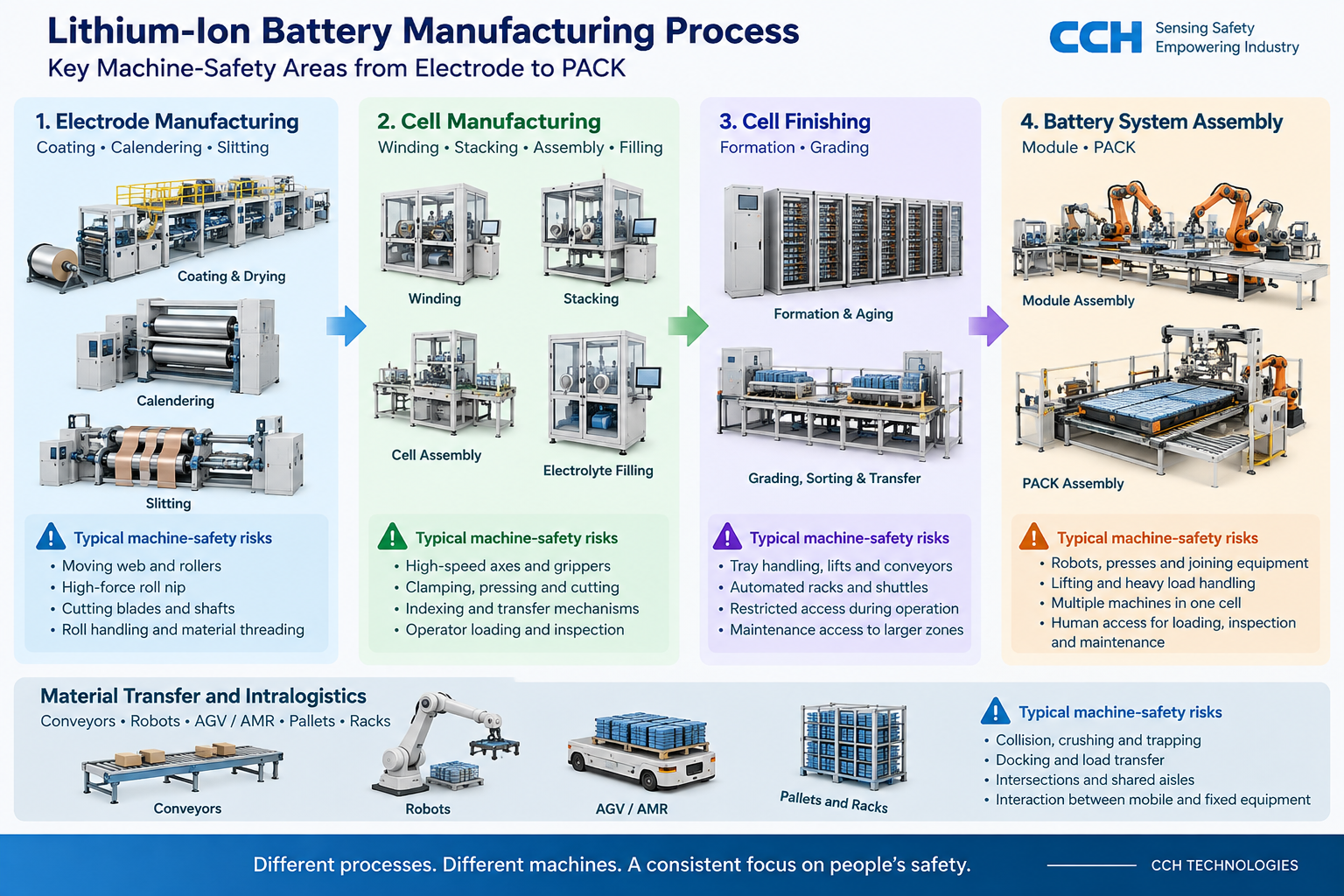
| Process | Typical Mechanical Concerns | Common Human Interaction |
|---|---|---|
| Coating | Moving web, rollers, unwind/rewind mechanisms | Roll change, threading, setup and recovery |
| Calendering | High-force roll nip, drawing-in and crushing | Setup, adjustment, cleaning and maintenance |
| Slitting | Cutting section, shafts and rewind mechanisms | Changeover, threading, roll handling and blade service |
| Winding / Stacking | Clamps, grippers, cutters and fast moving axes | Loading, material replenishment and setup |
| Cell Assembly | Fixtures, pressing, indexing and transfer | Loading, inspection and production recovery |
| Formation / Grading | Tray handling, lifts, racks and conveyors | Loading, inspection and maintenance access |
| Module / PACK | Robots, presses, welding, lifting and transfer | Component supply, inspection and cell entry |
| AGV / AMR | Collision, crushing and trapping | Shared aisles, crossings and docking areas |
The table is a map rather than a selection chart. Two machines performing the same process can still require different safeguards because their layouts, access openings, operating modes and stopping characteristics are different.
Electrode Manufacturing: Coating, Calendering and Slitting
Electrode manufacturing contains some of the most characteristic continuous machinery in a battery plant. Metal foil passes through coating and drying, roll pressing and slitting before it is prepared for cell manufacturing.
Electrode coating
A coating line is much more than the coating head itself. It can extend over a considerable distance and include unwind and rewind stations, guide rollers, web-tension mechanisms and other powered components.
The line may operate automatically for long periods, but that does not necessarily mean human exposure is low at every stage of operation. Roll loading, material threading, startup, inspection and rewind changeover can bring people much closer to the machinery than steady production does.
For machinery safety, the beginning and end of the web path often deserve as much attention as the coating process itself. Heavy rolls need to be positioned, shafts can rotate, and the web must follow a defined route through multiple driven components.
Calendering
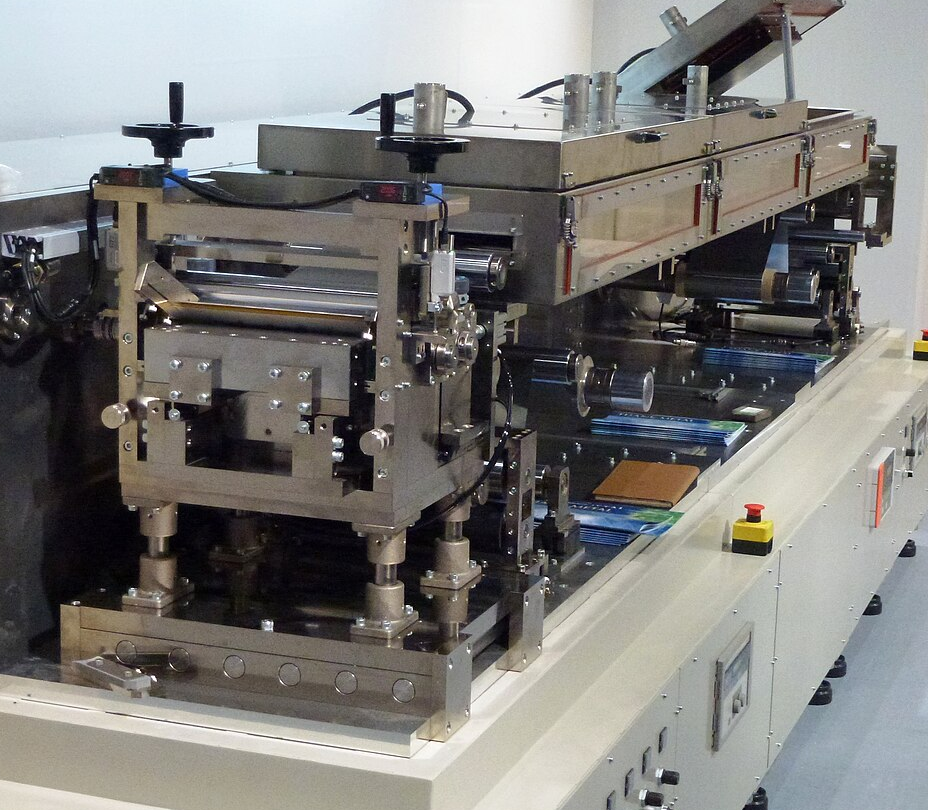
Calendering compresses coated electrode material between rotating rolls to achieve the required thickness and density.
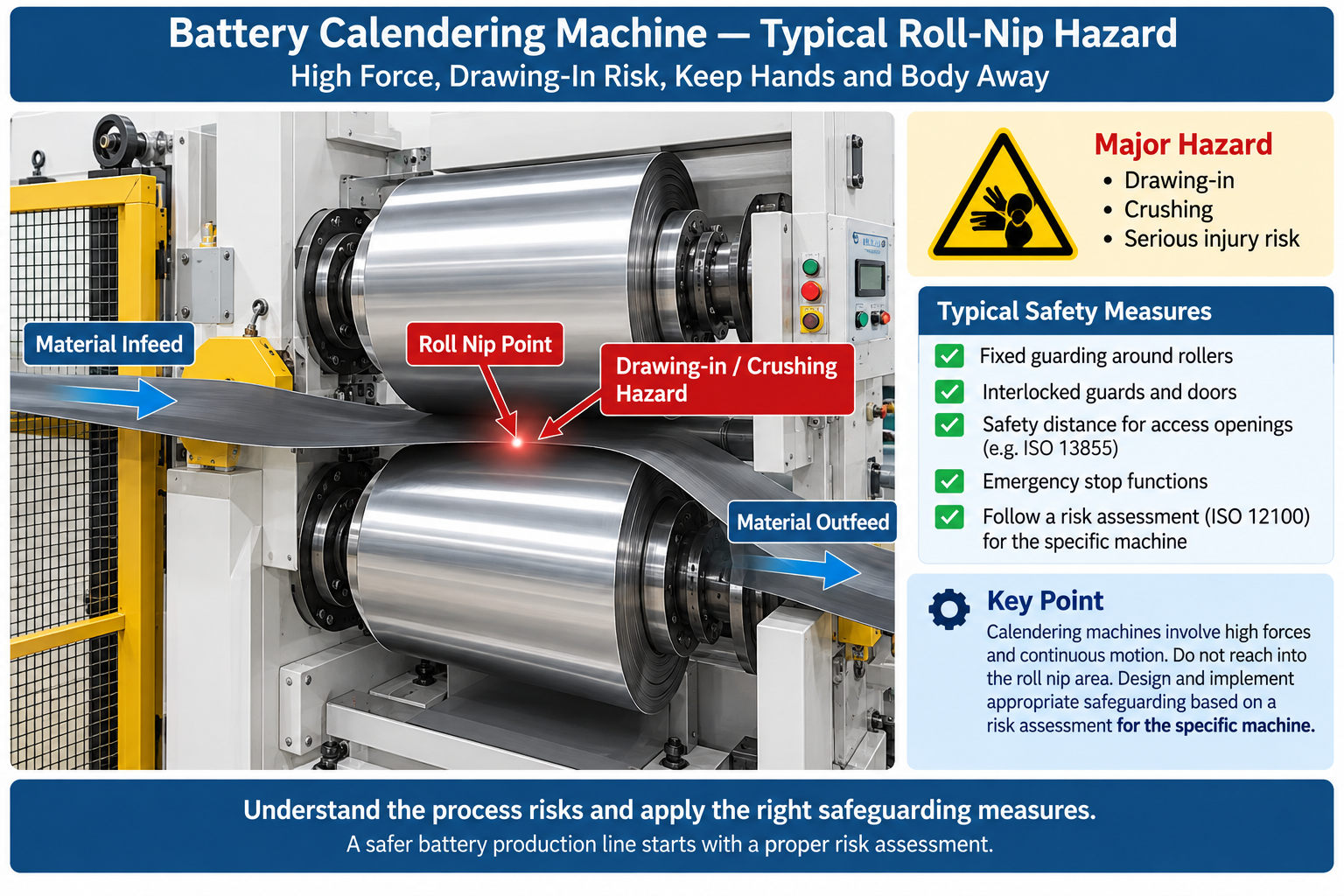
From a machinery-safety perspective, the most important feature is the high-force roll nip. The material is intentionally drawn through the rolls, which means an accessible nip can also create a serious drawing-in and crushing hazard for a person.
The first question is therefore not “Which sensor should protect the rolls?” but “How can access to the high-force nip be prevented?”
Where routine access is unnecessary, fixed or interlocked guarding may be the most direct solution. If an operating task genuinely requires an open access point, the designer then needs to consider the access route, machine stopping performance and whether protective sensing is suitable.
Slitting
Slitting cuts a wide electrode web into narrower strips for downstream cell production. The cutting section is the obvious hazard, but it is not the whole safety problem.
A slitter-rewinder can also include powered shafts, rollers, chucks and rewind systems. Many real operator interactions occur during web threading, roll change, rewind removal and adjustment rather than while the cutting section is running normally.
Cutting components that do not require routine access can remain enclosed. Rewind and loading positions may need a different approach because people work closer to the material and rotating mechanisms.
Across coating, calendering and slitting, a useful lesson emerges: the highest human exposure often occurs during transitions in the process rather than during steady automatic production.
Cell Manufacturing: Winding, Stacking, Assembly and Electrolyte Filling
After electrode preparation, the machinery changes character. Long web-processing equipment gives way to smaller, faster automated mechanisms packed into comparatively compact machines and workstations.
Winding and stacking
In winding, electrode and separator materials are formed into a compact structure. In stacking, electrode sheets and separator layers are positioned in sequence.
These processes can contain many synchronized motions in a small space: feed rollers, clamps, grippers, cutters, winding heads and indexing axes. No single movement needs to look dramatic for a serious pinch, crushing or cutting hazard to exist.
Frequent access is one of the important design questions. If operators regularly replenish material, remove parts or interact with a loading position, the machine boundary needs to support that production workflow without unnecessarily exposing the internal mechanisms.
Cell assembly
Assembly commonly introduces a station-based production structure: components arrive, a fixture positions or clamps them, a process takes place and the part transfers to the next station.
Servo axes, pneumatic cylinders, presses, indexing tables and moving fixtures can all create local trapping points.
The machine-safety question increasingly shifts from protecting one mechanism to protecting the interface between a person and a sequence of automated stations.
Loading points are particularly important because they may be the place where normal production intentionally brings the operator closest to the automatic process.
Electrolyte filling
Electrolyte filling introduces process-specific risks, but the filling equipment may still contain conventional machinery such as indexing tables, fixtures, automatic doors and transfer mechanisms.
Those mechanical hazards require their own assessment. Controls for chemical exposure do not automatically protect a person from a closing fixture or powered transfer system.
Formation, Module/PACK Assembly and Material Transfer
Farther downstream, machinery safety increasingly becomes a line-level problem rather than the problem of one isolated machine.
Formation and grading
Formation receives a great deal of attention because of electrical and thermal considerations, but much of the mechanical risk can come from the automation surrounding the process.
Cells and trays may be moved by conveyors, lifts, shuttles, racks or other handling systems. During normal operation, personnel may rarely approach the equipment. Inspection or maintenance, however, can require entry into a much larger automated zone.
Once whole-body entry is possible, simply detecting that someone crossed a boundary is not enough. The safety concept also needs to address unexpected restart while a person remains inside.
Module and PACK assembly
Module and PACK production often resembles a highly automated industrial assembly line. Robots, fixtures, presses, welding equipment, lifting systems and conveyors can all operate within the same production area.
Several hazards can therefore exist in one cell. A robot may position cells while a fixture clamps them; a joining head may move into place; a conveyor may then transfer the module out of the station.
The handled product also becomes larger and heavier as production moves from individual cells to modules and complete packs. A moving module or PACK can itself create a crushing zone between the load and surrounding machine structures.
This is also where coordinated safety-related control becomes more important. If several machines share one protected zone, the required response should consider every piece of equipment capable of creating a hazard inside that zone.
Conveyors and transfer systems
Conveyors can look simple compared with robots or presses, but their hazards become most obvious when normal material flow stops.
A misaligned tray, blocked pallet or failed transfer can bring an operator close to pushers, lifts, rollers or indexing mechanisms that normally move without human contact.
Long conveyor systems can also divide working areas. Pedestrian crossings, loading points and material openings should be designed intentionally rather than created informally after the line is installed.
Robot Loading and Automated Cells in Battery Manufacturing
Industrial robots are widely used for cell handling, module transfer, joining processes, tray movement and PACK assembly. For a deeper discussion of access openings, perimeter protection and area monitoring, see our Robot Cell Safety guide .
The important safety point is that a robot cell should not be assessed as an isolated robot arm. The real application can include the robot, end-of-arm tooling, the handled battery component, fixtures, conveyors and adjacent machines.
The hazardous area can be much larger than one point
Robot motion can cover a three-dimensional operating envelope. Grippers and large workpieces can extend the effective reach even farther.
For that reason, many robot applications establish a defined safeguarded perimeter. The critical design questions then move to the places where that perimeter needs to be opened.
A loading opening and a personnel gate solve different problems
A loading opening may need to remain accessible every production cycle so components can enter or leave the cell. The challenge is to maintain the required material flow without giving a person access to hazardous robot or fixture movement.
A personnel gate is different because it may allow someone to enter the cell completely. Once full-body entry is possible, the system also needs to prevent hazardous automatic restart while that person remains inside.
Stopping only the robot may not make the cell safe
A stationary robot does not guarantee that everything inside the cell is safe.
A fixture may still be capable of closing, a lift may still move, or a conveyor may continue transporting a heavy module through the same area. The safety function therefore needs to consider every hazardous mechanism inside the protected zone.
Teaching, setup and production recovery also create operating conditions that differ from normal automatic production, which is why robot-cell safeguarding needs to be evaluated at the application level.
Robot-cell safety is fundamentally about controlling
access, hazardous motion and restart across the complete
integrated cell.
AGV and AMR Safety in Lithium-Ion Battery Factories
AGVs and AMRs increasingly move electrode rolls, cell trays, modules and other materials between production areas without requiring a fixed conveyor connection between every machine. For more detail on protective fields and mobile robot personnel protection, see our AGV & AMR Safety Laser Scanner guide .
Their safety challenge differs from stationary machinery because the hazardous equipment itself moves through the factory.
Pedestrian interaction is the central problem
A vehicle can share an aisle with people, pass through intersections, approach workstations or dock next to production equipment. Collision is only one potential hazard; trapping between the vehicle and a wall, machine or rack may be equally important.
The safety strategy therefore needs to account for vehicle direction, speed, braking performance, load geometry and the environment around the vehicle.
The protective area moves with the vehicle
A mobile robot travelling through an open aisle may require a different protective distance from the same vehicle approaching a docking station slowly.
Detection is useful only if the vehicle can achieve the required safe response before reaching the person. Load, floor conditions, braking and control response can all affect stopping performance.
Travel and docking are two different safety situations
At a docking station, the vehicle may interact with conveyors, lifts, rollers or other machinery.
A safely stopped AGV can still become part of a hazardous transfer operation once a tray or module starts moving between the mobile platform and the fixed machine.
Travel safety and load-transfer safety should therefore be evaluated separately.
Navigation sensing and personnel-protection sensing are different jobs
Mobile robots can use more than one laser-based sensing system. One may provide environmental scan data for localization, mapping or route planning, while another participates in the safety-related function used to protect people.
Because both technologies can detect objects and measure distance, their roles are sometimes confused.
A sensor that provides excellent navigation or localization data is
not automatically suitable for safety-related personnel
protection.
The vehicle and its load should also be considered together. A battery rack, tray or PACK may extend beyond the mobile platform and change the possible crushing zones around the system.
Factory layout matters as well. Good visibility, controlled crossings, adequate aisle width and sensible separation between pedestrian work areas and frequent vehicle traffic can reduce difficult interactions before a sensor ever needs to respond.
Choosing the Right Safeguarding and Sensing Technology
The manufacturing process tells us where to investigate, but it does not determine the protective device.
Different technologies solve different problems.
| Technology | Main Function | Typical Fit |
|---|---|---|
| Safety Light Curtain | Detect access through a defined opening | Suitable loading stations, machine openings and assembly fixtures |
| Safety Laser Scanner | Monitor a defined two-dimensional protective field | Wider approach areas, robot zones and mobile equipment |
| Safety Relay / Safety Control | Evaluate safety-related inputs and initiate the defined response | Light curtains, scanners, guard interlocks and other safety functions |
| Industrial 2D LiDAR | Provide scan and measurement data for automation | Navigation, localization, positioning and non-safety sensing |
Light curtain or safety laser scanner?
A safety light curtain is often well suited to a defined opening where people need frequent access but the protected boundary remains relatively narrow.
A safety laser scanner becomes more attractive when the problem involves monitoring a larger two-dimensional area at floor level or around mobile equipment.
Neither technology is automatically “better.” The geometry of the access route and the required safety function determine which approach makes sense.
Protective sensing does not work alone
Once a light curtain, scanner or interlock detects a condition requiring action, the signal still needs to be evaluated and translated into the required machine response.
A simple way to view the chain is: detection → safety-related evaluation → machine response → safe state.
Safety laser scanner or industrial 2D LiDAR?
This distinction is especially important in automated battery factories.
Industrial 2D LiDAR can provide useful scan data for navigation, localization, positioning, object detection or other automation tasks. A safety laser scanner serves a different purpose when it participates in a safety-related personnel-protection function.
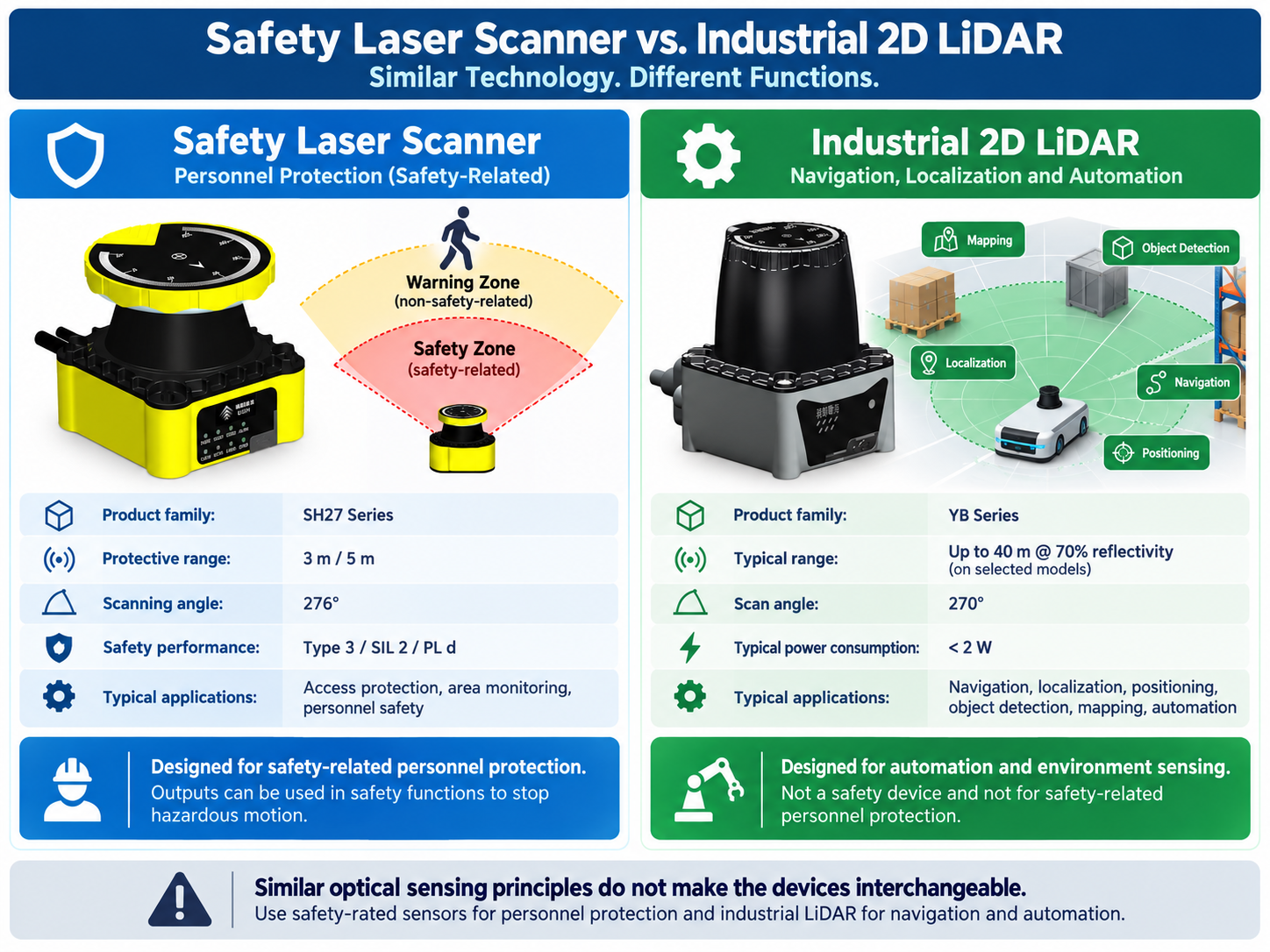
Similar optical sensing principles do not make the devices interchangeable.
Machinery-Safety Standards to Consider
Several standards can be relevant to one battery production line because they answer different engineering questions.
| Standard | Why It Matters Here |
|---|---|
| ISO 12100:2010 | General machinery risk assessment and risk-reduction framework |
| ISO 13849-1:2023 | Design and integration of safety-related control functions |
| ISO 13855:2024 | Positioning of safeguards relative to human approach to hazards |
| IEC 61496 series | Electro-sensitive protective equipment such as safety light curtains and safety laser scanning devices |
| ISO 10218-1/-2:2025 | Industrial robot and robot-cell safety requirements |
| ISO 3691-4:2023 | Driverless industrial trucks and systems, including AGV/AMR applications |
These standards do not all address the same issue. ISO 12100 provides the overall risk-assessment framework; ISO 13849-1 deals with safety-related control; ISO 13855 helps with safeguard positioning; IEC 61496 addresses electro-sensitive protective equipment; ISO 10218 covers robot applications; and ISO 3691-4 addresses driverless industrial trucks.
No single standard number makes a complete battery production machine safe or compliant. The actual machine, safety functions, installation, target market and applicable regulatory requirements still need to be evaluated.
For light-curtain applications where safety distance is being evaluated, see our ISO 13855 Safety Distance Calculator .
Where CCH Technologies May Fit
Product selection should come after the required function has been defined. CCH product families cover several of the sensing and safety-related functions discussed above, but they do not all perform the same job.
| Required Function | CCH Product Family |
|---|---|
| Safety-related access detection at a suitable machine opening | ENT Safety Light Curtain |
| Safety-rated protective-field or area monitoring | SH Safety Laser Scanner |
| Safety-signal evaluation in a suitable control architecture | SRB Safety Relay Module |
| Navigation, localization and non-safety industrial sensing | YB Industrial 2D LiDAR |
A safety relay can be appropriate for straightforward safety functions, but complex production cells with multiple zones, operating modes and coordinated stopping functions may require an appropriate programmable safety controller or safety PLC.
The YB 2D LiDAR family belongs to a different functional category. Appropriate raw-data models can provide scan information used by systems for navigation, localization and other automation tasks.
Where personnel protection requires a safety-rated protective function, a non-safety-rated YB LiDAR should not be substituted for a safety laser scanner or other appropriate safety-rated protective device.
Frequently Asked Questions
Can a safety light curtain protect a battery calendering machine?
It can form part of the safeguarding concept at a suitable access point, but it should not automatically be treated as the primary protection for the calender roll nip. Where routine access to the rollers is unnecessary, fixed or interlocked guarding may be more appropriate.
Where are safety light curtains used in battery manufacturing?
They can be useful at suitable loading stations, assembly fixtures, winding or stacking access points and other defined openings requiring frequent access. Final suitability depends on the hazard, stopping performance and access geometry.
Should a battery robot cell use a light curtain or a safety laser scanner?
It depends on the protected geometry. A light curtain can protect a defined opening, while a safety laser scanner can monitor a wider two-dimensional area. Physical perimeter guarding and interlocked gates may also form part of the same safeguarding concept.
Can ordinary 2D LiDAR replace a safety laser scanner on an AGV or AMR?
Not where the required function is safety-related personnel protection. Industrial LiDAR can provide valuable navigation, localization and environmental data, but that does not automatically make it suitable for a safety-related protective function.
What is the difference between a safety laser scanner and navigation LiDAR?
The main difference is intended function. A safety laser scanner is designed to participate in a safety-related protective system. Navigation LiDAR normally provides scan or measurement data to automation software for localization, mapping, positioning or route planning.
Does a Type 4 safety light curtain automatically make a machine PL e?
No. The protective device is only one part of the complete safety function. Safety-related logic, output elements, architecture, diagnostics and machine response also influence the achieved performance of the overall function.
How is the correct safety distance for a light curtain determined?
The design needs to consider the way a person approaches the hazard and the time required for the protective system and machine to respond. Machine stopping time, protective-device response and possible reach around the detection zone all matter.
Is a safety relay enough for an entire battery production line?
It may be appropriate for relatively straightforward safety functions. Large integrated lines with multiple zones, robots, gates and operating modes may require a more capable programmable safety-control architecture.
Are machine safety and battery fire safety the same thing?
No. Machine safety addresses hazards such as crushing, cutting, drawing-in, impact and unexpected movement. Battery process safety can also involve electrolyte, electrical, ventilation, fire and thermal risks. Both matter, but they require different engineering controls.
What should be checked before selecting a safety sensor?
Start with the hazard, the way people access it, whether physical guarding can prevent access, whether whole-body entry is possible, machine stopping performance and the required safety function. Also confirm whether the sensing task is truly safety-related or simply part of normal automation.
References and Further Reading
The following standards and technical sources provide background for the machinery-safety principles and lithium-ion battery manufacturing processes discussed in this guide.
- ISO 12100:2010 — Safety of machinery — General principles for design — Risk assessment and risk reduction.
- ISO 13849-1:2023 — Safety of machinery — Safety-related parts of control systems — Part 1: General principles for design.
- ISO 13855:2024 — Safety of machinery — Positioning of safeguards with respect to the approach of the human body.
- IEC 61496 series — Electro-sensitive protective equipment: IEC 61496-1:2020 , IEC 61496-2:2020 and IEC 61496-3:2025 .
- ISO 10218-1:2025 / ISO 10218-2:2025 — Safety requirements for industrial robots, robot applications and robot cells.
- ISO 3691-4:2023 — Industrial trucks — Safety requirements and verification — Part 4: Driverless industrial trucks and their systems.
- Liu et al., Current and future lithium-ion battery manufacturing, iScience, 2021 — Technical overview of lithium-ion battery manufacturing processes.
- Dürr — Li-Ion Battery Electrode Manufacturing — Industrial process background covering web handling, coating and drying, calendering and slitting.
Standards and regulatory requirements may change and can differ by machine type, application and market. Applicable requirements should be confirmed for the specific machinery and installation.
Evaluating Machine Safeguarding for Battery Manufacturing Equipment?
Useful product selection normally requires more information than the machine name alone.
If you are evaluating a safety light curtain, safety laser scanner, safety relay or industrial 2D LiDAR, useful starting information includes the machine or process, the hazardous area, photos or a layout drawing, the access dimensions and the machine stopping time if it is already known.
With that information, we can discuss which CCH product category may fit the application and which technical details should be confirmed before final selection.
Contact UsFinal machinery risk assessment, safety-function design and compliance should be completed for the specific machine and target market by the responsible machine builder, system integrator or qualified safety professional.