
Get in touch with QJKH Company

Safety Relay vs Safety PLC: A Risk-First Selection Guide
Safety Control Architecture
Safety Relay vs Safety PLC: How to Choose the Right Architecture
On a small machine, a safety PLC can be more system than the application needs. On a larger automated line, adding separate relay circuits one after another can eventually make troubleshooting and modification harder than the safety functions themselves.
That is why the choice should not start with a fixed rule such as “two safety devices means relays, five means a safety PLC.” What matters is how many safety functions the machine has, how those functions interact, how distributed the equipment is and how likely the system is to change later.
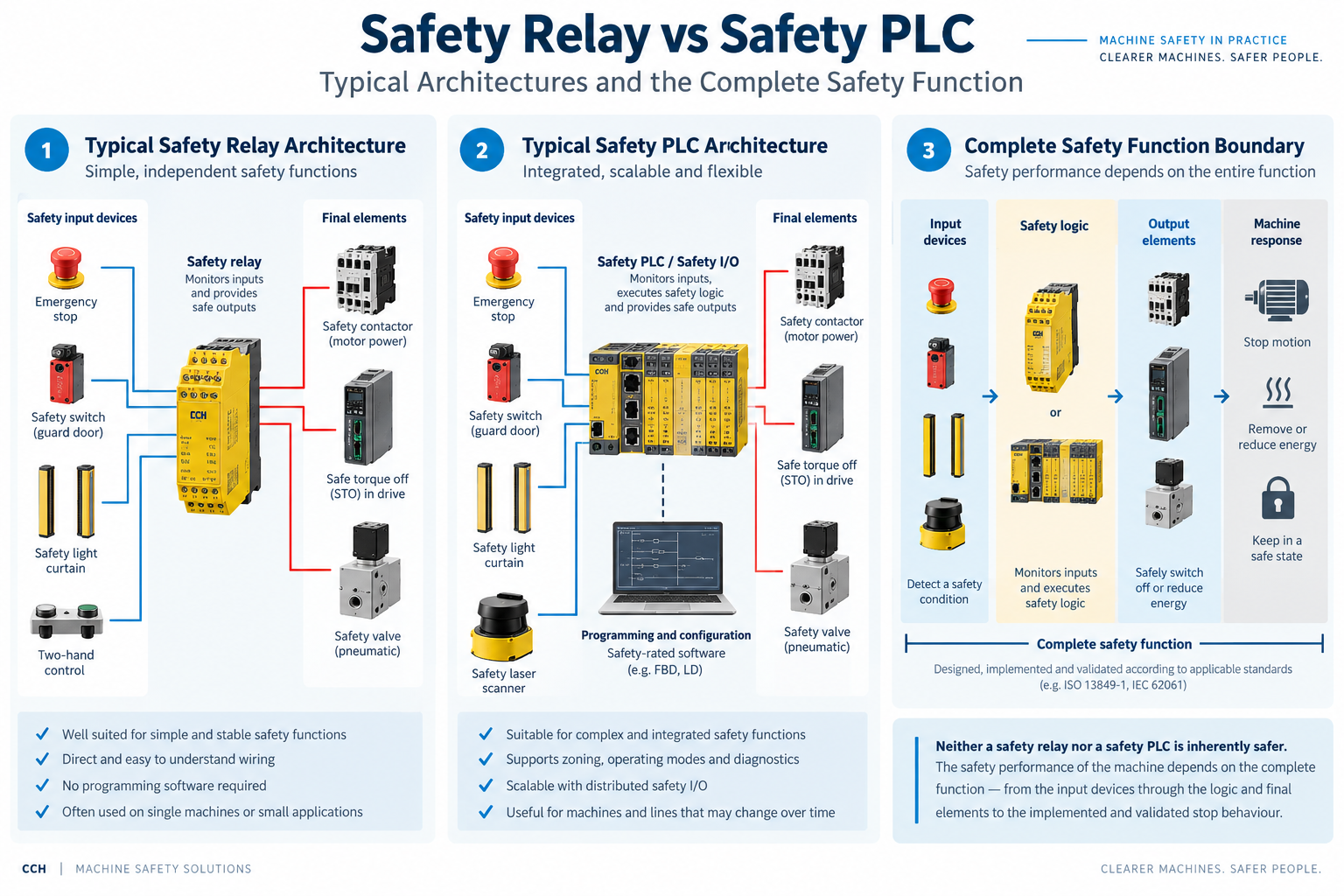
Neither architecture is inherently safer. The safety performance of the machine depends on the complete function — from the input devices through the logic and final switching elements to the implemented and validated stop behaviour.
Safety Relay
What Is a Safety Relay?
A safety relay is a device used to monitor defined safety inputs and control safety-related outputs. Typical applications include emergency-stop circuits, guard switches, safety light curtains and other protective devices where the required logic is relatively clear and stable.
Conventional safety relay architectures are attractive because their signal paths are usually easy to understand, document and troubleshoot. For a machine with one or several independent safety functions, this simplicity can be an advantage during commissioning and maintenance.
The term safety relay should not, however, be treated as synonymous with purely fixed hardwired logic. Configurable safety relays also exist and can provide programmable function blocks, multiple safety inputs and more flexible logic. They occupy useful middle ground between a conventional dedicated relay and a full safety PLC architecture.
Best fit
Safety relays generally make the most sense when the safety functions are limited in number, relationships between functions are simple and future changes are expected to be modest.
Safety PLC
What Is a Safety PLC?
A safety PLC is a programmable controller designed for safety-related control functions. Depending on the system, safety inputs, logic and outputs may be centralised or distributed across the machine while being managed within a common safety control architecture.
This becomes useful when a machine has several safety zones, multiple operating modes, coordinated protective devices or functions that must interact. Diagnostics can also be more detailed, helping maintenance teams identify which input, condition or safety function is preventing machine operation.
The additional flexibility comes with additional engineering responsibility. Software configuration, change control, access management, backups, testing and validation all become important parts of maintaining the safety function over the life of the machine.
A standard PLC should not be confused with a safety PLC. Non-safety control can exchange status information with the safety system, but that communication does not make the standard PLC or connected non-safety devices part of a safety-rated function unless the architecture has been designed and evaluated for that purpose.
Best fit
A safety PLC generally becomes more attractive as the number of interacting safety functions, operating modes, zones and distributed devices increases.
Core Comparison
Safety Relay vs Safety PLC
The main difference is how much safety logic, interaction and lifecycle flexibility the machine requires.
| Decision Area | Safety Relay | Safety PLC |
|---|---|---|
| Architecture | Dedicated or function-oriented logic with relatively direct input-to-output relationships. | Programmable logic for coordinating multiple safety functions, conditions and zones. |
| Complexity | Well suited to compact systems with a limited number of clearly defined functions. | Becomes attractive as functions interact or the machine becomes distributed. |
| Diagnostics | Usually straightforward, with detail depending on the device and circuit design. | Can provide more detailed device, zone and logic-state information. |
| Changes & Expansion | Best where logic is stable and future additions are limited. | Better suited to systems expected to gain functions, zones or safety I/O. |
| Lifecycle | Simple architectures can reduce engineering and make troubleshooting easy to follow. | More engineering is required, but software and diagnostics can simplify larger systems. |
| PL / SIL | Not determined by the relay alone. | Not determined by the safety PLC alone. |
Architecture Review
Nine Questions to Review Before Choosing
There is no universal device-count threshold for changing from safety relays to a safety PLC. Review the safety functions and machine lifecycle instead.
01
How many safety functions are required?
Count complete safety functions rather than individual sensors.
02
Do the safety functions interact?
Interacting zones, modes or machine states often favour programmable safety logic.
03
Will the logic need to change?
Stable functions favour simpler architectures; frequent reconfiguration increases the value of controlled programming.
04
How distributed is the machine?
Long lines, modular cells and remote safety I/O can make individual relay wiring harder to manage.
05
What diagnostics are needed?
Decide whether simple status indication is enough or detailed device and zone diagnostics are valuable.
06
Who will maintain the system?
Match the architecture to the skills, software and tools available to maintenance personnel.
07
How likely is future expansion?
Additional zones and devices can eventually make repeated relay additions harder to understand.
08
How will validation be performed?
Each safety function must remain clear enough to test and validate systematically.
09
What does the machine lifecycle look like?
Consider commissioning, troubleshooting, spares, modification and revalidation as well as initial hardware.
Safety Relay Fit
When a Safety Relay Is Usually the Better Fit
A relay-based architecture works well when the safety circuit remains easy to understand on the electrical drawing and easy to test at the machine.
Example
A compact packaging or assembly machine with an emergency stop, one guard circuit and one protective device may gain little from moving immediately to a programmable safety platform.
- The logic is stable. Safety functions are unlikely to change significantly during the life of the machine.
- The functions remain largely independent. There are few dependencies between zones, operating modes or machine states.
- Maintenance simplicity matters. Direct signal paths can be easier to trace without specialised programming software.
For product-level information, see safety relay modules .
Safety PLC Fit
When a Safety PLC Is Usually the Better Fit
The case for a safety PLC usually appears gradually. A machine gains another zone, then another access door, several operating modes and remote safety I/O. At some point, keeping each function in a separate relay circuit can make the overall system harder to understand rather than simpler.
This is common on automated lines, modular cells and equipment expected to change over time. Here, coordinated logic and useful diagnostics may matter more than minimising the number of programmable components.
-
Several safety zones
with different stop or restart behaviour. -
Interacting devices
linked to machine states or operating modes. -
Distributed safety I/O
across a larger machine or line. -
Expected modification
as modules or functions are added later.
The trade-off is additional responsibility for software, backups, access control, change management and validation.
Hybrid Architecture
Safety Relay + Standard PLC Can Be a Practical Combination
A safety relay can perform the safety-related function while a standard PLC handles normal machine control, HMI messages and non-safety diagnostics. Status can be exchanged where appropriate, but that communication does not make the standard PLC safety-rated.
Safety Device
→
Safety Relay
→
Safety Output / Machine Stop
Lifecycle Cost
Compare Cost Across the Machine Lifecycle
Hardware price alone is a poor comparison. The better question is which architecture will be simpler to engineer, commission, maintain and modify for the actual machine.
- Hardware and safety I/O
- Engineering and programming
- Panel wiring and installation
- Commissioning and testing
- Maintenance training
- Spare parts and replacement
- Troubleshooting time
- Modification and revalidation
Avoid universal TCO assumptions. Machine architecture, labour, software, spares and expected modifications vary too widely for a generic five-year figure to be reliable.
Validation
Validation and Documentation Still Matter
Whichever architecture is selected, the completed safety function must be evaluated and validated against its specified requirements.
- Define each safety function and its required risk reduction.
- Verify the input, logic and output architecture.
- Confirm component data and applicable operating conditions.
- Test stopping, reset, restart and relevant fault behaviour.
- Record software or wiring revisions that affect the safety function.
Common Misunderstandings
Four Mistakes to Avoid
“A safety PLC is automatically safer than a safety relay.”
No. Safety performance depends on the complete safety function, not simply on whether the logic device is programmable.
“A safety relay is always purely hardwired.”
Configurable safety relays also exist, creating a middle ground between dedicated relay logic and full safety PLC systems.
“A standard PLC becomes safety-rated when connected to a safety relay.”
No. Status exchange does not change the safety capability of the standard PLC.
“The PL or SIL rating of one component is the rating of the machine.”
The complete safety function must be evaluated, including its inputs, logic, outputs, architecture and implementation.
FAQ
Safety Relay vs Safety PLC FAQ
When should I use a safety relay instead of a safety PLC?
A safety relay often fits machines with a small number of clearly defined, stable and relatively independent safety functions.
When does a safety PLC become worthwhile?
It becomes more attractive when several safety functions, zones, operating modes or distributed devices must interact, or when detailed diagnostics and future expansion are important.
Is a safety PLC safer than a safety relay?
Not inherently. The required and achieved safety performance must be considered for the complete safety function.
Can a standard PLC be used with a safety relay?
Yes. It can handle normal machine control, indication or non-safety diagnostics while the safety-related function remains within the appropriate safety architecture.
Should cost decide between a safety relay and a safety PLC?
Cost matters, but hardware price alone is a poor decision rule. Engineering, wiring, commissioning, maintenance, expansion and future modification should also be considered.
References
References & Sources
- ISO 13849-1:2023 — Safety of machinery — Safety-related parts of control systems — Part 1: General principles for design. ISO official publication →
- IEC 62061:2021 + AMD1:2024 + AMD2:2026 — Safety of machinery — Functional safety of safety-related control systems. IEC official publication →
- DGUV / IFA — SISTEMA — Software and practical resources supporting evaluation of safety-related machine control systems according to ISO 13849-1. IFA SISTEMA resource →