Get in touch with QJKH Company

Quick Specs, LDR at a Glance
| Full form | Light Dependent Resistor (LDR) |
| Also called | Photoresistor, photocell, photoconductive cell |
| Sensing material | Cadmium sulfide (CdS) — also CdSe, PbS |
| Dark resistance | ≥ 1 MΩ |
| Light resistance (10 lux) | ≈ 8–20 kΩ |
| Response time | Rise ≈ 20–45 ms; fall ≈ 30–55 ms |
| Peak spectral response | ≈ 540 nm (CdS, near human-eye) |
| Output / type | Analog, passive, non-polarized |
Spec ranges from GL55-series CdS photoresistor datasheets.
What Is the Full Form of LDR in Electrical?
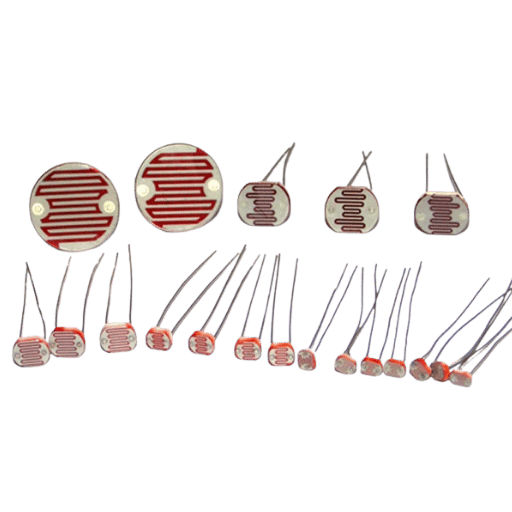
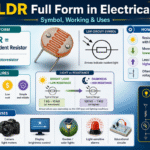
In electrical and electronics work, LDR stands for Light Dependent Resistor: a passive component whose electrical resistance decreases as the light intensity striking it increases. In darkness its resistance can exceed 1 MΩ; under bright light it can fall below 1 kΩ. Because the same device is sold as a photoresistor or photocell, those three names all describe one part.
That extreme range is the whole point of the component, and it earns its first nickname here: the 3-Decade Resistance Swing. An LDR doesn’t output a voltage or a current on its own, it simply changes how much it resists, and a surrounding circuit turns that change into a usable signal. It’s the cheapest, simplest way to let a circuit “sense” light.
It’s also where a useful contrast begins. The same simplicity that makes an LDR perfect for a night light is exactly why a safety-rated machine guard never relies on one, a thread we pick up in the final section, drawing on our work building photoelectric safety sensors.
How a Light Dependent Resistor Works: Photoconductivity
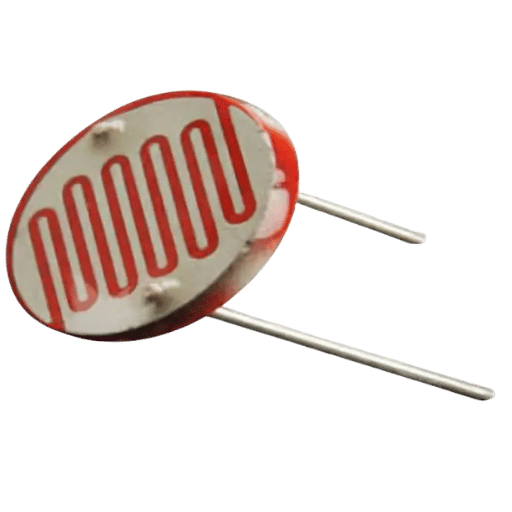
An LDR works on photoconductivity. Its sensing element is a semiconductor whose electrons are normally locked in the valence band, so in the dark few charge carriers are free to move and resistance stays high. When photons of light hit the material, they hand their energy to electrons and lift them across the bandgap into the conduction band. Each freed electron (and the hole it leave behind) becomes a charge carrier, so current flows more easily and resistance drops.
So what? Brighter light frees more carriers, which is why resistance keeps falling as illumination rises. The effect is wavelength-dependent: a cadmium sulfide LDR peaks at about 540 nm, close to the green-yellow band the human eye is most sensitive to, which is why CdS cells are so well matched to everyday visible-light tasks.
📐 Engineering Note — the LDR symbol
On a schematic, the LDR symbol is a resistor (a rectangle, or a zig-zag in older drawings) enclosed in a circle, with two arrows pointing inward toward it. The arrows mean “light falling on the device”; the circle marks it as a special, light-sensitive resistor rather than a fixed one.
Inside an LDR: Construction, Cadmium Sulfide and the Zig-Zag Track
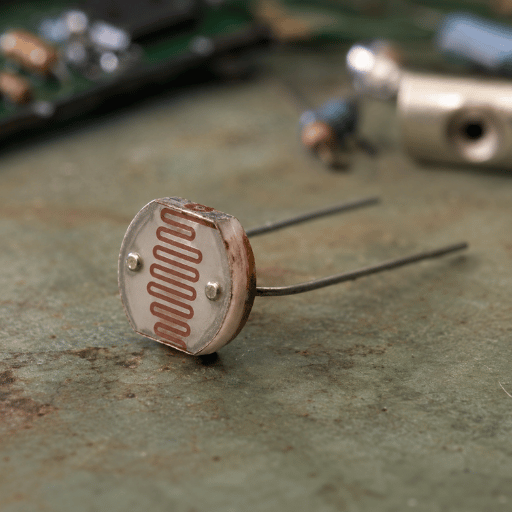
Open up a typical LDR and you find a thin film of light-sensitive semiconductor deposited on a ceramic disc, with two metal electrodes. The classic material is cadmium sulfide (CdS) for visible light; cadmium selenide (CdSe) shifts the response toward red, and lead sulfide (PbS) is used for infrared detection.
The semiconductor track is laid down in a zig-zag or snake pattern between comb-shaped electrodes. There’s a reason for that shape: the snake maximizes the length of illuminated track between the contacts and the exposed surface area, which lowers the lit resistance and raises sensitivity without making the cell physically larger.
⚠️ Important — cadmium and RoHS
CdS contains cadmium, one of the substances restricted in electrical equipment by the EU RoHS Directive. Cadmium-based photoresistors survive on narrow, shrinking exemptions, which is a major reason new and export-bound designs increasingly move to cadmium-free sensors.
LDR Specifications That Actually Matter
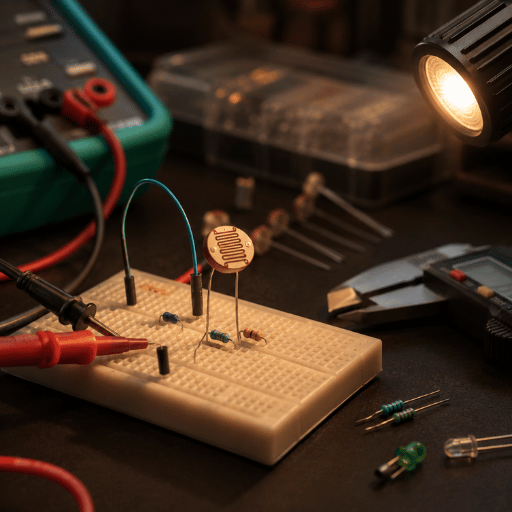
Most introductions stop at “high resistance in the dark, low in light.” The numbers that decide whether an LDR fits your circuit are more specific. The table below uses values from the widely sold GL55-series CdS photoresistors.
| Parameter | GL5528 (typical) | Why it matters |
|---|---|---|
| Light resistance @ 10 lux | 8–20 kΩ | Sets the lit end of the voltage divider |
| Dark resistance | ≥ 1 MΩ | Sets the dark end; defines the swing |
| Rise time | ≈ 20–45 ms | How fast it reacts to light appearing |
| Fall (recovery) time | ≈ 30–55 ms | Slower than rise — recovery lags |
| Peak wavelength | ≈ 540 nm | Matches visible green-yellow light |
| Gamma (γ, 10–100 lux) | ≈ 0.7 | Describes the non-linear slope |
| Max voltage / power | 150 V / 100 mW | Absolute limits — do not exceed |
Source: GL55-series CdS photoresistor datasheets (e.g. the KTH-hosted GL5537 datasheet).
Two numbers do the most work. First, the response time is measured in tens of milliseconds, not microseconds, and the recovery is slower than the onset. Second, the response is non-linear (that gamma of about 0.7), so an LDR indicates “brighter” or “darker” well but doesn’t measure exact light levels. Both facts come straight from the datasheets, and both matter in the last section.
Building a Basic LDR Circuit: The Voltage Divider
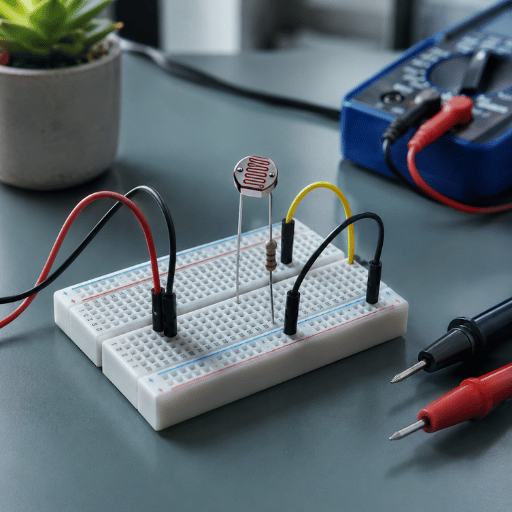
An LDR only changes resistance, so a circuit has to convert that into a voltage a microcontroller can read. The standard answer is a voltage divider: wire the LDR in series with one fixed resistor, feed the pair from your supply, and read the voltage at the junction. As light changes the LDR’s resistance, the junction voltage moves, and an analog input or a comparator picks it up.
The one design choice that matters is the fixed resistor. A practical rule of thumb is to pick it near the geometric mean of the LDR’s dark and lit resistance, for a GL5528 sitting between roughly 10 kΩ (lit) and 1 MΩ (dark), a fixed resistor around 100 kΩ keeps the junction voltage swinging through the middle of the range where your threshold lives.
How Do You Test an LDR With a Multimeter?
To check an LDR, set a multimeter to resistance (Ω) mode and touch the probes to its leads; polarity doesn’t matter, since an LDR is non-polarized. In normal room light you should read a few kΩ. Cover the LDR with a finger and the reading climbs toward hundreds of kΩ or the MΩ range; shine a phone torch and it drops to the low kΩ. A reading stuck at a wildly high value usually means a damaged or aged cell.
Where LDRs Are Used: Street Lights, Alarms and Photocells
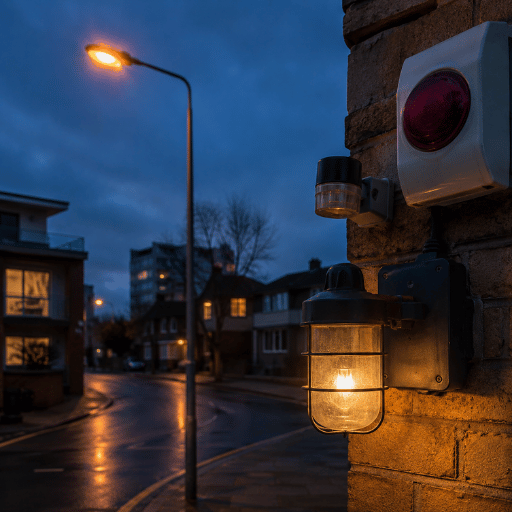
The most familiar use of an LDR is the dusk-to-dawn street light. The photocell on top of a street lamp is an LDR (or a small module built around one): as daylight fades, its resistance rises past a set threshold, a comparator trips, and the lamp switches on, then reverses at dawn. No timer, no calendar, just ambient light.
Picture a municipal maintenance technician on an autumn evening, holding a screwdriver to a roadside lamp’s photocell controller. They cup a hand over the photocell, the resistance jumps, the comparator flips, and the lamp glows on in daylight, a five-second field test that confirms the LDR and the relay both still work before they move to the next pole.
Beyond street lighting, LDRs show up in night lights and garden lamps, camera and phone light meters, automatic display-brightness control, solar trackers that compare two cells to follow the sun, and light-beam burglar alarms, when something breaks the beam, the LDR’s reading jumps and the alarm triggers. They’re a staple of ambient-light automation wherever “is it bright or dark?” is a good enough question.
LDR vs Photodiode vs Phototransistor: Choosing a Light Sensor
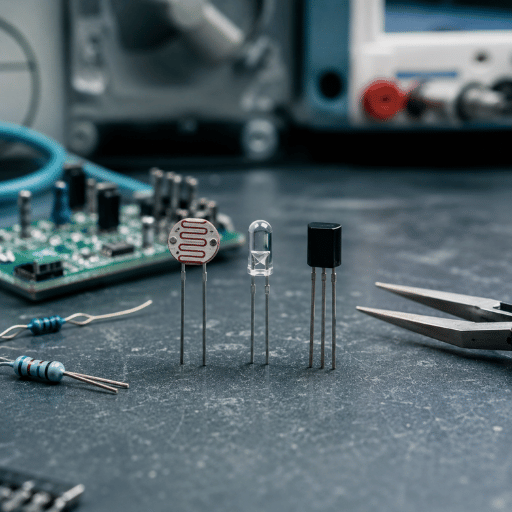
The LDR isn’t the only way to sense light, and it’s the odd one out among the common options. Here’s how the three usual suspects compare.
| Trait | LDR | Photodiode | Phototransistor |
|---|---|---|---|
| Device type | Bulk photoconductor | PN junction | Bipolar junction |
| Response time | Tens of ms (slow) | Nanoseconds (fastest) | Microseconds |
| Output | Resistance change | Small current | Larger current |
| Linearity | Non-linear | Linear | Moderate |
| Relative cost | Lowest | Higher | Moderate |
✔ LDR advantages
- Very low cost, two-wire simplicity
- Wide sensing range, dark to bright
- No bias polarity to get wrong
- Spectral match to visible light
⚠ LDR limitations
- Slow response (tens of ms)
- Non-linear; poor at exact measurement
- Drifts with temperature and age
- Cadmium raises RoHS concerns
A quick way to choose: if you need raw speed, use a photodiode; if you want a stronger switching signal, use a phototransistor; if you just need a cheap “bright or dark?” decision and can tolerate a slow, approximate answer, the LDR wins. There’s a fourth case, anything safety-rated, where none of these single parts is enough on its own.
The Limits of LDRs, and What Industrial Safety Sensing Uses Instead
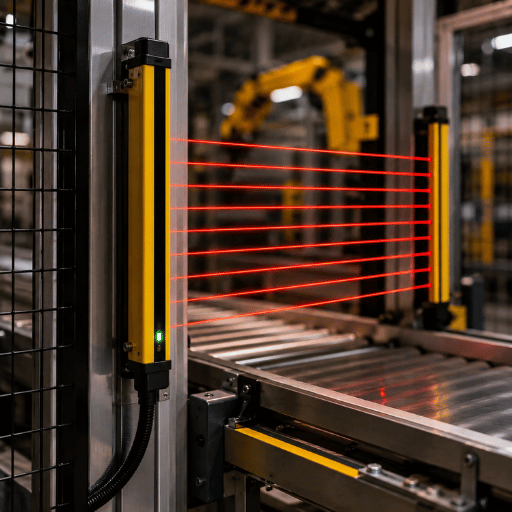
This is where our day job come in. We build photoelectric machine-safety sensors, and the question we get asked most is some version of “why not just use a cheap LDR?” The honest answer is a useful one for understanding the component, and it has three parts, call it the Latency Wall.
First, timing. An LDR’s tens-of-milliseconds response, with recovery slower still, is fine for a street lamp but far too slow and too variable for guarding a fast-moving machine, where the safety system must react within a tight, guaranteed time budget. Second, stability: an LDR drifts with temperature and ages over months of service, the same erratic-reading failure hobbyists report. Third, and decisive, an LDR has no way to check itself. It can’t tell a controller “I’m still working,” so a failed-dark LDR looks exactly like darkness.
“A safety sensor has to fail safe and prove it is alive. A photoconductor that quietly drifts and can’t run a self-test is the one thing a guarding circuit cannot be built on.”
CCH Shanghai Sensing Intelligence Technology, safety-sensor engineering team
So industrial guarding took a different path, call it the move from photocell to photoelectric curtain. Instead of one passive cell, a safety light curtain pairs an infrared LED emitter array with a matched phototransistor or photodiode receiver array, runs them on dual, cross-monitored channels, adds continuous self-testing, and outputs fault-detecting safety signals. International standard IEC 61496-2 defines exactly these “active opto-electronic protective devices,” and grades them Type 2 and Type 4 by how thoroughly they detect their own faults. An LDR cannot meet any of it, not because a standard names and bans it, but because the part was never built to prove it is working.
The market reflects the split. Analysts put the photoresistor market in the low hundreds of millions of dollars in 2025, growing at roughly 7% a year, even as cadmium-free photodiodes, phototransistors and integrated ambient-light-sensor chips take over new designs. The humble LDR endures in low-cost ambient automation; everything that has to be fast, precise, or safe has already moved on. If your project is on the safety side of that line, our guides to through-beam safety light curtains and broader industrial safety solutions are the next step.
Frequently Asked Questions
Q: What does LDR stand for in electrical terms?
View Answer
LDR stands for Light Dependent Resistor. It is a passive, two-terminal electronic component made from a light-sensitive semiconductor, usually cadmium sulfide (CdS). Its resistance falls as the light intensity on it rises, dropping from over 1 MΩ in darkness to only a few kΩ in bright light. The same part is also sold as a photoresistor, photocell, or photoconductive cell, and that large resistance swing is what lets a simple circuit sense light.
Q: Is an LDR analog or digital?
View Answer
An LDR is an analog component: its resistance varies continuously and smoothly with light, with no built-in on/off threshold. To turn that into a digital signal, you pair it with a voltage divider and feed the junction voltage to a comparator or to a microcontroller’s analog-to-digital input, which then reports the surrounding light level as a number your code can act on.
Q: What is the dark resistance of an LDR?
View Answer
Dark resistance is the resistance of an LDR with no light reaching it. For common GL55-series CdS photoresistors it is specified as at least 1 MΩ, and datasheets measure it a set time, about ten seconds, after the light is removed, because the cell recovers slowly. The very large gap between this megaohm dark value and the kilohm-level lit value, often three orders of magnitude, is what makes an LDR useful as a simple light-triggered switch.
Q: Why do LDRs have a slow response time?
View Answer
Because freeing and re-trapping charge carriers inside the bulk semiconductor takes time. For a GL55-series cell, typical rise is about 20 to 45 ms and recovery 30 to 55 ms. That is fine for lighting, but far too slow for fast or safety-critical sensing.
Q: Can an LDR detect infrared light?
View Answer
A standard cadmium sulfide (CdS) LDR mainly senses visible light, peaking near 540 nm, and is weak in the infrared. For infrared, you change the material: cadmium selenide reaches into the red, and lead sulfide types handle true infrared and flame detection.
Q: What can replace an LDR in a modern or safety design?
View Answer
In ordinary designs, a photodiode, a phototransistor, or an integrated ambient-light-sensor chip replaces it with faster, cadmium-free sensing. In safety-rated guarding, no single sensor is enough; the job goes to a self-checking, dual-channel Type 4 safety light curtain.
Why We Wrote This
We design and manufacture photoelectric machine-safety sensors, so we spend our days at the exact boundary where simple light sensing stops being enough. The response-time and self-test points in the final section come from that work, and from the international light-curtain standards we build to. We wrote this LDR primer because understanding the humble photoresistor is the clearest way to see why safety-rated sensing looks so different.
Related Articles
- What Is a Safety Light Curtain? — how photoelectric guarding actually works
- Type 4 safety light curtains — the product family that replaced simple photocells in guarding
- Machine-guarding light curtains — choosing protection for a hazard zone
- ISO 13855 safety distance calculator — size a guarding zone correctly
References & Sources
- RoHS Directive — European Commission (cadmium restriction in electrical equipment)
- GL5537 CdS Photoresistor Datasheet — hosted by KTH Royal Institute of Technology
- GL5528 Photoresistor Datasheet — light/dark resistance, response time and spectral data
- Photoresistor — overview of photoconductive light dependent resistors
- EN IEC 61496-2:2020 — safety light curtain standard, active opto-electronic protective devices (Type 2 / Type 4)
- Photoresistor (Light-Dependent Resistor) — patent reference — defines the photoconductive light-controlled variable resistor