Póngase en contacto con la empresa QJKH

Safety light curtain distance calculation is the step that decides whether a guarded machine is actually safe or only looks safe. Mount the curtain too close to the hazard and a hand can reach the danger point before the machine finishes stopping. This guide works through the ISO 13855 formula S = (K × T) + C variable by variable, with three worked examples, a penetration-factor reference grid, the standards that govern it, and the changes introduced by ISO 13855:2024.
Quick Specs, ISO 13855 Safety Distance
| Governing standard | ISO 13855:2024 (3rd ed., in force Nov 2024) |
| Master formula | S = (K × T) + C |
| Approach speed K | 2000 mm/s (hand/finger) or 1600 mm/s (body / when S ≥ 500 mm) |
| Penetration C | 8(d−14) mm for d ≤ 40 mm; 850 mm for body; 1200−0.4H horizontal |
| Detection capability d | 14 mm finger / 25–30 mm hand / 45 mm body (QJKH ENT: 14 / 25 / 45 mm) |
| Worked range (this guide) | 220 mm (fast finger) to 612 mm (slow hand, pre-recalc); QJKH ENT t₁ from 6.0 ms, scaling with beam count |
The Safety Distance Formula S = (K × T) + C: A Variable Decoder
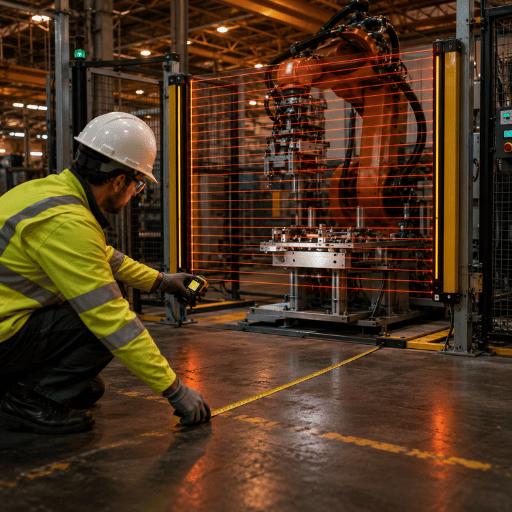
A safety light curtain’s minimum safety distance, the smallest gap, or minimum distance, allowed between the detection plane and the nearest hazard, comes from the following formula in ISO 13855:
S = (K × T) + C
Each term answers a different question. The S = (K × T) + C Variable Decoder below is the fastest way to see where engineers actually get the number wrong.
| Term | Meaning | Typical value | Where it goes wrong |
|---|---|---|---|
| S | Minimum safety distance (mm) | ≥ 100 mm | Treated as a fixed catalog number instead of being calculated |
| K | Approach speed of the body (mm/s) | 2000 or 1600 | Using 1600 for a hand reach, or skipping the S ≥ 500 recalculation |
| T | Total system stopping time (s) | 0.1–0.3 | Counting only the curtain, not the relay, contactor and machine |
| C | Penetration / intrusion distance (mm) | 0–850 | Forgetting reach-over, reach-under and reflective-surface additions |
⚠¦ Important — ISO 13855 is not ISO 13857.
ISO 13855 covers the speed-based positioning of presence-sensing devices. ISO 13857 covers fixed-guard reach distances (the reach-over / reach-through tables for fences and barriers). Several published guides print the speed formula and label it “ISO 13857” — that is a mislabel. Use ISO 13855 for any light curtain, laser scanner or other active opto-electronic protective device.
📐 Engineering Note — what the formula does not cover
ISO 13855 assumes a normal walking or reaching approach. It does not cover running, jumping or falling toward the hazard, it is derived for persons 14 years and older, and the separation distances do not apply to safeguards used solely for a presence-sensing function (for example, restart muting). If your risk assessment involves any of these, the calculated S is a floor, not the whole answer.
Approach Speed (K): When to Use 2,000 vs 1,600 mm/s

K is a parameter, a fixed constant, that models how fast a body part travels toward the hazard. ISO 13855 gives two values for this parameter and one rule that catches people out.
| Situation | K (mm/s) | Why |
|---|---|---|
| Detection capability d ≤ 40 mm (finger / hand) | 2000 | A hand can penetrate quickly through a fine field |
| Detection capability 40 < d ≤ 70 mm (body) | 1600 | Whole-body approach is the walking-speed model |
| Hand case where the result S ≥ 500 mm | recalc 1600 | Recalculate with 1600; if the new S ≤ 500, set S = 500 |
A frequent audit finding on press brakes is a hand-reach distance computed with K = 1600 mm/s when 2000 mm/s applies. The shortfall reads as a rounding error on paper, yet it leaves the curtain roughly 20% too close, so an operator’s hand can reach the bend line before the ram halts. Picking the wrong constant is the quietest way to fail a safety distance calculation.
Q: What is the hand speed constant in ISO 13855?
The hand speed constant is K = 2000 mm/s. It applies whenever the light curtain resolves fingers or hands (detection capability d of 40 mm or finer) and the approach is perpendicular to the detection plane. If that calculation returns a distance of 500 mm or more, you recompute once with the walking-speed constant of 1600 mm/s, because over that range a full-body stride is the realistic motion.
Total Stopping Time (T): Add Up Every Delay, Then Measure It
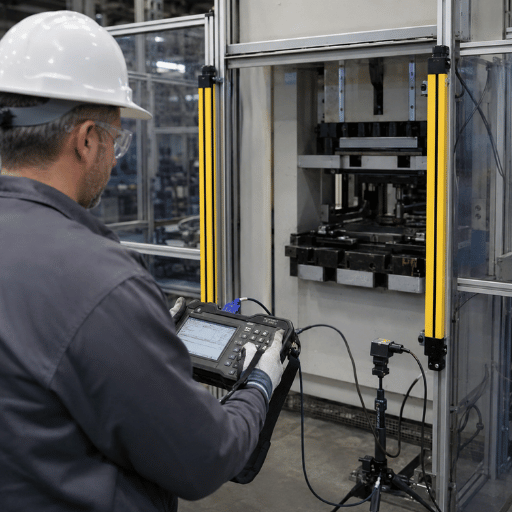
T is the single largest lever in the calculation: at K = 2000 mm/s, every extra millisecond of system response adds 2 mm to the required distance, and every extra second of stopping time adds two full metres. It’s also the term people underestimate, because they count the light curtain alone.
| Element | Symbol | Example value |
|---|---|---|
| Light curtain response (ON→OFF) | t₁ | 6.0–30.8 ms, scales with beam count (QJKH ENT: t₁ = 5 ms + 0.255 ms × beams) |
| Safety relay / safety controller | t₂a | 10–30 ms |
| Contactor / final switching element | t₂b | 10–40 ms |
| Machine mechanical run-down | t₂c | measured, often the largest term |
Because the relay and contactor sit between the curtain and the motor, replacing a safety relay module with a slower one quietly increase your required distance. A QJKH ENT curtain contributes a t₁ from 6.0 ms that rises with beam count, more protective height means more beams, which means a slower response and a larger required distance, while the rest of the chain is yours to measure.
💡 Pro Tip — measure, do not assume
Do not trust the nameplate stopping time. Use a stop-time measurement (STM) device, take ten readings, then use either the mean plus three standard deviations or the highest of the ten. Machines slow down as brakes and clutches wear, so re-measure after maintenance and feed the new value back into the distance calculation.
Detection Capability (d) and the Penetration Factor C Reference Grid
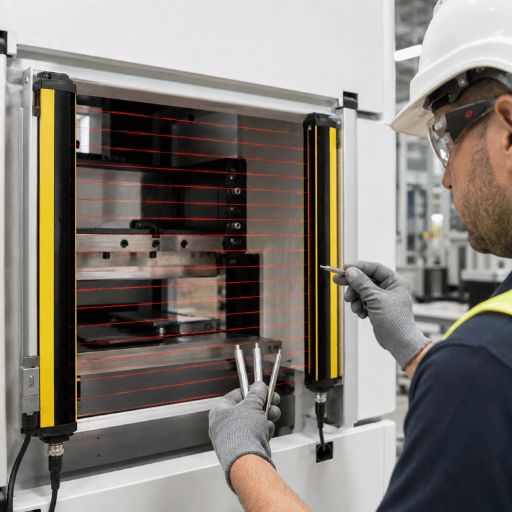
C accounts for how far a body part can travel into the detection field before it’s sensed. For a vertical curtain with d of 40 mm or finer, C = 8(d − 14) mm, never less than zero. For a body-detecting field (40 < d ≤ 70 mm), C is a flat 850 mm. The Penetration Factor C Reference Grid turns that into a lookup.
| Detection capability d | Body part | K (mm/s) | C (mm) |
|---|---|---|---|
| 14 mm | Finger | 2000 | 0 |
| 20 mm | Finger | 2000 | 48 |
| 25 mm | Hand | 2000 | 88 |
| 30 mm | Hand | 2000 | 128 |
| 40 mm | Arm | 2000 | 208 |
| 50 mm | Leg / body | 1600 | 850 |
| > 70 mm | Body (access) | 1600 | 850 |
This grid is also a selection tool: a finer resolution lowers C, which lets you mount closer, but it raises curtain cost and nuisance trips. Choosing a 14 mm finger-detection light curtain only pays off if the application genuinely needs it. The 8(d−14) value is the long-established through-penetration term carried by every major manufacturer guide; ISO 13855:2024 refines how the over-, through- and under-reach distances combine into a single reaching term, which the final section covers.
⚠¦ A finer field does not fix a wrong distance.
Field practitioners say it plainly: adding beams or buying a finer resolution doesn’t make a curtain compliant if it sits inside the calculated S. Resolution sets C; it doesn’t move the curtain.
Worked Examples: Three Real Calculations
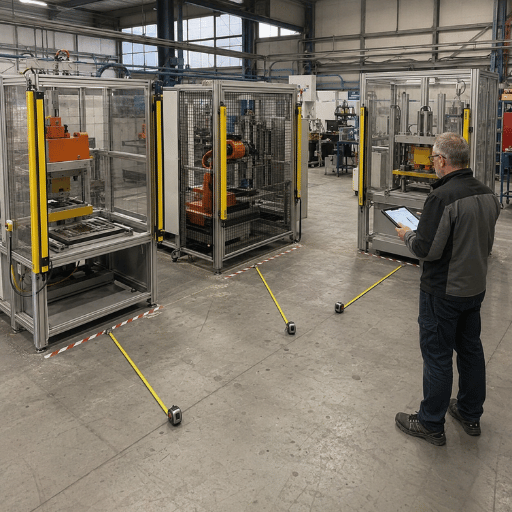
Three perpendicular-approach cases using representative QJKH ENT response times (the ENT line runs from 6.0 ms, scaling with beam count). Run your own numbers in the ISO 13855 safety distance calculator once you follow the logic.
Example A — Finger detection, fast machine
A small assembly press is guarded by a 14 mm finger-detection curtain (ENT-14, t₁ ≈ 10 ms). Machine run-down plus relay and contactor measure 100 ms.
d = 14 mm → K = 2000, C = 8(14−14) = 0. T = t₁ 0.010 + t₂ 0.100 = 0.110 s.
S = 2000 × 0.110 + 0 = 220 mm. S is below 500 mm, so K stays at 2000.
Example B — Hand detection, mid-speed machine
A robotic cell load station uses a 25 mm hand-detection curtain (ENT-25, t₁ ≈ 12 ms); the total stop chain measures 120 ms.
d = 25 mm → K = 2000, C = 8(25−14) = 88 mm. T = 0.012 + 0.120 = 0.132 s.
S = 2000 × 0.132 + 88 = 352 mm. Still below 500 mm, so no recalculation.
Example C — Hand detection, slow-stopping machine (the recalculation trap)
Same 25 mm curtain, but a heavier machine takes 250 ms to stop.
First pass: T = 0.012 + 0.250 = 0.262 s. S = 2000 × 0.262 + 88 = 612 mm. Because 612 ≥ 500, recalculate with K = 1600: S = 1600 × 0.262 + 88 = 507 mm. The result is still above 500 mm, so 507 mm is the answer, not the 612 mm a single-pass calculation would give.
Mounting Orientation: Vertical, Horizontal, and Angled Approaches
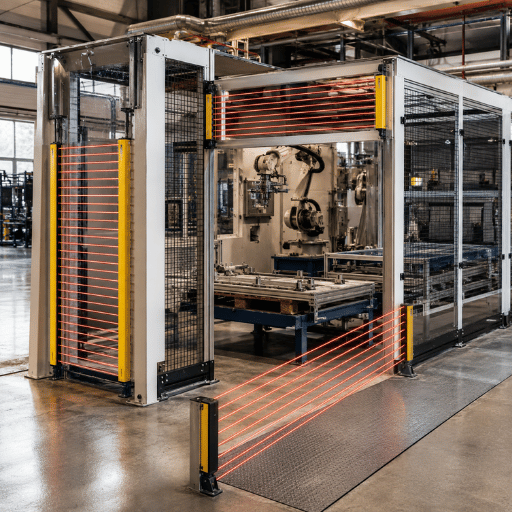
Everything above assumes a vertical curtain a person walks toward. Mount the field horizontally, as an area guard in front of a machine, and both the penetration term and the height limits change under ISO 13855.
| Orientation | Penetration term | Key constraint |
|---|---|---|
| Vertical (perpendicular) | C = 8(d−14) or 850 | Standard finger/hand/body cases |
| Horizontal (parallel) | C = 1200 − 0.4H (≥ 850) | Field height H limited to 15(d−50) ≤ H ≤ 1000 mm |
| Circumventing the top | CRO from hazard / field heights | Take the larger of this S and the vertical S |
The orientation swap bites in the field. A palletizing cell that replaces a vertical access guard with a horizontal floor field, then reuses the old mounting distance, can discover its safe zone has quietly shrunk once C = 1200 − 0.4H is applied at floor height, a low detection plane drives C toward its 850 mm floor. Recompute the distance every time the mounting plane change, not just when the curtain does.
Q: How do you calculate safety distance for a horizontal light curtain?
For a horizontal field, swap the penetration term for C = 1200 − 0.4H, where H is the height of the detection plane above the floor, and never let C fall below 850 mm. The detection height itself is bounded: it must sit between 15(d − 50) mm and 1000 mm. A lower field need a finer resolution to stay valid, which is why area guarding often uses dense beam spacing.
The Safety-Distance Standard Matrix: ISO 13855 vs ISO 13857 vs ANSI B11.19

Each region answers the same physical question differently, and the device standards are separate again from the positioning standards. The ISO 13855-vs-ANSI B11.19 Safety-Distance Standard Matrix keeps them straight.
| Standard | Region | What it governs for distance |
|---|---|---|
| ISO 13855:2024 | International | Positioning by approach speed: S = (K × T) + C |
| ISO 13857 | International | Fixed-guard reach-over / reach-through tables (not speed) |
| ISO 12100 | International | Risk-assessment basis that selects the safeguard |
| IEC 61496-1 | International | ESPE general requirements (device function, not position) |
| IEC 61496-2 | International | AOPD (light curtain) particular requirements |
| ISO 13849-1 | International | Performance Level (PL) of the safety function |
| IEC 60204-1 | International | Stop categories that shape the T term |
| ANSI B11.19 | United States | D = K(Td+Ti+Tc+Ts+Tscm) + dds; penetration ddt = 3.4(de−7) |
| ANSI/RIA R15.06 | United States | Robot system safeguarding distances |
| OSHA 1910.212 | United States (law) | General point-of-operation guarding duty |
| OSHA 1910.217 | United States (law) | Power-press Ds, including the PSDI formula |
Sources: ISO 13855:2024, OSHA 1910.217.
Three points trip people up. First, the penetration math differs: ISO uses 8(d−14), ANSI B11.19 uses ddt = 3.4(de−7), and the basic OSHA eTool formula Ds = 63 in/s × Ts carries no penetration term at all. Second, OSHA’s power-press rule is fuller than the eTool: 1910.217(h)(9)(v) gives the PSDI distance as Ds = Hs × (Ts + Tp + Tr + 2Tm) + Dp, where Dp is a penetration-depth factor. Third, choosing a Type 4 device under IEC 61496 does not by itself make the installation compliant, that standard governs how the curtain functions, not where it sits. The distance calculation is the application-level requirement.
Reach-Through, Over, Under, and Around: Exposure Checks That Change Your Distance
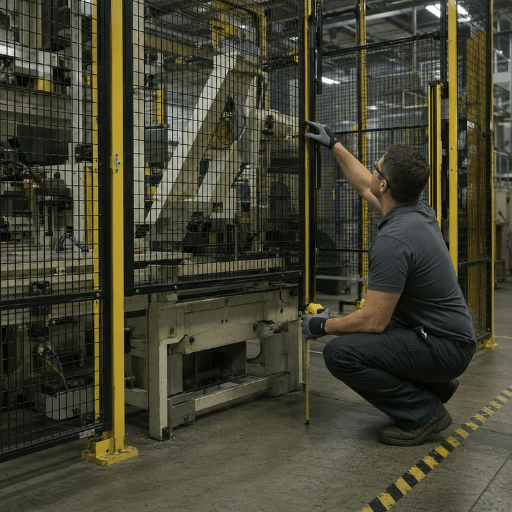
A curtain that passes the perpendicular formula can still be defeated by geometry. ISO 13855:2024 formalises this with a single reaching term, DDS, built from three directions. The Reach-Through / Over / Under / Around Exposure Check walks each one.
- ✓Reaching over (DDO): if a person can lean over the top of the field, add the over-reach distance from the hazard and field heights, then take the larger result.
- ✓Reaching through (DDT): the penetration term itself, the 2024 edition extends it with an additional formula for finer cases.
- ✓Reaching under (DDU): newly required in ISO 13855:2024. The 2010 edition only set a 300 mm lowest-beam value, leaving a one-arm gap; the new edition makes you calculate the under-reach.
- ✓Reaching around / reflection: keep the field clear of reflective surfaces that can bridge a broken beam, and block walk-around paths.
Field experience makes the under-reach concrete: leave a 150 mm gap beneath a vertical curtain and the required distance can start at 1.2 metres and grow from there. That’s the gap the 2024 reach-under requirement closes.
⚠¦ Distance alone is not compliance.
OSHA’s machine-guarding rules add constraints the formula doesn’t: guard the access areas a presence-sensing device doesn’t cover, don’t apply presence-sensing-device initiation on full-revolution-clutch presses, and don’t use a perimeter or work-envelope device for point-of-operation protection. The calculated distance is necessary, not sufficient.
What Changed in ISO 13855:2024 (and What It Means for Your Distance)

ISO 13855’s third edition came into force in November 2024 and cancels and replaces the 2010 edition. If your last design referenced the 2010 text, several inputs to the distance calculation have moved: the reaching terms are restructured into over, through and under, reaching under the field becomes a required calculation, and the standard reaches toward moving robots with a dynamic distance concept. Here is what changed.
Key 2024 changes for the distance calculation
- The perpendicular calculation is revised and extended for a more precise result.
- Reaching under (DDU) is now a required term, not an afterthought.
- The parallel-approach calculation is simplified with flat-rate values.
- New Z supplements cover scanner measurement inaccuracy and vehicle brake wear.
- Distances to reset and acknowledgement buttons must now be calculated, so an operator can’t reach the restart from inside the danger zone.
- A dynamic safety distance concept is introduced for moving robots.
- Two-beam access grids are effectively ruled out: beam spacing is capped at 400 mm and the reach-under value drops from 300 mm to 200 mm, so at least three beams are needed.
⚠¦ Current edition is not the same as CE presumption of conformity.
ISO 13855:2024 is the current edition and reflects the state of the art, so it is the right basis for new designs. But the EU list of harmonised standards still references EN ISO 13855:2010 at the time of writing. For CE marking, check which edition currently carries presumption of conformity for your machine, and document why you applied the values you did.
“We treat the calculated distance as the start of a sign-off, not the end. A number on a worksheet means nothing until the measured stopping time behind it has been re-checked on the actual machine, with the actual relay and contactor in the loop.”
QJKH Functional Safety Engineering Team, CCH Shanghai Sensing
Preguntas frecuentes
Q: What is the formula for safety distance?
Ver respuesta
Under ISO 13855 the minimum safety distance is S = (K × T) + C. K is the approach-speed constant in millimetres per second, T is the total system stopping time in seconds, and C is the penetration or intrusion distance in millimetres. You multiply the approach speed by the measured stopping time, then add the penetration term, which depends on the curtain’s detection capability and on whether it is mounted vertically or horizontally.
Q: Is ISO 13855 the same as ISO 13857?
Ver respuesta
No, and the confusion is common. ISO 13855 governs the speed-based positioning of presence-sensing devices such as light curtains. ISO 13857 instead sets fixed-guard reach distances for fences and barriers, with no speed or stop-time term. Use ISO 13855 for any light curtain.
Q: Should I use 1,600 or 2,000 mm/s for the approach speed?
Ver respuesta
Use 2,000 mm/s when the curtain detects fingers or hands (detection capability 40 mm or finer). Use 1,600 mm/s for body or access detection. There is also a recalculation rule: if a hand-case result comes out at 500 mm or more, recompute once at 1,600 mm/s, and if the new value is 500 mm or less, set the distance to 500 mm.
Q: How do I measure my machine’s total stopping time?
Ver respuesta
Use a stop-time measurement device that triggers the safety function and records how long the hazardous motion takes to cease. Take ten readings, because the result scatters with temperature, load and wear, then use either the mean plus three standard deviations or the highest of the ten. Crucially, capture the whole chain — curtain response, safety relay, contactor and machine run-down — not just the curtain, and re-measure after any brake, clutch or relay maintenance.
Q: Does ANSI B11.19 use the same formula as ISO 13855?
Ver respuesta
It is the same idea with different bookkeeping. ANSI B11.19 writes D = K(Td + Ti + Tc + Ts + Tscm) + dds, splitting the stop time into five reaction times, and its penetration term is 3.4(de − 7), not the ISO 8(d − 14). Never mix the two standards in one calculation.
Q: Do I need to recalculate distance after replacing the safety relay?
Ver respuesta
Yes. The relay’s reaction time is part of the total stopping time T, so a slower replacement raises the required distance. Re-measure the system stopping time with the new relay in the loop and recompute S before returning the machine to service; do not assume the old distance still holds.
Calculate it, then verify it
Work the formula with your own resolution and measured stop time, then size the curtain against your protective height. QJKH builds Type 4 ENT-series light curtains in 14 / 25 / 45 mm resolutions with response times from 6.0 ms, and offers free ISO 13855 distance support.
Why We Wrote This
Our engineering team at CCH Shanghai Sensing (QJKH), a factory-direct maker of safety light curtains, laser scanners and relay modules since 2003, prepared this guide. The worked examples use representative ENT-series response times (our published ENT line runs from 6.0 ms and scales with beam count); the standards readings reflect ISO 13855:2024 and the US OSHA and ANSI texts as of mid-2026. Reviewed by the CCH Shanghai Sensing (QJKH) technical team.
Referencias y fuentes
- ISO 13855:2024, Safety of machinery, Positioning of safeguards with respect to the approach speeds of parts of the human bodyInternational Organization for Standardization
- Machine Guarding eTool, Presses: Safety Distance (Ds = 63 in/s × Ts)U.S. Occupational Safety and Health Administration
- 29 CFR 1910.217, Mechanical power presses (PSDI safety distance)U.S. OSHA
- 29 CFR 1910.212, General requirements for all machinesU.S. OSHA
- Commission Implementing Decision (EU) 2023/1586, harmonised standards for machinery (lists EN ISO 13855:2010)EUR-Lex
- How the updated standard changes the game in sensor positioningEngineer Live
- US9200955B2, Multi-optical-axis photoelectric sensor (light curtain)Google Patents
Artículos relacionados
- What Is a Safety Light Curtain, the ESPE basics behind the formula
- Type 2 vs Type 4 Safety Light Curtain, matching the device to the risk
- Finger and Hand Protection Light Curtains, choosing resolution d
- Machine Guarding with Light Curtains, presses, robot cells and conveyors
- Safety Relay Modules Guide, the t₂ in your stopping time
- Safety Light Curtains, ENT-series product overview and resolution selection