
Get in touch with QJKH Company
Woodworking Machine Safety
Safety Light Curtains for CNC Routers
Open-bed CNC routers and nesting machines are designed for fast, repeated loading and unloading of panels, sheets and finished parts. This open access improves productivity, but it also allows operators to approach the moving gantry, spindle and other hazardous machine motion.
A safety light curtain can provide non-contact access protection across an open side of the machine. When a person enters the protected opening during hazardous operation, the safety system detects the interruption and sends a signal to the machine safety control system.
01
Where Are the Main Hazards on a CNC Router?
A CNC router contains several different hazards, and they should not all be treated in the same way. The first step is to understand where the operator needs access and what hazardous motion remains reachable from that position.
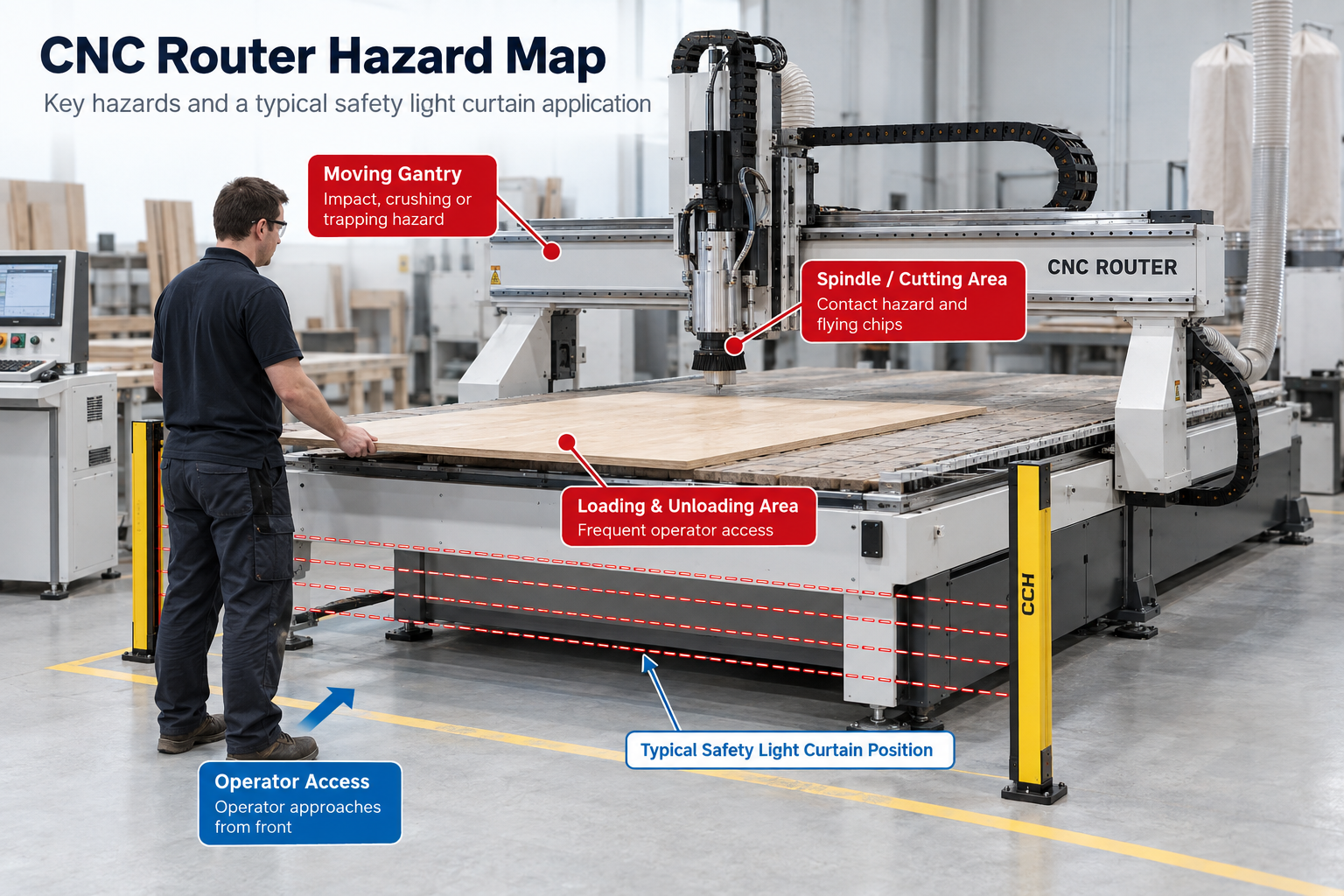
Moving Gantry and Machine Axes
On many CNC routers and nesting machines, the gantry travels rapidly across a large working table.
An operator entering this area while automatic movement is active may be exposed to impact, crushing or trapping hazards between the moving structure and other parts of the machine.
This is particularly important on machines with an open front or open sides, where there is no physical door separating the operator from the working envelope.
Spindle and Cutting Tool
During machining, the rotating spindle and cutting tool can create a serious contact hazard if personnel enter the cutting area while hazardous motion is present.
Routing can also generate wood chips, sawdust and splinters. Damaged tooling or an improperly secured workpiece can introduce additional projection hazards.
For this reason, access detection and physical containment should not be confused. A safety light curtain can detect a person entering a protected opening, but it cannot contain flying chips, a broken tool or ejected material. Where these hazards exist, suitable physical guarding, covers or an enclosure may still be required.
Automatic Tool Changer and Auxiliary Motion
CNC machining centers equipped with automatic tool changers may contain additional moving mechanisms around the spindle, tool magazine or rear section of the machine.
These areas may require a different safeguarding method from the normal operator loading side. Areas that do not require frequent production access may be better protected by fixed guards or interlocked access doors.
Loading and Unloading Area
The loading side is often where a safety light curtain becomes most useful. Operators may need regular access to load MDF, plywood, particle board or other panels, position the workpiece, remove machined parts and clear the table for the next production cycle.
Completely enclosing this access point with a manually operated door may not suit every machine or production process. A properly designed safety light curtain can maintain an open loading area while monitoring access to hazardous machine motion.
The important question is not simply “Does this CNC router need a safety light curtain?” It is “Where does the operator require frequent access, and what hazardous motion must be stopped before that person can reach it?”
02
Where Are Safety Light Curtains for CNC Routers Typically Used?
Safety light curtains are particularly useful where a CNC router has a clearly defined open access side and operators need to approach the working area repeatedly during normal production.
Front Loading Access
On an open-bed CNC router, the front of the table is commonly used for loading sheets and removing finished parts.
A light curtain can be installed across this open approach so that operator access is monitored without requiring a physical access door to be opened and closed during every loading cycle.
Side Access Protection
Some CNC routers remain accessible from one or both sides. If a person could enter the travel area of the gantry or another moving axis from these locations, a safety light curtain may be used to monitor that access path.
A light curtain creates a defined two-dimensional sensing plane. It is therefore particularly suitable when the access route can be protected by a clear, straight detection field between the emitter and receiver.
Openings Between Fixed Guards
Not every CNC router is completely open. Some machines use fixed panels or fencing around most of the working area while leaving one opening for material loading and unloading.
In this type of layout, the fixed guards prevent access from other directions while the safety light curtain monitors the remaining opening.
The Protective Field Must Control Access to the Hazard
The objective is not simply to place a safety light curtain somewhere in front of the machine. The protective arrangement must prevent a person from reaching hazardous motion.
The design should also consider whether a person could:
- reach over the protective field;
- reach underneath it;
- approach the hazard from an unprotected side;
- remain inside the safeguarded area without being detected.
These conditions depend on the actual CNC router layout and should be evaluated as part of the machine risk assessment.
03
How the Safety Function Works
A safety light curtain does not stop a CNC router by itself. It detects access and provides safety-related output signals to the machine safety control system.
- Operator enters the protected opening
- Safety light curtain detects beam interruption
- Safety outputs change state
- Safety relay or safety controller evaluates the signal
- Hazardous machine motion is brought to the required safe state
For a CCH solution, an ENT safety light curtain can be integrated with an SRB safety relay module where the electrical architecture and required safety function are appropriate.
The exact machine architecture should always be based on the risk assessment and control-system design. The light curtain should not be treated as an independent emergency-stop device or as a substitute for the machine’s complete safety control system.
04
Safety Light Curtain vs Safety Laser Scanner for CNC Routers
Both technologies can monitor personnel access around CNC routers, but they solve different machine-layout problems.
When a Safety Light Curtain Is a Good Fit
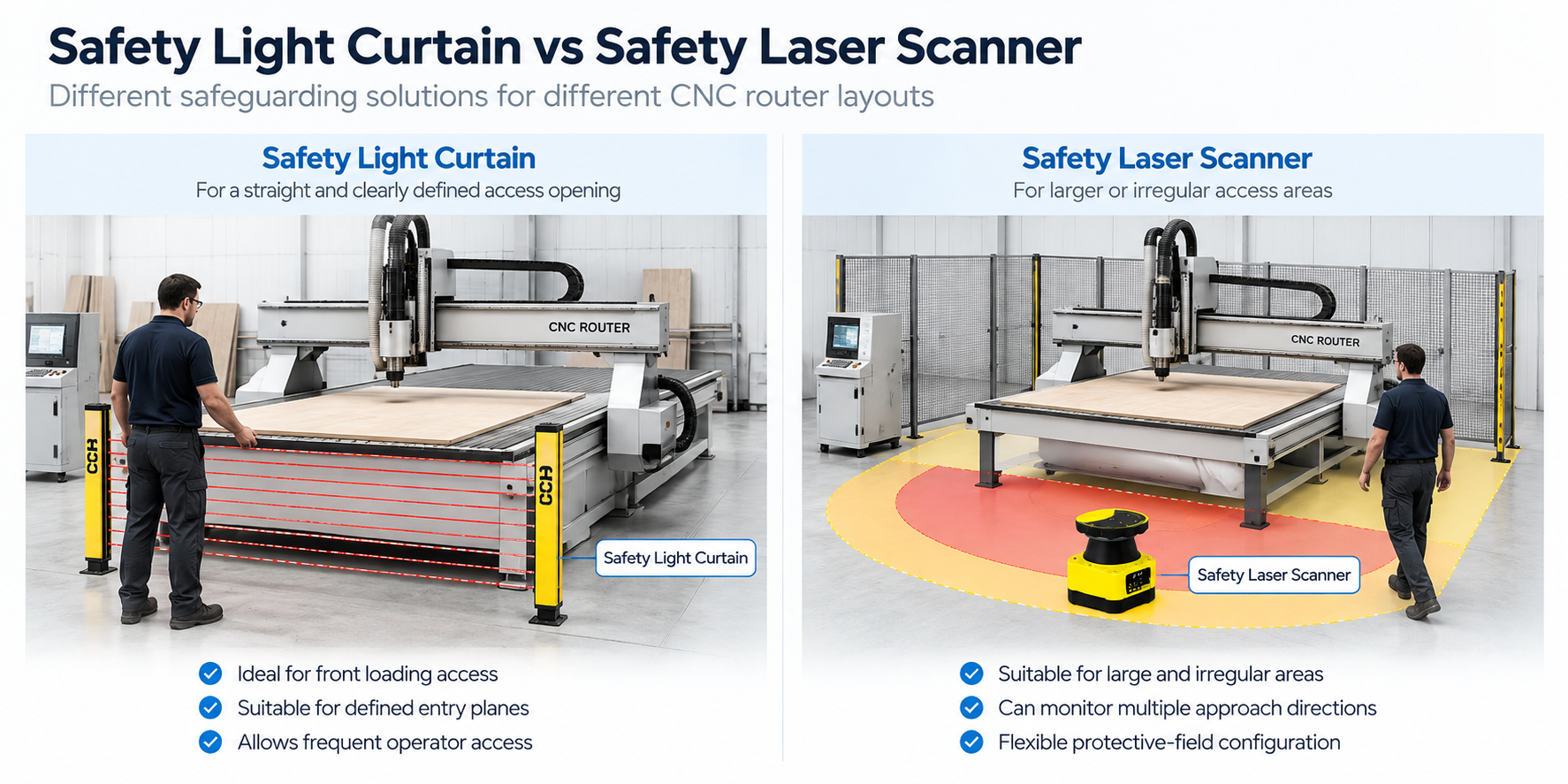
A safety light curtain is often suitable when the access path is clearly defined and can be protected by a straight vertical sensing plane.
Typical examples include:
- the open front of a CNC router;
- a straight loading or unloading side;
- a narrow access opening between fixed guards;
- a side where personnel approach through a defined entry plane.
When a Safety Laser Scanner May Be More Suitable
A safety laser scanner can be more suitable when the area requiring protection is larger, irregularly shaped or accessible from several directions.
Instead of creating one straight sensing plane, a scanner monitors a configurable two-dimensional protective area.
This can be useful where:
- personnel can approach from several directions;
- the open area is too wide for a practical light-curtain installation;
- the machine footprint is irregular;
- a defined floor-level protective area is preferred.
| Machine Layout | Typical Safeguarding Approach |
|---|---|
| Straight open loading side | Safety light curtain |
| Narrow access opening | Safety light curtain |
| Opening between fixed guards | Safety light curtain |
| Large open floor area | Safety laser scanner |
| Irregular access area | Safety laser scanner |
| Access from several directions | Safety laser scanner or combined guarding |
| Flying chips or tool-fragment hazard | Physical guarding may also be required |
ENT and SH for Different CNC Router Layouts
Within a CCH safeguarding solution, the ENT safety light curtain can be considered for clearly defined access openings where a vertical protective field is appropriate.
An SH safety laser scanner can be considered where a larger or configurable two-dimensional protective area is required.
The purpose is not to install the maximum number of safety sensors. It is to select a protective arrangement that matches how personnel actually move around the CNC router.
05
Wood Dust, MDF Dust and Installation Conditions
Woodworking CNC machines operate in a more challenging optical environment than many clean industrial applications.
Routing MDF, particle board, plywood and solid wood can generate fine wood dust, MDF dust, sawdust, chips and resin-containing particles. Dust extraction can reduce contamination, but it does not necessarily keep every part of the machine environment clean.
Avoid Unnecessary Exposure to the Cutting Zone
The closest possible mounting position is not always the best position.
Installing the safety light curtain close to the spindle or cutting area may expose the optical surfaces to unnecessary dust and flying chips.
Where the machine layout permits, locating the protective device outside the heaviest contamination zone can make inspection and maintenance easier while still maintaining the required safeguarding function.
Protect the Sensor from Mechanical Damage
Large MDF or plywood sheets may be moved manually around the CNC router. Forklifts, carts, vacuum lifters or other handling equipment may also operate nearby.
Mounting positions should therefore reduce the risk of the emitter or receiver being struck during normal loading and unloading operations.
Keep the Optical Surfaces Clean
Accumulated dust on an optical sensor can affect reliable operation. Inspection and cleaning should therefore form part of the normal machine maintenance routine.
The required interval depends on the actual process. A CNC router processing MDF continuously may require more frequent inspection than a machine operating intermittently in a cleaner environment.
Check the Installation After Maintenance or Impact
After maintenance, mechanical adjustment or an impact near the protective device, the installation should be checked to confirm that:
- the emitter and receiver remain correctly aligned;
- the protective field has not been bypassed;
- brackets and mounting hardware remain secure;
- the safety function still operates as intended.
Wood dust does not automatically make a safety light curtain unsuitable for a CNC router. It means environmental conditions should be considered during device selection, positioning and maintenance planning.
FAQ
Frequently Asked Questions
Can a safety light curtain be used on a CNC router?
Yes. A safety light curtain can be used to monitor operator access to hazardous areas on CNC routers, particularly where the machine has a clearly defined open loading side or access opening. The suitability depends on the machine layout, hazardous motion, stopping performance and risk assessment.
Where is a safety light curtain typically installed on a CNC router?
Typical locations include the front loading side, side access points and openings between fixed guards. The installation should monitor the route an operator would use to approach hazardous machine motion.
Should I use a safety light curtain or a safety laser scanner?
A safety light curtain is often suitable for a straight, clearly defined opening. A safety laser scanner may be more suitable where the protected area is larger, irregularly shaped or accessible from several directions.
Can a safety light curtain replace a CNC router enclosure?
Not in every application. A light curtain detects access but does not physically contain wood chips, broken tools or ejected workpieces. Where containment hazards exist, suitable physical guarding, covers or an enclosure may still be required.
Does wood dust affect a safety light curtain?
Wood dust, MDF dust and sawdust can accumulate on optical surfaces and should be considered when determining mounting position and maintenance routines. Where practical, the sensor should be kept outside the heaviest contamination zone while still providing the required protection.
Can the CNC router restart automatically after the light curtain is clear?
The disappearance of an obstruction should not automatically be assumed to mean that hazardous operation can safely restart. Restart behavior depends on the machine layout, safety-control design and whether a person could remain inside the safeguarded area after passing through the protective field.
Explore more applications in our Woodworking Machinery Safety Solutions overview.
PROJECT SUPPORT
Discuss Your CNC Router Safety Application
The most suitable safeguarding method depends on how your CNC router is built and how operators interact with it during loading, machining and unloading.
CCH can support CNC router and woodworking-machine projects with ENT safety light curtains, SH safety laser scanners and SRB safety relay modules according to the required safeguarding architecture.
Useful application information includes:
- machine photo or layout drawing;
- open-access location and dimensions;
- working-table dimensions;
- loading and unloading method;
- accessible sides of the machine;
- hazardous motion to be stopped;
- available stopping-time information.
With these details, we can better evaluate whether a safety light curtain, safety laser scanner or combined safeguarding arrangement is appropriate.
Contact Us →