
Get in touch with QJKH Company
Woodworking Machine Safety
Woodworking Machinery Safety Solutions
Modern woodworking machinery combines high-speed processing, automatic panel movement and frequent operator access. Safeguarding therefore needs to consider both the machine itself and the way people interact with loading, unloading and material-handling areas.
Safety light curtains, safety laser scanners, fixed guards and safety-control devices can all play different roles depending on the machine layout and the hazardous area that needs to be protected.
This application overview covers common safeguarding situations around CNC routers, panel saws, beam saws and automatic panel loading and unloading systems.
01
Common Safety Challenges in Woodworking Machinery
Woodworking machinery safety needs to consider several types of hazardous motion within the same production area. Cutting tools, moving gantries, pressure systems, conveyors and automatic handling equipment may all operate while operators remain close to the machine.
The safety problem is therefore not limited to preventing contact with a saw blade or router spindle. The complete machine layout also needs to consider how people approach the equipment, where material enters and leaves the process, and whether personnel can enter an automatic movement area during production.
Open Loading and Unloading Areas
CNC routers, nesting machines and panel-processing systems often require frequent access for loading sheets, removing finished parts or clearing the working area.
These open production areas may need personnel detection without completely enclosing every access point with a physical door.
Automatic Panel Movement
Panels may be pushed, conveyed, lifted or transferred automatically between machines. Gantry loaders, vacuum handling systems, conveyors and unloading equipment can create crushing, trapping or impact hazards outside the main machine enclosure.
Material and Personnel May Use the Same Opening
In some applications, an opening must allow normal workpieces to pass while still preventing personnel from entering the hazardous area.
This requires a different safeguarding approach from an opening used only for personnel access. Additional sensing and safety logic may be required where material must pass through the protective field.
Wood Dust and the Working Environment
MDF dust, sawdust, chips and material-handling activity should also be considered when positioning optical safety devices.
The protective device needs to perform its safety function while remaining accessible for inspection, cleaning and maintenance and avoiding unnecessary exposure to impact or heavy contamination.
02
Safety Applications by Machine Type
Woodworking machines can have very different layouts even when they process similar panel materials. The appropriate safeguarding method therefore depends on how the machine moves, where the operator needs access and how material passes through the process.
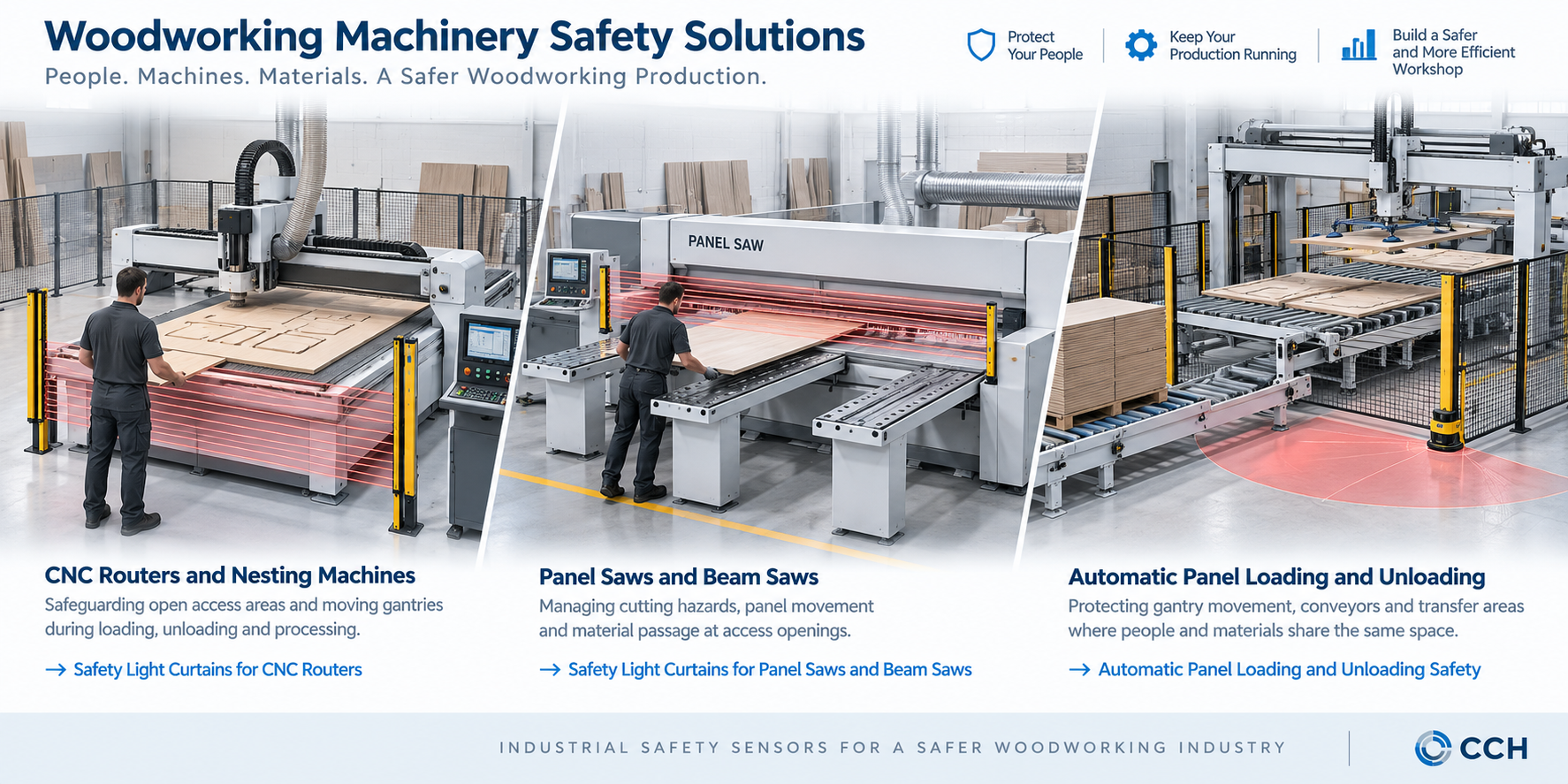
CNC Routers and Nesting Machines
Open-bed CNC routers and nesting machines often require repeated operator access for loading full sheets, removing finished parts and clearing the working table.
The moving gantry, spindle and other automatic machine axes can remain accessible from the front or sides of the machine if these areas are not physically enclosed.
Where the approach path is straight and clearly defined, a safety light curtain can be used to monitor access to the working area. Where the approach geometry is irregular or personnel can enter from multiple directions, a safety laser scanner may be more suitable.
Related application: Safety Light Curtains for CNC Routers →
Panel Saws and Beam Saws
Panel saws and beam saws introduce a different safety problem. In addition to the cutting unit and powered panel movement, the machine may need to allow large workpieces to pass through openings that could also provide access to hazardous areas.
Safety light curtains or light barriers can be used at suitable access points, but the safeguarding design also needs to consider whether normal panel movement will interrupt the protective field.
Where material must pass through the same protected opening, additional sensing and safety logic may be required to manage the intended material transfer while maintaining personnel protection.
Related application: Safety Light Curtains for Panel Saws and Beam Saws →
Automatic Panel Loading and Unloading
Automatic panel-handling systems can extend the hazardous area beyond the woodworking machine itself.
Gantry loaders, vacuum handling equipment, powered conveyors, transfer tables and unloading systems may move panels through areas where operators also need access during normal production.
Clearly defined loading or pickup openings may be suitable for safety light curtains. Irregular approach areas, multiple approach directions or configurable floor-level protection may favor a safety laser scanner.
Related application: Automatic Panel Loading and Unloading Safety →
03
Choosing the Safeguarding Method
No single protective device is suitable for every woodworking machine. The safeguarding method should follow the actual machine layout, the hazardous motion and the way personnel approach the working area.
Safety Light Curtain for Defined Access Openings
A safety light curtain is particularly useful where personnel approach the hazardous area through a straight and clearly defined opening.
Examples include the front of an open CNC router, an opening between fixed guards, or a defined loading and unloading access point.
The emitter and receiver create a protective sensing plane across the access path, allowing the safety system to detect when a person enters the protected opening.
Safety Laser Scanner for Irregular Access Areas
A safety laser scanner can be more suitable where the operator approach area has an irregular shape, where personnel can enter from multiple directions, or where a configurable floor-level protective field is required.
The choice should not be based simply on the physical size of the area. A wide but straight opening may still be suitable for a safety light curtain.
Physical Guarding for Containment and Restricted Access
Optical safety devices detect personnel access, but they do not contain flying chips, broken tooling or ejected workpieces.
Fixed guards, covers, machine enclosures and interlocked access doors may therefore still be required around cutting units, tool-changing areas or other zones where physical containment or restricted access is necessary.
Safety Control Is Part of the Complete System
A safety light curtain or safety laser scanner does not independently make a woodworking machine safe.
Its safety-related output needs to be evaluated by an appropriate safety control system so that the required hazardous motion can be brought to the intended safe state.
Depending on the machine architecture, this may involve a safety relay, safety controller or other safety-related control equipment.
04
Material Passage in Automated Woodworking Systems
One of the most important differences between simple access protection and automated material handling is that the workpiece itself may need to cross the protective boundary.
This is common around panel saws, transfer conveyors and automatic loading or unloading systems.
If a panel passes through the same protective field used to detect personnel, the safety design needs to distinguish the intended material-transfer condition from unexpected human access.
In suitable applications, this can involve external sensors together with muting or other safety-control logic.
The safety light curtain itself should not be assumed to recognize whether the object passing through the field is a panel or a person. That function depends on the additional sensing arrangement, safety logic and machine integration.
Where the normal material flow does not cross the personnel protective field, muting may not be required at all.
05
Planning Safeguarding Around the Real Machine Layout
Effective woodworking-machine safeguarding starts with the actual production layout rather than with the selection of a sensor.
Important information includes where the operator loads and unloads material, which sides of the machine remain accessible, how panels move through the process and whether personnel can enter an automatic handling area from more than one direction.
The design should also consider fixed structures, fencing, machine enclosures, panel dimensions, dust conditions and the location of other material-handling equipment around the machine.
Once these conditions are understood, the appropriate combination of safety light curtains, safety laser scanners, physical guarding and safety-control devices can be evaluated for the specific application.
FAQ
Frequently Asked Questions
Where are safety light curtains commonly used on woodworking machines?
Safety light curtains are commonly considered for clearly defined access openings where operators need frequent access to loading, unloading or machine working areas. Examples include open CNC router access points, openings between fixed guards and defined panel-handling stations.
When is a safety laser scanner more suitable?
A safety laser scanner may be more suitable where the approach area is irregular, where personnel can enter from multiple directions, or where the protective field needs to follow a configurable floor-level boundary.
Can safety sensors replace physical machine guarding?
Not in every application. Safety light curtains and safety laser scanners detect personnel access, but they do not contain flying chips, broken tools or ejected workpieces. Physical guarding or machine enclosures may still be required where containment hazards exist.
PROJECT SUPPORT
Discuss Your Woodworking Machinery Safety Application
CCH can support woodworking-machine and panel-handling projects with ENT safety light curtains, SH safety laser scanners and SRB safety relay modules according to the required machine-safety architecture.
For application evaluation, useful information includes a machine photo or layout drawing, accessible sides of the equipment, loading and unloading direction, material flow, operator working position and the hazardous motion that needs to be controlled.
With this information, we can better evaluate which safeguarding method is appropriate for the machine.