
Get in touch with QJKH Company

Press brake safety refers to the control of closing tools, moving sheet metal, and unexpected machine motion in the course of performing a job. For sheet-metal fabrication, start with a task-specific risk assessment, use safeguarding that works for the complete bend sequence, protect operators and helpers, and isolate hazardous energy for applicable servicing. Stop the job when a protective function fails or the approved setup no longer fits the job.
A sensor at the front of a machine can detect an approaching hand while leaving a helper exposed at the side or a heavy workpiece free to swing. That exposure can vary depending on the part, the tooling, or the operator. The practical question is whether everyone remains protected through loading, each bend, unloading and any intervention.
Updated November 2026 · Author: CYH · U.S. federal baseline, with state and UK examples labeled separately.
Press brake safety at a glance
- Primary hazards: closing dies, lifting or ejected material, backgauge motion and unintended cycling.
- Safeguarding choice: match access geometry, part handling and measured machine stopping performance.
- People covered: the operator, helpers, setters, maintenance personnel and nearby workers.
- Job-release condition: the approved safeguards and operating method work for every bend and person.
Press brake safety requires effective guarding during production and appropriate hazardous-energy control during servicing. Match protection to every bend, access route and person. A failed safeguard means stop work and arrange correction.
Key points
- Press brakes are excluded from the mechanical-power-press section, 1910.217, while general machine-guarding requirements still apply.
- Two-hand controls protect the person using them; helpers need their own protection.
- A light curtain initiates a safety response. The machine still needs time to stop.
- Sensor hardware, installation and validated machine acceptance are separate purchasing deliverables.
Press Brake Hazards Across the Job
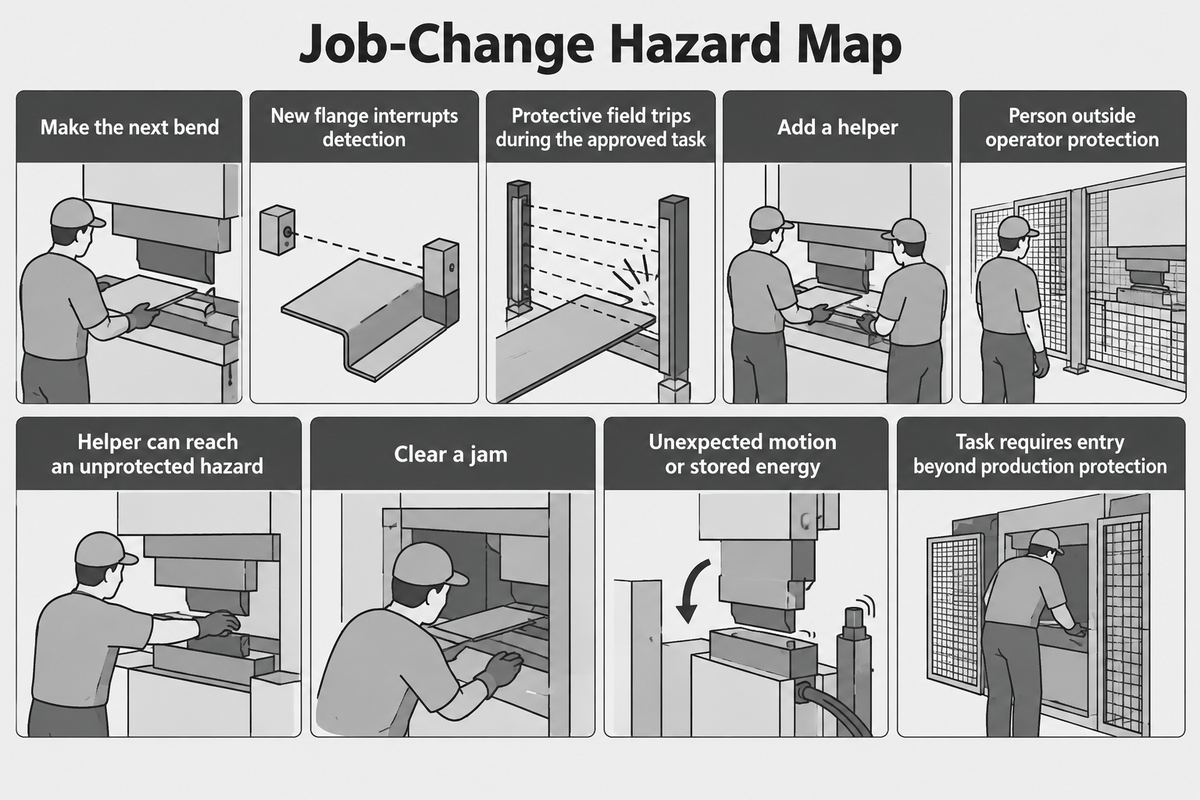
A sheet can lift into the operator, a back gauge can trap someone behind the machine, and a foot pedal can start a cycle unintentionally. Assess the task and every exposed person before deciding which combination of guarding and work support is suitable.
Why Are Press Brakes So Dangerous?
Hands can be trapped between the rising material and the machine front, even when they stay outside the closing tools. The closing tooling concentrates forming force while the nearby sheet changes shape and position as the ram descends. Helpers and people approaching from behind face different hazards.
The OSHA powered-press-brake guidance identifies moving-material pinch points and accidental foot-control actuation. Therefore, a useful machine safety risk assessment follows the entire job, as opposed to treating the front opening as the only danger zone.
Job-Change Hazard Map
A Job-Change Hazard Map links each task change to an exposure, a responsible role and a reason to stop and reassess.
Use the following map in the job review. The control families are planning prompts; the machine-specific assessment determines the installed arrangement.
| Task or change | Exposure to reassess | Control focus | Responsible role | Stop-and-reassess trigger |
|---|---|---|---|---|
| Load a small blank | Hand approaches tooling | Holding method and active safeguarding | Setter and operator | Part cannot be held outside the hazard |
| Make the next bend | New flange interrupts detection | Complete bend-sequence compatibility | Setter | Protective field trips during the approved task |
| Change sheet size | Sheet sweep and loss of support | Support, handling route and clear space | Supervisor | Material enters a person’s position |
| Add a helper | Person outside operator protection | Coverage and coordinated control | Supervisor | Helper can reach an unprotected hazard |
| Use a new tool height | Changed detection geometry | Approved tooling and safeguard setup | Setter and integrator | Protection no longer covers the required zone |
| Approach the rear | Backgauge or die access | Rear guards and access interlocks | Operator | Access protection is missing or defeated |
| Change the foot control | Unintended actuation | Approved control location and condition | Maintenance | Pedal operates unexpectedly or is damaged |
| Clear a jam | Unexpected motion or stored energy | Applicable energy-control procedure | Authorized maintenance employee | Task requires entry beyond production protection |
| Replace a safety component | Changed response or fault behavior | Integration review and validation | Qualified integrator | Replacement differs from the approved configuration |
A historical case shows why material movement deserves its own assessment. In January 2005, an Oklahoma operator was fatally struck by a 920 lb steel lug that slipped off the back of a V-shaped die and was ejected during curving. A coworker was assisting. The Oklahoma FACE investigation describes a struck-by mechanism, not simply a hand entering the dies. Heavy-part support and personnel positions must address the material’s possible travel as well as the tooling opening.
Which Safety Rules Apply to Press Brakes?
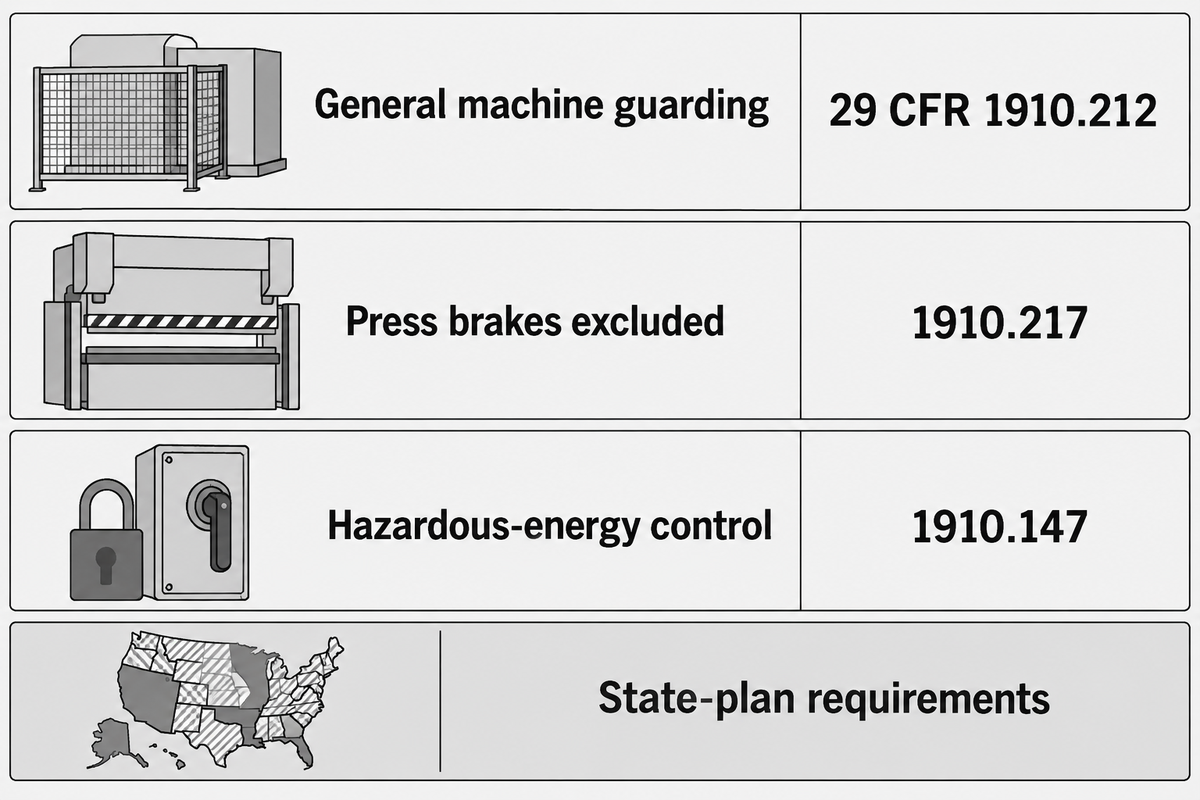
For the U.S. federal baseline, apply general machine guarding under 29 CFR 1910.212 and hazardous-energy control under 1910.147 where its scope applies. Press brakes are expressly excluded from 1910.217. State-plan requirements and the machine’s classification also matter; a mechanical-power-press formula or inspection rule shouldn’t be transferred automatically to a press brake.
What are the OSHA regulations regarding press brake guarding?
OSHA 1910.212 requires protection from machine hazards, including the point of operation where the work exposes an employee to injury. Section 1910.217(a)(5) excludes press brakes from that particular mechanical-power-press section. The exclusion leaves the general guarding duty in 29 CFR 1910 Subpart O in place. Servicing exposure is assessed independently under the applicable hazardous-energy provisions.
The general machine-guarding rule addresses operators and other employees in the machine area. Its rule concerning hand-feeding tools is explicit:
“Such tools shall not be in lieu of other guarding required by this section”
A holding tool can help position material without placing a hand in the hazard. The required guarding still serves its protective function. An engineered arrangement of supports and remotely located controls is a different system: California Title 8, section 4214(b)(7) specifically describes such an arrangement and requires that the operator cannot activate the machine and reach the point of operation. This California provision should not be read as general federal permission to use a self-made fixture.
Among consensus safety standards, the publisher lists ANSI B11.3-2022 for power press brakes designed specifically for bending material.
Use machine instructions and the applicable ANSI standard for more details. For installations outside of the U.S., the equipment requirements of the installation jurisdiction and the actual machine classification apply.
Why keeping a “safe distance” is a restricted alternative
The 1997 OSHA press-brake directive permits its safe-distance alternative only when physical barriers or devices are infeasible and the employer meets the stated conditions. Those include restricted custom piece parts or small-quantity work, a safety program with procedures, training and supervision, and a qualifying history of safe operation. Small-quantity work is defined as a continuous time period not exceeding four hours in any month. This is a conditional enforcement approach, not an everyday clearance rule for repetitive production.
State instructions can provide key information. The Minnesota press-brake instruction dated 28 January 2026, for example, addresses operators and helpers, as well as device specific checks only within Minnesota. Keep the federal rule, state instruction and consensus-standard edition distinct when documenting the site’s safety program.
Compare Press Brake Guarding Methods
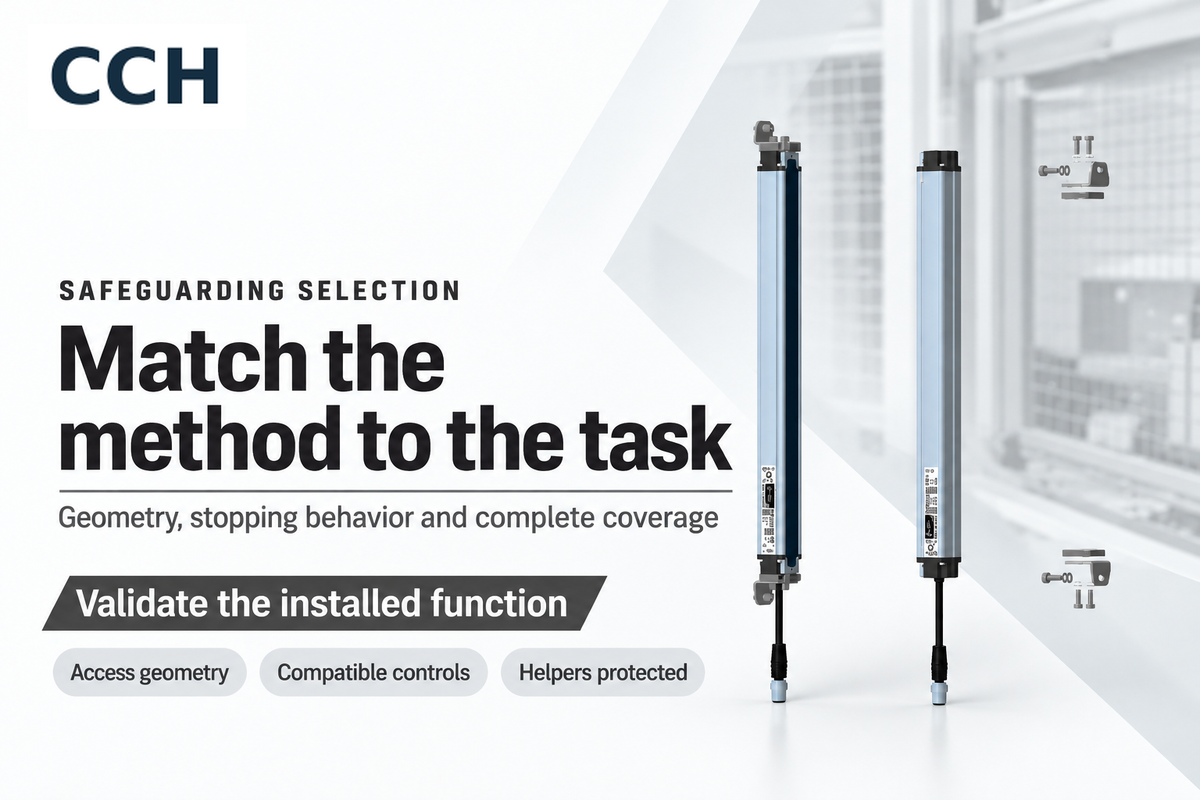
Select guarding according to how a person could reach the hazard during the actual bending operation. These safety systems apply different techniques. Fixed and interlocked guards restrict access; light curtains monitor an access plane; dedicated laser guards monitor a zone near the punch. All methods must provide compatible controls and coverage for the people and access ways that are unprotected.
| Method | Protective approach | Useful task fit | Key design question |
|---|---|---|---|
| Fixed physical guards | Restrict access by construction | Areas not needing routine entry | Can anyone reach over, under or around them? |
| Interlocked access guards | Connect access-door position to the safety function | Rear or side entry needing controlled access | Does access achieve the required safe condition? |
| Safety light curtain | Infrared transmitter and receiver monitor an access plane | Tasks whose material and hand positions suit that plane | Does every bend preserve effective detection? |
| Dedicated close-proximity optical protection | Monitors a defined zone near the punch | Compatible press brakes and approved tooling arrangements | Are tooling heights, stopping behavior and operating modes supported? |
| Two-hand controls | Require use of the operator’s hands at the controls | Suitable operations with a properly supported part | How is each helper protected independently? |
Should I choose light curtains or AOPD for a press brake?
Use dedicated close-proximity optical protection for compatible small-part work that would interrupt a separate light-curtain plane; consider light curtains for other geometries, including supported multi-height tooling. Either choice must remain effective for the complete part sequence and machine setup. Both are optical/electronic systems, and herein their distinction is based on application and the geometry of detection.
For example, Lazer Safe’s Sentinel Plus uses a transmitter and camera receiver mounted to the upper beam. Its BendShield feature describes protection until a 2 mm tool opening, and the manufacturer also supports third-party light curtains for tasks such as multi-height tooling. They are not CCH specifications or a general hand-clearance instruction.
To assess performance for stopping, the entire system, including sensors, safety logic, outputs and the machine’s physical response, must be considered, along with the minimum safe separation required for the application. A fast device connected to a slow or incompatible machine doesn’t create instantaneous stopping. The type 4 safety light curtain guide discusses device classification; for machine-level performance, the entire integrated function must be designed and validated.
The analysis team must determine how to ensure the safety of employees assisting the operator, as Minnesota’s instruction states that two-hand controls don’t provide protection for employees assisting the operator. Assess the helper’s reach and position independently. A general navigation LiDAR sensor or an area-monitoring scanner should not be used in place of a dedicated point-of-operation device without the required application and safety-function engineering.
For component configuration work, CCH’s press-machine light curtain application support covers ENT selection and integration inputs. During that review, the required sensing field, the full control arrangement, and the brake’s stopping data must be kept together.
Safe Bending for Small Parts and Large Sheets
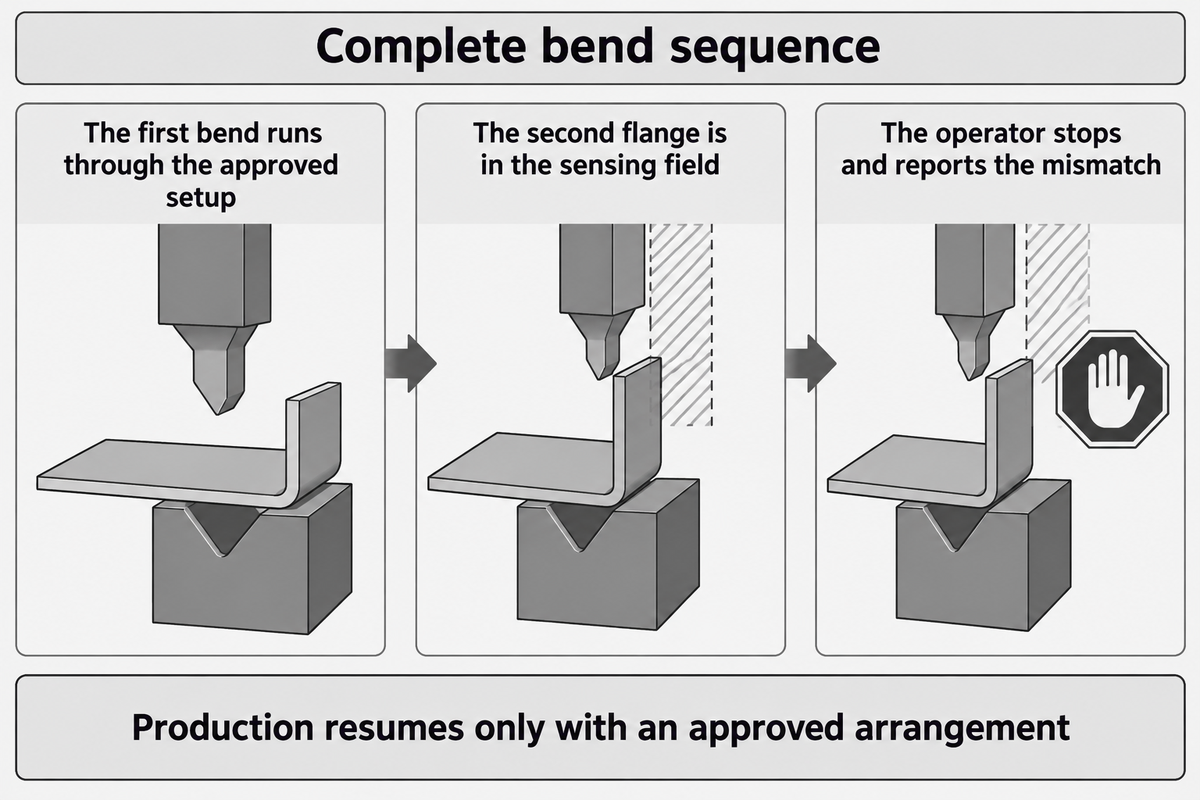
Small parts require a holding method that keeps hands clear of the tooling hazard while the safeguard remains effective. Large sheets require controlled support and space to enable the material to move. Review each bend and the position of every helper; a setup that works for the first stroke can be unsuitable after a flange has changed the shape of the part.
Planners should first consider whether the planned protection is adequate to cover the area being safeguarded for the entire sequence, and whether a clamp or different fixture is required for the protection of employees. If production safeguarding is inadequate, the method should be changed prior to production. OSHA 1910.212(a)(3)(iii) notes that hand tools are to be used in an assisting capacity only.
A real roof-cap job illustrates the sequence problem. In a 2019 OSHA investigation, the pieces required two to five bends. The recorded arrangement accommodated only one bend; additional bends interrupted the light curtain, and it was turned off. A helper placed a hand under the die when the operator pressed the foot pedal and suffered crushing injuries requiring hospitalization. The piece measured 44 inches long by 2.5 inches wide, with the report giving rounded metric dimensions of 1.12 m by 64 mm. The failure concerned the actual sequence and exposed helper, not a universal limit on light-curtain technology.
Hypothetical planning example: a shop changes from a flat blank to a narrow channel with return flanges. The first bend runs through the approved setup, but the second flange is in the sensing field. The operator stops and reports the mismatch. The setter reviews the remaining bends, tests approved part support options through the authorized procedure, and involves the integrator if protection or control modes must change. Production resumes only with an approved arrangement that handles the complete channel. Turning the sensor off to finish the batch isn’t an acceptable process correction.
For large sheet metal, plan the upward sweep, unloading route and support positions before operating a press brake. Keep people out of trapping spaces between material and machine surfaces. The Oklahoma ejection case also calls for considering the loss of material stability and the possible struck-by path. Ergonomic aids should control the load without creating new pinch points or obstructing protective devices.
Do
- Review the complete bend sequence.
- Assign protected positions for helpers.
- Stop when the job no longer fits its approved setup.
Don’t
- Do not reach around a protective field.
- Never defeat a guard to avoid nuisance stops.
- A slow ram does not make hand entry into an unprotected tooling hazard safe.
Setup, Tool Changes and Hazardous Energy
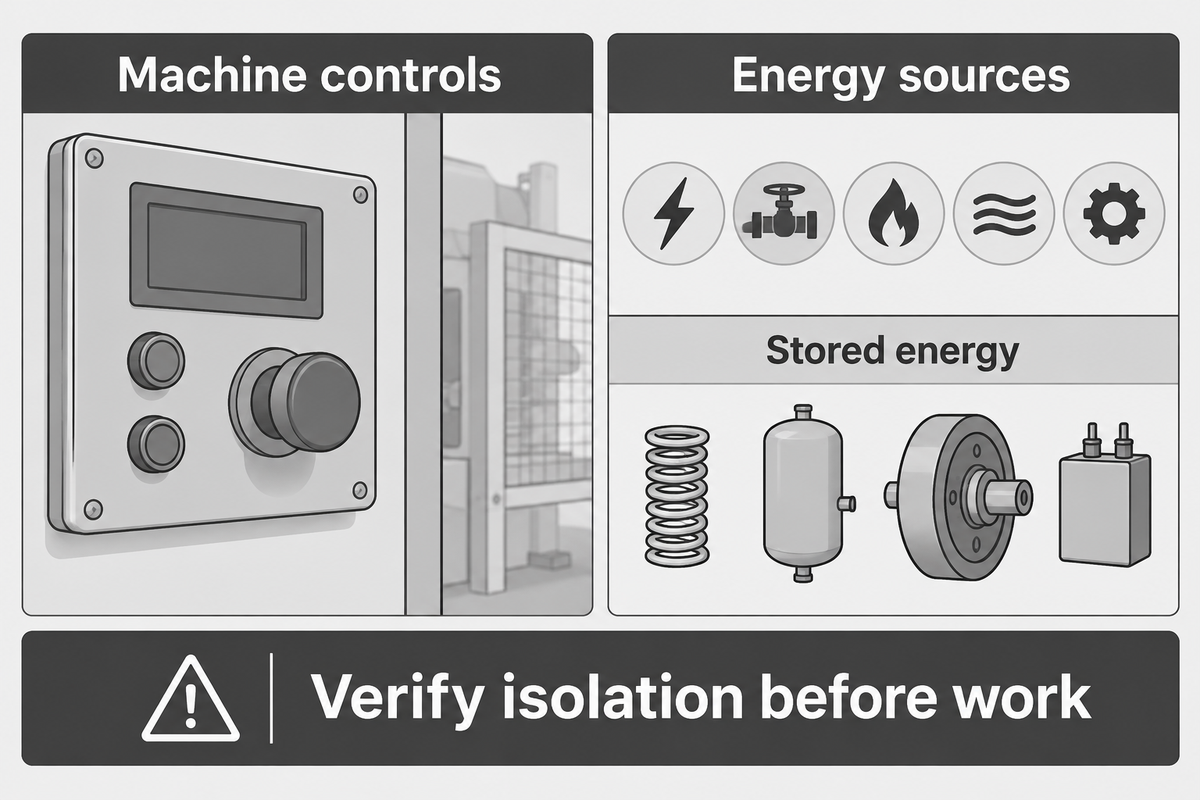
Setup and servicing require the protection specified for the task, including hazardous-energy control when the work falls within OSHA 1910.147. A sensor stop or emergency stop operates through machine controls; energy isolation acts on the energy sources. Authorized persons must also address stored pressure, gravity and possible reaccumulation before exposed servicing begins.
The hazardous-energy standard is concerned with servicing situations where unexpected energization, startup or release of stored energy could result in the injury of a person. In this standard, pushbuttons and selector switches are classified as control-circuit devices rather than energy-isolating devices. Electrical supply, hydraulic pressure and the weight of a ram which is in the up position, require machine-specific procedures and appropriate isolation and/or restraint measures.
A general guide isn’t a universal shutdown sequence. The authorized employee follows the documented machine procedure: locate and operate the required isolating devices, apply the specified energy controls, render stored energy safe and verify isolation before work. Where hazardous energy could reaccumulate, verification continues as required by the procedure and standard.
Minor tool changes and adjustments during normal production have a narrow exception: the work must be routine, repetitive and integral to production, with effective alternative protection while the work is performed. Calling a work activity a “quick setup” doesn’t mean it’s routine and repetitive. Maintenance outside normal production, a jam requiring exposed access and a change to the machine’s protective arrangement need their proper task classification.
Specified safety blocks or other engineered restraints can address hazardous ram movement as part of that procedure. Their capacity and position come from the machine and restraint design. Scrap timber or a convenient object isn’t an engineered support. An emergency-stop function is still useful for an emergency. Energy isolation protects applicable servicing work.
OSHA 1910.147(c)(6)(i) states that the energy-control procedure must be inspected at least annually. This type of inspection differs from routine brake-function checks and preventive maintenance of the equipment. Prior to re-energizing the equipment, the standard requires that the condition of the equipment be checked, employees be safely positioned or removed and affected employees be notified before startup.
A Press Brake Safety Checklist That Triggers Action
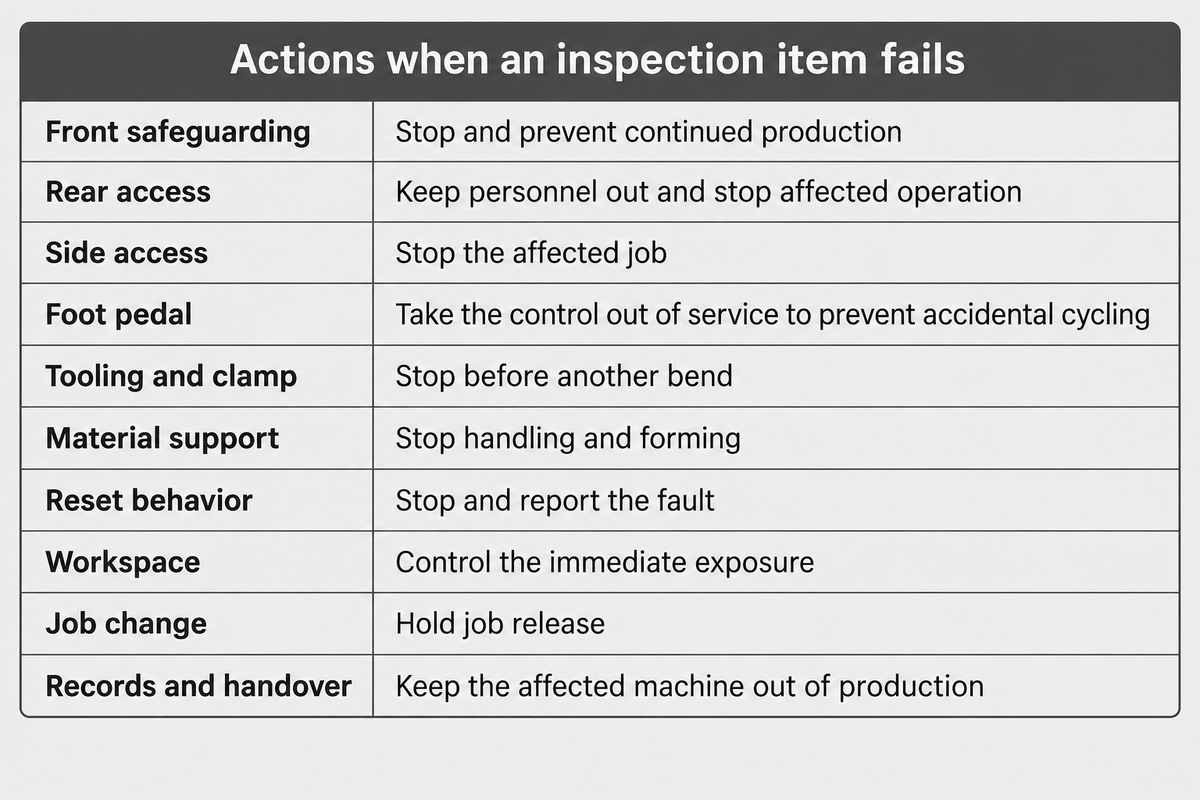
A useful press brake safety checklist turns an observed defect into a stop, an assigned correction and a controlled return to service. Operators perform only those checks they are trained and authorized to make. Trained, competent maintenance personnel resolve the detected faults. A supervisor releases the job, through the established procedure after the protective function has been restored.
The guidance from the UK Health and Safety Executive on machinery focuses on effective safeguards and competent maintenance of machinery and the avoidance of dangerous equipment being placed in use. For a U.S. shop, the check schedule comes from applicable requirements, manufacturer instructions and the site program. Pre-operation checks complement technical validation; they do not replace it.
| Check area | Finding that needs action | Immediate response | Assigned follow-up |
|---|---|---|---|
| Front safeguarding | Required detection or guard function fails | Stop and prevent continued production | Maintenance diagnoses; qualified personnel verify restoration |
| Rear access | Open route to backgauge or dies | Keep personnel out and stop affected operation | Restore the approved access protection |
| Side access | Guard removed, loose or bypassed | Stop the affected job | Correct guarding and reassess reach paths |
| Foot pedal | Damage, sticking or unintended actuation | Take the control out of service to prevent accidental cycling | Repair and verify the specified control behavior |
| Tooling and clamp | Damage or insecure mounting | Stop before another bend | Authorized setter corrects under the appropriate procedure |
| Material support | Unstable sheet or trapping position | Stop handling and forming | Setter and supervisor revise the support arrangement |
| Reset behavior | Unexpected restart or abnormal reset | Stop and report the fault | Integrator or maintenance validates required behavior |
| Workspace | Tripping hazards, oil or obstructed access | Control the immediate exposure | Maintain a clean and organized work area through safe housekeeping |
| Job change | New tooling, piece parts or helper outside approved setup | Hold job release | Review and approve the changed task |
| Records and handover | Unresolved protective-function fault | Keep the affected machine out of production | Record corrective work and authorized return-to-service decision |
Protective device checks involve using suitable test equipment and following the test procedures described in the manufacturer’s instructions. A hand or any other part of the body isn’t to be used in the testing of protective devices in the danger zone. “It stopped yesterday” isn’t a completed inspection after someone has moved a sensor or changed the tools.
Inspection triggers may be device-specific. Minnesota’s 2026 instruction calls for restraint and pull-out device checks at the start of each operator’s shift, following tool or die changes or adjustments, and when operators change. Its presence-sensing guidance calls for routine documented testing, under the employer’s procedure. The federal safe-distance program, separately, requires that exposure-prevention procedure be reviewed at least annually. None of the above cited, however, constitutes a universal daily machine-inspection requirement.
Press brake operator training covers fault reporting, approved control modes, part handling and safe operating procedures for the actual brake. Refresher training discusses changed work or demonstrated gaps; regular training covers operators and helpers. Clear communication matters when only one person is in control of the cycle and several people handle the sheet. To operate a press brake safely, follow the approved method and report changes. A practical safety culture lets the operator stop the job without pressure to mute protection or finish the batch.
Plan a Retrofit Without Losing the Safeguarding Function

Examples of prices published include USD 4,995 for an RMT DSP product package and a USD 13,000 installed starting price for typical LazerSafe systems, quoted by Production Resources and observed in November 2026. These systems vary in scope. Build the project budget around the machine, controls, access protection and documented acceptance, as opposed to comparing sensor prices in a vacuum.
| Offer | Published amount | Stated scope | Budget treatment |
|---|---|---|---|
| RMT DSP laser system | USD 4,995 | Transmitter, receiver and mounting brackets | Product-package line; price installation and machine work separately |
| PRI Protech Eagle Eye system | USD 7,500–15,000 | Light-curtain/control-system offer varies with features and motor controls | Obtain an explicit installation and acceptance scope |
| PRI typical LazerSafe systems | From USD 13,000 installed | Installed starting-price description | Define the machine-specific work and final delivered scope |
Prices can change. A complete retrofit may include stopping-performance measurements, changes to the control system, mechanical mounting, guarding other access routes, and production disruption. Modern press brakes and an older mechanical brake can require very different integration work; a new control panel alone does not settle that comparison.
Hypothetical purchasing example: a buyer receives a hardware quote and assumes the maintenance team can wire it during a short shutdown. The integrator’s review finds that the existing controls do not support the proposed protective function. The buyer revises the project scope before ordering: controls work becomes an explicit deliverable, the production trial covers the most awkward part sequence, and the return-to-service decision belongs to the qualified team. An improperly matched device is a risk of injury, and the purchasing review must resolve this before it’s installed. This is to avoid purchasing a sensor without a mechanism-level integration.
For projects in the UK, HSE guidance on modified machinery distinguishes like-for-like refurbishments from more substantial changes to a safety strategy. Some changes require renewed conformity assessment. Where the machinery is in the UK, apply the rules of that jurisdiction. Don’t present the UK Supply of Machinery Safety Regulations as if they were requirements of the U.S.
Put these deliverables in the retrofit request
- Identify the press brake make, model, drive type, CNC configuration and existing control architecture.
- List tooling heights, part geometries and complete bend sequences, including difficult repeat jobs.
- Identify every operator, helper and foreseeable side or rear access route.
- Assign responsibility for stopping-performance assessment and required safety-distance calculations.
- Define device, safety logic, output and machine-interface work, including fault behavior.
- Specify guards, mounting, work supports and access protection included in the supply.
- Include approved operating modes, monitored safe speeds where applicable, and the handling of part interference without unauthorized bypass.
- Set the commissioning, functional testing and documented validation deliverables.
- Define operator/helper training, maintenance instructions and spare-component requirements.
- Name the party responsible for acceptance and controlled return to production.
Many press brakes require a combined guarding arrangement rather than a single front end device. The device manufacturer supplies the protective device, the component supplier can assist in choosing the required configuration, and the integrator engineers its interaction with the machine. The employer is responsible for safe use and job release. CCH supports ENT application selection, while complete machine-safety engineering and validation need an assigned qualified party. Its safety relay modules are part of the component discussion rather than a complete machine retrofit compliance claim.
Send the CCH application team the details of the machine, tooling layout and required sensing coverage when reviewing component configuration. Invite the integrator to participate so that the sensor and safety function are assessed concurrently.
Frequently Asked Questions
What is the purpose of a press brake?
A press brake bends and forms sheet metal by moving a punch toward a die. Its purpose differs from punching holes or shearing stock, although a shop may use several machines together. The operator positions the material and controls the cycle, so the forming task and foreseeable access must be assessed together.
Is press brake operator a hard job?
Yes, press brake operation demands sustained attention to part positioning, tooling and material movement. Large or awkward sheets add handling demands, while small parts bring hands close to the tools. Proper training develops competence on the actual machine, including recognizing when the job no longer fits its approved setup and stopping before improvising.
What should press brake operator training cover?
Training should cover the actual machine, approved operating modes, part handling, safeguards, pre-use checks, fault reporting and emergency actions. Setup and servicing responsibilities need separate authorization where the tasks differ. Training and certification records support the program, while observed competence shows whether operators and helpers can follow the approved method for their work.
Can gloves replace a press brake guard?
No. Personal protective equipment can address selected handling hazards, but gloves don’t prevent crushing between closing tools. Follow the task assessment and machine instructions for glove use, including entanglement concerns. Keep hands outside hazardous spaces and use the required engineering protection.
What are press brake safety blocks used for?
Specified safety blocks or equivalent engineered restraints help control hazardous ram movement during applicable servicing work. They form part of the machine-specific energy-control procedure. Select the specified restraint arrangement with adequate capacity and use the required isolation, stored-energy controls and verification before exposed work. A block doesn’t authorize entry during production. Improvised timber or scrap metal should never be treated as an engineered ram support, even if it appears to fit the opening.
Requesting assistance with a safeguarding review? Bring the machine model, complete bend sequence and tooling arrangement to the discussion. CCH can help narrow the ENT component configuration; keep control integration, testing, and machine acceptance within the defined engineering scope before releasing the job.
This guide addresses press brake safety planning and exemplifies certain U.S. federal standards and requirements. State and UK examples are included where appropriate. Machine instructions, the applicable jurisdiction and the assessed task determine the required protective arrangement.
References & Sources
- Powered Press Brakes, U.S. Occupational Safety and Health Administration.
- FACE 05OK005: fatal steel-lug ejection incident, Oklahoma State Department of Health / National Institute for Occupational Safety and Health, 2005.
- 29 CFR 1910.212: General requirements for all machines, U.S. Occupational Safety and Health Administration.
- 29 CFR 1910.217(a)(5): Excluded machines, U.S. Occupational Safety and Health Administration.
- Title 8, section 4214: Press brakes, California Department of Industrial Relations.
- ANSI B11.3-2022 scope, B11 Standards.
- CPL 02-01-025: Point-of-operation guarding of power press brakes, U.S. Occupational Safety and Health Administration, 1997.
- STD 1-12.12A: Press-brake guarding instruction, Minnesota Department of Labor and Industry, 28 January 2026.
- Accident summary 121834.015, U.S. Occupational Safety and Health Administration, 2019.
- 29 CFR 1910.147: Control of hazardous energy, U.S. Occupational Safety and Health Administration.
- Introduction to machinery safety, UK Health and Safety Executive.
- Refurbished and modified machinery, UK Health and Safety Executive.