
Get in touch with QJKH Company
Woodworking Machine Safety
Safety Light Curtains for Panel Saws and Beam Saws
Panel saws and beam saws bring cutting, clamping and panel movement into the same working area. Operators need access to load sheets, collect cut parts and adjust the process, while automatic equipment may feed panels from behind the machine. The protection arrangement has to account for both people and the route taken by the material.
A safety light curtain can monitor a suitable access opening, but a panel passing through that opening also interrupts its beams. This is the central question for the application: how can the machine allow the intended panel transfer without creating a route for personnel to enter the hazardous area?
Where Are the Main Hazards on a Panel Saw or Beam Saw?
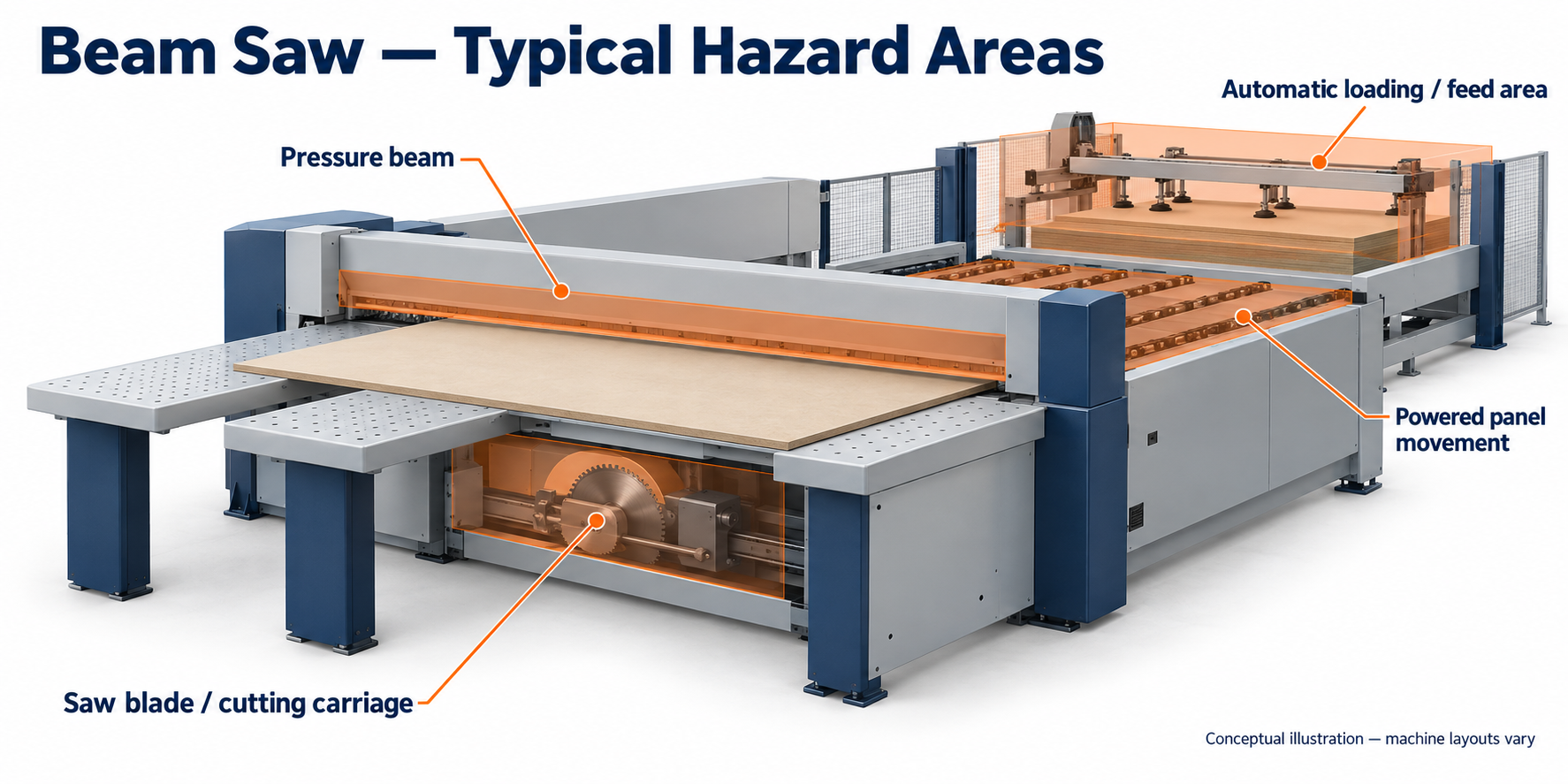
The saw blade and cutting carriage are the most obvious hazards. Depending on the machine design, the blade may travel beneath a table or within an enclosed cutting section. Access to the blade path remains dangerous even when most of the cutting mechanism is hidden from view. Clearing offcuts or reaching into an opening can bring a hand into this area.
The pressure beam introduces a separate crushing hazard as it moves down to hold the panel. A hand left between the beam and the workpiece can be trapped before cutting begins. Blade enclosure alone does not address this movement.
Powered panel movement also deserves attention. Pushers, grippers and feed mechanisms can move a large sheet or stack across the table, trapping someone against a fixed structure or another machine component. On lines with automatic loading, the rear loading and feed area may contain moving panels and handling equipment that are difficult to see from the operator position.
The actual access routes matter more than the machine name. A manually loaded vertical panel saw and an automatic horizontal beam saw should not be assumed to need the same protection layout.
Where Can Safety Light Curtains for Panel Saws Be Used?
At the front operator side, a light curtain may be suitable for an opening through which someone could reach or walk toward hazardous movement. It must be positioned so the relevant movement can stop before the person reaches it. A curtain placed too close to the hazard does not provide that separation, even if it detects the interruption correctly.
Rear and feed-side access may also be candidates, particularly where an automatic loading system creates an open entrance into a restricted area. Here, the design needs to distinguish an opening used only for personnel access from one through which panels routinely travel. That distinction determines whether ordinary access detection is sufficient or whether material passage needs additional consideration.
A light curtain can also monitor an opening between sections of fixed guarding. The surrounding guards must prevent access around, above or below the detection field. If a person can pass through and remain inside, additional measures are needed to prevent an unexpected restart while that person is still in the area.
These are possible installation locations, rather than a universal recommendation for every saw. The machine layout, stopping performance and required safety function determine whether a light curtain is suitable.
Why Material Passage Makes This Application Different
At a panel-transfer opening, the requirement is straightforward: panels must pass, while personnel must be excluded from the hazardous area. A light curtain by itself does not know whether an interrupted beam has been blocked by a board, a hand or a person.
Muting can address this conflict in suitable applications. It temporarily suspends the protective function of the light curtain under defined, controlled conditions so that the intended material can pass. Once those conditions end, normal protection resumes. This general material-transfer principle is described in Leuze’s guidance on muting and Smart Process Gating.
Not every panel saw needs muting. If panels remain on one side of the detection field, or use a separate guarded transfer route, there may be no reason to suspend the light curtain. Muting becomes relevant only where the intended material passage crosses the protective field and the machine’s safety concept permits it.
The difficult part is preventing a person from using the same opening during that temporary suspension. Panel dimensions, gaps around the material and the possibility of someone following a panel must therefore be considered. Long or thin sheets can make sensor placement particularly important. Muting is not permission to leave the feed opening freely accessible while the machine runs.
How the Safety Function Works
During ordinary protection, an interruption of the light curtain causes the safety control system to command a stop of the relevant hazardous movement. Restoring a clear field must not create an unexpected restart. Where someone can enter and remain inside, clearing the beams alone does not establish that the area is empty.
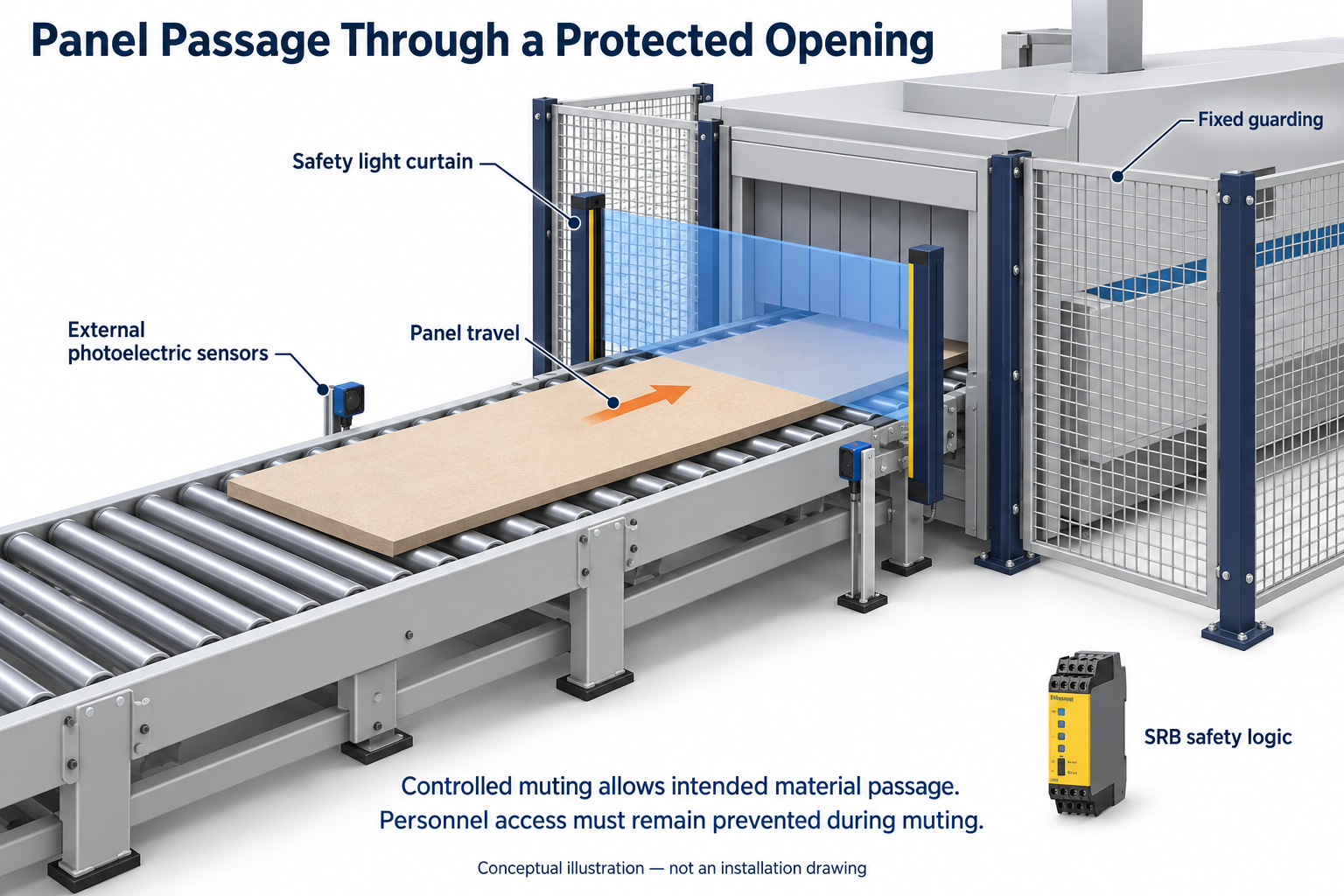
For permitted panel passage, external sensors supply signals to the safety logic. When the defined conditions for material transfer are satisfied, that logic permits a temporary muting interval. A missing or invalid condition must not be treated as permission to bypass protection.
For a CCH project, ENT + SRB + external photoelectric sensors is a configuration that can be evaluated. ENT provides the protective detection field; the applicable SRB module handles the external muting signals. ENT does not independently identify a panel or provide built-in muting. The sensor arrangement and the module’s supported logic must be checked against the actual feed process before selecting this configuration.
A crucial boundary remains: while muting is active, interruption of the muted light curtain cannot be relied on to detect personnel entering through that opening. The surrounding guarding, opening geometry and validated muting arrangement must prevent that access. Simply blocking two photoelectric sensors is not, by itself, proof that the object is a panel.
Wood Dust and Installation Conditions
Sawdust and fine MDF dust can accumulate on optical surfaces or interrupt the optical path, leading to loss of detection availability and unwanted stops. Position the light curtain away from the direct cutting plume where the layout allows, while maintaining the required protective distance and coverage. Dust extraction helps keep the installation usable but does not replace cleaning.
Include the emitter, receiver and external photoelectric sensors in routine inspection. Clean their optical surfaces using the method specified by the manufacturer, and investigate repeated contamination rather than repeatedly resetting the machine.
Keep sensors and brackets outside the panel impact path. Large sheets, bowed material and stacks can strike a poorly positioned device, damaging it or disturbing alignment. Any added mechanical protection should preserve the detection field and avoid introducing an access gap.
FAQ
Can a safety light curtain be used on a panel saw?
Yes, on suitable access openings where the machine’s hazardous movement can stop before a person reaches it. Suitability depends on the saw design, stopping performance and guarding arrangement. It is not a universal replacement for the machine’s existing guards.
Why is muting used on some beam saws?
Some beam saw installations transfer panels through an opening monitored by a light curtain. Controlled muting can allow the intended transfer without stopping solely because the panel interrupts the beams. The arrangement must also prevent personnel access during that interval.
Does every panel saw need muting?
No. If panels do not cross the protective field, muting may be unnecessary. The material route and operating sequence determine whether it is relevant.
Can a light curtain replace physical guarding?
It may monitor a suitable access opening as part of the overall protection system. It cannot contain ejected material, chips or broken tooling, and it does not physically prevent access. Fixed guards and enclosures remain necessary wherever those functions are required.
Does sawdust affect the light curtain?
Yes. Airborne dust and deposits on optical surfaces can obstruct the beams and cause unwanted stops. Suitable placement, effective extraction and regular cleaning help maintain reliable operation.
Explore more applications in our Woodworking Machinery Safety Solutions overview.
Project Support
Planning protection for a panel saw or beam saw? Share a layout or photographs showing the operator position, panel travel direction and access opening. Include the panel size range and whether loading is manual or automatic so we can discuss an appropriate ENT light curtain and external control arrangement for your project.