Entrez en contact avec la société QJKH

Écrit par l'équipe d'ingénierie QJKH · Révisé par les ingénieurs de détection de sécurité CCH Shanghai Sensing Intelligence · 2026
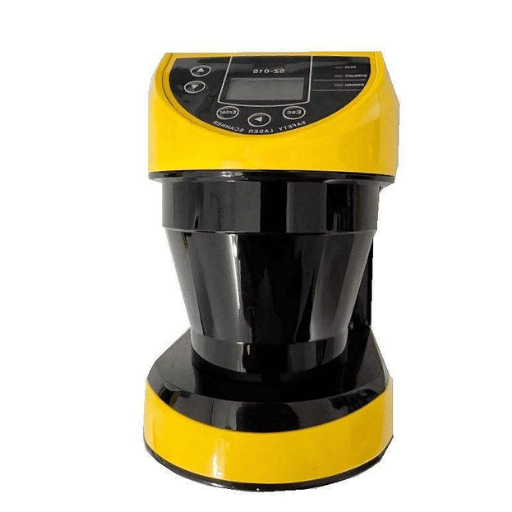
Les choix de scanner laser de sécurité des robots d'entrepôt décident si une cellule réussit son audit CEI 61496 ou reste ancrée dans la mise en service de l'enfer. La plupart des intégrateurs que nous achetons encore “a sensor” lorsque le travail nécessite deux appareils très différents avec des certifications différentes, des optiques différentes et un câblage différent. pour garder les humains, un pour guider. Ce guide est le tableau de référence que nous aurions aimé avoir lorsque nous avons commencé à faire correspondre les capteurs aux robots d'entrepôt il y a dix ans.
Il absorbe les robots de palettisation, de prélèvement et de tri, de chargement et de déchargement, les transstockeurs, les navettes à palettes, les navettes à caisses, les palans aériens, les robots mobiles automatisés de manutention (ACR) et les véhicules guidés par rail (RGV et son cousin automatisé de véhicule guidé, l'AGV).) en une seule feuille d'appariement, puis parcourt les normes, les contraintes environnementales et six questions que nous utilisons pour arriver à un choix à toute épreuve en moins de dix minutes.
📐 Spécifications rapides : deux classes de capteurs en un coup d'œil
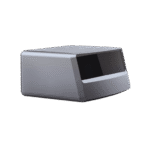
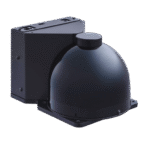
| Paramètre | Scanner laser de sécurité | Navigation LiDAR |
|---|---|---|
| Emploi | Arrêt du mouvement avant contact (zone de protection + zone d'avertissement) | Construire la carte, éviter les obstacles, la position d'alimentation |
| Sécurité fonctionnelle | CEI 61496 Type 3 · SIL 2 · PL d · Cat. 3 | Non classé sécurité |
| Angle de balayage | 276° (QJKH SH27) | 270° (QJKH YB27) |
| Rayon de protection/mesure | 3 m ou 5 m de protection @ 1.8% réflectivité | 15 m à 40 m @ 70% réflectivité |
| Temps de réponse | 100 ms configurables (chaîne d'arrêt : 200 µs + 100 ms + 300 ms) | 67 ms (2 balayages) à 536 ms (filtre à 16 balayages) |
| Immunité à la lumière ambiante | 3 000 lux | 100 000 lux |
| Sortie typique | OSSD (PNP) + Ethernet | Ethernet UDP + PNP/NPN dual |
Source : QJKH SH27 et YB27 spécifications publiées, CCH Shanghai, catalogue 2026.
✔ Note d'ingénierie La chaîne d'arrêt de 400 ms
Un scanner laser de sécurité de type 3 n'arrête pas à lui seul le robot La chaîne d'arrêt complète est : impulsion de détection (t1 ≈ 200 µs) → réponse bloquant la lumière du scanner (t3 ≥100 ms) → relais PLC de sécurité + récupération du frein moteur (t4 ≈ 300 ms). Budgétiser environ 400 ms de l'intrusion au repos. À une vitesse AMR typique de 1,2 m/s, soit 480 mm de mouvement continu (d'où l'existence de décalages de champ de protection et de zones de tolérance (SH27 publie une extension ZR de 350 mm + 350 mm).
Pourquoi la détection de la sécurité des robots d'entrepôt se divise en deux pistes
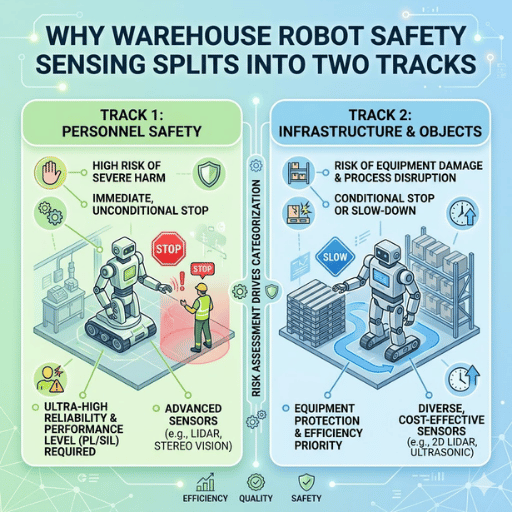
Chaque robot d'entrepôt (rotor), des cellules de palettisation stationnaires et mobiles aux robots mobiles autonomes (AMR) itinérants dans les allées ouvertes, détient deux rôles de détection distincts, un capteur ne peut tout simplement pas remplir efficacement les deux tâches. Les scanners laser de sécurité (également appelés scanners de zone dans la littérature ancienne) sont conçus pour protéger les humains et empêcher les mouvements dangereux avec deux zones de sécurité programmables, une zone de protection (le voyage OSSD dur) et une zone d'avertissement qui réduit la vitesse de mouvement avant l'intrusion, la zone de protection étant parfois subdivisée en deux zones pour une géométrie cellulaire complexe. La navigation LiDAR, en revanche, est conçue pour construire un nuage de points de sécurité, alimenter les flottes les données de position dont elles ont besoin, et évitent les obstacles statiques non humains, et les obstacles de balayage à grande vitesse, à grande vitesse, à grande vitesse, à grande vitesse, car les obstacles, les obstacles, les obstacles, les robots, les obstacles, les obstacles, les obstacles, les cartes, les robots, les cartes, les cartes, les cartes, les cartes, les cartes, les cartes, les cartes, les cartes, les cartes, les cartes, les cartes, les cartes, les cartes, les cartes, les cartes, les cartes, les cartes, les cartes, les cartes,.
Cette confusion n'est pas seulement académique Les deux Aperçu de la robotique OSHA et le Manuel technique de l'OSHA Section IV, chapitre 4 imposez une responsabilité de sauvegarde au constructeur de machines et à l'intégrateur d'applications de robots Si vous spécifiez un LiDAR de navigation parce qu'une fiche technique quelque part l'appelait un scanner laser à “,” aucun inspecteur OSHA ne l'acceptera dans un audit PLd.
️️ Inconception courante. Acheter un LiDAR de qualité navigation et le nommer scanner de sécurité “” car le logiciel SLAM produit une clôture virtuelle qui semble protégée Navigation LiDAR ne possède pas d'autorisation de type 3, n'a pas d'OSSD et ne réussira pas un audit de sécurité fonctionnelle initial. Cette idée fausse apparaît assez fréquemment dans les catalogues d'intégrateurs Directive de sécurité robotique de l'OSHA STD 01-12-002 exige explicitement que les appareils utilisés pour la détection de présence soient certifiés à cette fin exacte.
Les chiffres de déploiement global rendent les enjeux concrets Selon le IFR World Robotics 2024 report, 4,281,585 industrial robots are now operating in factories worldwide — a 10% year-over-year increase, with annual installations exceeding half a million units for the third consecutive year. A meaningful share of those deployments are now mobile or semi-mobile warehouse platforms, which means every warehouse robot safety laser scanner specification error compounds across thousands of new cells every year.
La matrice d'appariement de détection de robot d'entrepôt
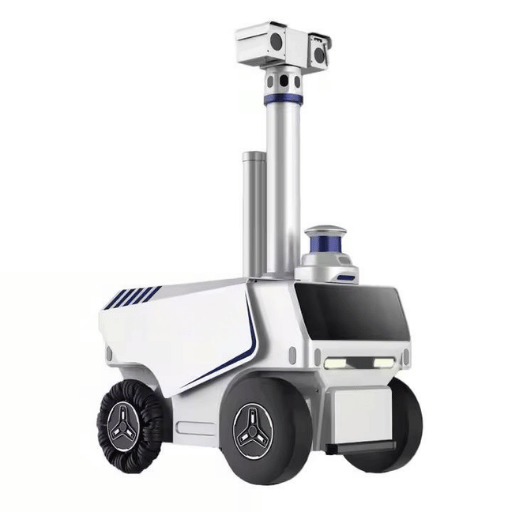
This is the core of this guide. Instead of define sensors abstractly, we pairing each warehouse robot type with the sensor class and specific QJKH model that aligns with its threat profile, its motion envelope, and its environment. The matrix uses the QJKH SH27 safety laser scanner (IEC 61496 Type 3, SIL 2, PL d, Cat. 3) series for all fixed safety functions and the QJKH YB27 navigation LiDAR for all position, mapping, and obstacle-avoidance functions. As each cell varies, treat the model column as a baseline rather than a definitive prescription.
| Warehouse Robot Type | Dominant Risk | Sensor Class Needed | QJKH Model Starting Point |
|---|---|---|---|
| Palletizing robot (stationary) | Cell intrusion during cycle | Safety laser scanner, horizontal floor zone | SH27-05D (5 m protective, Ethernet) |
| Picking and sorting robot (stationary) | Operator hand-over-zone entry | Safety laser scanner, multi-zone | SH27-03D (3 m protective, 256 zone groups) |
| Robotic sorter / sorting robot | Perimeter + flow mapping | Safety scanner + sorting robot LiDAR | SH27-03S + YB27-15CE |
| Loading and unloading robot | Dock zone collision with personnel | Safety laser scanner, 5 m protective | SH27-05D |
| Stacker crane (rail-guided) | End-of-aisle stop + position | Navigation LiDAR + end-stop safety scanner | YB27-40HE + SH27-05S |
| Pallet shuttle | Narrow aisle, low mounting | Nav LiDAR (position) + compact safety scanner | YB27-15CS + SH27-03S |
| Case shuttle | Bin-level high throughput | Dual-output nav LiDAR | YB27-15CD (dual output) |
| Overhead hoist transport (OHT) | Ceiling rail gap, wafer-FOUP clearance | Long-range navigation LiDAR | YB27-25HE |
| Automated case-handling mobile robot (ACR) | Free-roaming + human coexistence | Safety scanner + nav LiDAR dual stack | SH27-03D + YB27-25HD |
| Rail-guided vehicle (RGV) | Linear corridor + end-stop + position | Safety scanner for RGV + position LiDAR | SH27-05D + YB27-40HE |
De quel type de capteur un AGV a-t-il réellement besoin ?
An AGV needs both. The safety laser scanner takes care of Type 3 protective-field tasks at the front of the vehicle to prevent the vehicle from striking anyone and the navigation LiDAR manages path-following, obstacle-avoidance around pallets and racks, and position feedback to the fleet manager. As the sensors run concurrently on separate harnesses, the scanner’s OSSD output wires into the safety PLC or safety relay, and the LiDAR’s Ethernet UDP stream feeds the motion controller. Configuring just one device to accomplish both jobs only works on very slow, fenced-cell AGVs—and even then, the stationary-cell safety laser scanner still handles cell entry because a navigation LiDAR cannot validate down to PL d.
A few notes before making use of the table. First, the SKUs quoted expect typical warehouse conditions (indoor, 3,000 lux ambient at the scanner window, 1.0-1.5 m/s maximum vehicle speed, 5-45 C.) If those parameters are exceeded, either upgrade the protective radius or move onto the dock-door installation pattern we specify in the environmental section. And second, the matrix considers the picking and sorting robot safety laser scanner and the robotic sorter safety laser scanner to be the same class, as both have operator hand-over zones and both are permanently fitted to the cell. The actual distinction is in the zone library programming, not the hardware.
Everything below that – the standards section, the dual-stack wiring discussion, the decision tree – exists to substantiate and improve upon the decision matrix presented here. For more information on navigation LiDAR specifications and range, see our guide to navigation LiDAR range and resolution specs for AGV and AMR platforms which covers the YB27 matrix row by row.
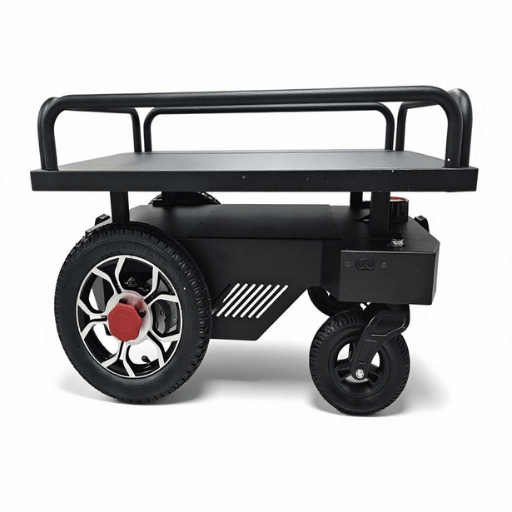
Safety laser scanners are not defined by their optics. They are defined by the four certifications stamped on the datasheet. If any one is missing, you do not have a safety scanner – you have a measurement LiDAR with marketing aspirations. Our QJKH SH27 series publishes the full stack, and that stack is the industry baseline you should demand from every vendor you investigate.
IEC 61496-1 / -3: Type 3. Type 3 is the laser safety baseline for electro-sensitive protective equipment (ESPE) — the same standard family that covers light curtains and pressure mats. It indicates the scanner has been tested for fault detection, signal diversity, and electromagnetic compatibility, with warning fields and protection fields both validated against object-resolution targets. Type 3 is the appropriate class for warehouse robot cells; Type 4 is for more hazardous fixed-guarding applications, such as press-brake light curtains, where intrusion into hazardous areas carries higher consequence.
IEC 61508: SIL 2. Safety Integrity Level 2 indicates the probability of dangerous failure per hour (PFH) lives in the 10⁻⁷ to 10⁻⁶ range — a statistically bounded reliability goal linked to a quantified hazard analysis. No SIL rating is published for navigation LiDAR because its failure modes are not analyzed against a safety function.
ISO 13849-1: PL d, Cat. 3. Performance Level d with Category 3 specifies the architectural requirements — dual-channel signal paths, diagnostic coverage, and the ability to detect common-cause failures. Your integrator will mention this standard when performing the cell’s risk assessment. Third-party datasheets from multiple safety sensor manufacturers display the same PL d / Cat. 3 rating, confirming this is the industry baseline — not a unique value.
ISO 10218-2. This is the mandate for industrial robot system safety. Here is where the cell design — which includes the selection of presence-sensing protective equipment — is rigorously inspected. Any scanner meeting IEC 61496-3 Type 3 qualifies as complying with the PSPE requirement under ISO 10218-2, assuming proper mounting geometry and stop-chain timing. For a full breakdown of these four standards as they apply to scanner selection, see our deep dive on the industrial safety laser scanner standards and selection criteria.
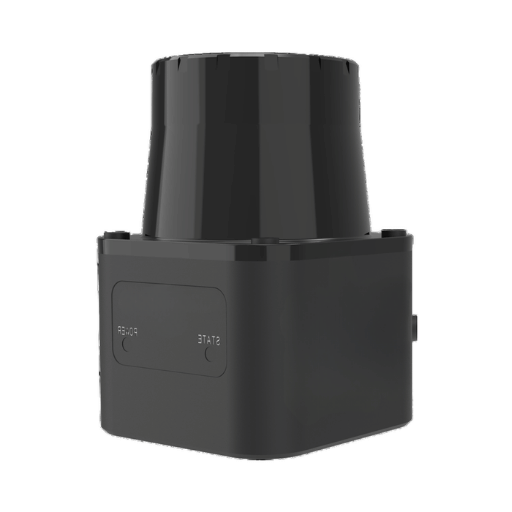
In the case of rail-guided and overhead-rail platforms, the safety requirement curve shifts. Because vehicle motion on these platforms is limited to a linear aisle, the human collision potential is lower than for a free-roaming AMR. These platforms require high-accuracy position feedback — fraction-of-a-degree angular resolution and stable range at long distances — which is well provided by a direct time-of-flight (dToF) single-line navigation LiDAR.
Stacker crane LiDAR sensors are typically long-range, high-resolution variants mounted on the carriage, supporting two functions: absolute position along the aisle (for put-away and retrieval targeting) and end-of-aisle gap measurement. Our QJKH YB27-40HE (40 m measurement range, 0.2° resolution at 50 Hz, Ethernet UDP output) is a common choice because 40 m comfortably covers the longest practical aisles, and the Ethernet output lets the WMS read position directly.
Pallet shuttles and case shuttles inhabit even tighter geometry. Pallet shuttle LiDAR sensors face two constraints: mounting height generally stays below 150 mm over the rails, and the sensor must see the far end of a 15–25 m tunnel with pallets stacked above it. YB27-15CS (15 m, 0.3° resolution at 30 Hz) solves the short-shuttle case, and YB27-25HS handles the longer racking. Case shuttles drive the data rate higher as pick-to-place cycles are faster — our dual-output YB27-15CD (Ethernet + PNP) can both order the controller to track position and trip the emergency stop relay on a fast obstacle.
Overhead hoist LiDAR is another dimension of the problem. OHT vehicles run alongside ceiling-guided rails in semiconductor fabs and bonded warehouses. They serve as vertical gap measurement and wafer-FOUP clearance sensors — not as people-avoidance sensors, since the rail keeps the vehicle above human height. Our YB27-25HE handles the variable fluorescent lighting these environments impose, with 100,000 lux immunity, and 25 m range matches typical inter-rail segment lengths.
“The greatest point of failure we find on stacker cranes is not in the scanner but in the singular decision to use one sensor for both navigation and emergency stop. When a technician has to perform maintenance at the end of the aisle, the nav LiDAR cannot verify the gap is safe – only a Type 3 safety scanner mounted at the end-stop can.”
Jumelage de capteurs RGV et ACR, boîtier à double pile
RGVs and ACRs are the clearest demonstration of why one sensor cannot cover both jobs on a single platform. RGVs move linearly but can travel 2–3 m/s along a corridor where maintenance staff periodically need access. ACRs roam freely through aisles where human pickers work on the same rack face. In both cases, navigation LiDAR cannot satisfy ISO 13849-1 PL d, and a safety laser scanner cannot deliver the 0.1° angular resolution required for natural-feature SLAM.
The clean architecture for these platforms yields a dual stack. Our RGV lidar – typically a YB27-40HE at the front and back – gives a point cloud over Ethernet UDP to the motion controller. Our safety laser scanner for RGV – the SH27-05D at each front and rear end – drives two OSSD outputs into a safety PLC or dedicated safety relay module. These two stacks do not compete with each other. Navigation operates in the soft real-time loop, safety operates in the hard real-time loop, and the stop decision takes place solely within the safety PLC.
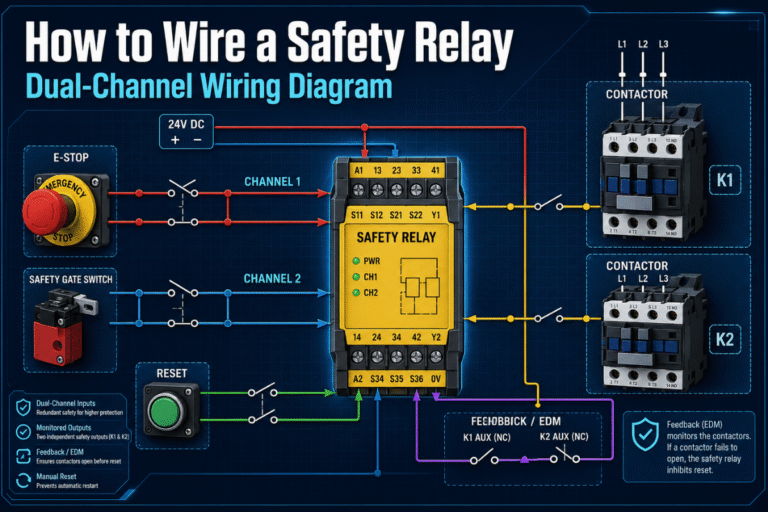
The 17-pin M12 power connector on our QJKH SH27-03D scanner supplies DC 24 V, two OSSD channels (PNP, 24 V high when clear), and EDM feedback from the downstream contactors. Those OSSD lines feed the safety PLC input module — not the motion controller. A separate M12 4-pin Ethernet connector supplies the diagnostic stream over TCP/IP. Our YB27-25HD navigation LiDAR outputs its Ethernet UDP stream to the motion controller and, in dual-output mode, also feeds four configurable PNP outputs into the safety relay as a secondary slow-down source. Both devices sit on a fused distribution block sharing a 24 V rail, but nothing else, to preserve the Category 3 dual-channel architecture. See our reference on safety relay modules for OSSD wiring on mobile robots for hookup details.
Contraintes environnementales et d'installation que vous ne pouvez pas ignorer
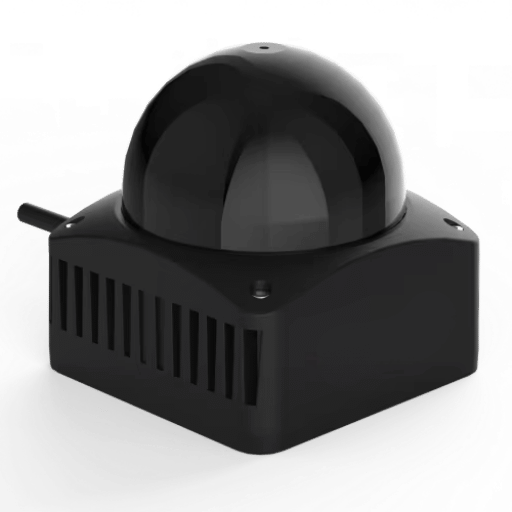
Datasheet specs are just that, if the scanner works in the lay out you want, it will work when you put it there. But five environmental conditions will be factors in every real deployment, and determine if your purchase is still a good one at commissioning.
Ambient light. Safety laser scanners publish an ambient-light immunity of roughly 3,000 lux. Navigation LiDAR tops out much higher — 100,000 lux on our QJKH YB27 series. This is not marketing speak. Installation manuals from Rockwell, Banner, SICK, and Omron all explicitly warn against mounting safety laser scanners where incident sunlight can saturate the window, because saturation produces false trips, and a false trip at a dock door means the fleet sits idle until somebody reaches for the reset. If your loading and unloading robot safety scanner has to look at an open dock door between 10 a.m. and 2 p.m., either add a sun shield, reorient the scanner, or use a navigation LiDAR for the approach segment and bring the safety scanner online only when the door is closed.
Temperature and condensation. SH27 operating temperature sits at –10 to +50 °C with no frost or condensation. Refrigerated warehouse deployments below –10 °C fall outside this envelope and need either a heated enclosure or a different sensor class entirely.
IP rating. Both SH27 and YB27 publish IP65 as the baseline. That means dust-tight and protected against water jets, but it is not rated for high-pressure washdown or submersion. Spray-down food-grade environments need additional protection.
Vibration and impact. SH27 vibration class sits at 10–55 Hz at 0.35 ± 0.05 mm, 5M1 per IEC 60721-3-5. Shock test is 10 g over 16 ms. Mounting a safety scanner on a forklift attachment or on a stacker crane carriage — where you will see frequent 3–5 g starts and stops — works within spec, but the tolerance zone and ZR extension (each 350 mm on the SH27) were implemented because the field under vibration is less stable than at rest.
Mounting geometry. Protective fields assume a specific mounting height and angle, and blind spots appear wherever the scan plane misses an approach vector. At 70 mm minimum detectable object resolution across the maximum protective radius, you need an ankle-height scan plane to mark the boundary between walkable floor and danger zones; a mid-leg scan plane misses children and stooped operators. One more muting detail worth naming: when a conveyor needs to cross the protective field (a loading and unloading robot dropping cases onto an outbound line), use the muting function (configured to mute the protection zone only when the conveyor’s paired safety sensors agree) so the scanner ignores the pallet but not the person walking next to it. Commissioning checklists should verify the actual scan plane, not assume the datasheet value.
✔ Engineering Note — Why 3,000 lux is the cutoff. Safety laser scanners use a 905 nm Class 1 laser pulse, expecting a near-IR return above a noise floor set by the broadband IR component of sunlight. At around 3,000 lux of direct sunlight on the optical window, the receiver’s signal-to-noise ratio falls below the safety function’s fault-detection threshold, and the device safely but inconveniently outputs an OSSD-off state. Navigation LiDAR tolerates far more ambient light because its SNR budget is larger and its output is not a safety function.
Arbre de décision de sélection Six questions en dix minutes
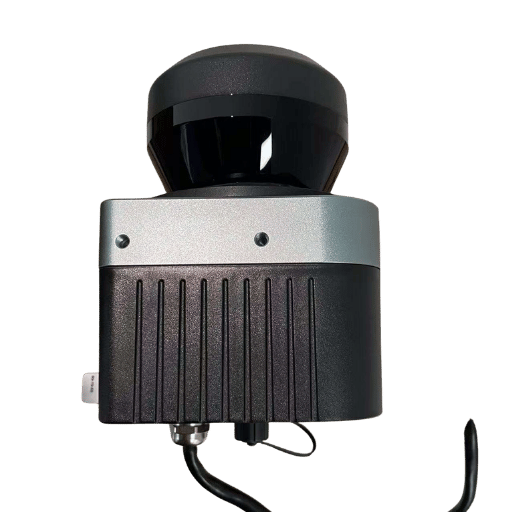
Use these six questions in order. Whichever one you answer “yes” to first determines the sensor class; later questions draw in the specific model. This is the process our QJKH engineering team guides new integrators through and it reliably returns a defensible choice faster than arguing over datasheets.
- Is the robot rail-guided or free-roaming? Rail-guided (stacker crane, shuttle, OHT) favors navigation-LiDAR-dominant; free-roaming (AMR, ACR, forklift) favors safety-scanner-dominant. RGVs occupy the middle ground and get the dual stack.
- Does the cell or route need SIL 2 / PL d certification? If yes — and for any application where a human may enter the motion envelope it is yes — a safety laser scanner is required. A navigation LiDAR cannot replace it.
- What protective radius is required? Calculate (vehicle speed × stop chain time) + safety distance according to ISO 13855. Under 3 m → SH27-03D. 3–5 m → SH27-05D. Over 5 m → you must slow, or add a second scanner.
- Is the installation exposed to above 10,000 lux ambient light? If yes, the approach segment is a navigation-LiDAR task (YB27, 100,000 lux) and the safety scanner only engages once the vehicle reaches the end of the direct light.
- Does the fleet manager require immediate position data from this platform? If yes, select a YB27 dual-output variant (CD/HD) so one device supplies both Ethernet UDP positioning and PNP obstacle trips.
- Is the output path managed by a safety PLC or a dedicated safety relay? Either path functions. Our SH27 OSSD lines terminate on a 17-pin M12 connector and connect directly into any modern safety input module. If designing a standalone cell, our QJKH SH27 safety laser scanner series pairs natively with the corresponding safety relay modules.
A brief note for the pallet-shuttle and case-shuttle car readers who jumped to this section: the optimal warehouse robot safety laser scanner for narrow-aisle pallet shuttles is almost always the SH27-03S since 3 m protective fields match the aisle width, the compact housing fits under 150 mm clearance and the OSSD output wires into the shuttle’s on-board safety PLC without a dedicated controller. Navigation duty on the same shuttle is assigned to the YB27-15CS.
Foire aux questions
Voir la réponse
Un scanner laser de sécurité est un produit certifié CEI 61496 (Type 3, SIL 2, PL d) : il déclenche une sortie OSSD lorsque des personnes ou des objets s'introduisent dans un champ contrôlé, dans le but prévu d'arrêter le mouvement avant l'impact. Le LiDAR de navigation est un instrument de mesure : haute résolution, plus longue portée, non-sécurité certifié IEC 61496, avec des applications en SLAM, suivi de chemin et évitement d'obstacles bénins Vous ne pouvez pas mélanger et faire correspondre ces fonctions dans une application de sécurité et la plupart des robots d'entrepôt lourds nécessitent les deux.
Voir la réponse
N° Les deux tâches ont des exigences incompatibles de certification CEI 61496 et de réglage optique Lorsque vous commercialisez des modules LiDAR à double sortie et multicanaux en tant que solutions combinées, le canal de sécurité est généralement exécuté à une résolution inférieure à celle du canal de navigation, et aucun des deux canaux n'a une certification CEI 61496 unique et intégrée Spécifiez les appareils certifiés individuellement.
De quel rayon protecteur ai-je besoin pour une cellule de palettisation ?
Voir la réponse
Appliquer la formule de distance de sécurité ISO 1355 (vitesse d'approche × temps de réponse total) + distance d'intrusion (intrusion distance) et arrondir la plupart des cellules palettisantes à 2.55 m de terrain, c'est pourquoi le SH27-05D (5 m de protection) couvre le cas commun avec une marge confortable.
Les scanners laser de sécurité sont-ils exigés par la loi pour les robots d
Voir la réponse
La réponse courte est non, mais l'OSHA et les régimes pertinents de directive machine (directive UE Machines, ANSI/RIA R15.06) attendent du concepteur/commissaire qu'il procède à une évaluation des risques afin de déterminer quel type de protection est le mieux adapté à l'appareil, à l'emplacement et à l'utilisation Pour toute cellule où une personne peut entrer dans l'enveloppe de mouvement, un dispositif de détection de présence de type 3 est presque toujours ce que recommande l'intégrateur, et un scanner laser de sécurité est toujours généralement le plus simple. Les différentes responsabilités juridiques impliquées concernent l'intégrateur du système.
À quelle fréquence les scanners laser de sécurité ont-ils besoin d'une
Voir la réponse
Le certificat fourni par le document a une date non expirée, mais l'analyse des risques au niveau du système cellulaire doit être revue chaque fois que la disposition, la vitesse de déplacement ou le programme de travail du robot change. Les indicateurs de nettoyage des fenêtres et de contamination doivent être vérifiés à chaque quart de travail.
Pourquoi 3 000 lux sont-ils la limite d’immunité à la lumière sur les scanners de sécurité ?
Voir la réponse
3,000 lux is not a physics ceiling – it is the illuminance level at which the device can still be licensed to meet the fault-detection and false-trip criteria accepted under IEC 61496 by Type 3 equipment. Above that there are technical interactions between the receiver’s signal-to-noise ratio and the level at which a false trip is guaranteed; below it are physical interactions between the sender’s optics and the receiver’s far-field inability to distinguish objects and noise, so the scanner disables the LIDAR’s fault-triggering ability and effectively switches to a safe-state OSSD-Off. A safe navigation LIDAR operating at 100,000 lux immunity does not encounter this restriction because it is working outside of a safety application.
Need help narrowing the matrix?
QJKH builds the SH27 safety laser scanner and YB27 navigation LiDAR series under the CCH Shanghai Sensing Intelligence R&D program — twenty-plus years of industrial safety sensing, OEM customisation supported, and engineering samples available for evaluation. Tell us the platform and the cell layout and we will send back a shortlist from the matrix above.
Transparency note. This guide was penned by the QJKH engineering team with safe discovery by CCH Shanghai Sensing Intelligence safety sensing engineers. The QJKH SH27 and YB27 specs cited throughout are from our 2026 product brochure; our IEC 61496 Type 3, SIL 2, ISO 13849-1 PL d Cat. 3 certificates are independently traceable to linked standards bodies. We reference the specified QJKH models in the matrix because the pairing logic is entirely useless unless it is grounded in existing, shippable hardware–consider the models as a tangible conceptual anchor for the discussion rather than the sole answer you seek.
Références et sources
- OSHA Robotics Overview 'U.S. Sécurité et santé au travail' Administration
- Manuel technique de l'OSHA Section IV, chapitre 4 — U.S. Department of Labor
- OSHA Guidelines for Robotics Safety STD 01-12-002 'U.S. Sécurité et santé au travail' Administration
- IFR World Robotics 2024 — Record of 4 Million Robots in Factories Worldwide Fédération Internationale de Robotique
- IEC 61496-1 / IEC 61496-3 — Safety of machinery: Electro-sensitive protective equipment (International Electrotechnical Commission)
- IEC 61508 — Functional safety of electrical/electronic/programmable electronic safety-related systems (International Electrotechnical Commission)
- ISO 13849-1:2023 — Safety of machinery: Safety-related parts of control systems (International Organization for Standardization)
- ISO 10218-2 — Robotics: Safety requirements for robot systems in an industrial environment (International Organization for Standardization)
- ISO 13855 — Safety of machinery: Positioning of safeguards with respect to the approach speeds of parts of the human body (International Organization for Standardization)
Articles connexes
- → Industrial Safety Laser Scanners: IEC 61496 Standards, SIL 2, and PL d Selection
- → Positioning LiDAR for AGV and AMR Navigation: YB27 Range and Resolution Guide
- → Safety Relay Modules for Mobile Robot OSSD Wiring (coming soon)
- → Safety Light Curtains vs. Safety Laser Scanners (coming soon)
- → Solid-State LiDAR for Warehouse Automation (coming soon)
- → Cobot Safety Zone Configuration Walkthrough (coming soon)